Let me add some confusion to your question about voltmeters. For the most part, we look at voltage in relation to ground, which in this case is the car's body sheet metal, engine block, and battery negative post and cable. We're reading electrical pressure in relation to a common starting point. It is customary to put the black meter probe on ground, then take the reading with the red probe. The nice thing about even the cheapest of digital voltmeters is if you accidentally switch the probes, the meter will not be damaged. It will just show a minus sign in the display.
With tvs and car radios, it is usually important to know the exact voltage at a point, and if it's off by just a few tenths of a volt, that is a clue, but when working in cars, especially with totally dead or intermittently-dead circuits, we're usually just looking to see if we have something or nothing. That's where a test light can take less time. A quick poke, and you can move on.
Where this can get confusing is when we talk about measuring a "voltage drop" in a circuit. It is pretty likely the black probe will not be on ground for these tests. To do this the long way, you could measure the voltage at one contact of a relay, for example, then at the other contact, then calculate the difference between the two. In a perfect world, if you found 12.0 volts at one of them, you should find 12.0 volts on the other one, when that relay is energized. In reality, due to the resistance caused by arced or pitted contacts, lets say you find 12.0 volts on the first one, then 11.9 volts on the second one, you'd have an undesirable loss of 0.1 volt. With a voltage drop measurement, you'd put one probe on each terminal, then the meter would read the 0.1 volt directly. Instead of reading two voltages at two points, you're reading a single voltage between two points. Another advantage to doing it this way is you can switch the meter to a lower range so you get another place after the decimal point, and more accuracy.
For the type of problem you're working with, voltage drop readings have little value unless you have a real good understanding of electrical theory and can interpret the results quickly. Where they really become valuable is in very high-current circuits like starter circuits. During cranking, the battery's voltage gets drawn down by that heavy current. To be technical, we blame that on the "internal resistance" inside the battery. It can't be avoided, but that current causes a drop in voltage, and we would like that to be no more than 3.0 volts. That's pretty easy to achieve with a good, fully-charged battery. The actual goal is to have no less than 9.6 volts at the starter to make it run fast enough for the engine to start running. The problem is there is always a little loss in the two cables and in the mechanical connections.
An older GM or Ford starter would draw around 300 amps to get started spinning. A fully-charged battery starts out at 12.6 volts. If we use "Ohm's Law", one of the 12 formulas says "resistance equals voltage divided by amps", R=V/A. R = 12.6 / 300 = .042 ohms. There's a good three to five ohms just in the meter leads themselves, so it's easy to see .042 ohms is way too small to be measured with our digital meters. However, we can measure the results of that resistance. In this case, we might start out with one meter lead right on the battery's positive post, and the other probe on the cable clamp on that post. Logic dictates the reading should be 0.0 volts because those are two adjacent points in the same circuit, and in fact, you will read 0.0 volts, . . . until a helper tries to crank the engine. That is when the current flow will cause a voltage to be dropped across any undesirable resistance in that mechanical connection. The industry standard is 0.2 volts, during cranking, across any one mechanical joint, (connection), and no more than 0.4 volts total for that entire half of the circuit. For most cars you only have the positive cable connection at the battery post, and a second one at the starter solenoid. While the solenoid's switching contacts are in that circuit too, we don't include them because they are usually impossible to get to with the meter. On the negative side, again, there's only two connections, one at the battery's post and one on the engine block.
Older Fords are the notable exception. You still have the mechanical connection at the battery's positive post, then the other end of that cable bolts to the solenoid on the inner fender. Now we include the two sets of contacts inside the solenoid. Next, another cable bolts to the second high-current terminal on the solenoid, and the other end bolts to the starter. Now there's six mechanical connections in the positive side of the circuit. We're still allowed no more than 0.2 volts drop across any one of those connections, and still no more than 0.4 volts in total. That means you could find only 0.1 volt dropped across each connection, which by themselves would be okay, but the total of 0.6 volts would slow that starter down a lot.
Here's where my story finally has meaning. Suppose you're trying to diagnose that common slow-cranking starter on a Ford. If you were to use standard voltage measurements, you would start at the battery with the voltmeter's negative probe right on the negative post, and the red probe on the positive post. Your helper cranks the engine just long enough for you to get the reading. It's 11.0 volts. Now you move the positive probe to the positive cable clamp. The engine is cranked for a few seconds, and you find 10.9 volts. That connection is okay. We typically do not count a terminal that is crimped onto the end of a cable as one of the mechanical connections because corrosion or some other problem with a cable will show up in these tests anyway.
Move the red probe to the stud on the fender-mounted solenoid, not the terminal that is bolted to it. Crank the engine and take another reading. Now you find 10.8 volts. Go to the stud on the other side, take a reading, then move the probe to the terminal bolted to that stud. To move this sad story along, we'll say you find 10.6 volts at both places. The last place is the stud down on the starter, not the terminal bolted to it. Here you find 10.5 volts.
You started with 11.0 volts at the battery, and ended up with 10.5 volts at the starter. The industry standard is no more than a 0.4 volt loss in that half of the circuit, but there's two problems that haven't entered in yet. The first one is each measurement took about five seconds of cranking time, so the battery has been running down. By the time you took the reading at the starter, the battery might have only been supplying 10.7 volts, so you really have a total loss of only 0.2 volts, which is acceptable.
The second problem is starting trouble commonly occurs in the first few cold winter days, so when the vehicle is brought into the shop, the battery is cold. Batteries work through a chemical reaction, and those always slow down in cold temperatures. As the engine is being cranked, the high current causes the plates and electrolyte to heat up a real lot. That makes the battery more able to supply the needed current without as much internal voltage drop. By the time you work your way down to the starter, the battery might be supplying 11.4 volts during cranking, especially when that heat has time to work its way around in between cranking attempts.
So there's two problems with taking a pile of voltage readings and then calculating the differences. Too much cranking time can run the battery down, or it can heat it up and raise the voltage it can supply. Each of these variables makes this type of testing pretty much worthless except for the most serious of defects.
The better way to do this is with those voltage drop tests. Put one meter probe on the battery's positive post, and the other one on the stud on the starter. Now take a single reading when your helper cranks the engine. You'll be measuring the total of all the voltage drops at the same time, under the same conditions, so all the variables are eliminated. If you find 0.4 volts or less, you're done in the positive half of the circuit. Should you find too much voltage drop, that is the time to take individual readings to locate the high resistance. For my story, we'll say there's a 0.5 volt drop when you have one probe on the battery's positive post and the other probe on that cable clamp. If this is the older V-8 starter that draws 300 amps to get started spinning, according to Ohm's Law, "R=V/A", R = 0.5 / 300 = 0.001666 ohms. That very tiny resistance is way too small to measure, but it's easy to measure the results of that resistance, the 0.5 volts. This would tell us that connection needs to be cleaned and tightened.
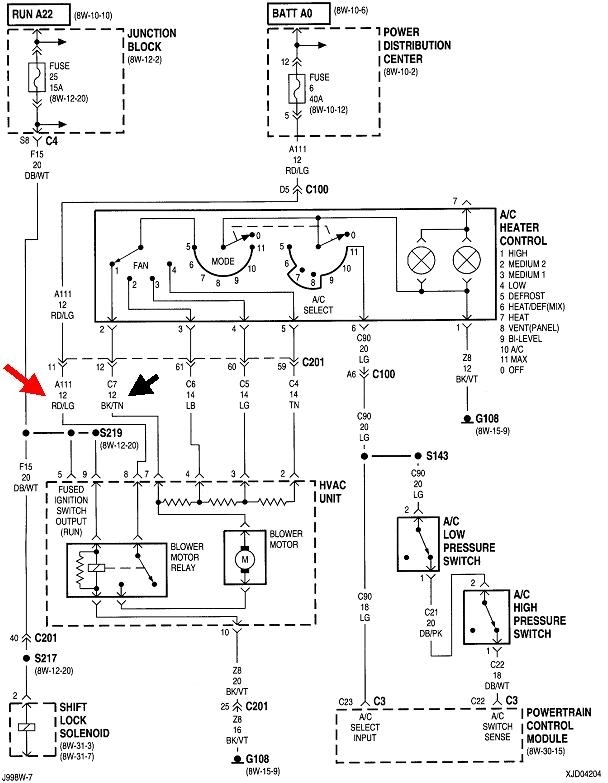
It's important to remember this type of testing is mainly valuable in high-current circuits. It's too hard to get to all the connections in your heater fan circuit to be of value.
To finish the Ford starter story, suppose we do find only 0.3 volts dropped in the entire positive half of the circuit, but we still have very slow cranking. Move the meter probe from the battery's positive post over to the negative post. Move the other probe from the starter terminal to the engine block. Crank the engine, and you find a reading of 3.6 volts. The most you're allowed in that half of the circuit is 0.4 volts, so obviously 3.6 volts is too high. There's only two mechanical connections in this half of the circuit. Leave the meter probe on the engine block, and put the second one right on the terminal bolted to it, at the end of the negative battery cable. Here you find 0.0 volts during cranking, so it is okay. Place a probe on the negative battery post and the other one right next to it on the cable clamp. Here you find just 0.1 volt, which is also okay. The last step is to leave the probe on the cable clamp, and put the other one on the terminal that's bolted to the block. Here you find 3.5 volts. In fact, a common cause of slow cranking is the strands of wire are corroded away from the terminal where it's hidden from view under the cable's insulation.
Notice for most of these I didn't specify whether to use the red or black probe at a certain point. It can be figured out, but there's no point. We're interested in the voltage reading, not the polarity, so just disregard the minus sign if it shows up.
If it helps, you can equate this to searching for an obstruction in a compressed air line. You have 100 psi everywhere in the system around your shop as long as everything at the end of the hoses is turned off and no air is flowing. Once you open a line and try to run a sander, the pressure at the end of the hose drops to almost nothing. You could install pressure gauges at a dozen places in the piping, then you'd still find 100 psi everywhere up to that obstruction, then much less pressure after that obstruction, but only when air is trying to flow. In this sad example, you find 100 psi all the way up to a hard-to-see valve, and 20 psi after it while your helper is trying to run the sander. Some goofball turned the valve off when he needed to replace a ruptured hose, then he failed to open the valve all the way after the repair was completed. That partially-closed valve is the resistance to current flow, (air flow), so it caused a drop in air pressure, similar to a drop in voltage, (electrical pressure).
Here again, we have the variables caused by taking multiple gauge readings at different times. Each time you hollered to the helper to turn on the sander, some air was used up from the tank, so supply pressure began to drop, just like the battery's voltage dropped during the course of multiple cranking attempts. Pressure gauges compare pressure at a point to atmospheric pressure. Atmospheric pressure is the equivalent of ground in electrical systems. If you could visualize a pressure gauge that has one side connected close to one side of the valve, like before, and the other side connected to the other side of the valve instead of to atmospheric pressure, it would be performing a pressure drop test across the restriction. You start with 100 psi at the tank, and have 20 psi after the valve, so the gauge would read 80 psi. In actual practice, it's not practical to go drilling all kinds of holes in the piping around the shop, but the concept is exactly the same when we do voltage drop tests.
I know you probably don't need it, but here's a link to an article about voltmeters that might give you more ideas:
https://www.2carpros.com/articles/how-to-use-a-voltmeter
Dec 3, 2019 at 3:05 PM