stalling problems

1999 JEEP GRAND CHEROKEE
130 MILES • 6 CYL • 4WD • AUTOMATIC
Advertisement
Avatar
ERNESTO123
  • MEMBER
  • 26 POSTS
Checking the IAC is simple.
Checking the Crank Position Sensor wiring is simple.
Should you have done these checks by now you would either have fixed the problem or know for sure the problem is not there, which moves us forward.
Jul 12, 2011 at 9:46 PM
Avatar
ERNESTO123
  • MEMBER
  • 26 POSTS
"The failing/stalling can happen while driving" Well I had understood this meant not necessarily whenever your foot was pressing the accelerator, but when coming to a stop, which prompts an idling problem. What about a broken wire in the IAC connector lines?

Chrysler did a good job of cutting all unnecessary copper when assembling all wire harensses to cut production costs, which in the end has left vehicles with tight wiring. See how tight wiring masses are inside the bodyframe, no loose cables, which in turn increases the posibility of having lines rubbed against the frame or against splices, creating undue shorts to ground.
I would strongly urge you to perform short to ground checks, specially in the sensor signal line. That is the wire numbered one in the crankshaft position sensor connector, gray color with a black tracer and goes all the way to female pin As in connector one of the power-train control module.
Jul 12, 2011 at 9:57 PM
Advertisement
Avatar
ERNESTO123
  • MEMBER
  • 26 POSTS
I meant to say female pin A4 of the power-train control module, sorry.
Jul 12, 2011 at 9:59 PM
Avatar
CARADIODOC
  • CERTIFIED EXPERT
  • 34,306 POSTS
All good suggestions, but when the problem is so intermittent, it can be easy to overlook the cause or to disturb it enough that it will not act up for a while.

A grounded wire for a sensor should be detected by the computer. Same for an open wire for the IAC. Its position is not monitored; only the wires are monitored for continuity, so there should be a related fault code but only if it acts up long enough.
Jul 12, 2011 at 10:05 PM
Avatar
CJ MEDEVAC
  • CERTIFIED EXPERT
  • 11,004 POSTS
Doc,

I can tell, that you can tell, that I love you man!

I really do not want people to think I am all about negative.

My scale starts at "zero", there is no negative, any improvement is Positive,......anything down hill from that, is negative.

I do, every now and then, get some satisfaction, when I answer some posts. Really makes me feel good! And yes, I get a "warm fuzzy"! you will surely be able to detect it in this link.

https://www.2carpros.com/questions/2000-jeep-grand-cherokee-has-lost-its-mind

This is all I have to offer. I will still get an e-mail notifications, as you continue.


The Medic
Jul 12, 2011 at 10:21 PM
Avatar
JESSIESJEEP
  • MEMBER
  • 12 POSTS
It has been a while, but I wanted to give an update. Since my last post, the mechanic advised that I could either take it to a dealership and risk spending lots of money until they could pinpoint the problem, or try to tough it out and keep driving it until it got worse. The idea being if the car got worse, the problem was happening more frequently and, therefore, the problem would be easier to find.

So, I have driven it for the past several months. It will always start now, but it takes a few tries at times and at other times it will start, stalls, and I will have to start it again until it finally stays running. It went from stalling out when I stopped sometimes to stalling out every time I stop. So, I have learned to put one foot on the brake and the other on the gas when stopped to keep it running. (Great that I learned a new skill, right?)

It seems that as long it stayed above the 1 on the rpm thing, it is fine. As soon as it goes below the 1, it starts spitting and sputtering and finally just quits. Well, today it did something new - stalled out while I was driving with my kids in the car trying to turn left. With no power steering, it was all I could do to keep from hitting anything and get it off the road.

I am not a princess, I do not need a nice shiny new car. I can live with people staring and snickering when I pick my kids up and have to crank the car over and over to get it started. I can handle people blowing their horns when it shuts off at the red light in town. But, it is getting dangerous at this point and I am fed up.

The 0320 code has been showing since my last post. It never went away, even after having a new crankshaft and camshaft sensor installed. I checked this morning, and three new codes showed. I am hoping, praying, and begging that the new codes will point someone to the answer. They are: 0352, 0351, and 1594.

If you have anything , anything at all to offer, I would be greatly indebted and thankful. If it cannot be fixed at this point, I am just going to park it. Thanks.
Oct 31, 2011 at 7:27 PM
Avatar
CARADIODOC
  • CERTIFIED EXPERT
  • 34,306 POSTS
The 1594 code refers to "charging system voltage too high". The voltage regulator is built into the engine computer and gives very little trouble on its own. There is one wire between the alternator and computer that can become grounded but that will set a different code, "alternator field circuit not switching properly". I would sooner suspect the system voltage sensing wire to the computer has a bad or corroded connection or loose terminal in the plug that is making the computer think system voltage is too low, then it commands the voltage regulator to increase alternator output.

Regardless of what is happening, the place to start is by measuring battery voltage while the engine is running. Use an inexpensive digital voltmeter. Proper voltage is between 13.75 and 14.75 volts. It will have to reach at least 16.0 volts before setting code 1594. That problem is not related to stalling or hard starting, however, suppose a wire harness fell off its clip and onto hot exhaust parts or is rubbing on a sharp metal bracket. If the alternator field control wire is touching something metal now, maybe the wire next to it in the harness is doing the same thing and is related to the stalling issue. That is why I always told my students it is never acceptable to just run a new wire to fix a problem. I required them to find exactly what was wrong with the original wire because that often exposed a different problem that was going to act up in the near future.

The other two codes refer to ignition coils one and two not reaching a high enough current flow, suggesting a break in the wire going to them. I would be looking for a connector with corroded pins or a stretched pin that is making intermittent contact with the mating pin. Connector pins can be aggravated by anything that causes the engine to shift position, such as accelerating, turning, coasting, or driving over bumpy roads.
Oct 31, 2011 at 8:08 PM
Avatar
VAGABONDO
  • MEMBER
  • 9 POSTS
I have a 1999 Jeep GKL 4.0 auto two wheel drive, that has in the past stalled many times a day and would start back again sometimes right away and others it would take some time. manipulation of trying to start it by turning the key over three times engaging the starter each time. It started four years ago and I replaced the in-tank fuel pump and then the crankshaft position sensor. That last a few years then it started the stalling again so I replaced the crankshaft sensor once again. It worked okay for a year maybe and within the last six months it began to stall. Once it took me about three hours to get home from about fifteen miles by pulling over and restarting or letting it sit for a while. I replaced the crankshaft sensor again and this time it only ran well for a few days. I bought an OBDII tester and the code read 1391 with the engine light on so I erased the code because I had a new sensor in it. The light continued to come on and I would erase it. It started running real rough and hard starting all the time, I would erase the code and it would run fair for maybe a day. I put another crankshaft sensor in it and changed out the ECM computer box and had it flashed to my VIN number by the dealer. The check engine light was still on after the dealer flashed it and they said they usually replace the camshaft sensor along with the crankshaft sensor, so I did two weeks ago. Then I started getting check engine light code 353 Ignition coil C primary/ secondary circuit. So I replaced the coil pack, the spark plugs with Champion and the throttle position sensor. I started it up and it ran really better than it had in some time until it got warmed up and then it started popping and spitting back through the intake especially when accelerating hard. I will not drive it very far from fear of it stranding me again. While in my driveway and warm it was missing and popping back on rev up. So I turned it off and checked the code and it was 1391 without the check engine light on. Today it started right up cold and again ran great until it warmed up completely and the spitting, missing, and popping back started again. Tested code without check engine light on and it read 1391 again after I had erased it before. I am a disabled Vietnam Veteran and I am not going to put it on a long trip until I get past this problem.

Thanks for your help.
Apr 19, 2012 at 1:37 AM
Avatar
CARADIODOC
  • CERTIFIED EXPERT
  • 34,306 POSTS
You are doing yourself a disservice by piggybacking on this thread for a couple of reasons. First of all, there are a lot of really smart experts here who are not going to even see your problem or be able to reply because only those of us who replied previously will get an automated e-mail directing us back here when any reply is posted. You are losing the chance to have your question read by those other people.

Second, erasing fault codes does not make the problem go away. Mechanics want that information and will often tell owners to not come back until the check engine light has turned on or a code is set in memory so they have that to work with.

What is needed here is a full scanner, not just a code reader. Scanners display live data and will show if the engine computer is turning the automatic shutdown (ASD) relay off when the engine stalls, and if so, is it due to a missing signal from the cam or crank sensor? The scanner will also let you trigger each ignition coil and each injector to see if those circuits are working or if something is causing the computer to shut down to protect those circuits.

Beyond that, I would copy and paste your question into a new post so everyone gets a chance to read it and respond. I am not much of a Jeep expert. There are a lot of people here who can give you a better answer.
Apr 19, 2012 at 5:32 PM
Avatar
VAGABONDO
  • MEMBER
  • 9 POSTS
Thanks, I had followed you through this entire post and you sounded as though you have a good hold on this problem. As far as piggybacking, I responded to this post and was told to open a new post so I did and CJ MEDIVAC told me to come back to this post because you were extremely good with this problem and would hang in there until the end gladly. As far as erasing the codes, I am the mechanic but needed some assistance because I am getting on up there in age and on a pension now. I guess that I have done myself a disservice.
Apr 19, 2012 at 7:12 PM
Avatar
CARADIODOC
  • CERTIFIED EXPERT
  • 34,306 POSTS
CJ might have thought you started a new question after we had already been in an on-going conversation. He does think I am a genius. I have lots of people fooled.

What you might look into is checking at some auto parts stores that borrow or rent tools to see if they have a scanner available. I use the Chrysler DRB3 but it is very expensive. Being one of the newer versions, it only works on 1998 and newer vehicles, but with additional plug-in cards it will work on all Chrysler products back to 1983 models and it can do all emissions-related stuff on any 1996 and newer brand of car sold in the U.S. For that reason a lot of independent shops bought them too. If you want to look into owning one of them, check eBay. I sold three of them there to pay for the one I kept.

Most of the better aftermarket scanners cost in the area of $3,000.00 but they have to be updated regularly. Only consider owning one if you plan on doing all of your own diagnostics for years to come. Also, by the 2004 models the DRB3 was obsolete. A different model scanner is needed for those vehicles.

The scanner will list the cam and crank sensors with "no" or "present" to show if signals are coming from both sensors when it won't start. It will also show if the ASD relay is being turned on.

One thing that is not monitored is fuel pressure. I am suspecting an intermittent pump failure right now with my 1988 Grand Caravan. It has stalled four or five times in the last six months, and twice it took some work to get it restarted. I still had great spark but pressure at the fuel test port seemed way too low, and one time I also cycled the ignition switch three times to run the pump for its one-second burst each time. That got it started again and that is my clue it is a pump problem.

Chrysler fuel pumps are built to very tight clearances to make them much quieter than those of other manufacturers but that also makes them more prone to locking up from microscopic debris in the tank. Often people run into repeat failures of four or five new pumps within a month or two, then out of desperation they by a new pump from the dealer and have no more problems. In reality it is not the aftermarket pumps that are bad; it is that all that debris got collected in the first pumps, then by the time they bought the pump from the dealer, that debris was gone. In fact, NAPA buys their Chrysler pumps from the same supplier Chrysler buys them from so you are actually getting a factory pump from them. Many mechanics now take gas tanks to radiator repair shops to have them steam-cleaned when they are replacing the pump.

The clinker to this story is when Chrysler fuel pumps quit, they usually fail to start up, and once they do start up, they rarely quit while they are running. GM pumps are the opposite. They will stop without warning and let you sit on the side of the road.

The best I can suggest for finding an intermittent pump problem is to install a pressure test gauge and clip it under the right wiper arm so you can see what happens to pressure when the engine stalls. That is what I am going to do with mine, when I can find the stupid thing!
Apr 19, 2012 at 9:29 PM
Avatar
VAGABONDO
  • MEMBER
  • 9 POSTS
I do appreciate your reply and I do not think that I am wrong about you knowing what is going on with the Jeep problem that has plagued some models of the Jeep Grand Cherokee Limited. I have worked on Singer sewing machines for my Mother, jet fighters for my Uncle Sam, BMW/Mercedes/Rolls, and so many others that it is ridiculous. I am not bragging, I do not have to at sixty six years of age, reminiscing is more like it and trying to save some money and prove that I can still do my own car.

I guess that I will take it back to the dealer for a scan to pinpoint the problem. They know me as an disabled Vietnam Veteran and give me a break once in a while but a break is not what I am looking for. I want a solution that will not leave me stranded with no medical facilities.

Thanks again caradiodoc.You are better than you think.
Apr 20, 2012 at 1:00 AM
Avatar
RASMATAZ
  • CERTIFIED EXPERT
  • 75,992 POSTS
Alright lets see what we can all do here. Rent or get a scan-tool, run it through and report back any of your findings. we all start here.
Apr 23, 2012 at 6:05 PM
Avatar
VAGABONDO
  • MEMBER
  • 9 POSTS
Rasmataz. Started in S. CA 1999 Jeep GCL would stall in traffic then would start after a while. Got a garage to check it out, said was either the cps or in-tank fuel pump. Had him to replace the pump first, nothing, and then the CPS. Fixed until five years. 40,000 miles later it starts the same stalling again. I think, I know what is wrong, CPS. Pulled the old one out in my garage, oil and grease and metal shavings attached to magnetic end. Put in another and worked okay for a few months. Back to internet and parts store, replaced it again. Did okay for a few days. Bought a Autel Maxi-Scan MS300 OBDII, code reading 1391. Went back to parts store and internet suggesting cheap Chinese part so installed another. Worked good for one day. Started and again with 1391 code. Did not know what to do so, I kept deleting code to help it along. Sometimes code 352 would appear. Bought another computer box and to it to dealer for flashing. I ask him about code 1391 that was on as we were talking, he said CPS, mentioned the history and he said then camshaft position sensor, "we usually replace those in pairs. Replaced camshaft position sensor, coil pack, throttle position sensor, and plugs. It is acting a bit different that just the stalling as before. Now from a morning cold start it will run fine, until it warms up and then spitting and popping back through the intake and loosing power. I got to thinking the crankshaft position sensor was installed wrong (maybe without spacer) or the end of it is cover again with grease and shavings. I even replaced the valve cover gasket to prevent further oil from running down the block. I have been looking for help on the Internet on how to correctly install the crankshaft position sensor on a i4.0 but Chrysler pretty much has it to themselves.

Thanks, Jim.
Apr 23, 2012 at 7:41 PM
Avatar
RASMATAZ
  • CERTIFIED EXPERT
  • 75,992 POSTS
Does it start right back up when it stalls? what is the exact CPS code it is giving and have you checked the interrupter/reluctor rings on the crankshaft?
Apr 23, 2012 at 9:24 PM
Avatar
VAGABONDO
  • MEMBER
  • 9 POSTS
If it is warmed up to operating temperature and sputters to a complete stop, it will not start right up unless I try to briefly start it three times. On the third time it will start but not run well. The check engine light will be on and code reads 1391. I have no idea what an interrupter/reluctor ring looks like but to state what I said before, it runs fine now until the engine gets hot. It is fifty degrees here now and I can go out and start it on first try, drive until the engine is hot (at the grocery store), shut it off, go inside and come back out and it will not start on the first try. I will have trouble starting it and usually the check engine light will come with 1391 code. I will have trouble getting it back home, running poorly, missing, sputtering on acceleration. Cools off and does the same thing again. When the engine is cold I can accelerate like it is suppose to do.
Apr 23, 2012 at 9:51 PM
Avatar
RASMATAZ
  • CERTIFIED EXPERT
  • 75,992 POSTS
Check/monitor the fuel pressure if its within specs if it is the fuel pump it will show as a sore thumb when the fuel pressure starts dropping real fast before the engine stalls. Also, the ignition switch could have an internal problem when it heats up to a certain temperature it break opens taking out the ignition system

I have no idea what an interrupter/reluctor ring: The CPS tracks the reluctor on the crankshaft.

Have you check the CPS wiring back to the computer?
Apr 24, 2012 at 7:50 AM
Avatar
FIXERMAN
  • MEMBER
  • 7 POSTS
I have a 1999 Jeep Grand Cherokee Laredo with the 4.7L V8 and 169K on the odometer. It is otherwise in very good condition (Arizona vehicle, garage kept) and has been well maintained but it has the intermittent stalling problem very much as described by the other owners here.

In 2010 it had a problem one morning where it would start but stall immediately upon completing its "flare up start" and returning to curb idle. It would only run if you kept your foot on the gas and kept the rpm's above 1500 or so. After a bit of driving it would idle on its own but it went into the shop that week and had its cam and crank sensor replaced. No problems until about a year later when the intermittent stalling began. It usually happened at idle but also happened two times at seventy mph. It usually will restart and be fine for a few days after a fifteen to thirty cool-down period except for the last time in our Arizona heat where the cool-down took about ninety minutes.

A friend of mine is a very good tech, great with diagnostics, electronics and has some very current Snap-On hand-held analyzer tools. Last year when the problem began, he was told by a guy at the Chrysler/Jeep parts counter to replace the cam sensor even though it had already been replaced a year earlier so he did but that did not fix the problem. He drove it home one night and it stalled on him but did not display the "check engine" light (it never has throughout the entire problem). He says there is no codes recorded unless that light comes on but he has plugged his scanner into the OBD II port and found no problems. Last year he said it must be a PCM problem so I found an outfit online in Florida that "repairs" them or "rebuilds" them so I removed the PCM myself and shipped it to them. Three weeks later I got it back, reinstalled it and the vehicle ran flawlessly until about the end of March when the stalling problem returned. I called the people in Florida who worked on the PCM and said if there is no trouble codes and no other indications, they cannot help by looking at it again under warranty.

What I have noticed is that the problem seems to be heat related. Our November to March months are cooler here and it was not until ambient temperatures were above 80F or so that the problem returned.

I am going to pass along the link to this thread to my tech friend for him to read and see what he thinks given all the information we have now. Do you feel given this information that the crank sensor is the place to focus on with this vehicle?

Hope this adds to the "file" on this problem, I am glad to find others dealing with it. It is my wife's vehicle, she loved it until its problem has caused her to lose confidence in it.
I have bought her a different vehicle to drive daily but now am faced with the problem of selling the Jeep with its fatal flaw.
Jun 18, 2012 at 11:28 PM
Avatar
CJ MEDEVAC
  • CERTIFIED EXPERT
  • 11,004 POSTS
I am CJ kind guy, if you saw me above you already know.

I have been here quite some time, i read up on a good bit of the problems dealing with the other Jeeps. Many times i have seen a new crankshaft sensor fix the issue (in the forums).

I have a friend in Arizona, who had the same "wait thirty minutes to an hour" and it would bust off and run. He is sorta of "tight and lazy", and had his trips measured and stop timed, so that his rig would continue to get him around locally.

I suggested throwing the part at it, before he took it to a shop. His wife managed several apartment complexes and he was "elected" maintenance man. Just with his mechanical (non-automotive) skills he was able to do this job himself.

It looks really expensive.

Http://shop.advanceautoparts.com/webapp/wcs/stores/servlet/product_crankshaft-sensor-bwd_18260313-p_762_r%7cgrpsensams_____

Maybe there is a certain technique to install one 100% correctly. In the factory manual?

I rely on my manuals for "law" (especially factory paper manual) "word of mouth" is just a "guide" or layman's terms for me to better understand the manual.

Do you have a manual?

Would you like access to the factory manuals?

The Medic
Jun 19, 2012 at 12:44 AM
Avatar
CARADIODOC
  • CERTIFIED EXPERT
  • 34,306 POSTS
You friend is misinformed about the check engine light. When that light turns on while driving, there eill be a fault code in memory. Chrysler is very good about that. GM's can have the light turn on when the computer is just watching a developing problem. They call those "pending" codes. Those are why GM owners are often frustrated by that light turning on all the time.

When the light turns on, the code is related to something that could adversely affect emissions. There are other codes that can be set that do not turn the light on. Very minor problems do not turn the light on. For minor intermittent problems that affect emissions, the light will turn off while you are driving if the problem clears up. For more important problems that clear up, the light will stay on until you turn the ignition switch off and restart the engine, then it will remain off until that problem occurs again. For still more serious problems that clear up, the light will always be on even after restarting the engine. The highest level is when the check engine light is flashing. That means too much raw fuel is entering the exhaust system and is going to overheat the catalytic converter and damage it.

I use the Chrysler DRB3 scanner on all of my vehicles because it does more than any aftermarket equipment. One of the things it will display is a "no" or "present" for the cam and crank sensors. If you select the "no start" menu and drive until the stalling occurs, it will show instantly which signal was lost. It will also show other things that can cause that problem. For example, it will list the automatic shutdown (ASD) relay. If that is still on while you are coasting to a stop, you had to have lost fuel pressure or spark, but not both. If the ASD relay is off, both fuel pressure and spark will be lost. If the twelve volt feed to the engine computer is lost, you would suspect an overheated contact in the ignition switch. No code would be set for that because that is the same as turning that switch off which is a normal condition. Those types of things can help you find the circuit that has the intermittent problem. Without a scanner there is just way too many circuits to pick at random hoping to find the correct one to diagnose.
Jun 19, 2012 at 5:48 PM
Avatar
FIXERMAN
  • MEMBER
  • 7 POSTS
I am confused. The check engine light has never come on with this problem. My tech friend says if the check engine light does not come on, there will not be any trouble codes to read with my OBD II scanner or his Snap-On analyzer. Is he mistaken or does it take a Chrysler DRB3 scanner to read them? Can I find a code in memory with my OBD II scan tool by cycling the key on and off three times?
Jun 19, 2012 at 6:37 PM
Avatar
CARADIODOC
  • CERTIFIED EXPERT
  • 34,306 POSTS
There can be a code in memory without turning the light on. Every Chrysler product will set a code in cold weather for "running cold too long" because the engine does not reach operating temperature within six minutes of starting. If that code caused the check engine light to turn on, the light would be on in every Chrysler car and truck on the road, at least up here in the northern part of the country.

A code can be set related to the clutch on an air conditioning compressor. During setup of the scanner, they often ask if the car has air conditioning. If you press "no", it will not display the stored code for an open circuit to the clutch, (which is not there).

The confusion comes from the fact that the on-board diagnostics, version 2, (OBD2) that started on all models in 1996 multiplied many times over the emissions-related things that are monitored by the engine computer. There are hundreds of things now instead of a few dozen that can set a code, but there are still some codes that do not turn on the check engine light. When that light turns on while driving, you can be one hundred percent certain that the circuit or system with the fault is involved in some way with emissions and the result of that fault could lead to higher emissions.

If you look in section 25 of the service manual, all the potential code numbers are listed along with their descriptions. Any numbers with an "M" after it means that code will cause the "MIL", (malfunction indicator lamp) to turn on. That is the check engine light. On one page alone there are twenty two codes listed and only three of them will turn the light on. That means you can have nineteen codes in memory just from that one page that will not turn the light on.

Curiosity got the better of me so I looked through the 2000 Caravan service manual and found two hundred and one fault codes listed. Only ninety eight of them will turn on the check engine light. Of those that will not, the greatest percentage would seem like they would affect emissions but apparently there is some reason they do not. Federal law mandates that any detected fault that can adversely affect emissions must turn the light on. They do not require the light to turn on if the code is not related to increased emissions.
Jun 19, 2012 at 7:30 PM
Avatar
FIXERMAN
  • MEMBER
  • 7 POSTS
Will any scan tool read those codes? When we checked before, there were no codes stored. Will they stay in memory until they are cleared or disappear after driving X number of miles or drive cycles? Does the key need to be cycled three times to access them?
Jun 19, 2012 at 7:52 PM
Avatar
CARADIODOC
  • CERTIFIED EXPERT
  • 34,306 POSTS
Cycling the ignition switch three times is strictly a Chrysler thing to make getting the codes easy. Any scanner should read them but that is just the engine computer codes. There can be other codes in the transmission computer, body computer, and a few others. Many newer scanners will access those computers too but they never do as much as the manufacturer's stuff. The Chrysler DRB3 will even access the engine computers on any other brand of vehicle sold in the U.S. after 1995 if you use a small plug-in card.

If a problem does not occur again, the code will erase after starting the engine fifty times which for most people is about two weeks.
Jun 19, 2012 at 9:15 PM
Avatar
FIXERMAN
  • MEMBER
  • 7 POSTS
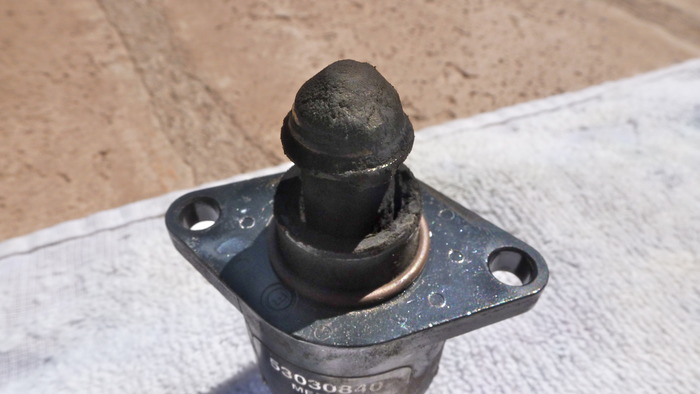
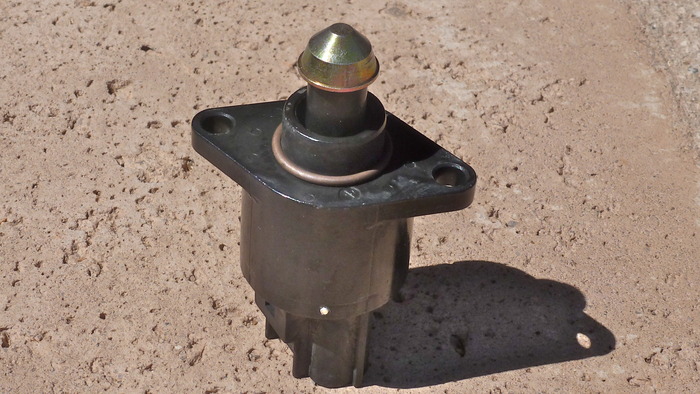
While waiting for my tech friend to read this thread and give me his thoughts, I got curious about the condition of my IAC valve. I do not know if it is a factory scheduled maintenance item so I do not know if it has ever been cleaned. Today I removed it for inspection. It looks to me (see photo) like it has never been cleaned but I could be wrong. In any case, it obviously needed cleaning so I sprayed it with CRC throttle body cleaner and lightly scrubbed it with a baby toothbrush then blasted it with compressed air. I found the seat inside the orifice in the same dirty condition so I cleaned that (the seating surface specifically) with the same except I used cotton swabs rather than a toothbrush then blew it out with compressed air.

After reassembly, the vehicle started normally and after the "flare up", curb idle settled at 650 rpm. Not sure if that is the factory spec, wish I had checked the idle speed before cleaning but it seems normal and smooth.

Before and after cleaning photos are attached.
Jun 21, 2012 at 11:21 PM
Avatar
CARADIODOC
  • CERTIFIED EXPERT
  • 34,306 POSTS
What you did cannot hurt but you got better results than what I would have expected. The air passage is about half inch in diameter and that is what used to become totally blocked with carbon. A little carbon will not do it because the computer will just keep on increasing the number of steps until idle speed comes up. At first it will also command more fuel at the same time, but eventually the short and long-term fuel trims will be modified to keep the mixture correct.

If you do not know what fuel trim numbers are, just ask and I will explain them. I am following so many similar posts lately that I get confused on who is doing what.
Jun 21, 2012 at 11:36 PM
Avatar
ERNESTO123
  • MEMBER
  • 26 POSTS
Hello Fixerman. I am so glad you have performed a cleaning of the IAC. Mine was like that, and after freeing the spintle with contact cleaner all my stalling problems were gone. I do not know if you had the chance to read my post way above, dated July 6, 2011. My engine es a 5.2l 1996 JGC limited.
Jun 22, 2012 at 8:29 PM
Avatar
FIXERMAN
  • MEMBER
  • 7 POSTS
Cleaning the IAC valve sounded like something I should do after reading the entire thread here. I do not expect that to solve my stalling problem however.

Before performing this service, I connected my OBDII code reader and there were no codes stored. The crankshaft sensor has been replaced once and the camshaft sensor twice. The PCM was checked and repaired by a firm that specializes in them.

My questions now: would a code be stored immediately after engine stalling even without the check engine light on? I have never had a check engine light on after a stalling event. If it is known that the crankshaft position sensors become "heat sensitive", has Chrysler addressed the issue with a re-engineered part? In fact, has Chrysler acknowledged the Grand Cherokee stalling issue at all? Has there ever been a tech service bulletin?
Jun 22, 2012 at 9:03 PM
Avatar
CARADIODOC
  • CERTIFIED EXPERT
  • 34,306 POSTS
Heat-sensitive cam and crank sensors are common on all car brands and models simply because of the environment they live in. No need for a service bulletin. It is the first thing mechanics check for a no-start or a stalling-when-warm complaint. On many cars the check engine light will not turn on when one of them fails because that light is required to turn on only when the fault could adversely affect emissions. An engine that does not run cannot have excessive emissions.

The fastest way to check for proper sensor operation is with Chrysler's DRB3 scanner. Under the sensors menu it will list both sensors with "no" or "present" to indicate whether they are producing a signal. When one signal shows up, the computer knows to check for the other one and if it is missing it will set a code. Either sensor can short and turn off the supply voltage to both of them. In that case no code may be set because the computer doesn't know when to expect the signals.

In the absence of a scanner, you have to check for spark and fuel pressure during cranking. That can be a little tricky. Spark is easy to see missing but for fuel pressure, the pump will not run during cranking but it will run for one second each time the ignition switch is turned on. That will produce close to normal fuel pressure. A better way is to monitor the voltage at the ignition coil(s), any injector, or the alternator field terminals. They all get twelve volts during cranking from the automatic shutdown (ASD) relay. The computer turns that relay on when it gets the two sensor signals.
Jun 23, 2012 at 5:35 AM
Avatar
FIXERMAN
  • MEMBER
  • 7 POSTS
I spoke to my tech and I was wrong about something; the crankshaft sensor has been replaced twice, the cam sensor has been replaced once. The crankshaft sensor is located in the block and only installs one way the air gap adjustment is not an issue in this application. Its location makes it difficult to remove and replace, it is done from below with the vehicle on the lift.

The camshaft sensor is easier to access and he suggested I could try replacing that one myself if, as you say, those sensors become heat-sensitive over time. He also assures me that his Snap-On analyzer will read all the same codes from both sensors in the same way as the DRB3.

We talked about the parts becoming heat-sensitive over time. My question is, how could both sensors last 130,000 (plus) miles and their replacements (Jeep OE) last only a year or so before being affected by engine heat?

I suppose its possible when I think about other Jeep OE parts I have replaced. This vehicle's taillights began to fail (bulb and socket replacements were not a fix) and we found that the entire lens/bucket assemblies had to be replaced (about $78.00 each) due to internal circuitry that fails. Less than a year later, one of those OE replacements failed. Also, this Jeep is on its fourth radiator since new, the first one having failed (cracked plastic tanks) at only 47,000 miles. (Incidentally, for anyone reading this who owns a Grand Cherokee and plans to keep it for a long time, when your radiator fails, take a lesson from this. Spend the money to replace it with a custom all-aluminum aftermarket radiator instead of an OE type with the aluminum core and plastic tanks. You will spend more for the part but you are cost in the long run will be far less due to the labor savings because the entire front fascia has to be removed to replace the radiator on these vehicles.) My tech friend says you cannot escape this design flaw because all newer vehicles have the same aluminum/plastic radiators and they are all junk!

Sorry to digress. The last time the vehicle stalled, I called my tech buddy and gave him my theory that maybe the fuel pump is going bad. He suggested that I find the Schraeder valve on the fuel rail, remove the cap and use a key or knife blade to press it and see if fuel squirts out under pressure. It did. Also, after the engine stalls, I try to restart it and when it will not start, I notice that it cranks quickly without trying to fire at all just like it would with no spark.

When you say I have to check for fuel pressure and spark, you mean after it has stalled. I never know when it will stall and it is running now. We are not driving this vehicle regularly anymore so I do not know when that will be and I do not know where the coil or coils are located on this engine. (I am an old car guy). I assume you mean checking for twelve volts with a simple meter and probes?
Jun 24, 2012 at 9:57 PM
Avatar
CARADIODOC
  • CERTIFIED EXPERT
  • 34,306 POSTS
Do not have an answer to your radiator dilemma. Almost all vehicles use the same plastic tanks since the mid 1980's. The radiator in my 1988 Grand Caravan rotted away over ten years ago and developed a bunch of holes in the tubes, so I replaced it with a good used one. It is still my daily driver and I regularly work it really hard by dragging a tandem axle enclosed trailer to car show swap meets. Before you blame the design, which really does not cause that much trouble, you might want to check the radiator cap to be sure it is not maintaining too much pressure on the system. Also, check that the hoses are not tight and tugging on the tanks when the engine rocks under acceleration. There is definitely something else going on to have that many failures.

Testing the fuel pressure after stalling can be misleading. Too many people get hung up on the first thing they find missing, spark or fuel pressure. They forget that you must check for both of them because they have their power source in common. You want to determine if you have a spark problem, a fuel supply problem, or a power supply problem to both systems. That power source is the automatic shutdown (ASD) relay. The engine computer turns it on when it gets pulses from both the cam and crank sensors. If either signal is missing, you will lose spark because the computer will not know when to fire a coil, but you will lose fuel pressure too because the power to the fuel pump and ignition coil(s) has been turned off. Where it gets confusing is even though the computer will not turn the ASD relay on during cranking, it will turn it on for one second after you turn on the ignition switch. That is to run the fuel pump to be sure the pressure is up for starting in case it bled off over a few days. For that reason, it can look like you have fuel pressure, you will find the no spark, and you will be trying to diagnose the coil circuit which is not the one with the problem.

When you do not have a scanner with you to see the state of the cam and crank sensor signals and whether the ASD relay has been commanded on, the next best thing is to measure the voltage that the ASD relay provides to see if it turns on during cranking. On most vehicles of the late 1990's, that was a dark green wire with an orange stripe. Look for that at any injector. If your wire colors are different, just look for the wire color that is the same at every injector, every ignition coil, and on the back of the alternator. You can measure at any of those points. You should see twelve volts for one second after a helper turns on the ignition switch, then it should come back during cranking. Many digital voltmeters don't respond fast enough to see that twelve volts so a test light might work better.

As for a failing fuel pump, I suppose it is possible but your mechanic is drawing an incorrect conclusion from seeing too many failed GM fuel pumps. GM pumps typically fail while you are driving down the highway and they leave you sitting in a puddle of tears on the side of the road. Ninety nine percent of Chrysler pump failures are a failure to start up when you try to start the engine. The engine will run for a few seconds until the pressure gets drawn down. You can usually hear the hum of the pump when you first turn on the ignition switch. If you do, a no-start is not due to a pump failure. If you do not hear the pump or you do have good spark and a no-start condition, you will very often get the pump going by banging on the bottom of the gas tank. It is extremely rare for a Chrysler fuel pump to fail while driving.
Jun 25, 2012 at 3:06 AM
Avatar
ERNESTO123
  • MEMBER
  • 26 POSTS
Hi Fixerman,
I have been reading the threads above. Here are some comments. 1)It is good to realize that your stalling problems might be already solved-simple logic. 2)Do not expect to solve any problem by looking at a DRB, those are diagnostic tools, and even though they might have lots of information, are not through with all possible engine problems. 3)If your stalling problem is still an ongoing issue, you might benefit from rethinking your failure again. 4)For instance you can start looking at the same problem from a different perspective: e.g. if your problem. (I will continue later) bye.
Jun 26, 2012 at 2:26 PM
Avatar
ERNESTO123
  • MEMBER
  • 26 POSTS
As I was saying, if your SUV continues to stall whenever the engine warms up, it could very well be due to a faulty coil in the automatic shutdown relay. Sometimes faulty coils behave in such a way that when used, they warm up a lot and then they open the contacts. If that is the case the engine would stall intermediately and the only thing to do is to replace the relay.

Simple solutions are very easy to overlook but should not be overlooked for many a time it happens that engine problems are easy to solve. It also happens often that mechanics request to change this part and that part, and yet another part, all without thoroughly testing the parts they want replaced, making the owner spend lots of hard earned dollars, to no avail.
On the other hand, do not become discouraged by you vehicle troubles because, as I have already said, your stalling problems might have already been solved and you might not be aware of it. Also, remember that your rig is one of the finest, most rugged, all terrain vehicles ever built. Jeeps are fine vehicles, built to last, rugged and competitive in harsh driving conditions.
Jun 26, 2012 at 4:42 PM
Avatar
CARADIODOC
  • CERTIFIED EXPERT
  • 34,306 POSTS
Most of what you said is true but you are not seeing the value of the DRB3 or any other scanner. It is correct that it is only a tool but tools are what it takes to get the job done; in this case diagnose an intermittent no-start condition. The DRB3 is all I use at home on my cars.

Mechanics rarely test parts. I worked with a very ineffective teacher who put great stock in teaching how to test parts because that is what he understood. He never was a mechanic. He was a service adviser and was not qualified to teach what he was teaching. The level of dissatisfaction among students and employers was very high. Time is money, both for employers and customers. I saw one fellow get fired for "testing" a thermostat in a can of water after the new one took care of the problem. (That wasted an hour of the boss's time but it was not his first offense). Good mechanics diagnose as quickly as possible, then replace parts. They understand that replacing random parts introduces new variables that computers are not ready to relearn and can affect performance, and they know that testing of parts wastes time and to be effective in finding the cause of an intermittent problem, it must be done while that part is still in its bad state. In the case of your ASD relay suggestion, no testing is involved and no parts need to be purchased. Simply switch it with a different one like it such as the AC compressor relay or wiper relay. If the problem still occurs, you can move on to in-depth testing without wondering if that relay is all that is wrong.

There is little chance anyone will be successful replacing a spark plug without a spark plug socket, but it can be done. There is little chance you can remove a trim screw without a screwdriver, but it can be done. There is little chance you can diagnose a no-start problem without a scanner, but it can be done, if you want to waste a lot of time. In all those cases you need the right tool for the job. You are right that the DRB3 is just a tool, but it is the right tool for the job.

To identify an intermittent ASD relay which is extremely rare, you might check for spark when the no-start condition pops up. You might also observe that the fuel pump does not hum for one second after turning on the ignition switch. But you still do not know if it is a defective relay, a defect in the computer running that relay, a wiring problem with the relay's coil circuit, or the most common cause, an overheated contact or connector terminal on the ignition switch. You would need to drag out your voltmeter or test light to test all those circuits with a helper, or, all of those things can be learned in less than a minute with a scanner. The DRB3 lists the ASD relay and whether the computer has commanded it on or off. It also lists "ASD Sense" meaning did the relay actually turn on and send twelve volts to the ignition coil, fuel pump, injectors, alternator field, oxygen sensor heaters, and back to the computer? If it is listed as "high", you instantly know every circuit associated with the relay, and the cam and crank sensors are working. It lists "twelve volt ignition sense". If that is "high", you know the ignition switch is working. Without that proper tool, how long would it take to test all those circuits before you found the one that needed further diagnosis?

Most aftermarket scanners today do a real good job but they never do everything the manufacturer's scanner will do. In some cases they do more, such as tell you which wire color to test and what to expect, but I never allowed my students to use them, or the troubleshooting charts in service manuals. Both of those tools are for people who do not understand the circuits they're working in. That does not mean those people are stupid or unqualified. It just means they have not learned the circuit yet. You can be the best over-the-road driver in the world, but occasionally you may need a road map because you do not have every route memorized. When my students truly understand how a circuit works, the diagram is all they need to know what to test and the results to expect, but they still need the tools. In many cases a voltmeter is that tool. When testing numerous parameters of a circuit that a computer already knows, the most effective tool to use is one that can talk back and forth with that computer, and that is the scanner.

If you could measure a good signal from a cam sensor, then from a crank sensor, how are you ever going to determine if they are in sync without a scanner displaying that information from the computer? Worse yet, if the cruise control kicks out intermittently but can be "resumed" a few seconds later, how will you ever find that without the scanner to display "reason for last cutout"?

You are down-playing the importance of the DRB3 being the right tool for the job. You stated it is not thorough with all engine problems. We are not dealing with all engine problems; we know we are dealing with an electrical or fuel supply problem, and based on the really good description of the symptoms, we can rule out fuel problems. Mechanical problems will not cause a sudden stalling and intermittent no-start, then magically fix themselves later.

"It also happens offen that mechanics request to change this part and that part, and yet another part, all without throughly testing the parts they want replaced, making the owner spend lots of hard earned dollars, to no avail."

You have that backward. It is do-it-yourselfers who throw random parts at a problem in hopes they will stumble on the fix. One of the goals of this forum is to prevent people from doing that and to straighten them out after they have done it and are still lost. Every time a mechanic wants to simply "try" a part, unless it is something they normally stock, he has to order it, wait for it to arrive, then when it does not solve the problem, it gets put in stock and represents wasted money. It could be years before that part is sold, if ever. Worse yet, with intermittent problems like this, how do you know that new part is the solution? We know it is not the solution if the problem occurs again, but what if that problem does not occur in the next week, or month? Is it fixed? Would you trust it on a trip deep into the wilderness?

The other thing you are overlooking with scanners is their ability to record a snapshot of events occurring with input sensors telling the computer how to respond and output sensors telling the computer the results of that response. We are lucky here that the vehicle stalls and remains in the no-start condition for half an hour, but what if you do not get your testing done in that half hour? The clues to this problem can be captured in a few seconds of sensor data, but only with a scanner with that capability.

You would be hard-pressed to suggest a better tool for finding this problem, but a lot of testing has already been done on this vehicle. We are way beyond the simple and common stuff. Now we are looking for the more obscure, one-of-a-kind, uncommon causes. The chances of stumbling onto a corroded connector terminal or cut wire are very small so we have to rely on more involved test results and observations. That is pretty hard to do over a computer, so the best we can do is suggest the best course of action that will help the mechanic and/or owner resolve this. We need to make that process as simple and reliable as possible. That is by using a scanner, even if it must be rented or the vehicle must be taken to a mechanic.
Jun 26, 2012 at 6:43 PM

Avatar
FIXERMAN
  • MEMBER
  • 7 POSTS
I appreciate all the knowledge and thinking applied here, wish I would found it sooner! However, even if somebody gave me a scanner, I would not know how to use it. I am kind of a hobbyist, hack mechanic with 1960's project cars pre-computer!

Going through the above information, I will add this: I do hear the pump's key-on one second hum or buzz. I am in the habit of listening for that at start-up since I got my first fuel-injected car many years ago an 1981 Volvo DL with the old Bosch K-Jetronic fuel injection. But I digress. This Jeep gives me that familiar fuel pump buzz, even after it stalls. When it cranks (after stalling) it "sounds" like an engine that has no spark it does not even try to fire, there is no "resistance" to cranking. It just spins--cranks quickly and it does so on successive attempts to start until thirty to ninety minutes later when something has either cooled down or reset itself then it starts and runs as though nothing had happened and never displays the check engine light. My inclination is to suspect an ignition or spark problem it is not getting spark. I know from experience that even when an engine is starved for fuel or flooded, it will choke, puff, fire intermittently or even backfire if it is getting spark. But if there is no spark, you are just pumping raw fuel into the cylinders and it will spin like a sewing machine with no resistance. So, like my tech buddy, I tend to suspect a problem in the ignition circuit.

When this engine has stalled in the past, I have not had any tools or opportunity to diagnose or check anything except the last time I was able to check for residual pressure in the fuel rail which satisfied me and my tech buddy that it is getting fuel. I would think that even if the injectors were shut down, there would be enough fuel in a cylinder or two that tried to ignite, given the presence of spark. But as I said, there is no indication of combustion when cranking after a stall event. Turn the key on and you hear the fuel pump buzz but it just cranks quickly. If I could drive this vehicle on its starter, I would be fine!

Now, one possible clue it stalled once at seventy mph. As I coasted over four lanes of traffic to the shoulder, a dash light came on briefly that I had never seen before. It looked like a broken "key" icon. I looked it up in the owner's manual but it did not seem to be anything that made sense for stalling. My wife also observed the same icon when it stalled on her under the same conditions, running down the highway at speed, not idling. The explanation of that circuit or function in the manual did not make any sense to me. Any information on this that applies? I will try to find it again.
Jun 26, 2012 at 7:26 PM
Avatar
CARADIODOC
  • CERTIFIED EXPERT
  • 34,306 POSTS
It would be helpful if you could post a photo of that light.

Keep in mind that if all you are losing is spark, when the engine does finally start it is going to be loaded up with raw fuel and it will take some time to clear out. You will see black smoke from the tail pipe. When it does start, if it fires right up and runs fine like nothing was wrong, you had to have lost spark and fuel, or just fuel.

Given all that has transpired, my best recommendation is to put your effort into finding a scanner you can borrow. When I built my hobby shop, I needed to find someone with a crane to lift the 54' roof trusses. There is no way easy to do that without the right tool. Similarly, I am thinking about an overheated ignition switch contact, an intermittent crank sensor again, and numerous other possibilities. To send you out to check all of them would take weeks, and you would have to do any testing while the problem was occurring. As validation of that suggestion, look how much testing has already been done, and we still are not even sure if it is a spark or fuel problem, or both.

Learning to use a scanner is not that complicated. If you have Windows XP on your home computer, a scanner is much easier to run. For the most part you keep making selections from drop-down menus. I became proficient on the Chrysler DRB2 by just using it, then I went to the school on the DRB3. It does the same stuff, just more of it.

You might even inquire at the local dealership's service department to see if you could rent their DRB3 for a week. Speak only with the service manager because he is the person who would have to allow it. A new type of scanner started being used with some 2004 models. Because the DRB3 was needed by many mechanics working on different systems at the same time, most dealerships have more than one. Now they are being used less frequently so you might be able to use one for a while.

You might also ask at a community college that has an Automotive program. The bigger programs have many different scanner brands, and a lot of them have DRB3's because with a small plug-in card, they will do emissions-related stuff on all brands of 1996 and newer cars sold in the U.S.

If you really want to get emotionally-involved with this diagnosis, you can probably find a used scanner on eBay. I sold three new DRB3s there a few years ago. You may also be able to still buy one through the dealer but they cost close to twice as much as most aftermarket scanners.

I just found that they are still available from the manufacturer:

http://www.toolsource.com/scan-tool-package-chrysler-jeep-dodge-p-98745.html

but the price will floor you. There appears to be a lot more used stuff out there now. I also came across a lot of them listed as being from China and Singapore. Not sure what that is all about.

"Genysis" is a popular aftermarket brand of scanner. I only used one a few times but got frustrated because it did not do what I knew the DRB3 could do. Snapon makes a few different models too but they are very proud of their stuff and charge accordingly for it. There are some less sophisticated scanners available that do much more than just read fault codes but it is the recording capability you should look for when you have problems that act up and are gone in a few seconds. When you have over a half hour to do the diagnosis, the "no-start" menu of tests will be what you want to follow.
Jun 26, 2012 at 9:43 PM
Avatar
TIMMYTUCKER73
  • MEMBER
  • 1 POST
I have a 1998 Jeep Grand Cherokee Laredo and I had the same problem with mine stalling. I changed the ADS fuse in the engine bay fuse box it should be a 20 amp. I had to replace a couple time because the fuse blew about five times but after that it never did it again. I hope this helps
Nov 22, 2013 at 5:50 PM
Avatar
CARADIODOC
  • CERTIFIED EXPERT
  • 34,306 POSTS
Thank you for sharing that, but it does not match the symptoms here. Except for corrosion on a socket, a fuse will never be intermittent and cause an intermittent problem. When it blows, you are done until you replace it. When the engine starts again once it cools down, you know it was not a fuse problem.

Also, you did not find a cause for your fuse to be blowing so the problem is still there. (One common cause, especially if it is intermittent, is a wiring harness to an oxygen sensor fell down onto hot exhaust parts. There is a twelve volt feed wire from the ASD relay to the oxygen sensor heaters. If that grounds out it will cause the fuse to blow, but not until the ASD relay turns on.

If the problem of blowing fuses starts up again, a simple trick to finding a short is to replace the blown fuse with a pair of spade terminals, then use small jumper wires to connect them to a twelve volt light bulb. A brake light bulb works well. When the circuit is live and the short is present, the bulb will be full brightness and hot so be sure it is not laying on the carpet or against a plastic door panel. Now you can unplug electrical connectors and move things around to see what makes the short go away. When it does, the bulb will get dim or go out.

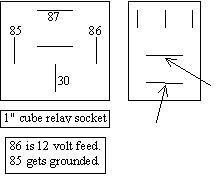
The problem with this is the bulb limits current to a safe level, but that causes the voltage to drop in that circuit,even when it's working properly and the short is not there. That means the ignition coil(s) will develop very low spark voltage. That can result in misfires or a failure to start. The ASD relay only turns on for one second after turning on the ignition switch, then again whenever the engine is rotating. That means the engine either has to run, or you have to do something else that allows you to power up the circuit. That is, in this case, bypassing the relay with a piece of wire. By jumping terminals 30 and 87 together, you can troubleshoot the circuit without even having to turn on the ignition switch.
Nov 22, 2013 at 11:22 PM