stalling problems

1999 JEEP GRAND CHEROKEE
130 MILES • 6 CYL • 4WD • AUTOMATIC
Avatar
JESSIESJEEP
  • MEMBER
  • 12 POSTS
I have owned this car for about four years now. I love the thing but have been experiencing a lot of problems with it over the past few months. At first, it would just shut down while driving down the road. It did not spit and sputter and then quit, just a clean and quick shut down, almost as if the key had been turned off. Sometimes it would fire right back up, other times it would only crank but not fire. But it always started back up after a few (fifteen to thirty) minutes.

About a month ago, I paid almost $1,000.00 to have my computer replaced. It was running really rough, missing and sputtering, and the check engine light was on. Every time they hooked it up to read the code it would show a different code but all were related to a cylinder misfire. The number of the cylinder would continually change though. After checking the coil pack, spark plugs, etc., the mechanic said it must be a bad computer and replaced it.

Since then I have had major problems getting the thing to start at times. I can leave the house in the morning and it will start fine, stop and start the car several times throughout the day with no problems, but then, bam!, it will refuse to start. Again, it will crank normally but never actually turns over and fires. After waiting a few (thirty to forty five) minutes, it will start right up as if nothing has happened.

I have taken it to several mechanics, but each tell me they have no idea what the problem is. Any suggestions would be a major answer to prayers and greatly appreciated.

Thanks,
Jessie
May 26, 2011 at 6:51 PM
Advertisement
Avatar
JESSIESJEEP
  • MEMBER
  • 12 POSTS
P.S. Momma of two kids who have about a billion things to do in a week so a reliable vehicle every day is really important. Anything you have to offer would be greatly appreciated. :)
May 26, 2011 at 6:54 PM
Avatar
CARADIODOC
  • CERTIFIED EXPERT
  • 34,306 POSTS
Most likely there was nothing wrong with the engine computer. That is what a lot of mechanics fall back on when they can't figure out the real cause. That is because General Motors does have a real lot of expensive computer trouble and that is what they are used to finding. Chrysler products, at least up to that time period had very little computer trouble.

this guide will help

https://www.2carpros.com/articles/car-cranks-but-wont-start

There are two sensors that commonly cause the problem you described. They are the camshaft position sensor and crankshaft position sensor. Normally a diagnostic fault code wll be set in memory to direct the mechanic to the right circuit, but if no code is being set, the Jeep dealer has the Chrysler DRB3 scanner that does the best job of displaying live data while driving the vehicle. Once the engine stalls, it will display "no" or "present" for the signals from each sensor while you crank the engine. Many independent shops also have that DRB3 because with a plug-in card it can be used on any brand of car sold in the U.S. starting with the 1996 models.

It is very common for those sensors to become heat-sensitive when they fail. Once they cool down, typically in a half hour to an hour, they will work again. This is so common, your mechanics should be aware of this as it happens a lot on all brands of cars and trucks.

I can tell you how to test it but that is the only way you are going to find your problem.

All "crank, no start" conditions are approached in the same way. Every engine requires certain functions to be able to run. Some of these functions rely on specific components to work and some components are part of more than one function so it is important to see the whole picture to be able to conclude anything about what may have failed. Also, these functions can only be tested during the failure. Any other time and they will simply test good because the problem is not present at the moment.
If you approach this in any other way, you are merely guessing and that only serves to replace unnecessary parts and wastes money.

Every engine requires spark, fuel and compression to run. That is what we have to look for.

These are the basics that need to be tested and will give us the information required to isolate a cause.

1) Test for spark at the plug end of the wire using a spark tester. If none found, check for power supply on the possitive terminal of the coil with the key on.

2) Test for injector pulse using a small bulb called a noid light. If none found, check for power supply at one side of the injector with the key on.

3) Use a fuel pressure gauge to test for correct fuel pressure, also noticing if the pressure holds when key is shut off.

4) If all of these things check good, then you would need to do a complete compression test.

Once you have determined which of these functions has dropped out,
you will know which system is having the problem.
May 26, 2011 at 7:47 PM
Advertisement
Avatar
JESSIESJEEP
  • MEMBER
  • 12 POSTS
Thank you so much for your reply. It is a very frustrating thing to be a chick who knows diddly about vehicles and is, therefore, at the mercy of a mechanic. It is not good to know that I might have forked out all that money for something that was not needed, but I cannot tell you how excited I am to finally make contact with someone who can offer some sort of remedy. Two more question if you do not mind. Are these two sensors expensive (like the computer), or are they fairly reasonable? Also, how difficult/lengthy are they to make? (The last fellow to replace the computer had my car for over three weeks! I was a bit frazzled by the time I got my Jeep back.) Again, thanks so much for the information. :)
May 26, 2011 at 8:06 PM
Avatar
CJ MEDEVAC
  • CERTIFIED EXPERT
  • 11,004 POSTS
I do not know why Doc has not come back yet.

I did some investigating for you.

Some people believe in only "Genuine" expensive parts.

I am not one of them! I have gotten a bad parts before (non working from the start genuine or not!), but I have not had any problems out of "cloned parts" that I have used.

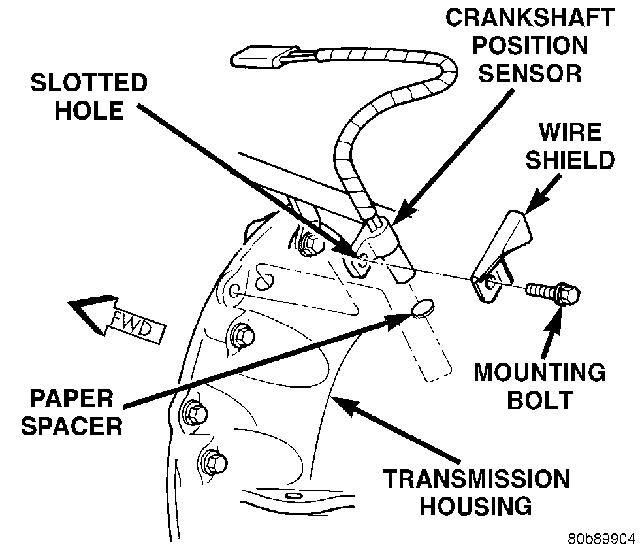
As far as changing these puppies, the cam sensor really looks easy I do not know about the crankshaft sensor. It is sort of hidden, and looks like it may be a bit difficult to get to (see picture) Both may be easy and you could do this yourself! A repair manual is a real plus, I use them constantly.

As far as cheating the mechanic, there are other inexpensive routes. My favorite is the person who works at the self service, Ma and Pop, Small Auto Salvage Yard. He will slap them on for $20.00 and a cold soft drink! Another is the Technical School Auto Technology Department. If you can schedule it, around here there's a $15.00 to $20.00 charge on various things (visit the instructor and ask).

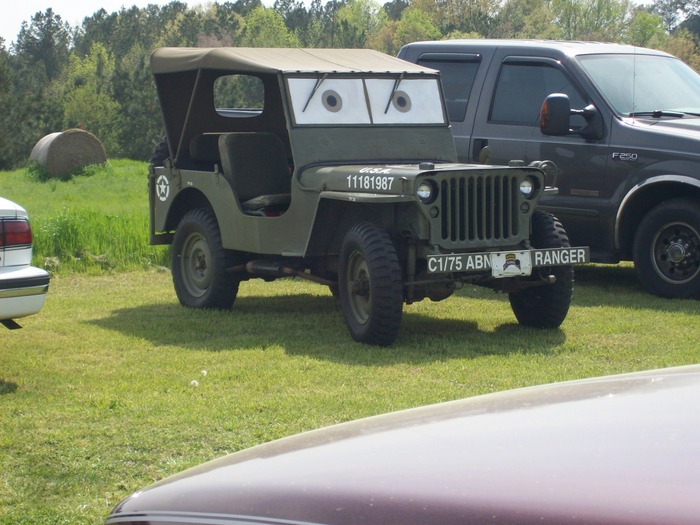
Here is the locations of both sensors and my second Jeep.

Hope this does help.

The Medic
May 27, 2011 at 1:55 AM
Avatar
JESSIESJEEP
  • MEMBER
  • 12 POSTS
Doc and Medic-

Big thanks to you guys for the helpful information. It is great to finally feel like there might be an end to the sitting in various parking lots for half an hour every other day waiting for my Jeep to start. (Ha, ha, kind of funny when it is not actually happening) While I am in no way even close to being mechanically minded enough to attempt this repair, I do have a few good fellows around me that can probably get the job done with the information I got from you guys. Hopefully they will attempt the fix this weekend, and I will be sure to post the results. I really cannot tell you how relieved I am to have a possible answer to such an annoying issue. God bless you guys, and I hope you both have an awesome weekend! :)
May 27, 2011 at 3:13 AM
Avatar
JESSIESJEEP
  • MEMBER
  • 12 POSTS
Oh, and one more thing.

I was able to get a code after reading the various posts on here. Even though my check engine light is not on, I tried the little trick with turning the key three time and seeing if a code came up. I got "P0320" which I understand to mean the PCM is not getting a signal from the crankshaft sensor. (I know that is probably not the technically-correct way of saying it, but hopefully you will get the idea.) So, I am going to try replacing that sensor before the camshaft sensor. Again, a big thanks!
May 27, 2011 at 3:17 AM
Avatar
CJ MEDEVAC
  • CERTIFIED EXPERT
  • 11,004 POSTS
Could be that maybe it came unplugged or the contacts are corroded.

Maybe no need to spend money.

You can get little condiment packets of "dielectric grease" at the auto parts store. Smear some on your contacts before you plug 'em back in.

Good luck, come back to this post and update us.

This is an on-going soap opera for us we like to hear the rest of the story!

Thanks for coming to 2carpros.

The Medic
May 27, 2011 at 4:11 AM
Avatar
CARADIODOC
  • CERTIFIED EXPERT
  • 34,306 POSTS
Sorry to take so long to reply. This site has stopped working on my main computer.

Happy to hear you have a code related to the crankshaft position sensor. Usually that will cause the check engine light to turn on, but that only must turn on when the detected problem could have an adverse effect on tail pipe emissions. A non-running engine will not cause excessive emissions.

This sensor sits on the top driver's side of the transmission, right behind the engine block. It is very important to install it with the proper air gap. If that gap is too large, the engine will hesitate, stall intermittently, or not start at all. If the gap is too small, it is possible for it to be broken from being hit by the spinning flex plate.

New sensors from the dealer come with a thick paper spacer glued to the end to set that air gap. Some aftermarket sensors have a thin plastic rib molded onto the end to set the gap. As soon as the engine starts, the paper spacer will slide off. The plastic rib, if used, will wear down. In either case, its job is done. Anytime a used sensor is going to be reinstalled, a new paper spacer must be used. If there is a partial plastic rib remaining, it must be cut off, then a paper spacer is used to set the gap.

The reason for bringing up that story about the spacer is every once in a while I read where a sensor got broken because someone did not know how important that air gap is.

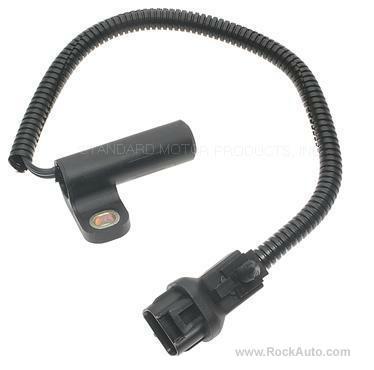
Here is a photo from rockauto.com showing what the sensor looks like, and a drawing from the Chrysler web site that shows where it is located:
May 27, 2011 at 6:36 AM
Avatar
JESSIESJEEP
  • MEMBER
  • 12 POSTS
Sorry, thought of a couple more questions.

Would the bad sensor also cause my jeep to run bad? Ever since the computer was replaced, it has run really rough and even sounds rough when it idles. I have also noticed that sometimes when starting up a hill, it will miss really bad (almost like it is going to shut off completely) and then all of a sudden it will get a surge of power and shoot forward. Could this be related to the sensor as well? Again, it does not do it all the time.

Also, should I go ahead and have both the crankshaft and camshaft sensors replaced since they are both relatively unexpensive? I remember having to have an oxygen sensor replaced a couple years ago. They only replaced one, and not even a week later they had to go back and replace the other also. And, do you think the replacement of the sensors is something your average person with a limited knowledge of mechanical things should attempt? Thanks again for your guidance and wisdom. :)
May 27, 2011 at 1:19 PM
Avatar
CARADIODOC
  • CERTIFIED EXPERT
  • 34,306 POSTS
First of all, if you are close to a larger city, you will likely have a salvage yard where you pay your buck, then throw your tool box into one of their wheel barrows, and you can spend the whole day there looking for parts. That would be a dandy place to find a similar vehicle to practice on. If you are near Indianapolis or between Ohio and southern Georgia/Alabama, there is a real nice chain of yards called Pull-A-Part. Their yards are very clean and well-organized, and the people and customers are very friendly. You can search their inventory on the internet too. I have been to at least a dozen of their yards in Nashville, Memphis, Knoxville, Indianapolis, Montgomery, four in Georgia, etc. I think they have about two dozen yards altogether. I think all you'll need to remove a crankshaft position sensor is a 10mm wrench but there might be other stuff that is in the way and has to be removed as well. You might even consider buying the used sensor. Parts are real inexpensive there. I bought a rust-free sliding door and lift gate for my 1988 Grand Caravan about two years ago for less than a hundred bucks for the pair. A similar type of yard in St. Louis wanted $250.00 just for a rusty lift gate.

Do not start replacing more things than necessary. When you consider that new parts can be defective, that air gap is critical, and anything else that can go wrong, you are inserting another variable into the equation each time you change something. If the camshaft position sensor was intermittent, there would be a different fault code stored in the computer.

As for your oxygen sensors, there is a different explanation for that. The engine computer is constantly running tests on all of the sensors. Some of those tests involve comparing their readings to those of other sensors. Here are just a few examples:

1. After the engine has been off for more than six hours, the engine coolant temperature sensor and the outside air temperature sensor had better be reading the same temperature.

2. If the coolant temperature sensor says the engine is at forty degrees when you start it, it had better be reading considerably higher after the engine has been running for five minutes.

3. There will be no signal coming from the vehicle speed sensor when it is standing still. That is a normal condition. There can also be no signal coming from it if it is defective. That is not a normal condition. If the computer sees that the transmission shifted to a higher gear or there is a load on the engine, it knows the vehicle is moving and there had better be a signal coming from the speed sensor.

In all of those examples the computer knows what to expect from each sensor for a given set of conditions, but it has to also know that "given set of conditions". If there is a problem detected with one sensor and a code is set in memory, the computer knows it can not rely on that sensor's readings to compare to other sensors. With nothing reliable to compare to, it will not set a code for the second item. That is likely what happened with your oxygen sensors. You actually have four of them, two on each half of the engine. The front ones measure if the correct amount of fuel is entering the engine. When everything is working correctly, both sensors will report nearly the same readings. As they age, one of them can begin responding slowly. The computer watches that but as long as the readings stay within acceptable limits, no code will be set in memory. If both sensors start to respond slowly, the computer will make fuel delivery adjustments that are not the best but you might not notice that fuel mileage has dropped or tail pipe emissions have increased. Eventually one of the sensor's readings will be bad enough, or unbelievable enough to the computer, that it finally sets that first fault code and turns on the check engine light. The second sensor is just as old and just as tired but it has not quite failed yet. Also, since there is a problem that was detected for the first sensor, the computer has nothing reliable to compare to the second sensor so it will never set a code for that second one.

Eventually you get the sensor replaced to take care of the fault code in memory. Now the computer has a reliable signal to compare to the second sensor, and it realizes that second one is not performing properly. That is when it sets the second code a week later. Unfortunately that means two trips to the shop, but there was no way to know during the first visit that another problem was going to show up. That is one reason mechanics get the blame very often for causing new or additional problems. Even if they are sharp enough to catch the second problem after they make the first repair, they get accused of "finding more things wrong as long as you keep approving the additional repairs".

General Motors is real bad about that with their anti-lock brakes. It is real common for wheel speed sensors to give problems within 15,000 miles, but only one fault code will be set in memory. Fix that sensor, then a different code pops up. Fix that one, then a different code shows up again. That is more likely to happen when the first code was ignored for many months giving those other things time to fail. Smart mechanics will ask you how long that warning light has been on. If only a few days, you likely have just that one problem. If it has been on for months, they know to prepare you for multiple items and lots of diagnostic time.

To address the poor running and whether it could be related to the crankshaft position sensor, the answer is yes, but it is usually intermittent. The signal from that sensor is either zero volts or five volts and it switches instantly between those two states. Those are the only two conditions the computer recognizes. If the failing sensor starts producing one volt or four volts, the computer might understand that it meant zero and five volts, but at some point it is going to get confused.

Think of a “do not walk” sign. The work “walk” is always lit up, but the word “do not” turns on and off. Those are the only two acceptable conditions. If the word “do not” glows very dimly when it should be off, you would understand it is okay to walk. Same is true if it does not quite get full brightness when it is on. You know to not walk or you will get mowed over by a bus! But what do you do when “do not” is lit up half brightness? Some people will walk, some will not, and some will step off the curb, then change their minds. That is the confusion the computer sees when the signal does not turn fully on or fully off from a failing sensor. It cannot decide whether it should fire a spark plug or an injector, or if it is supposed to be waiting for a better pulse.

It is rare for the sensor to produce those confusing signals for very long. Typically they go from working properly to total failure very quickly, with perhaps a few minutes of producing confusing signals. That said, it is also possible for a different type of failure to take place where the signal never reaches the full five volts. That is usually aggravated by the slow engine speed during cranking so it is more common to cause a no-start condition, but it can cause a hard start/hesitation/sputtering problem too. There are two ways to verify if it is the sensor causing the running problem. The fastest way is to install a new sensor, then see if the problem is gone. Professionals are trained to avoid that method because it involves buying parts that might not be needed. The other way is to connect an oscilloscope that lets you view the waveform and see if it is correct. Most people do not have access to a “scope” and they can take a while to set up and connect. In this case, since this is a known commonly failed sensor, there is a good chance it will solve the problem so my recommendation is to stick it in. If it does not solve the problem, hang onto the old one for a spare.
May 27, 2011 at 10:56 PM
Avatar
ERNESTO123
  • MEMBER
  • 26 POSTS
I have been reading the responses above. One thing that would be an easy, cheap, factory like and permanent fix is as follows. Suppose the door key switch needs replacement (they usually wear out normally). When that happens, if you unlock the driver's door using you key, as the switch is bad, it will not disarm the alarm. If the alarm active then it might shut off the engine silently a while after it has started. If such a switch turns out to be in good condition, you still need to figure out how to disarm the alarm. My jeep has a VTSS (Vehicle Theft Security System) module located under the dashboard just on top of you put your right knee when sitting on the drivers seat. On its leftmost connector locate the violet/black line, touch it by a fraction of a second with a sewing pin connected to a good ground, then start the engine. If the engine starts right a way, then you will need to locate the faulty switch that is triggering the engine interrupt function of the VTSS. If this is the case you cannot bypass the VTSS. The switches are: hood open mercury switch, lift-gate open switch, left front door open switch, right front door open switch, left back door open switch, and right rear door open switch. The hood switch is one piece with the hood lamp holder. Anyone of these switches, when faulty, might trigger the VTSS engine interrupt function while driving.
Jul 4, 2011 at 8:01 PM
Avatar
CARADIODOC
  • CERTIFIED EXPERT
  • 34,306 POSTS
Good information, but the alarm will shut off the engine after two seconds and the horn should be blowing and the lights will be flashing. A broken wire between the door hinges is much more common than a bad switch. In that case, the alarm will turn off by unlocking the front passenger door. The alarm will not cause stalling after you have been driving, and it will not magically reset after the vehicle has cooled down.

The stalling when hot is the classic way crankshaft position sensors fail. I appreciate the information about the violet/black wire. Going to add that to the memory banks.
Jul 4, 2011 at 8:15 PM
Avatar
ERNESTO123
  • MEMBER
  • 26 POSTS
Hi, this post regards the post above by caradiodoc. You have just described the behavior of an aftermarket alarm. Well that is not the case with a VTSS (Vehicle Theft Security System). This vehicle has a VTSS, and as a system it be, it controls several functions, being one of them an alarm triggering function (lights blinking, horn blowing,) Yet, another function of the VTSS is called engine interrupt. It is completely possible for the VTSS so trigger the engine interrupt function without triggering the alarm function. When the engine interrupt function of the VTSS is triggered, it communicates such to the PCM (Power-train Control Module) which is the one commanding the engine. In other words, anytime you try to start the engine, the very first thing the PCM does is to ask the VTSS module for a go. If the VTSS engine okays it then the PCM will go ahead and turn on the engine.

It is very much possible that the VTSS engine interrupt function is triggered while driving. For instance if there is line with a faulty short to ground which, as the vehicle moves, touches ground once in a while, then the VTSS might sense it and broadcast an engine interrupt signal to the PCM through the communication line (this line is the twisted pair, the only twisted pair in the PCM, and other modules).

Also, it is very much possible that the engine interrupt function resets after the engine stops (say the driver perfomed an alarm dissarm operation) and then you can restart the vehicle, but if the faoulty ground persists, then the engine interrupt funcion will be triggered again.

I believe there might be other possible caused of the malfunction that have not been covered here, but from an electrical point of view, I would suggest resetting the VTSS (by using the procedure described in my prior post) the next time the problem occurs. If you are able to start the engine after doing the resetting, then this theory is confirmed and you will need to look out for the faulty door, hood or lift-gate switch.
Jul 4, 2011 at 11:01 PM
Avatar
CARADIODOC
  • CERTIFIED EXPERT
  • 34,306 POSTS
I have never gotten involved with aftermarket alarms, just factory stuff. I have never heard of a vehicle stalling while driving but I guess that does not mean it is not a possibility. If that were to happen, that would be extremely rare and uncommon. In this case, the original comment, "But it always started back up after a few (fifteen to thirty) minutes", is real common. The common stuff should be checked first. If that can be eliminated from the list of potential causes, that is when we start looking at the unusual or uncommon things such as the VTSS.

Still good information to have.
Jul 5, 2011 at 8:10 PM
Avatar
JESSIESJEEP
  • MEMBER
  • 12 POSTS
First, let me say sorry for not letting you guys know how things turned out. I finally had the crankshaft position sensor replaced. Everything was great for a couple of days, then my Jeep started stalling whenever it idles for any length of time (example, in the driveway, at a red light). The problem I had before where it would shut off and I would have to wait sometime to get it restarted has not happened since the replacement of the CPS. So, I have essentially traded one problem for another? I do not know if maybe the new sensor could have been bad or put on properly, or if maybe this is a whole new problem. But I would think it would be related since it was at the exact time it was replaced that the first problem stopped and the new problem started. Also, it seems to shut off much more often when I am below a quarter of a tank of gas for some reason. It makes no sense to me, but I have been paying attention to what happens and when it happens and how frequently it happens with hope that somebody can put it all together and figure out what is wrong.

Also, when it started acting up again, I took it to a different local mechanic. After ensuring that he would take a look at it the same day and not doing a thing with it until four days later, he told me he did not know except that it was still throwing code P0320. He suggested I take it to another local mechanic who is good with the electronic type stuff on cars. I talked to him briefly last week, and after he found out my PCM had recently been replaced, he said it may possibly need to be re-flashed. I have not the slightest clue what that means, but I do know it involves taking it to a dealer and I would really like to try and avoid that if at all possible. (I am sure we are talking some big money there!)

Anyway, hopefully somebody will be able to put all the pieces of my mess together and come up with a solution. I really do appreciate any and all help that is offered. I no longer feel safe having my kids in this thing while I am driving, but I really just do not have much of a choice right now.
Jul 6, 2011 at 1:53 PM
Avatar
CJ MEDEVAC
  • CERTIFIED EXPERT
  • 11,004 POSTS
Just to let you know we are still monitoring your situation.

I feel caradiodoc is probably your best source of information for this problem!

He really goes out of his way to research these things and he writes back with informative novels. lol!

Most everyone here respects his judgement (especially me, I am still living in the 1980's on back, with fixing vehicles of the past!)

Doc know quite a few of the other fellers here too, and they will jump in from time to time and aid him or share their experiences.

Doc's also way out yonder in Wisconsin his sleep patterns are definitely different than other folks.

Most likely drinking a glass of milk or having a cheese sandwich right now!

He will be back soon!

The Medic


Jul 6, 2011 at 2:34 PM
Avatar
ERNESTO123
  • MEMBER
  • 26 POSTS
This post regards to Jessie's last post. Your description of your problem can be linked to a a dirty idle Air control valve. IAC valves become clogged with smock through time. No need to replace it, just clean it. Locate the IAC valve, unplug its connector, and unscrew it. When you have it removed, apply it a spray of electric contact cleaner while moving it is spring loaded shaft/tube. You will notice a lot of black dirt coming out loose. Apply more liquid until it drips clean. Next dry it and put the piece back to where it belongs. That should solve it. No need to replace it, just clean it. Your engine will run smooth at idle again without stalling.
Jul 6, 2011 at 3:18 PM
Avatar
CARADIODOC
  • CERTIFIED EXPERT
  • 34,306 POSTS
Okay people, I am back, but only now finally because my internet service was down last night, again!

Jessiesjeep, "whenever it idles for any length of time (ex. in the driveway, at a red light)", what does "ex" mean? Example or except? I seriously doubt the automatic idle speed motor is the problem. It used to be real common for the air passage around the throttle blade on the 3.0L engines to become plugged with carbon but we have not seen that in over ten years thanks to the newer additives in the fuels today. I drive an old rusty trusty 1988 Grand Caravan 3.0L with 379,000 miles and have never had to clean that passage, and I always buy the cheapest gas I can find.

A real easy way to tell if the automatic idle speed motor is working is to observe engine speed at start-up. It should immediately give you an "idle flare-up" to 1500 rpm, then drop down to 800 rpm. If it does that, the AIS motor is working. If you do not get that idle flare-up and/or the engine idles too low when warm, suspect the engine computer has not yet relearned "minimum throttle" after the battery was disconnected during other service. Most mechanics will take your vehicle on a test drive at the completion of any service when the computer may have lost its memory to perform this procedure but many of them ignore it because it is so simple on Chrysler products that they leave it to the owner. It is probably the single biggest, although minor complaint after other service work was done. To relearn minimum throttle, drive at highway speed with the engine warmed up, then coast for at least seven seconds without touching the brake or gas pedals. That will meet the conditions needed to signal the computer to take a voltage reading from the throttle position sensor. From then on it knows that whenever it sees that same voltage, your foot is off the gas pedal and it has to be in control of idle speed. Once that relearn is done, you will definitely get the nice idle flare-up at start-up. If you do not, that is the time to start looking at the automatic idle speed motor. It has four coils of wire that can be monitored by the computer for integrity, and a problem there will set a fault code and turn on the check engine light, but a stuck motor armature or plugged air passage are not monitored in any way so those failures will not set a code.

"Re-flashing" a computer simply means reinstalling the software, just like on your home computer. In the past, engine computers were relatively basic and performed simple functions. Chrysler's in particular were uncommonly reliable and rarely caused a problem. They get more complex every year, and starting with the newer "on-board-diagnostics version 2 (OBD2) emissions systems mandated in 1996, they also monitor the efficiency of the catalytic converter.

Two things can happen that require a change in the computer's software. One could be the discovery that under a specific set of conditions, (road speed, altitude, engine load and temperature, etc.), tail pipe emissions might exceed legal limits. The engineers will design a fix for that in the software, then issue an emissions recall to re-flash all of the affected computers in those vehicles. That is less expensive than replacing the entire computer which is what they would have had to do in the earlier models. GM vehicles used their famous "PROM's. That was a plug-in integrated circuit that contained all of the programming specific to that vehicle and engine, and it set the "personality" of the computer. Those were fairly easy to replace too, after they sat down to redesign it and send out to have them manufactured, tested, then shipped to the dealers.

The second reason to reflash a computer is when the software is suspected to have been corrupted. This again is very common on GM vehicles due to the huge voltage spikes their generators produce. The problems usually start when the battery gets old and loses its ability to dampen and absorb those spikes. Welding on the car can also damage computers and the software.

A third reason to reinstall software has to do with simple economics for the manufacturer. In the past they had to have a different part number computer for every possible combination of engine size, power rating, vehicle weight, vehicle options, California vs. federal emissions, etc. That could mean a few dozen different computer choices for each car model for each year. No dealer would want to stock hundreds of computers so when you needed a new one, they had to order the correct one and wait a day or two for it to arrive. Today they only have a few different computers and it is easy and inexpensive to keep them in stock. Once installed, they connect it to the internet and download the software specific to that vehicle. You can be on the road in an hour or less.

Today, with downloading the software over an internet connection directly into the computer, there is no need to redesign any computer chips or have them manufactured. Of course with any new technology there are drawbacks. General Motors is the master at separating owners from their money after the sale. One of their many customer-unfriendly business practices is that re-flashing computers can only be done by the dealer. Independent shops are allowed to re-flash three computers, as mandated by the government, because they can affect emissions. For all of the other dozens of computers, GM refuses to release the information to anyone else, so you are tied to the dealer and that very expensive repair bill you are worried about. These business practices are one reason why so many people are saying "never again" when considering which brand of new car to buy, and GM has been losing repeat customers.

Hyundai is at the exact opposite extreme. Any independent repair shop with a laptop computer can connect those cars to the internet and the Hyundai web site, and install any software into any computer for free. Look who is putting their customers' interests ahead of profits. Chrysler and Toyota are in the middle of that range. Any independent shop can download the software for any computer except the security system. For that one, the car must go back to the dealer so they can verify it is not stolen. The only time that software download would be needed is if that computer had to be replaced. Chrysler charges $40.00 per download, and the shop must purchase a one-day, one-week, or one-year subscription to their web site, but for that subscription you get access to all their service bulletins, service manuals, diagnostic fault code descriptions, and most of the things the dealer's mechanics get to use. The point is, even though there is a charge for the service, the information is available to everyone, and it costs way less than the aftermarket service information providers charge.

Okay, getting back to your intermittent stalling problem, the code 320 is the monster clue staring at you that is proof the AIS motor is not the problem. That code has to do with an intermittently missing signal from the crankshaft position sensor or camshaft position sensor which was commonly inside the distributor. It is common for mechanics to read the code and just throw in a new sensor, and ninety nine percent of the time the vehicle is fixed, but in reality, the codes do not specify a defective sensor. All fault codes get you into the circuit or system with the problem that needs further diagnosis.

This is no different than troubleshooting cars decades ago. There were no such things as fault codes. We checked to see if fuel was squirting in, then we checked to see if we had spark. Whichever one was missing, that is the system we diagnosed. Today we can have all kinds of problems besides the simple no-start conditions. There can be a dozen sensor circuits and it would be extremely inefficient to make the mechanic look at each one every time the car came in the shop. Instead, we let the computer detect the circuit that has a problem, then the mechanic diagnoses just that one. Most of the time the sensor at the end of the line is the cause of the problem, but there could also be a corroded terminal in a connector, a wire could be rubbed through and grounding out, or a terminal could just be stretched to the point of not making good contact with the mating terminal. To add to the confusion, some of the terminology can be misleading. An engine computer may use a "distributor reference signal" for an engine that does not use a distributor. The signal provides the same information but it comes from a different source or different type of sensor. On your engine, there is indeed a distributor, and code 320 refers to the camshaft position sensor that lives in it. You said your mechanic replaced the crankshaft position sensor which provides the same type of signal but it is actually in a different place and develops its signal from a different source. Either one of those sensors can become heat-sensitive and fail intermittently. They will often work again once they cool down in about an hour.

Another problem to be aware of when a new crankshaft position sensor is installed is they require the use of a thick paper spacer on the end to set the critical air gap. That spacer slides off when the engine is started but by then its job is done. Many aftermarket sensors have a thin plastic rib molded to the end to set the gap. It wears away when the engine is running so if that type is removed and reinstalled, it is supposed to have the remaining part of the rib cut off and you use a paper spacer. I had to reinstall that sensor after replacing transmissions. After doing a half dozen of them, I got so "good" at setting the air gap on those sensors that I didn't need the spacer. I learned later that on the thirteenth one, the owner developed intermittent stalling two weeks after I replaced his transmission, and a different shop read the fault code for that sensor, replaced it, and it solved the problem. Now I suppose it is entirely possible the sensor did become heat-sensitive and decide to fail, but I suspect it was due to my not setting the gap properly. I was going to suggest that is what happened on your Jeep, except the fault code is related to a different sensor. I suspect you have a failing camshaft position sensor. That is a bolt-in item, but I never replaced one so I am not certain, but I do not think there are any special procedures to follow or air gap to set.

Now, if you will excuse me, I have not eaten in over an hour! I am going to grab a slice of cheese and wash it down with some milk.
Jul 6, 2011 at 8:18 PM

Avatar
JESSIESJEEP
  • MEMBER
  • 12 POSTS
I do not know if you guys realize how thankful I am to have found this site and all of you who have helped this far. I love my Jeep, but I was getting worried I might have to just get rid of it because nobody around my neck of the woods seems to be able to figure out the problem. Hopefully, with all that is suggested here, I will figure it out and be back on the road (safe and happy) again sometime soon.

Anyway, I thought of something else that might be useful. My car rarely (and I mean almost never) stalls or stutters or dies when it is in motion only when it is idling. But, there is one stretch on my road going to my house that it always bogs down at. It is a pretty big dip in the road you go down a hill and then right back up another one, both of which are pretty steep. Sometimes it just gets bogs down and then snaps out of it once I get to the top, sometimes it shuts off completely and I have to restart it. Not sure why or if it is even helpful, but that is always a problem spot.
Jul 6, 2011 at 8:24 PM
Avatar
JESSIESJEEP
  • MEMBER
  • 12 POSTS
Here are a couple more things I have noticed: Sorry to rattle on, but I just figured the more information I give then maybe the easier it is for you to identify the problem.

When I first turn on my car, it idles okay for the first few seconds. I think the little stick thing points to just about the first number (maybe a 1? ) on the tachometer. Then, it will drop below that first number quickly each time the engine sputters, then shoot back to where it was. (Sorry I do not know exactly what I am talking about, but if it is helpful, I will write it down so I can give you the absolute correct information.)

Again, it stalls and sputters and dies much more often when the gas tank has less than a quarter of a tank. It also is really bad when I put it in reverse.

I have noticed that if I put it in neutral when I am stopped and just at an idle it helps to keep it keeps the car from stalling as frequently.
Jul 6, 2011 at 8:50 PM
Avatar
CARADIODOC
  • CERTIFIED EXPERT
  • 34,306 POSTS
The "stick" you are referring to is the tachometer which displays engine speed. The "1" is for 1,000 rpm. What is important is what it reads for the first few seconds when you start the engine. It should go to around 1,500 rpm, then drop right back down. That proves the idle speed motor is working.

It sounds like you have something else going on related to the stalling. A vacuum leak in a hose or engine gasket is a good possibility. The engine computer is not designed to work with leaks but will try to make adjustments in response to the results of those leaks, and that can cause symptoms similar to what you described.

A good course of action is to have a mechanic connect a scanner that can view and record live sensor data during a test drive. When the stalling or erratic idle occurs, the "record" button is pressed. The recorded sensor data can be reviewed frame-by-frame slowly at the shop to look for a glitch or signal dropout. Because that data passes through and is retained momentarily in the scanner's memory, the recording actually begins a few seconds before the record button is pressed so part of it will include when the stalling occurred.
Jul 6, 2011 at 9:37 PM
Avatar
ERNESTO123
  • MEMBER
  • 26 POSTS
Hello, two things:
1) Indeed the code P0320 relates to a missing signal from the crank shaft position sensor. Such code does not necessarily mean that such sensor is bad or has become heat sensitive. It only means missing signal from that sensor, so you need to first look at the cable coming from that sensor. Take a look at it, see if it is damaged, unplug its connector and clean it by using contact cleaner and plug it back. This cleaning might be all you need.
2) The other fellow (cardiodoc) keeps talking about an “automatic idle speed motor”. Your engine does not have such a motor. Either such fellow does not know what the word motor means or he does not know such a devise does not exist in your engine! What I meant to say when in my prior post I spoke about the IAC (Idle Air Control) is a device that is a valve and it only has one coil, not four as he ignorantly said. Still, I believe your IAC valve needs some cleaning. I have added a picture of it to help you locate it. Look for it around the throttle body.
This is how it functions: Whenever the driver lifts his/her feet from the accelerator pedal, the throttle blade closes. It closes slowly and closes completely its air passage into the engine. When the PCM (Power-train Control Module, the module commanding the engine) senses the throttle plate is closing, it sends promptly a signal to the IAC (Idle Air Control Valve) to open its passageway. To do that, the IAC coil energizes and pulls in its shaft (see the coloured protruding shaft in the diagram), opening the tube it normally closes, and hence letting air into the engine. That is a spring loaded shaft. When this air comes into the engine, it allows it to idle. It is very much possible for such a passageway to conduct smoke whenever the engine malfunctions for another cause thus clogging the spring loaded shaft of the IAC valve. If the shaft and its spring are dirty, it will hardly slide, and will hardly perform as intended opening the alternate air passageway when the accelerator pedal is freed, making the engine sputter, stumble and stall. As the shaft is sticky with dirt, it might move or not move, or move at some times and not move at other times, that is why it has got to be clean. Just cleaning it will cost you nothing; you’ll be surprised of your stalling problem solved. To clean it, locate it around the throttle body, look for the device shown in the picture I have uploaded, and unplug its four wire connector. Unscrew it and remove it from the engine. Next spray it inside and outside with electronic or electrical contact cleaner. You will notice a lot of dirt coming out. Keep flushing with liquid spray until all liquid dripping from the inside comes out clean. Next dry it and reinstall it back. You are all done. No need to purchase another IAC. IAC’s are roughed devices; they withstand years and years of reliable service. Just a little cleaning once in a while is what is needed. Remember the old saying: Engine power comes from gasoline, spark and air.
Jul 7, 2011 at 3:55 PM
Avatar
ERNESTO123
  • MEMBER
  • 26 POSTS
In regards to the gas in tank, it is a good idea to have more gas than a quarter tank. What happens is that as you go up and down hills, braking or accelerating, being a high clearance vehicle it makes the gas in the tank to move a lot. It could be that the fuel intake hose does not suck fuel at some moment, thus causing your engine to sputter. Specially driving uneven roads, put gasoline to rise its level in the tank so that the intake hose does not suck air when the fuel is shaken.

Also, when you clean the IAC valve, if you do, you do not need to clean the air passage (as cardiodoc alluded to), just clean the valve.

Further, a vacum leak would not cause an engine to stall as cardiodoc mentions, but to raise its idle speed, so that is not your case.
Jul 7, 2011 at 5:07 PM
Avatar
CARADIODOC
  • CERTIFIED EXPERT
  • 34,306 POSTS
ernesto123, I am sorry my terminology does not agree with yours. I am using what we called it at the dealership and in the many Chrysler classes I attended.

If you are going to post that kind of reply, do not expect to be developing too many friendships on this site. It is a motor. It is a stepper motor, exactly the same as is used now for speedometers and other dash gauges. Stepper motors do not have brushes like regular motors, and they do not spin like regular motors. It is not a spring-loaded valve like you think. You are thinking of the troublesome Ford valve with two wires, a valve, and a spring. That thing runs on a varying voltage. This is a Chrysler product. There are four coils of wire tied to the four terminals in the connector. They are pulsed with varying duty cycle voltage signals and varying polarity to position the armature of the motor to various positions. Those positions are called "steps" and there are 256 of them. On my Chrysler DRB3 scanner, under live data, it lists "AIS steps:" to show how far the computer is commanding the valve to open. As the armature turns, it runs a threaded shaft in and out to open and close the valve. I had these apart to purposely break them and run hidden wires to switches to create real-life learning experiences for my students to troubleshoot. I played with stepper motors at the Chrysler Electrical classes. The trainers call them automatic idle speed motors so if it is good enough for them, it is good enough for you too. Different manufactures call their parts by different names. Do not be calling me ignorant just because you do not like the name I call something. GM uses the same part and has a different name for it too.

When you pull this motor out, there is nothing to clean on it. The carbon buildup, which has not been a problem in over ten years, is in the air passage around the throttle blade. I used to clean those at the dealership, but it was only a problem on the 3.0L engines. That does not mean it could not happen on other engines, but if you would have read the original problem, you would see the engine has been stalling while driving. You can pack that air passage full of mud, or weld it shut for all anyone cares, and it will not cause stalling while driving. Why in the world should we start off looking for some obscure VTSS problem that is so rare I never heard of it actually happening, or an AIS motor problem that does not fit the symptoms, when we already very likely know that this is caused by a very common problem. I gladly invite other people to add to my replies and I fully expect to be corrected when I make a mistake, but everyone else does that tactfully.

For you ernesto123, I invite you to take one of these motors, pull the little silver pin out of the side, pull the assembly apart, and find me a spring in it! Then explain why there are four terminals if it only has one coil of wire. Then count the individual coils in it. And if it is spring-loaded, why does the pintle valve stay in whatever position you place it in? And why does the new one move so darn hard when you tug on it or push it in? Maybe you think that new one needs to be cleaned too.

You are more than welcome to add to my posts, but you better be sure you understand how these systems work before you call me ignorant.
Jul 7, 2011 at 10:13 PM
Avatar
ERNESTO123
  • MEMBER
  • 26 POSTS

All I have to say is look at the Idle Air Control Valve as Chrysler calls it, see the picture I uploaded. Do not look for a stepper motor you just described which I never suggested was the source of the problem, got that?
Now, I am really sorry I put adjectives on you, I appologize.
Jul 7, 2011 at 10:33 PM
Avatar
ERNESTO123
  • MEMBER
  • 26 POSTS
Now, regarding the VTSS, after the last developments Jessie posted I believe there is no problem with that.
Jul 7, 2011 at 10:37 PM
Avatar
CARADIODOC
  • CERTIFIED EXPERT
  • 34,306 POSTS
Regardless of what name we put on it, the photo you posted is the part that controls idle speed and there is a stepper motor inside it.

Welcome to the forum.

caradiodoc
Jul 7, 2011 at 10:45 PM
Avatar
JESSIESJEEP
  • MEMBER
  • 12 POSTS
Okay, here is a summary of the latest part of my Jeep drama. I took it to another highly recommended mechanic in our area. These people are supposed to be top notch when it comes to the electronic-type repairs on vehicles, and were recommended by several people with stellar things to say about them.

I took it there Thursday, gave him a rundown of my problems (same as on here), and asked him to take a look. He suggested replacing both the crankshaft position sensor and the camshaft sensor. He said that sometimes when one sensor fails, it can lead to a failure in the other. And, although I just had the crankshaft sensor replaced not even a month ago, since that code was still showing that maybe it was a bad replacement part or improper installation. So, he replaced both of these, and called me that afternoon to say it was fixed. He said he had let the Jeep idle for over twenty minutes without one little problem.

I am usually a girl who thinks that positive thoughts produce positive results, but I did not let myself get to excited because this has been going on for what seems like forever. Good thing because when I went to pick it up on Friday I was greeted with the news that when he had started the Jeep to back it out of the garage, it had shut off before he could put it in drive. :(

So here is he's latest suggestion: The P0320 is showing yet again, but he says there is little to no chance that it's either of the sensors. He is thinking maybe there was something wrong with the PCM that was replaced by the other mechanic. He said the it has to be flashed with the software specific to my car which has California emissions and an anti-theft system. Apparently, these two particular things are what he thinks may have been overlooked upon flashing the PCM. My understanding is that both of these can cause the Jeep to shutdown if not programmed correctly.

Here is my problem: I have my receipt from where the PCM was purchased and installed by the other mechanic. I was told when it was repaired that he would purchase a new PCM (which I specifically told him I wanted, not a used one) and that it would have a one-year warranty. When I asked if I needed to get a copy of the receipt and warranty info for the part, at that time, he said it was not necessary and if there was a problem he would take care of it. Well, now there is a problem, and when I asked for the receipt, company he ordered it from, warranty information, he just talked around me until I agreed to let him get a new PCM to replace the one we suspect to be bad.

I do not care for this guy to put the replacement PCM that is on it is way now in my Jeep. I wonder, after talking with the new mechanic and a few other people and you guys on here, if he knows what he is doing. He told me himself that the emissions and anti-theft system do not really matter, and I now know better than that. So, I am thinking that I will just let him order the part and when he calls me to put it in, I will just go there and tell him I will have somebody else to do it and to just give me the part.

Here are my questions now:
Is the warranty still good regardless of who does the installation, be it that same mechanic or another qualified mechanic I choose?
Is it okay to demand a copy of the receipt including the company it was ordered from, warranty information, etc? (I hate to say demand, but I have a feeling that is what it is going to take to get it.)
Do you guys think the PCM that was recently replaced is the problem?
Do you think I am right about not wanting the original mechanic to do anymore repairs?

I am so sorry to go on and on. I am sick of this problem, absolutely sick of it, and I know I am wearing out my welcome with you guys. But, as usual, anything offered would be greatly appreciated. I feel relieved to have at least finally found a mechanic that does not just look at the problem for five minutes and then say 'do not know. Sorry. See ya.' and send me away with a broken Jeep. And I am trying so hard to learn everything I can myself to figure out what the problem is and not rely on everyone else. But, I am at the end of my rope and pray that maybe, eventually, somebody will figure this mess out.
Jul 11, 2011 at 5:45 PM
Avatar
CARADIODOC
  • CERTIFIED EXPERT
  • 34,306 POSTS
First of all, those diagnostic fault codes are to get you into the circuit with the problem, not to the specific part. Most mechanics would see the code for the crank sensor and replace it without doing further tests because ninety nine percent of the time they would be right and that would save you money for wasted diagnostic time. It is that one out of a hundred that are more involved and require further diagnosis. So do not fault the guys who just "throw a part at it". With a permanent problem such as a no-start condition, when the engine starts, you know you got it fixed. With an intermittent problem like you are having, you almost never know for certain if it is solved except if it acts up again, you know it is not fixed. I ran into the same problem very often when fixing TV's and VCR's. Intermittent problems drive us nuts.

As for the receipt for the computer from the first shop, that is not going to happen any more than Walmart will tell you what they paid for that new sweater you just bought. All parts are marked up above their cost so you pay an additional ten to twenty five percent. Contrary to the way democrats think, that profit is part of what keeps businesses in business. That markup is also what pays for the shipping, phone calls to the supplier, and the cost of doing it all a second time at no additional cost to you. Asking for the business to give you a copy of their invoice is like asking at a restaurant for a copy of their invoice for the food they bought. There is also a good chance the shop will not even get the bill until after the first of the month.

For warranty on your computer, the only thing anyone can expect you to supply is the receipt you got from the first shop that did the repair. It will list the part installed and the labor charge. The computer will typically have a serial number and/or a sticker with the re-builder's name and contact information. If there is a problem, they expect to be contacted by the shop that purchased the computer from them, but they also understand that a year later you might have moved across the country, or you could be on a trip, and it is not practical to go back to the same shop. That is why they keep records of the computers they rebuild. What you can expect is even if the second shop gets the computer replaced under warranty, you will have to pay the labor charge. They are going to have costs associated with contacting the computer supplier, shipping, labor to install it, and things like that. The first shop already charged you for those things and they had enough built into those charges to cover most future expenses related to that computer, so the first shop usually will not charge you again for that same repair.

Another way to look at it is say that Walmart sweater does not fit right and you want to exchange it. There will not be any cost doing that at Walmart, but you will not have much luck exchanging it at Sears.

Programming of the computer is not the issue. If your Jeep has the factory-installed anti-theft system, if either the engine computer or the body computer is replaced, it immediately learns that anti-theft programming from the other one. That does not need to be done by "re-flashing" it. That just means reinstalling the software. If your vehicle does not have the anti-theft system and the computer came programmed with it, the engine would not run. It would run for two seconds then quit.

The emissions system programming is irrelevant except to pass emissions testing. The wrong programming will not stop the engine from running. Using that logic, you could tow the vehicle across the state line, then it would magically run fine.

Now, addressing the sensors themselves, they are both fed the same supply voltage from the computer and they both share the same ground return wire. They each have their own signal wire. Any of those four wires could have an intermittent connection. Logic says the power and ground wires must be okay because the cam sensor is not setting a code. That just leaves the crank sensor's signal wire or the part of the computer that works with that signal. But there is another clinker to add to the story. When one of those signals is received, the computer knows it should be receiving the other signal too. Depending on how the loss of signal occurred, the computer may stop looking for the second signal when the first one goes away. It may not recognize that both signals are missing. That means there could be an intermittent connection in the power or ground wires for both sensors but only one sensor will set a fault code. That can be a real hard one to find. One clue that might lead to a wiring problem is that it seems to act up less when the vehicle is just sitting and idling. When it is moving, the engine will normally rock back and forth and tug on the wires. That is when connection problems will show up.

It sounds like you found a good mechanic you trust, but nothing you said suggests the first guy is not trying his best. I would let him continue to work on it a while longer, especially if he is willing to order another computer to try. If the problem persists with a second computer, since this is not a common problem to start with, that would really suggest the problem lies somewhere else. I can share two similar examples. If you go to a fancy restaurant and do not like the way your steak is prepared, you do not run down the street to a different restaurant and demand a different steak for free. Likewise, people tend to run from doctor to doctor trying to find the cure for their problem. If the first one does not figure it out right away, we go to the second one who will likely start over from the beginning with the same tests. Each new doctor starts over again from the beginning. If you have some really rare ailment, it could take a half dozen visits before they rule out the common stuff and start looking for the obscure things, but that will never happen if you keep switching to a different doctor. Mechanics are held to much higher standards than doctors. We call them incompetent if they do not know exactly what is wrong when we come through the door and especially if they do not figure it out on the first visit. Doctors only have to know two models in varying sizes. Mechanics have to learn hundreds of new models every year.
Jul 11, 2011 at 8:47 PM
Avatar
ERNESTO123
  • MEMBER
  • 26 POSTS
Many times it happens that a sensor signal is not being received by the computer and the repair man goes on to replace the sensor before performing a simple wire check.
If the computer continues to prompt code P0360, and thus no crank position sensor (CPS) is being received at the time of failure, it will be good to check the wiring: Here is how you should do it:
First inspect the connector and cables for damages, use contact cleaner to clean the CPS connector terminals with contact cleaner spray. Do the same with the Powertrain Control Module (PCM) connector number 1, its terminals and cables. Perform such visual inspection for the Camshaft Position Sensor three wire connector as both sensors share a couple of lines.
If that does not solve it, look for a faulty stranded cable in the CPS connection. To do that, follow this procedure:
1. Begin these tests with the battery connected, Power-train Control Module connectors connected, Crankshaft Position Sensor three wire connector plugged, and Camshaft Position Sensor three wire connector connected. Measure voltage between orange line of the Crankshaft Position Sensor (pin three of its connector) and ground. Voltage should be five volts, if higher PCM is at fault. If lower than five volts, suspect a short to ground. To find where the short to ground is, perform the following steps orderly.
2. Disconnect battery cable (negative), then disconnect (possitive) cable.
3. Locate line connector one in the PCM, unplug it.
4. In that connector locate wire A4, this is a brown/yellow line (that is brown color with a yellow stripe).
5. Measure continuity with an ohmmeter from that point to a good body frame ground. If continuity resistance is low, this could be considered a faulty short to ground of a line that was not designed to touch ground. If so, proceed accordingly. If not, continue to step five.
6. Unplug the three line connector of the Crankshaft Position Sensor.
7. Locate wire number two, again this is a brown/yellow line.
8. Measure continuity with an ohmmeter between this point and PCM connector one, pin A4. If resistance is high, then you have identified an open wire, and should proceed accordingly. If not follow to step nine.
9. Measure continuity with an ohmmeter between Crankshaft Position Sensor connector pin 2 and a good body frame ground. If resistance is low, then you have identified a short to ground, that line has not been designed to connect to ground, so you should proceed accordingly. If not follow to step ten.
10. Locate pin 2 of the Camshaft Position Sensor (CPS) and pin A4 of the PCM connector 1. This is a brown line with a yellow tracer. Perform a continuity test between both pins with an ohmmeter. If resistance is high then you have found an open wire and should proceed accordingly. If not follow to step eleven.
11. Connect an ohmmeter between pin 2 of the CPS connector and a good known body frame ground. If resistance is low, you have identified a faulty short to ground as this line has not bee designed to touch ground. If so, proceed accordingly. If not, follow to step eleven.
12. In the PCM connector, 1 locate pin A8 (gray line with a black tracer). Locate the same line color in the Crankshaft Position Sensor connector, pin 1. Perform a continuity test between both pins by using an ohmmeter. If resistance is high, then there an open wire which should be repaired. If not, proceed to step thirteen.
13. Touch pin A8 with an ohmmeter lead, and with the other ohmmeter lead touch a good known ground body frame connection. If resistance is low, then such line has a faulty short to ground as it was not designed to touch ground. If so, proceed accordingly. If not, continue to step fourteen.
14. Measure continuity between pin two of both sensor plugs: the Camshaft Position Sensor’s and the Crankshaft Position Sensor’s. If resistance is high then there is an open wire which should be repaired accordingly. If not, then all these wires have been tested okay and the fault should be traced somewhere else.
Jul 11, 2011 at 9:11 PM
Avatar
ERNESTO123
  • MEMBER
  • 26 POSTS
In step one above I forgot to say that the five volts mentioned should show up with the engine key in the run position but it is not necessary to start the engine.
Jul 11, 2011 at 9:33 PM
Avatar
CARADIODOC
  • CERTIFIED EXPERT
  • 34,306 POSTS
jessiesjeep, now you see what your mechanic has to go through on that one out of a hundred that is not solved by simply replacing the sensor. My only comment is it is not necessary to disconnect the battery to perform the continuity tests. Most mechanics will do that when they are disconnecting the engine computer connectors repeatedly, but the sensor circuits are not powered up when the ignition switch is off.

The other problem is these tests are for an engine that will not run. There is a problem to be found. With an intermittent problem, you have to catch it while it is acting up, otherwise the defect will test fine. The same observations apply though when looking for a wire rubbed through or a corroded connection. One problem with cleaning connector terminals is you may solve the problem, but you will not know it. I have done this myself on my own cars, then you have to worry about it acting up again. It is always better if you can actually spot the problem so you can have confidence it is really fixed.
Jul 11, 2011 at 9:54 PM
Avatar
ERNESTO123
  • MEMBER
  • 26 POSTS
Two more things:
It is good to say that battery should be disconnected before unplugging/plugging any module the vehicle has. This is of course true for the Power-train Control Module.
When disconnecting the battery, always disconnect first the negative cable and next the positive one. To connect the battery do it the other way around, connect first the positive and last the negative. This will help protect electronics in the vehicle.
Jul 11, 2011 at 10:03 PM
Avatar
JESSIESJEEP
  • MEMBER
  • 12 POSTS
First, I would like to clarify that I was not knocking on mechanics in general. I am totally okay with the fact that my mechanic marked up the price. Ia m all for the working man making a buck or two. What worries me is the way he danced his way around, it reminded of me my kids when they do not want to tell me something. And I have given him several shots at fixing my Jeep. It has been in and out of his shop at least half a dozen times in the past several months for this same problem. My problem is with every time he works on it and it is not fixed, his answer is something like 'run it until it gets worse cause I am not sure what is going on'. I get that it is a hard problem to diagnose, but I am very much getting the vibe that it is not his vehicle and he does not have the time or want to spend the time to figure this out. Anyway, please do not think that I do not respect the problem or all that a mechanic has to consider to find a solution.

That being said, here is a new one for you all: My Jeep shut off at a red light this morning and then started back up on its own! It shut off, and before I take it out of drive and restart it, it just fired back up on its own. I never touched the darn key! Maybe that is to be expected to you guys, but it was just way weird to me.

I also realized this morning that the tachometer (thanks for teaching me a new word, sounds a heck of a lot better than stick thingy) is now staying almost exactly half way between the 0.5 and 1 now. I do not think that is normal, but I could be wrong. Also, I do not know the exact definition of intermittent, but to me this is a continual problem. Although it only dies when its at idle, it does it every time. It is not a problem that comes and goes, it shuts off every single time you let it idle for more than twenty or thirty seconds.

I am not a mechanic, but I have tried to put all the information you all have given together to make sense of something. Last year, I had trouble with my car overheating several times before it was discovered that my fan was not working properly and, therefore, not cooling things down right. If I am right, it was right around that time that the car started, just every once in a blue moon, shutting off or not starting correctly. I am thinking that maybe the excessive heat caused damage to a wire that helps the sensors work, and that damage has just gotten worse over time? Also, maybe the restarting itself will be some sort of an indicator to you all as well?

And, again, please do not think I meant to offend anybody. I know mechanics are not perfect - and with a Jeep like mine, I am constantly indebted to them. :)
Jul 12, 2011 at 1:45 PM
Avatar
CJ MEDEVAC
  • CERTIFIED EXPERT
  • 11,004 POSTS
I really think caradiodoc is our best spokesperson, he taught this kind of stuff in school!


https://www.2carpros.com/questions/2006-ford-escape-twice-as-much-oil-in-car


https://www.2carpros.com/questions/1991-ford-f-150-hot-running-f150

And of course, my favorite section, this is the most recent, and I can and will, let this person , get the most out of this he can and I am offering even more if he wants it.

https://www.2carpros.com/questions/1979-jeep-cj7-front-disc-pads

Like I said, you came here for answers and opinions. I do not know computer cars well, I am learning and caradiodoc is an authority on it. here "my" thoughts on your "shut off and restart" I think it is barely running....that "Last" spark plug hit, brings it back to life....Sounds like IAC to me, but I am a CJ guy! Something else could cause this too? Cleaned this before? really? Did it get done right? How do you know? Maybe it is bad? anything "New", can be bad (a factor a lot of people overlook). These are just my opinions, I have seen the worst in folks.. Cell phones play a big part in actual, "full attention service", these days.

https://www.2carpros.com/questions/2005-ford-escape-rough-idle-at-low-rpm

Thought maybe, like me, you want it all, and must pick through it, and use what you can.

The Medic

Jul 12, 2011 at 2:37 PM
Avatar
ERNESTO123
  • MEMBER
  • 26 POSTS
Hello Jessie, please confirm your vehicle es a 1999 four wheel drive.
Jul 12, 2011 at 7:16 PM
Avatar
ERNESTO123
  • MEMBER
  • 26 POSTS
Your new post sounds to me like an IAC problem. You might want to have such device checked. It is around the throtle body and it may not be responding properly at the PCM command.
Jul 12, 2011 at 7:31 PM
Avatar
ERNESTO123
  • MEMBER
  • 26 POSTS
There is a tricky procedure when reinstalling crank shaft position sensors, read below
4.0L engine.

New replacement sensors will be equipped with a paper spacer glued to bottom of sensor. If installing (returning) a used sensor to vehicle, a new paper spacer must be installed to bottom of sensor. This spacer will be ground off the first time engine is started. If spacer is not used, sensor will be broken the first time engine is started.

New sensors: Be sure paper spacer is installed to bottom of sensor. If not, obtain spacer PN05252229.

Used sensors: Clean bottom of sensor and install spacer PN05252229.

Install sensor into transmission bellhousing hole.
Position sensor wire shield to sensor.
Push sensor against flywheel/drive plate. With sensor pushed against flywheel/drive plate, tighten mounting bolt to 7 Nm (60 inch lbs.) torque.
Route sensor wiring harness into wire shield.
Connect sensor pigtail harness electrical connector to main wiring harness.
Jul 12, 2011 at 7:46 PM
Avatar
ERNESTO123
  • MEMBER
  • 26 POSTS
That spacer is needed because the sensor is a hall effect sensor which is sensitive to magnetic metal near to it.

In other words, if they made a mistake when reinstalling the new part, you might need another new part again.
Jul 12, 2011 at 7:50 PM
Avatar
CARADIODOC
  • CERTIFIED EXPERT
  • 34,306 POSTS
Lots of new comments to respond to. Sorry that I gave the impression you did not trust your mechanic. I am visualizing someone who received less than ideal results after a single visit, and that is not your case.

Your idea of an intermittent problem is a matter of incorrect terminology between us. It is true the problem is always there, but being intermittent means it only acts up once in a while. As an example, a head light that never turns on has a definite problem that can be diagnosed by various means. When it does turn on, you know the problem is fixed. A head light that flickers off and on once every hour is an intermittent problem. If you pick the vehicle up from the shop and the head light is on, how do you know it is fixed? It could act up again in another hour, a day, or a month. No one knows if it is fixed unless something was found that made the problem show up. Most of the time that type of problem is solved by accidentally stumbling upon the cause. For example, if that head light comes on while the mechanic wiggles an electrical connector, then he takes it apart and sees a corroded connector pin, he will be pretty confident he found the problem. But, those terminals can also have a light film of corrosion that is real hard to see, and taking the connector apart and putting it back together can temporarily scratch a clean spot on them so they make good contact again for a little while. That might make that head light work fine for months, but the mechanic might have also cleaned a corroded ground wire. Now he thinks the ground wire was the problem, not realizing the connector terminal is still not making the best contact, and it is going to cause trouble again in a few weeks.

When anyone "tries" a dozen things to solve an intermittent problem, he might get lucky and one of them did, or he might have introduced a dozen new variables into the mix.

One thing that mechanics are really bad at is verbal communication. I found out very quickly while teaching how important correct grammar and terminology are, but using that terminology with customers can easily sound like we're talking down to them. As for, "his answer is something like 'run it until it gets worse cause I am not sure what is going on", I understand completely what he is thinking, but he did a lousy job of saying it. I ran into this very often when running service calls to fix TV's. Suppose the picture goes black for five minutes once a week. What am I supposed to do sitting behind the TV when the problem is not acting up? Everything is working correctly so there is no defect to be found. I would tell people to put up with it until it got worse so there was a chance I could catch it in the defective state and do some troubleshooting. Intermittent problems like that drove us nuts because you had to catch the problem in the act, and you were never sure if it was fixed.

As for the spacers on the crankshaft position sensor, that air gap they set is indeed rather critical. While replacing transmissions at the dealership, after the first half dozen, I got "smart" and figured out I did not need that spacer because I was just that good. I got lucky on the next half dozen when not using that spacer, but I heard through the grapevine that the thirteenth one developed a stalling problem two weeks after I worked on it and a different shop diagnosed and replaced that sensor. Now, it is entirely possible the sensor really did become heat-sensitive and fail after driving a while, but I suspect I caused that intermittent problem by not following proper procedure. Had that second shop known that, and the spacing was the only problem, the sensor would not have had to been replaced. It simply would have needed to be reinstalled with a new spacer. The only time the sensor would have to be replaced is if it was installed too far and hit the spinning flex plate and was broken.

jessiesjeep, I do not think this spacing issue is related to your stalling problem because it sounds like it only stalls after prolonged idling. The classic way these sensors fail is when warm, and they work again after cooling down for an hour. The failing/stalling can happen while driving too, not just standing still. The other clue is when the signal is lost from that sensor, whether it fails when warm or the spacing is wrong, the engine computer will detect that, set a diagnostic fault code in memory, and turn on the check engine light. You mentioned previously that code 320 was set, and that is related to the crankshaft position sensor. The computer does not know why the signal stopped showing up, only that it did. While incorrect spacing could be the problem, as in that one that I suspect I caused, I think it is more likely the sensor itself is failing or there is a break in the wiring such as a corroded terminal in a connector. In very rare instances the engine computer could fail to recognize the signal, but to have a replacement computer do exactly the same thing is pretty unlikely.

Finally, CJ MEDEVAC, if you feel like thinking I am a genius, well you just go right ahead. That just proves I got another one fooled!
Jul 12, 2011 at 9:03 PM