Check engine light

2004 DODGE DAKOTA
112,000 MILES • V8 • 4WD • AUTOMATIC
Advertisement
Avatar
ASEMASTER6371
  • CERTIFIED EXPERT
  • 52,796 POSTS
it is an internal failure in the pcm. it has to be replaced. you need a new, not used, computer, flashed and you will be back on the road.

Roy
Jul 14, 2020 at 11:52 AM (Merged)
Avatar
DAKOTABOY2002
  • MEMBER
  • 19 POSTS
ok so i just picked up my truck from the transmission shop and no bs a block down the road the check engine light came back on so i stoppped and got the P0748 error code again, they replaced the solenoid valve twice now and checked all the wiring harnesses this would be the 4th time taking it back there for this error code
Jul 14, 2020 at 11:52 AM (Merged)
Advertisement
Avatar
BMRFIXIT
  • CERTIFIED EXPERT
  • 19,053 POSTS
DTC P0748: GOVERNOR PRESSURE SOL

Circuit Description
Circuit is monitored continuously while ignition is on. DTC sets if voltage detected on governor pressure solenoid control circuit at the PCM does not match desired voltage.
Possible Cause
The following items may be area of concern:
Fused B+ circuit open.
Solenoid and harness assembly defective.
Governor pressure solenoid out of tolerance.
***********************************
Transmission control relay defective.
Governor pressure solenoid control circuit shorted to ground.
Governor pressure solenoid harness defective.
Governor pressure solenoid control circuit open.
Transmission control relay output circuit open.
Transmission control relay output circuit shorted to ground.
DTC P1765 is set.
PCM defective.
Diagnostic Procedure
Using scan tool, read DTCs. If good trip counter for DTC P0748 is not displayed or displayed count is not zero, go to step 16. If good trip counter is displayed and displayed count is zero, go to next step.
Using scan tool, read DTCs. If DTC P1765 is also set, see DTC P1765: TRANS 12-VOLT SUPPLY RELAY CNTRL CIRCUIT. If DTC P1765 is not set, go to next step.
Using scan tool, read transmission DTCs. If DTC P0743, P0748 and P0753 are present, go to next step. If DTC P0743, P0748 and P0753 are not present, go to step 8.
NOTE:When testing fused B+ or output circuit with a test light, ensure test light illuminates brightly. Compare test light brightness of circuit to brightness of test light when connected to direct battery voltage. If circuit does not illuminate with same brightness as direct battery voltage, circuit must be repaired.

Turn ignition off. Disconnect transmission solenoid harness connector. Inspect connector and terminals for damage. Repair as necessary. Turn ignition on. Using test light connected to ground, check fused transmission control relay output circuit at transmission solenoid connector terminal No. 1. If test light illuminates brightly, replace transmission solenoid assembly (internal transmission harness). See REMOVAL & INSTALLATION in appropriate SERVICING article in AUTOMATIC TRANSMISSIONS. If test light does not illuminate, or does not illuminate brightly, go to next step.
Turn ignition off. Remove transmission control relay from underhood Power Distribution Center (PDC) or Integrated Power Module (IPM), as applicable. Turn ignition on. Using test light connected to ground, check fused B+ circuit at transmission control relay connector terminal No. 30 (terminal C3 on AB body). If test light illuminates brightly, remove test light and go to next step. If test light does not illuminate, or does not illuminate brightly, repair circuit for open. If fuse is open, ensure to check for short to ground or high resistance in fused B+ circuit.
Turn ignition off. Measure resistance between ground and fused transmission control relay output circuit at transmission solenoid connector terminal No. 1. If resistance is 5 ohms or more, go to next step. If resistance is less than 5 ohms, repair relay output circuit for short to ground.
NOTE:When testing output circuit with a test light, ensure test light illuminates brightly. Compare test light brightness of circuit to brightness of test light when connected to direct battery voltage. If circuit does not illuminate with same brightness as direct battery voltage, circuit must be repaired.

Using fused jumper wire, jumper fused B+ circuit (terminal No. 30 (terminal C3 on AB body) and transmission control relay output circuit (terminal No. 87 (terminal C5 on AB body) together at transmission control relay connector. See WIRING DIAGRAMS. Turn ignition on. Using test light connected to ground, check fused transmission control relay output circuit at transmission solenoid connector terminal No. 1. If test light illuminates brightly, replace transmission control relay. If test light does not illuminate, or does not illuminate brightly, repair relay output circuit for open. If fuse is open, ensure to check for short to ground or high resistance in relay output circuit.
Turn ignition off. Disconnect PCM harness connector C2 (White) and transmission solenoid harness connector. Measure resistance of governor pressure solenoid control circuit between PCM harness connector C2 (White) terminal No. 8 and transmission solenoid harness connector terminal No. 5. If resistance is less than 5 ohms, go to next step. If resistance is 5 ohms or more, repair governor pressure solenoid control circuit for open.
Measure resistance between ground and governor pressure control circuit at PCM harness connector C2 (White) terminal No. 8. If resistance is less than 5 ohms, repair governor pressure solenoid control circuit for short to ground. If resistance is 5 ohms or more, go to next step.
Turn ignition on. Measure voltage of governor pressure solenoid control circuit. If voltage is more than .5 volt, repair governor pressure solenoid control circuit short to voltage. If voltage is .5 volt or less, go to next step.
Turn ignition off. Remove transmission control relay from underhood Power Distribution Center (PDC) or Integrated Power Module (IPM), as applicable. Measure resistance between governor pressure solenoid control circuit and all other circuits at transmission solenoid connector. If resistance is less than 100 k/ohms between governor pressure solenoid control circuit and any other circuit, repair circuit as necessary. If resistance is 100 k/ohms or more, go to next step.
Measure resistance of governor pressure solenoid control circuit between fused transmission control relay output circuit at transmission solenoid connector terminal No. 1 and PCM harness connector C2 (White) terminal No. 8. If resistance is 3-6 ohms, go to next step. If resistance is not 3-6 ohms, replace transmission solenoid assembly (internal transmission harness). See REMOVAL & INSTALLATION in appropriate SERVICING article in AUTOMATIC TRANSMISSIONS.
Measure resistance between ground and governor pressure solenoid control circuit at transmission solenoid connector terminal No. 5. If resistance is less than 5 ohms, repair short to ground in transmission solenoid assembly. If resistance is 5 ohms or more, go to next step.
Measure resistance between TCC solenoid control circuit and governor pressure solenoid control circuit at PCM harness connector C2 (White) terminals No. 8 and 11. Resistance should be 28-68 ohms. Measure resistance between governor pressure solenoid control circuit and 3-4 shift solenoid control circuit at PCM harness connector C2 (White) terminals No. 8 and 21. Resistance should be 28-68 ohms. If resistance for both measurements is within specification, go to next step. If resistance is not as specified, replace transmission solenoid assembly (internal transmission harness). See REMOVAL & INSTALLATION in appropriate SERVICING article in AUTOMATIC TRANSMISSIONS.
Measure resistance between governor pressure solenoid control circuit and all other transmission solenoid assembly circuits at appropriate PCM harness connector terminals. If resistance is less than 100 k/ohms between governor pressure solenoid control circuit and any other circuit, replace transmission solenoid assembly (internal transmission harness). See REMOVAL & INSTALLATION in appropriate SERVICING article in AUTOMATIC TRANSMISSIONS. If resistance is 100 k/ohms or more, replace PCM. See appropriate REMOVAL, OVERHAUL & INSTALLATION article in ENGINE PERFORMANCE.
Conditions required to set DTC are not currently present. Inspect all applicable connectors and terminals for damage. Repair as necessary. If connectors and terminals are okay
Jul 14, 2020 at 11:52 AM (Merged)

Avatar
MUSTANGXXX
  • MEMBER
  • 27 POSTS
check engine light keeps coming on, then after a while it goes off, but always comes back error code is po601 pcm internal fault do i have to replace the pcm or is there a way of checking the pcm
Jul 14, 2020 at 11:52 AM (Merged)
Avatar
MHPAUTOS
  • CERTIFIED EXPERT
  • 31,937 POSTS
ECU or PCM can be tested, check with your mechanic on who can do this in your location, it is a specialist job, your mechanic should have a contact for this sort of work.
Jul 14, 2020 at 11:52 AM (Merged)
Avatar
IOWA_MALE
  • MEMBER
  • 1 POST
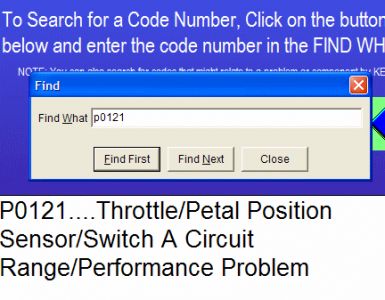
code is p0121 can u tell what it is and how much to fix it
thank you
Jul 14, 2020 at 11:52 AM (Merged)
Avatar
MERLIN2021
  • CERTIFIED EXPERT
  • 17,250 POSTS


https://www.2carpros.com/forum/automotive_pictures/62217_dakota_1.jpg

Not sure how much, but it's the sensor on the gas pedal...look up price here: https://www.2carpros.com/kpages/auto-parts-store.htm
Jul 14, 2020 at 11:52 AM (Merged)
Avatar
BOOMER02
  • MEMBER
  • 3 POSTS
my service engine light is on, what causes this?
Jul 14, 2020 at 11:52 AM (Merged)
Avatar
JACOBANDNICKOLAS
  • CERTIFIED EXPERT
  • 110,175 POSTS
If the light has come on, there could be many things that caused it. However, to determine the problem, you need to have the computer scanned. IT will identify where the problem came from. WHat to do is take the truck to a nationally recognized parts store and have them do it. Most will do it for free. Once they get the trouble code, let me know what it is and I can direct you.

Joe
Jul 14, 2020 at 11:52 AM (Merged)
Avatar
BOOMER02
  • MEMBER
  • 3 POSTS
[quote:ad5c229171="Jacobandnickolas"]If the light has come on, there could be many things that caused it. However, to determine the problem, you need to have the computer scanned. IT will identify where the problem came from. WHat to do is take the truck to a nationally recognized parts store and have them do it. Most will do it for free. Once they get the trouble code, let me know what it is and I can direct you.

Joe[/quote:ad5c229171]

the code says we have a vacume leak. we tried to tighten the gas cap, but still have light on. where should i check now?
Jul 14, 2020 at 11:52 AM (Merged)
Avatar
JACOBANDNICKOLAS
  • CERTIFIED EXPERT
  • 110,175 POSTS
Okay, it sounds like you have a leak in the "EVAP" system. First, it isn't very often that there is a problem with the fuel cap. Parts stores will sell them any time there is a leak. Let me know if they told you there was a leak in the EVAP system so I know how to direct you. Don't worry, we'll figure this out.

Joe
Jul 14, 2020 at 11:52 AM (Merged)
Avatar
BOOMER02
  • MEMBER
  • 3 POSTS
Yes that is what he said

[quote:eeed340306="Jacobandnickolas"]Okay, it sounds like you have a leak in the "EVAP" system. First, it isn't very often that there is a problem with the fuel cap. Parts stores will sell them any time there is a leak. Let me know if they told you there was a leak in the EVAP system so I know how to direct you. Don't worry, we'll figure this out.

Joe[/quote:eeed340306]
Jul 14, 2020 at 11:52 AM (Merged)
Avatar
AO7777
  • MEMBER
  • 17 POSTS
I have don't nothing yet just used my obdII scanner to get the code. can it be spark plug, rotor and cap? I don't have compress gage and other compress gages.
Jul 14, 2020 at 11:52 AM (Merged)
Avatar
JACOBANDNICKOLAS
  • CERTIFIED EXPERT
  • 110,175 POSTS
Here is what I recommend. Because the leaks can come from so many different places, they are hard to find. Contact your local shop and tell them you need to have the EVAP system fogged. What they will do is actually pump fog into the system at a low pressure. When it hits the leak, it will leak from the system and you can identify the problem. Otherwise, you will be looking for the problem and never find it. You can try to save time and money and have the fuel cap checked first. However, chances are it is fine.

Let me know what you find.
Jul 14, 2020 at 11:52 AM (Merged)
Avatar
ASEMASTER6371
  • CERTIFIED EXPERT
  • 52,796 POSTS
start with a compression test. it sould be that, plug, coil, vacuum leak or injector. this is why you need a real diag before throwing parts at it.

Roy
Jul 14, 2020 at 11:52 AM (Merged)

Avatar
AO7777
  • MEMBER
  • 17 POSTS
Do I need a compression Tester and which cyn hole? #3? How do I do a compression test?
Jul 14, 2020 at 11:52 AM (Merged)

Avatar
ASEMASTER6371
  • CERTIFIED EXPERT
  • 52,796 POSTS
remove the plug. unplug all coils. crank engine with tester installed and read the readings for us

Roy
Jul 14, 2020 at 11:52 AM (Merged)

Avatar
DAKOTABOY2002
  • MEMBER
  • 19 POSTS
Hello, my question is my Dakota is making this loud sound when accelearting had a friend with me sounds like its coming from the Drivers side of the car, its like a burst of air only really happens when going above 2 RPM's, does not happen while idling or at startup, could this be the cat converter? I checked the muffler doesn't seem like there is a hole in it, ive heard about cat converters getting clogged, also NO check engine lights are on as of now, but the acceleration is really slow, let me know if you need anymore information thanks guys
Jul 14, 2020 at 11:52 AM (Merged)
Avatar
ASEMASTER6371
  • CERTIFIED EXPERT
  • 52,796 POSTS
sounds like you are on the right track. you can verify it by checking the back pressure

Roy
Jul 14, 2020 at 11:52 AM (Merged)
Avatar
DAKOTABOY2002
  • MEMBER
  • 19 POSTS
How do I check the back pressure?
Jul 14, 2020 at 11:52 AM (Merged)
Avatar
DAKOTABOY2002
  • MEMBER
  • 19 POSTS
update: heres something else I noticed when I was driving this morning it was sounding ok, but once the engine heated up, I live in Denver, it started making the sounds again, im looking like its the Cat converter and it makes sense that it would be doing that and not tripping the check engine lights, so if I take to a shop just tell them thats the issue and have them replace the cat coverter?
Jul 14, 2020 at 11:52 AM (Merged)
Avatar
ASEMASTER6371
  • CERTIFIED EXPERT
  • 52,796 POSTS
no, let them do there job and tell you the issue. they are the pros.
do you go to the doctors and tell the doctor what is wrong with you?? just a comparison.

tell him the same story you told us and let them go with it and come back with there findings.

a loose material in a cat will not code.

Roy
Jul 14, 2020 at 11:52 AM (Merged)
Avatar
DAKOTABOY2002
  • MEMBER
  • 19 POSTS
taking it to thursday when the exhaust mechanic is there, its hissing pretty bad, will update and let you guys know what it was, question though, where is the vacuum hose? I just want to check it for my own sake, since im guessing its either that or that cat converter thanks, if there was a way I could record the sound and post it on here to listen to.
Jul 14, 2020 at 11:52 AM (Merged)
Avatar
IOWAMALE
  • MEMBER
  • 3 POSTS
went to the dealer thay put new Computer in it
check engine light payed 800 for that 3 days later
light was back on now thay say its emission hoses
are bad thats 500 more can i buy the hoses on line ???
thank you
Jul 14, 2020 at 11:52 AM (Merged)
Avatar
BMRFIXIT
  • CERTIFIED EXPERT
  • 19,053 POSTS
Cycle ignition key ON OFF ON OFF ON read P0000 codes in the odometer area
let me know what you have for codes
this way we can tell what emission hose you need
Jul 14, 2020 at 11:52 AM (Merged)
Avatar
DAKOTABOY2002
  • MEMBER
  • 19 POSTS
It was the catalyic converter, there was pieces of banging around inside, they got it fixed for me, thanks for all the help, hope this helps other who have this problem
Jul 14, 2020 at 11:52 AM (Merged)
Avatar
IOWAMALE
  • MEMBER
  • 3 POSTS
code is p0455
Jul 14, 2020 at 11:52 AM (Merged)
Avatar
BMRFIXIT
  • CERTIFIED EXPERT
  • 19,053 POSTS
DTC P0455: EVAP LEAK MONITOR LARGE LEAK DETECTED & DTC P0456: EVAP LEAK MONITOR SMALL LEAK DETECTED

NOTE: All Evaporative Emissions (EVAP) leak monitor DTCs listed above are diagnosed using the same test.

NOTE: If Powertrain Control Module (PCM) is replaced, PCM must be reprogrammed. See POWERTRAIN CONTROL MODULE under PROGRAMMING. After each repair procedure has been completed, reconnect all components and perform POWERTRAIN VERIFICATION TEST VER-6 under VERIFICATION TESTS to ensure system is functioning
properly.

Possible Causes
? Intermittent Condition
? EVAP Leak Detection
? EVAP Purge Solenoid Leaks/Stuck Open
? Intermittent Leak Detection Pump (LDP) Monitor Failure
? PCM


NOTE: A loose gas cap could have caused this DTC to set. Ensure gas cap is tight, in good condition and meets original equipment manufacturer's specifications.

Testing
1.Turn the ignition on, with the engine off. With the DRBIII(R), read DTCs. Is the Good Trip Counter displayed and equal to zero? If yes, go to next step. If no, go to step 5 .
WARNING: Keep lighted cigarettes, sparks, flames, and other ignition sources away from the test area to prevent the ignition of explosive gases. Keep the test area well ventilated.
NOTE: The fuel tank should have 20-80 percent of fuel tank capacity to properly test the EVAP system. To continue testing, you will need Miller EVAP Emission Leak Detector (EELD) tool (8404).

2.Disconnect the vacuum supply hose at the LDP. Connect and apply a continuous vacuum supply of about 20 in. Hg to the LDP. A vacuum pump such as an A/C recovery unit works well. Using the DRBIII(R), select Engine, System Tests and actuate the LDP Test (Option 3/Hold PSI). This energizes the LDP solenoid and allows the constant vacuum source to apply vacuum to the LDP pump diaphragm. This lifts the diaphragm up and seals the atmospheric canister vent valve at the bottom of the LDP. Connect the Red power lead of the EELD to the battery positive terminal and the Black ground lead to battery negative terminal. Connect shop air to the EELD. Set the Smoke/Air control switch to Air. Insert the EELD air supply tip (Clear hose) into the appropriate calibration orifice on the EELD control panel (based on DTC leak size). Press the remote Smoke/Air Start button. Position the Red flag on the air flow meter so it is aligned with the indicator ball. When the calibration is complete, release the remote button. The EELD has now calibrated the flow meter in liters per minute to the size leak indicated by the DTC set in the PCM. Install the Service Port Adapter (8404-14) on the vehicle's service port. Connect the Air supply hose from the EELD to the service port. Press the remote button to activate air flow. Larger volume fuel tanks, and/or those with less fuel, may require 4-5 minutes to fill. Compare the flow meter indicator ball reading to the Red flag. Above the Red flag indicates a leak present. Below the Red flag indicates a sealed system. Is the indicator ball above the Red flag? If yes, go to next step. If no, go to step 5 .
NOTE: A thorough visual inspection of the EVAP system hoses, tubes, and connections may save time in your diagnosis. Look for any physical damage or signs of wetness at connections. The strong smell of fuel vapors may aid diagnosis also. To continue testing, you will need the EELD.

3.Remove the air supply hose from the service port. Connect the smoke supply tip (Black hose) to the service port. Set the Smoke/Air control switch to Smoke. The flow meter indicator ball will not move at this point. Press the remote Smoke/Air Start button. Ensure that smoke has filled the EVAP system by continuing to press the remote Smoke/Air Start button, remove the vehicle fuel cap, and wait for the smoke to exit. Once smoke is indicated, reinstall the fuel cap. For optimal performance, introduce smoke into the system for an additional 60 seconds, continue introducing smoke at 15 second intervals, as necessary. While still holding the remote Smoke/Air Start button, use the White Light (8404-CLL) to follow the EVAP system path, and look for the source of the leak indicated by exiting smoke. If a leak is concealed from view such as on top of fuel tank, release the remote Smoke/Air Start button, and use the Ultraviolet Black Light (8404-UVL) and the Yellow Goggles (8404-20) to look for residual traces of dye left behind by the smoke. The exiting smoke deposits a residual fluid that is either Bright Green or Bright Yellow when viewed with UVL. Was a leak found? If yes, repair or replace the leaking component as necessary. If no, go to next step.
NOTE: After disconnecting the EVAP purge solenoid vacuum connections, inspect the lines and solenoid for any signs of contamination from the EVAP canister. This may indicate a faulty rollover valve. Replace/repair as necessary.

4.Turn the ignition off. Disconnect the vacuum hoses at the EVAP purge solenoid. Using a hand vacuum pump, apply 10 in. Hg of vacuum to the EVAP purge solenoid vacuum source port (component side). Monitor the vacuum gauge for at least 15 seconds. Does the EVAP purge solenoid hold vacuum? If yes, go next step. If no, replace the EVAP purge solenoid.
NOTE: Use the Freeze Frame Data to help duplicate the conditions that set the DTC. Pay particular attention to the DTC set conditions, such as, VSS, MAP, ECT, and Load. A thorough visual inspection of the EVAP system hoses, tubes and connections may save time in your diagnosis. Look for any physical damage or signs of wetness at connections. The strong smell of fuel vapors may aid diagnosis also.

5.Conditions that set DTC are not present at this time. Refer to any Technical Service Bulletin (TSB) that may apply. With the DRBIII(R) in System Tests, perform the LDP Monitor Test. This will force the PCM to run the LDP Monitor. If the monitor fails, further diagnosis is required to find faulty component. If the monitor passes, the condition is not present at this time. Were any problems found? If yes, repair as necessary. If no, test is complete.
Jul 14, 2020 at 11:52 AM (Merged)
Avatar
MUSTANGXXX
  • MEMBER
  • 27 POSTS
2002 dodge dakota check engine light on codes say it issomething wrong with evap and upstream o2 sensor internal fault how do i start to fix these prblems?
Jul 14, 2020 at 11:52 AM (Merged)
Avatar
CARADIODOC
  • CERTIFIED EXPERT
  • 34,306 POSTS
For leaks in the evaporative emission system, it depends on the code. For big leaks, look for hoses disconnected, loose gas cap, etc. For small leaks you really need a smoke machine. That allows you to inject white non-toxic smoke at 2 psi, then you search for where it's sneaking out.

There are a lot of oxygen sensor codes. The course of action depends on which code and for which sensor.
Jul 14, 2020 at 11:52 AM (Merged)
Avatar
MUSTANGXXX
  • MEMBER
  • 27 POSTS
o2 sensor code is po141 1/2 heater permformance? is this the rear o2 sensor bank one sensor 2?
Jul 14, 2020 at 11:53 AM (Merged)
Avatar
CARADIODOC
  • CERTIFIED EXPERT
  • 34,306 POSTS
P0141 – Oxygen Sensor Heater Circuit Malfunction (Bank 1 Sensor 2)

That would be the driver's side, downstream sensor, (after the mini catalytic converter). If this truck does not have the California emissions package, it will only have two O2 sensors, not 4.
Jul 14, 2020 at 11:53 AM (Merged)