1998 Honda Civic Transmission Flare

1998 HONDA CIVIC
164,000 MILES • 4 CYL • FWD • AUTOMATIC
Avatar
IHBIGRED
  • MEMBER
  • 35 POSTS
I have a 1998 Honda Civic DX with automatic transmission. When I purchased the car it had a shifting flare from 2nd to 3rd gear. The flare wouldn't occur until the transmission had warmed up by driving and then would persist. The one exception was that with a soft exceleration it would flare, but a hard acceleration it wouldn't flare.
Later I discovered that after some trips of about 75 miles or longer the transmission wouldn't flare anymore no matter how I drove it until after I shut the car off and turned it back on then it returned to flaring again.
I recently changed the transmission fluid and checked all the transmission solenoids for resistances within Honda specs and all activate when energized manually.
The car within the last week had gotten warm while driving so after letting it cool down I replaced the thermostat and bled the system of air.
Now the car's temperature guage fluctuates from normal to hot opperating conditions occaisionally and when it is fluctuating the shifting flare is non existent and when the temperature guage remains at normal position the shifting flare occurs between 2nd and 3rd. Also the left blinker started acting up (first it blinked like a bulb was burnt, then it worked fine, then blinked very slowly and is back to working properly) at the same time that the coolant temperature did. The check engine light is also not on.
The cooling fan works properly and when shorted so fan operates manually it will not cool the coolant temp as indicated by the temperature guage on the cluster.
I took the car to a transmission shop and after investigating it they guessed that one of the "pressure switches" were bad (assuming they were referring to the solenoids). I didn't have them do any further work to the vehicle after that.
Jun 6, 2011 at 6:22 PM
Advertisement
Avatar
MERLIN2021
  • CERTIFIED EXPERT
  • 17,250 POSTS
with several electric problems, check all grounds.
Jun 6, 2011 at 6:42 PM
Avatar
IHBIGRED
  • MEMBER
  • 35 POSTS
I wish that was the problem, but all grounds are clean, polished and conducting nicely.
Jun 7, 2011 at 12:01 PM
Advertisement
Avatar
MERLIN2021
  • CERTIFIED EXPERT
  • 17,250 POSTS
first step is to scan for b and u codes these won't turn on the check engine light
Jun 7, 2011 at 2:00 PM
Avatar
IHBIGRED
  • MEMBER
  • 35 POSTS
I'm familiar with the b-code (body codes) but not the u-codes. What are u-type codes and why would I be looking for b-codes? Also, when scanned recently by the tranny shop it came up with two codes P0117 and p0118 and nothing else.
Jun 7, 2011 at 2:48 PM
Avatar
MERLIN2021
  • CERTIFIED EXPERT
  • 17,250 POSTS
U codes are data line codes they tell us if a module stops "talking" to the other modules and the PCM, or if a data line is no good. P0117= engine coolant temp circuit low input, and P0118=engine temp coolant circuit high input, recheck grounds for engine, and test temp sensor, if improper reading are input to the computer, it can affect shift quality. The most important grounds are the negative cable both ends and the ground for the PCM and TCM on right rear of the engine.
DTC P0117 - ENGINE COOLANT TEMPERATURE (ECT) SENSOR LOW VOLTAGE
INPUT
1. Turn ignition on. Check ECT using OBD-II scan tool. If 302°F (150°C) or more
is indicated, go to next step. If 302°F (150°C) or more is not indicated, problem
is intermittent. System is okay at this time. Check for poor connections or loose
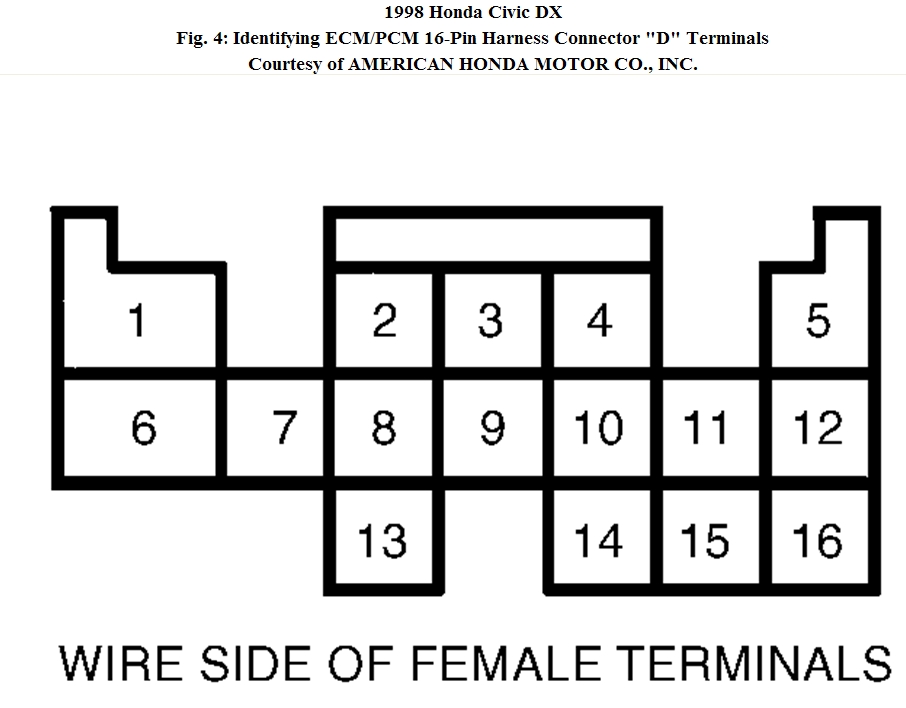
wires at ECT sensor connector and PCM 16-pin connector "D". See WIRING
DIAGRAMS article.
2. Disconnect ECT sensor 2-pin connector. Check ECT using OBD-II scan tool. If
302°F (150°C) or more is indicated, go to next step. If 302°F (150°C) or more is
not indicated, replace ECT sensor. 3) Turn ignition off. Disconnect PCM 16-pin
connector "D". Check for continuity between ground and ECT connector terminal
No. 1 (Red/White wire). See Fig. 4 . If continuity exists, repair short in
Red/White wire between ECT sensor and PCM 16-pin connector "D" terminal
D2. See WIRING DIAGRAMS article. If continuity does not exist, substitute a
known-good PCM and recheck. If symptom or indication goes away, replace
original PCM.
DTC P0118 - ENGINE COOLANT TEMPERATURE (ECT) SENSOR HIGH VOLTAGE
INPUT
1. Turn ignition on. Check ECT using OBD-II scan tool. If -4°F (-20°C) or less is
indicated, go to next step. If -4°F (-20°C) or less is not indicated, problem is
intermittent. System is okay at this time. Check for poor connections or loose
wires at ECT sensor connector and PCM connector. See WIRING DIAGRAMS
article.
2. Disconnect ECT sensor connector. Install a fused jumper wire between ECT
harness connector terminals. Check ECT using OBD-II scan tool. If -4°F (-20°C)
or less is indicated, go to next step. If -4°F (-20°C) or less is not indicated,
replace ECT sensor.
3. Turn ignition off. Using backprobe kit, install a fused jumper wire between PCM
16-pin connector "D" terminal D2 (Red/White wire) and terminal D11
(Green/Black wire). Turn ignition on. Check ECT using OBD-II scan tool. If -4°
F (-20°C) or less is not indicated, repair open in wire(s) between ECT sensor and
PCM connector terminals. See WIRING DIAGRAMS article. If -4°F (-20°C) or
less is indicated, substitute a known-good PCM and recheck. If symptom or
indication goes away, replace original PCM.
Jun 10, 2011 at 7:05 PM
Avatar
IHBIGRED
  • MEMBER
  • 35 POSTS
I have discoverd the temperature issue to be a head gasket failure due to a warped head. I'm in the process of repairing this particular issue. But, it makes me wonder why it took the car running hotter than normal opperating temperature for the transmission to stop flaring.
Jun 21, 2011 at 12:00 PM
Avatar
MERLIN2021
  • CERTIFIED EXPERT
  • 17,250 POSTS
why don't we fix the head and see if it's normal
Jun 21, 2011 at 12:26 PM
Avatar
IHBIGRED
  • MEMBER
  • 35 POSTS
Alright, the head gasket was replaced, planned head, new seals, new water pump and timing belt, cleaned the IAC valve, new fuel/air filters and the car is no longer running warm/hot. The shifting continues to flare after first shift from 2nd to 3rd. If I put the shift selector into second and drive around a bit, I've noticed when I move the selector into the 3rd or D position it will shift fine once then flair continually after that unless doing a hard acceleration.
Jun 29, 2011 at 5:04 PM
Avatar
RIVERMIKERAT
  • CERTIFIED EXPERT
  • 6,110 POSTS
By "flare" I presume you mean rev? The fact that it wasn't happening when the engine was in the "warmer than normal" range tells me that it could be one of the solenoids as mentioned or seals that aren't sealing properly anymore. What was the condition of the old fluid when it was changed? Brown and nasty smelling? Try putting 2 tablespoons of brake fluid into the transmission. This will swell the seals. If they are causing the problem, the problem will go away.
Jul 1, 2011 at 6:00 AM
Avatar
IHBIGRED
  • MEMBER
  • 35 POSTS
Yes, by "flare" I mean that the engine revs slightly before the transmission can finish shifting into 3rd gear. The fluid itself was not in real bad condition. It had the color of fairly good transmission fluid, didn't have a burnt smell and there were filings as normal on the magnet. Following the schematics there seems to be only one solenoid that is used to shift the transmission from 2nd to 3rd, but I'm a bit confused as to why an "above normal operating conditions" temperature would cause the solenoid to start working correctly again. Could you explain? Also, I've heard these transmissions are pretty finicky when it comes to additives and non-Honda tranny fluid. I wouldn't blink twice to try the brake fluid suggestion in my 700-R but is this gonna cause later issues that I should flush after I try this?
Jul 11, 2011 at 7:17 PM
Avatar
RIVERMIKERAT
  • CERTIFIED EXPERT
  • 6,110 POSTS
Yes, you should flush after trying it.
What I'm thinking is that parts expand when they heat up. So, there may be leaks while everything is cold that either get smaller or go away completely when everything gets properly warmed up.
Electronic parts sometimes tend to fail when cold and work somewhat properly when warmed up.
Jul 11, 2011 at 9:22 PM
Avatar
IHBIGRED
  • MEMBER
  • 35 POSTS
I'll give it a whirl, but the catch with your suggestion being that (reference begining of thread) the car shifts perfectly fine when it's been sitting for a while and if it's been cold out and gradually, after one or two shifts from 2nd to 3rd, starts acting up. So when cold or sitting for about an hour, it's okay. Also when the engine temp reads above normal, it's okay.
Jul 12, 2011 at 12:03 PM
Avatar
RIVERMIKERAT
  • CERTIFIED EXPERT
  • 6,110 POSTS
Yeah, I read right past that part. Have you ever used a cooling system thermometer to see how hot the coolant really was when the gauge was reading high? With the way you describe the problem, I'd first start and rule out anything electrical before anything else.

Most temperature sensing units are resistors that are adjusted by heat, so when the sensor sees an extreme in temperature one way or the other, the resistance of the sensor will change to an extreme value, either high or low.
Jul 12, 2011 at 5:52 PM
Avatar
IHBIGRED
  • MEMBER
  • 35 POSTS
Actually no I didn't. Since it was a bad head gasket, I assumed it was an air pocket that was being sensed. This car in particular has three sensors for the coolant. One that runs to the dash guage, another to the ECM and one for the cooling fan. I have not been able to follow any schematics that show a direct correlation between the temp sensor for the ECM and the transmission.
Jul 12, 2011 at 6:03 PM
Avatar
RIVERMIKERAT
  • CERTIFIED EXPERT
  • 6,110 POSTS
If the ECM is modifying the voltage it sends to the transmission based upon the voltage/current received from the temperature sending unit, it may be sending too much or not enough voltage.
Jul 12, 2011 at 10:56 PM
Avatar
IHBIGRED
  • MEMBER
  • 35 POSTS
From what you described above I did some more quick troubleshooting. I disconnected the TCS and the car would shift fine from 2nd to 3rd every time with the exception that it wouldn't shift into fourth. Once I reconnected the TCS the car began to "flare" from 2nd to 3rd and it would allow the car to shift to 4th gear. I then decided to swap the TCS for another one from my other civic and the problem continued. Because of this I'm wondering if the ECM is bad?
Jul 21, 2011 at 1:16 PM
Avatar
RIVERMIKERAT
  • CERTIFIED EXPERT
  • 6,110 POSTS
Without looking at it myself, that's what I would say, also. It doesn't seem to be a ground loop issue, since all grounds are in great shape. "Unless doing a hard acceleration". THAT tells me that there is an outside chance it's the valvebody. Which, as far as I know (not being a transmission tech), requires swapping valve bodies to verify.
Jul 21, 2011 at 6:56 PM
Avatar
MERLIN2021
  • CERTIFIED EXPERT
  • 17,250 POSTS
you might also check with honda to see if any pcm reflashes(updates) are available or needed.
Jul 21, 2011 at 9:11 PM
Avatar
IHBIGRED
  • MEMBER
  • 35 POSTS
I went ahead and put another ECM in the car that I got with a car I purchased that had 140k on it. The purchased car also has the same issue and it has been converted over to a VTEC from Non-VTEC using the VTEC ECM. My personal car still had issues with the shifting after swaping ECMs. The next thing I'm going to do is replace the A & B shift solenoid pack to see if that resolves issues.
Sep 20, 2011 at 11:46 AM
Avatar
RIVERMIKERAT
  • CERTIFIED EXPERT
  • 6,110 POSTS
Let us know how that goes. I'm still thinking that it may be a valve body issue.
Sep 20, 2011 at 11:02 PM
Avatar
IHBIGRED
  • MEMBER
  • 35 POSTS
I ended up not changing the solenoids first. I bought a 5k potentiometer to chase after my hunch with the overheating making it shift right. I measured the resistance of the engine coolant temperature (ECT) sensor to be ~260 Ohms at operating temperature. I took the connector that attached to the ECT and attached my potentiometer and made the resistance ~150 Ohms. The car shifted wonderfully through all gears and went into overdrive also. I went and purchased a new ECT and replaced the old one. The car continued to flare from 2nd to 3rd and the resistance at operating temperature was ~270 Ohms on the new ECT. I'm not sure why a lower resistance alows the car to shift right, but I also considered the thermastat being bad and not letting the car warm up enough, but I just recently replaced that with the head gasket.
Nov 5, 2011 at 6:41 PM
Avatar
MERLIN2021
  • CERTIFIED EXPERT
  • 17,250 POSTS
Did you ever check with Honda for a PCM update? They may have re wrote the control section for this flare condition...
Nov 5, 2011 at 7:15 PM
Avatar
MERLIN2021
  • CERTIFIED EXPERT
  • 17,250 POSTS
You can also try this recomendation from Honda:
BEFORE REPLACING ELECTRONIC COMPONENTS, TRY THESE TIPS
TECHNICAL SERVICE BULLETIN
Reference Number(s): HSN 0102-12, Date of Issue: January 2002
Related Ref Number(s): HSN 0102-12
ARTICLE BEGINNING
SERVICE INFORMATION
Many of the electronic components in automobiles have computer chips. Besides ECMs/PCMs,
you'll find them stashed in audio units; speedometers; odometers; clocks; climate control systems;
control units for ABS, TCS, ATTS, and SRS; security systems; keyless remote transmitters; and
multiplex control units. The downsides of all this high-tech stuff are software glitches or bugs, and
vulnerability to voltage spikes. And if that isn't enough, static electricity, lightning, ultraviolet light,
strong magnetic fields, radio waves, and radar can make a software bug even worse. Before you
replace a suspected electronic component, try these tips first. They could spare you unnecessary
replacement.
 Disconnect the positive and negative battery cables, and touch them together for a few minutes.
This forces all capacitors in the component to drain, which clears and resets the computer chip.
If a software glitch is the cause, resetting the chip this way is usually as effective as installing a
new component.
 Unplug the connectors from the component, wait a few minutes, then reconnect them. If a poor
connection is the villain, disengaging and engaging the terminals in the connector cleans
contact surfaces and usually fixes the problem. While you have the connector unplugged, look
at the pins and terminals for signs of contact. If you have any doubt that things are connecting
properly, remove the female pin and use it like you would a feeler gauge to check the contact.
If terminals are damaged and need to be replaced, see the article HSN 0800-04 - NEW
TERMINAL INSPECTION FEELER TOOL SET, in the August '00 issue of ServiceNews.
© 2008 Mitchell Repair Information Co., LLC.
HONDA: All
CATEGORY: Honda Service News
APPLIES TO:All
BEFORE REPLACING ELECTRONIC COMPONENTS, TRY THESE TIPS -1998 Hon...
Nov 5, 2011 at 7:29 PM
Avatar
RIVERMIKERAT
  • CERTIFIED EXPERT
  • 6,110 POSTS
I agree with merlin
Nov 7, 2011 at 3:56 AM
Avatar
IHBIGRED
  • MEMBER
  • 35 POSTS
I can't say I've honestly touched the positive to negative terminal yet, but many times had the battery out for long periods of time and also pulled the fuse that holds the memory for the car. And no, I have not contacted Honda previously to now, but just put in an inquiry to see if there is.
Nov 7, 2011 at 12:36 PM
Avatar
RIVERMIKERAT
  • CERTIFIED EXPERT
  • 6,110 POSTS
Let us know what you find out.
Nov 7, 2011 at 10:17 PM
Avatar
IHBIGRED
  • MEMBER
  • 35 POSTS
I talked to Honda technician and he said there is no reflash for the PCM in the 1996-2000 civics for shifting issues. I quickly shared my issue and he suggested changing the thermostat again since it seemed to be the coolant temperature that resolved the shifting. The last thermostat I put in only a few months ago broke at 170 F so I'm going to put in a 195 F and see if that resolves the issue.
Nov 8, 2011 at 3:50 PM
Avatar
RIVERMIKERAT
  • CERTIFIED EXPERT
  • 6,110 POSTS
Let us know what happens.
Nov 8, 2011 at 9:53 PM
Avatar
IHBIGRED
  • MEMBER
  • 35 POSTS
I switched out the thermostat with a 195 F thermostat and nothing changed. I'm wondering since the only electrical components on the transmission that would be effected by the PCM's reading of the temperature are the solenoids that maybe they're weak??? Even though their resitance comes within spec. Or another idea is maybe both PCM's I have are faulty? I have a car that I've been converting over from non-vtec to vtec and has a non-vtec automatic that does the same thing. I'm wondering if when I finish and am using the vtec PCM if it will continue to flare from 2nd to 3rd? Any ideas? Would a plugged up filter maybe cause this or if it was a faulty clutch pack why would the ECT sensor resolve it?
Nov 9, 2011 at 12:45 PM
Avatar
RIVERMIKERAT
  • CERTIFIED EXPERT
  • 6,110 POSTS
Have you been able to rectify this issue yet? Did you have the valve body checked? Have you tested the fluid pressure? And especially during shifting?
Jan 27, 2012 at 1:04 AM
Avatar
IHBIGRED
  • MEMBER
  • 35 POSTS
I have not yet resolved the issue. Here is what I've done since I last updated. Knowing the the engine coolant temperature effected the way the car shifted I troubleshot that area. I purchased a potentiometer that could get down the the range of resistance that the CTS operated in. I found that the CTS was around ~200 ohms when car was at operating temperature and that resistance decreased and temperature increased. So I attached the potentiometer to the connector for the CTS and changed the resistance the ECM was receiving to 150 ohms. Wa-Lah! That fixed the problem! Shifted great every time no problems ever. So I figured the CTS was bad. I replaced it and it didn't fix it and I found that the CTSs are not designed to go down to 150 ohms at operating temperature. So I started to lean towards the ECM or shift solenoids again. I stumbled across another used ECM with 215k miles on it and that didn't fix it, so I swaped the AB shift solenoid pack out for another used set, and that didn't make any difference also. Another thing, I've got the other car that is doing the same thing running, the one I converted to V-TEC with non-V-TEC transmission, and it continues to also flare from 2nd to 3rd once warmed up. So I'm still searching and I'm almost positive that it's not an issue internal to the transmission. By the way, what is the purpose and what does the linear shift solenoid do on these cars?
Jan 27, 2012 at 1:48 PM
Avatar
RIVERMIKERAT
  • CERTIFIED EXPERT
  • 6,110 POSTS
I'm not exactly sure what that solenoid does or is for, but I've seen it referred to as the line pressure solenoid. Here's a link I found:
http://techauto.awardspace.com/transmission.html

Also, I didn't re-read the whole thread here. Have you have the trans pressure tested?

I also saw a few places where people have removed and cleaned the solenoids and the problem was cured.
Jan 27, 2012 at 6:49 PM
Avatar
IHBIGRED
  • MEMBER
  • 35 POSTS
An update on what I have recently done. rivermikerat, no I have not checked line pressures as I don't have a gauge for that. I cleaned the solenoid and checked the gasket for cracks and then reinstalled and car continued to flare so I ended up purchasing a Honda OEM linear solenoid to rule that out as the problem. After replacing the car seemed to shift better between all gears but continued to flare worse and worse as the car warmed up. I read a thread that someone had very similar issues to mine and replaced the linear solenoid and that resolved the issue for a few months till the solenoid went out and had to be replaced again for which it only went out again after a year. It was suggested that the PCM might have been bad and in turn causing the solenoid to be ruined over time. I tend to continue to swing towards the PCM being faulty because of being able to trick the PCM into thinking it's running warmer and thus it shifting just fine. What are the output voltages and from what pins on the PCM should I get for the linear solenoid and AB shift solenoids? I think this would be a good test to see what the outputs are to both the linear and AB shift solenoids at the point the car shifts from 2nd to 3rd to see if these are good outputs.
Feb 9, 2012 at 2:27 PM
Avatar
KHLOW2008
  • CERTIFIED EXPERT
  • 41,814 POSTS
Are there any troubles codes now?
What type of transmission fluid was used? Is the fluid level correct?

A scan tool would enble you to monitor voltages. Since problem is not there all the time, only real time data analysis would tell you if there is anything wrong with the voltages.

A partially clogged fluid cooler inside the radiator can cause such problems.


Feb 9, 2012 at 10:02 PM
Avatar
IHBIGRED
  • MEMBER
  • 35 POSTS
No trouble codes. I took it to a tranny shop earlier on in this discussion and they checked for codes. I used only Honda ATF and fluid level is okay. I just deicded to pull some data with my multi meter from the pinout diagram. Shift solenoid B is at battery voltage till shifting from 2nd to 3rd. The voltage drops off cleanly every time even when it is flaring from 2nd to 3rd. The linear solenoid voltage sits at 1.15V while driving and just before shifting it drops to 0V. I noted when it flares it stays on 0V longer than any of the other shifts. I can't say it does that also when its cold and not flaring. I'm waiting for the car to cool down then I'm gonna go check that out. Maybe a plugged cooler section in the radiator, but that doesn't seem to tie with the ECT being directly related to the shift flare.
Feb 9, 2012 at 10:38 PM
Avatar
RIVERMIKERAT
  • CERTIFIED EXPERT
  • 6,110 POSTS
Most stores like Autozone and Pep Boys will rent (cheaply) or loan transmission fluid pressure gauges that you can use to test with.
Feb 9, 2012 at 11:56 PM
Avatar
KHLOW2008
  • CERTIFIED EXPERT
  • 41,814 POSTS
A plugged cooler can affect the transmission fluid temperature and line pressure. The transmission fluid temperature and ECT readings could be confusing the PCM to result in the flaring.
Feb 10, 2012 at 12:36 PM
Avatar
IHBIGRED
  • MEMBER
  • 35 POSTS
rivermikerat, I will see if I can rent one or find someone with one. Also, I've never done that particular test, should I just pick the car up and run it through the gear to see the pressure readings?
KHLow2008, I'll pull the lines and throw some pressure at it to see if anything is getting through.
Last night, I checked some more voltage readings.
B1 - Power supply to linear solenoid negative electrode
B2 - Power supply to linear solenoid positive electrode

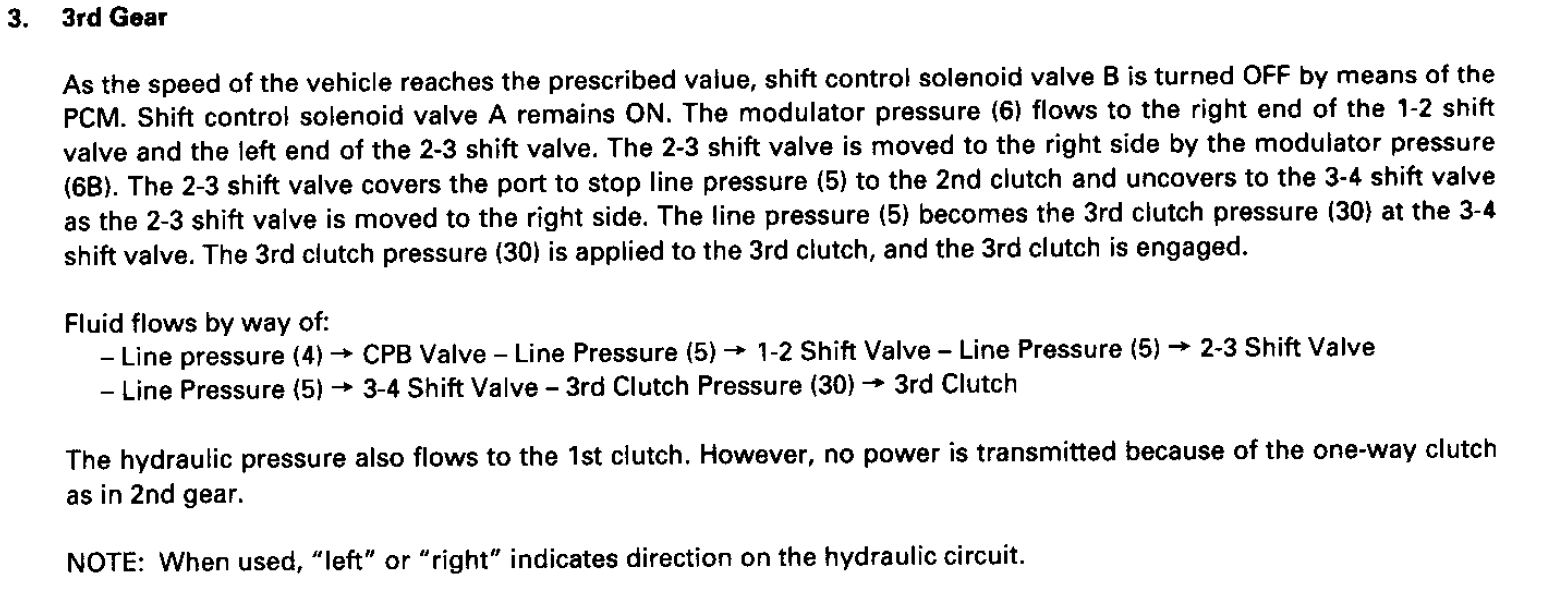
I check the voltage difference across B1 and B2 while shifting from 2nd to 3rd with the car warm and it was 1.15V just before shift. When I put the potentiometer in place of the ECT sensor (set at 150 ohms) the voltage difference across B1 & B2 was 1.25V. Seeing that an increase in voltage difference across those two PCM pins created a positive shift from 2nd to 3rd I checked each pins voltage to ground. B1 to ground read at -1.39V then dropped to 0V when shifting to 3rd and car was warm. When I put the potentiometer in place, B1 to ground was about -1.408V then dropped to 0V when shifting to 3rd. B2 to ground read 0.113V then raised to 0.5V when shifting to 3rd with car warm and with potentiometer in place B2 to ground read 0.115V then raised to 0.5V when shifting to 3rd. These readings seem a bit weird because their sums to follow the readings I got earlier when measuring across B1 and B2 but I used a PCM ground wire instead of the body (may be the problem). So it seems from the readings across B1 and B2 that an increased voltage difference across the linear solenoid made the car shift great. So I'm wondering what the linear solenoid really does? I know it only deals with high and low pressure (pretty vague, any help would be appreciated). So maybe by increasing the low pressure side voltage I'm allowing more pressure to build up before it shifts thus creating a better shift? (trying to follow the flow process attached)
Feb 10, 2012 at 1:29 PM
Avatar
RIVERMIKERAT
  • CERTIFIED EXPERT
  • 6,110 POSTS
Yes. That works. It'll be much easier than trying to do it on the road.
Feb 10, 2012 at 10:56 PM
Avatar
BGORPY
  • MEMBER
  • 3 POSTS
Greetings ihbigred:

I have been following your situation over the last several weeks on this thread. I have a 1996 Civic EX with 102000 miles on it that I purchased recently. The vehicle is exhibiting the exactly same 2nd to 3rd gear shift flare that you describe...trans shifts fine when cold but when the temp reaches normal, the 2-3 flare will occur and also only under light acceleration.
I have not gone as far as you have in my investigation yet. I have done a 3 x3 drain and refill with Honda's new DW-1 atf and saw no improvement in shift quality. I also removed the lock up, shift and linear solenoids, cleaned them, tested the operation and resistance. All were good and within the OEM specs.
I am posting not because I can offer you any insight but to show my support and to let you know that at least one other person out there has experienced the same issue as you have. I am hoping that you will be able to solve this problem and share your solution with others. Also, I wanted to thank you for all your hard work so far. Please know that what you have shared has helped me also, if for no other reason than to realize that I am not crazy in trying to solve this issue!!
By the way, my vehicle has been serviced almost exclusively by a Honda dealership during its lifetime so, the car has been well-maintained.
Feb 12, 2012 at 12:23 AM