Whining noise goes away when accelerating

1998 DODGE DAKOTA
190,000 MILES • V6 • 2WD • AUTOMATIC
Avatar
RANDEL LAAKE
  • MEMBER
  • 12 POSTS
When I have my truck on, there’s a whining noise coming from the passenger side, it’s really always on except when accelerating. (Not just a specific rpm, mainly when gaining speed) and the sound completely goes away until you stop accelerating.

(Warning the video gets pretty loud!)
Aug 10, 2019 at 10:18 AM
Advertisement
Avatar
RANDEL LAAKE
  • MEMBER
  • 12 POSTS
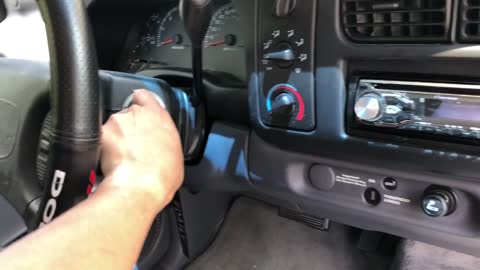
Here is the video. Noise warning!

As I was saying the sound doesn’t start when the car is on, but starts when it’s running.
Aug 10, 2019 at 10:22 AM
Avatar
KASEKENNY
  • CERTIFIED EXPERT
  • 18,907 POSTS
Hi,

That sounds like a metallic noise. I am not sure what it would be up close to the passenger side firewall but it is definitely coming from under the hood.

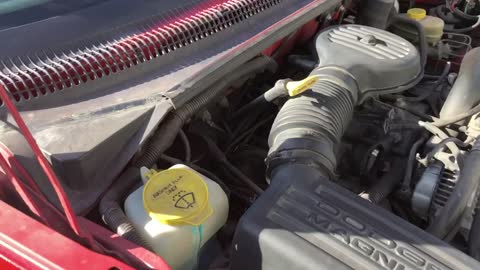
Go ahead and lift the hood and see if you can start to narrow in on it. If you want to take other videos from under the hood where you hear it the loudest then maybe we can better assist.

One thing that is the easiest to do is remove the serpentine belt and start the engine to see if it still does it with the belt off.

Once you get another video from under the hood we may be able to narrow it down further. I have no doubt we can find it because it does it so easily. It is not like you have to drive down the road to hear it. However, I will coach you through how to find it but that noise is not something I can just tell you what it is but again, I am sure we can find it. Thanks
Aug 10, 2019 at 1:29 PM
Advertisement
Avatar
RANDEL LAAKE
  • MEMBER
  • 12 POSTS
Here is a closer video, it’s still really loud. It does the noise in every gear, park and neutral, o/d on and off. Only thing that silences it, is accelerating. (Meaning in idle even if I increase rpm the sound doesn’t change.)

Doesn’t really sound like metal to me, since it’s a consistent ringing sound, but pitch does change if I’m accelerating. No change if just barely touching throttle, more like only when giving it enough acceleration to speed up. The noise doesn’t seem to depend at all on how fast/slow or anything. It’ll be loud idle and loud 70 mph on the highway.
Aug 10, 2019 at 5:07 PM
Avatar
KASEKENNY
  • CERTIFIED EXPERT
  • 18,907 POSTS
Take the air box and air tube off. Maybe just open the air box like you are changing your air filter then run the engine the same way. It may be a small crack or split in the intake. That would make sense that it goes away when you step on the accelerator because you are changing the pressure in that intake tube.

Let me know if this changes it and we can figure out exactly where that is.
Aug 11, 2019 at 7:20 PM
Avatar
RANDEL LAAKE
  • MEMBER
  • 12 POSTS
Tried doing that today, just took off the air box and left it slightly open and there were no noticeable changes in the noise.
Aug 13, 2019 at 1:45 PM
Avatar
KASEKENNY
  • CERTIFIED EXPERT
  • 18,907 POSTS
Okay. Then at this point we need to figure out every way that the noise is not there. At this point you said the only way you haven’t heard it is accelerating to speed up. Is that because the noise is drowned out or it is gone? It starting to seem as if it is a constant noise but there are times you just don’t hear it. Is that accurate?
Aug 13, 2019 at 6:49 PM
Avatar
RANDEL LAAKE
  • MEMBER
  • 12 POSTS
So here’s what I’ve tried out:

Radio off : Noise still there

A/C off : Noise still there

Belts slightly lubricated : Noise still there

Truck off : Noise gone

Cruising/Normal Driving/Idle : Noise still there

Accelerating (gaining speed) : Noise goes away depending on how much faster I’m going.

If slightly accelerating the noise just fades, if accelerating quickly, noise completely vanishes until I let off and resumes at the same original sound volume. Accelerating seems so far to be the only thing changing/muting the noise.
Aug 13, 2019 at 8:33 PM
Avatar
KASEKENNY
  • CERTIFIED EXPERT
  • 18,907 POSTS
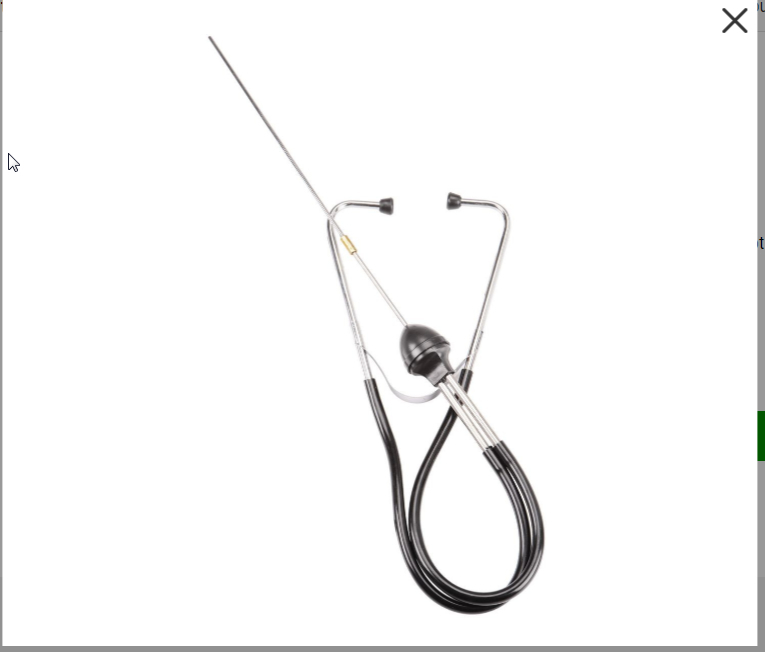
Okay, based on that, it may be the transmission oil pump. That is spinning at a constant speed pretty much all the time and would fit this scenario. However, this is not enough to go on yet to go that route because that requires removing the transmission. Take a look at the picture attached. This is a mechanics stethoscope. They are less than $5 in most cases and the way they work is you put it on your ears and then touch the end to each component around the noise where you hear the noise the loudest and see where the noise is the loudest using this. Basically, it helps you narrow down where the noise is coming from. Let me know where you hear it the loudest with this tool and we can go the next step. Thanks
Aug 14, 2019 at 3:25 PM