Which came first; battery grew a bad cell, or alternator overcharged?

1988 BUICK LESABRE
250,000 MILES • 3.8L • V6 • 2WD • AUTOMATIC
Avatar
ALPHAA10
  • MEMBER
  • 232 POSTS
After parking my car at a store one hot afternoon, and returning to the car 30 minutes later, the starter sounded weak on restart.

After barely restarting the engine and making it home, I immediately opened the hood, and found the battery case was overheated and misshapen-- the lower battery case bottom portion actually swelled outward.

Despite my effort to cool and recharge the battery, I soon learned the battery had developed into a dead cell. With the cell cover removed, I found the charging current made every cell but one issue a tiny bubble periodically, which indicates a dead cell.

This four-year-old battery could have failed on its own, but that also suggests a failing alternator regulator might have killed the battery from chronic over-voltage during charging.

So, that is the question-- which could have come first, the battery bad cell or a bad regulator?

* PS-- Having a battery or alternator fail silently is a problem. To prevent something like this from taking me by surprise ever again, I plan to mount an alternator output voltage meter somewhere on the dashboard. Do you have any suggestions about this approach?
Aug 28, 2023 at 3:47 PM

Advertisement
Avatar
JACOBANDNICKOLAS
  • CERTIFIED EXPERT
  • 110,175 POSTS
Hi,

Since the battery is 4 years old, I suspect it failed internally. The idea that it was swollen at points can indicate overcharging, but oftentimes it doesn't.

So, here is what I recommend. If the battery has already been replaced, check the alternator output right at the battery. With the engine running, it should show around 14v.

Here is a link that explains how to test an alternator:

https://www.2carpros.com/articles/how-to-check-a-car-alternator

If it is over 15v, replace the alternator.

Let me know what you find or if you have questions.

Take care,

Joe
Aug 28, 2023 at 7:31 PM
Avatar
ALPHAA10
  • MEMBER
  • 232 POSTS
Thanks, Joe!
What do you suggest for long-term monitoring, to avoid, or at least deal proactively with either a (1) developing bad cell or (2) an alternator wandering off its proper electrical output?
If I permanently wired a meter to the alternator, that would tell me about the alternator output, but nothing directly about the battery. So, should I permanently connect the meter to the battery, instead?
Some LeSabre instrument clusters offer a voltage monitor. Is a battery-based meter connection the way some LeSabre voltage instrument gauges work?
Aug 28, 2023 at 11:35 PM
Advertisement
Avatar
JACOBANDNICKOLAS
  • CERTIFIED EXPERT
  • 110,175 POSTS
Hi,

Chances are, there is nothing that could have been done to save the battery. Oftentimes, they do short internally causing a dead cell.

As far as the voltage gauge, it would be for the alternator. You really shouldn't need to install one because the system is designed to indicate an under or overcharging. Let me know your thoughts and if I can help.

Take care,

Joe
Aug 29, 2023 at 5:40 PM
Avatar
ALPHAA10
  • MEMBER
  • 232 POSTS
Are you saying the system will display an over- or under-charging indicator on the instrument panel?
On this Buick, the instrument panel shows no voltage indicator, only the standard collection of "idiot lights". The outline image of a battery displays and lights, if there is a problem, but with no information about over- or under-charging.
Aug 29, 2023 at 7:12 PM
Avatar
JACOBANDNICKOLAS
  • CERTIFIED EXPERT
  • 110,175 POSTS
Hi,

if there is an overcharge, you should see the light turn on. At that point, the alternator output would need to be tested.

You could install a gauge if it would make you more comfortable. It shouldn't be too difficult to do.

Here is a typical design.

1) Identify the wires you'll need to connect the gauge. There are typically three connections: power, ground, and signal.

2) Power: Connect the positive terminal of the gauge to a 12V power source that's active when the ignition is turned on. This can be a fuse box or a suitable ignition-switched wire.

3) Ground: Connect the negative terminal of the gauge to a clean and solid chassis ground. Find an existing grounding point or create one using a screw.

4) Signal: The signal wire connects to a switched 12V source that's active when the engine is running. This is often the same wire that connects to your vehicle's voltage regulator or alternator.

The one thing that is important is that the connections are done properly and insulated. You don't want a short.

Let me know if that helps.

Take care,

joe
Aug 29, 2023 at 8:07 PM
Avatar
ALPHAA10
  • MEMBER
  • 232 POSTS
Thanks, Joe. Seems clear enough.
I'll let you know how it turns out.
Aug 29, 2023 at 8:16 PM
Avatar
JACOBANDNICKOLAS
  • CERTIFIED EXPERT
  • 110,175 POSTS
You are very welcome. Take your time and make sure to shield/insulate the wires. Also, make sure they are clear of excessive heat and anything that can damage them.

Take care of yourself and let me know if I can help.

Joe
Aug 29, 2023 at 8:20 PM
Avatar
ALPHAA10
  • MEMBER
  • 232 POSTS
While weighing the best way to detect a failing battery or alternator in the future, I went ahead now with the ultimate solution-- to replace both battery and alternator, so both start at the same point. The car has a history of at least three owners, and I am the latest, inheriting all errors and omissions of maintenance.

Today, I finished the installation of battery and alternator, and so far, no problems. But what is your opinion about these VOM readings--

1. battery voltage, engine off, VOM on battery terminals-- 12.65v
2. battery voltage, engine ON, lights ON, VOM on battery terminals-- 14.70v
3. battery voltage, engine ON, lights OFF, VOM on battery terminals-- 14.70v

I could have tested the alternator output, as well, but ran out of time.
Sep 2, 2023 at 12:48 AM
Avatar
JACOBANDNICKOLAS
  • CERTIFIED EXPERT
  • 110,175 POSTS
Hi,

That indicates the alternator output. It is perfect. I have a feeling the problem won't return. By chance, did you check the voltages before the alternator was replaced? That would tell us if the battery or the alternator was the issue.

Let me know.

joe
Sep 2, 2023 at 8:09 PM
Avatar
ALPHAA10
  • MEMBER
  • 232 POSTS
It was the battery.

And you will laugh that, when I ran the alternator check at my local O'Reilly's, the original Delco Remy unit returned values exactly in the middle of acceptable ranges.

Of course, I had installed the new alternator to permit me to drive to the store, unwilling to risk damage to the new battery from a possibly bad original alternator.

Reviewing the situation, I realized the new alternator is an O'Reilly's lifetime (yes, I was told everything rests on finding fault in the previous unit) alternator which promises to have a longer life than the previous, older unit.

And by not turning in the original alternator for a refund of a core charge, I could keep the older unit in readiness if the new alternator ever has a problem, and I need to take the new alternator for a service check. It is almost a commodities/future value question, considering the same alternator may no longer be available in a decade.

As if I had not had enough frustration today, the MiniFuse from fuse panel slot 2E caused a no-crank situation when I began the trip home. Remembering the same weird fuse behavior from only weeks before, I checked slot 2E, pulled out the fuse, and simply reinserted it. The car started immediately.

In all the time you have known me, I have had a no-crank security lock-out, followed 12 months later by a no-crank from a faulty ground to the fuel pump, followed 12 months later by another no-crank from a loose/dropping MiniFuse. This car has its share of electrical problems.
Sep 2, 2023 at 11:34 PM
Avatar
JACOBANDNICKOLAS
  • CERTIFIED EXPERT
  • 110,175 POSTS
Hi,

LOL You have had your share of issues with it. But they all break. Not one is perfect.

Thanks for the update, and I'm glad to know you got it taken care of.

Feel free to come back anytime in the future. You are always welcome here.

Take good care of yourself,

Joe
Sep 3, 2023 at 8:43 PM
Avatar
ALPHAA10
  • MEMBER
  • 232 POSTS
Joe, two general questions. Having had the Buick 98 for about three years, I face some long-term maintenance concerns.
1. Should I change the ATF completely, since it never has been changed before? No performance issues, yet, and I read YouTube auto pundit Scotty Kilmer counsels against any ATF measure except adding fluid (if low)-- especially on older cars like mine.
2. Should I change / completely drain the brake fluid, since it never has been changed before? I want to avoid accumulation of water in the line, to prevent rust. So far, after a brief search, I have found no 2CarPros videos / tutorials on completely draining the brake system.
Both concerns are aggravated by the fact the previous owner's wife threw away all his service records on this car, so I start with zero background on its maintenance history and problems.
Sep 11, 2023 at 2:28 AM
Avatar
ALPHAA10
  • MEMBER
  • 232 POSTS
BTW-- The Buick 98 has 252,905 miles on its odometer.
Sep 11, 2023 at 4:31 PM
Avatar
JACOBANDNICKOLAS
  • CERTIFIED EXPERT
  • 110,175 POSTS
Hi,

How dirty is the transmission fluid? If it is dark and has a burnt odor, leave it alone. On the other hand, if it still has a redish color and no smell, you will be fine changing it.

I'm still old school. I prefer removing the pan so I can also replace the filter and gasket. Many people have gone to a total flush for the transmission. However, that doesn't replace the filter or gasket.

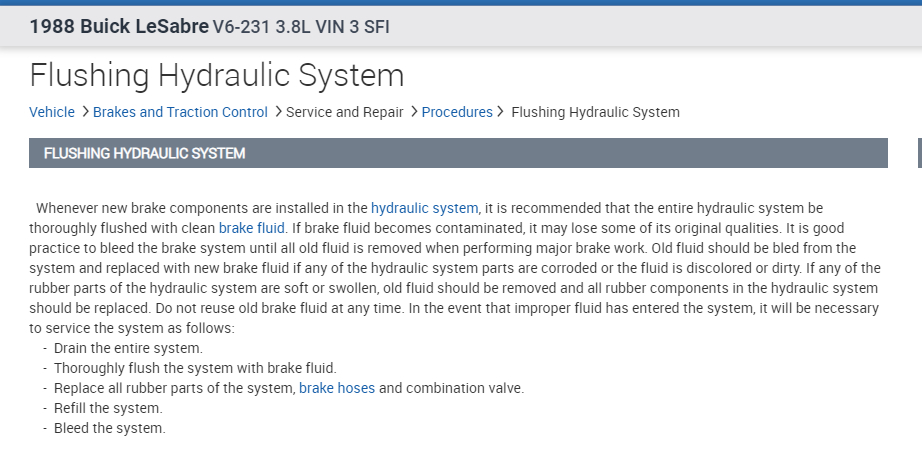
As far as the brakes are concerned, it certainly won't hurt to flush the fluid. Here again, that has become a new selling idea over the past 20 years. My 1978 C10 has never been touched and it still works fine. LOL

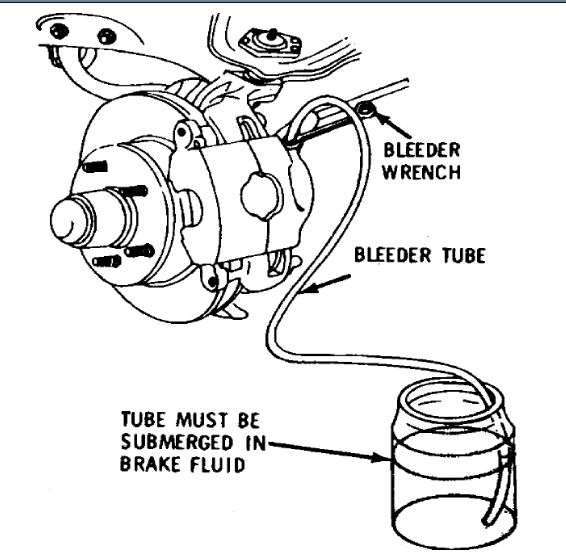
If you want to flush the brakes, we don't have a link for it. However, I attached the manufacturer's directions below.

Let me know if this helps.

Joe

See pics below.
Sep 11, 2023 at 8:37 PM
Avatar
ALPHAA10
  • MEMBER
  • 232 POSTS
The OEM method described above is what I usually have done with other cars, but I was not sure it cleared all the old fluid from the system.

Apparently, it does.

Thanks, Joe.

BG

Sep 12, 2023 at 12:50 AM
Avatar
JACOBANDNICKOLAS
  • CERTIFIED EXPERT
  • 110,175 POSTS
Hi,

It should get everything out. When you do it, make sure to start at the wheel farthest from the master cylinder and work your way to the closest.

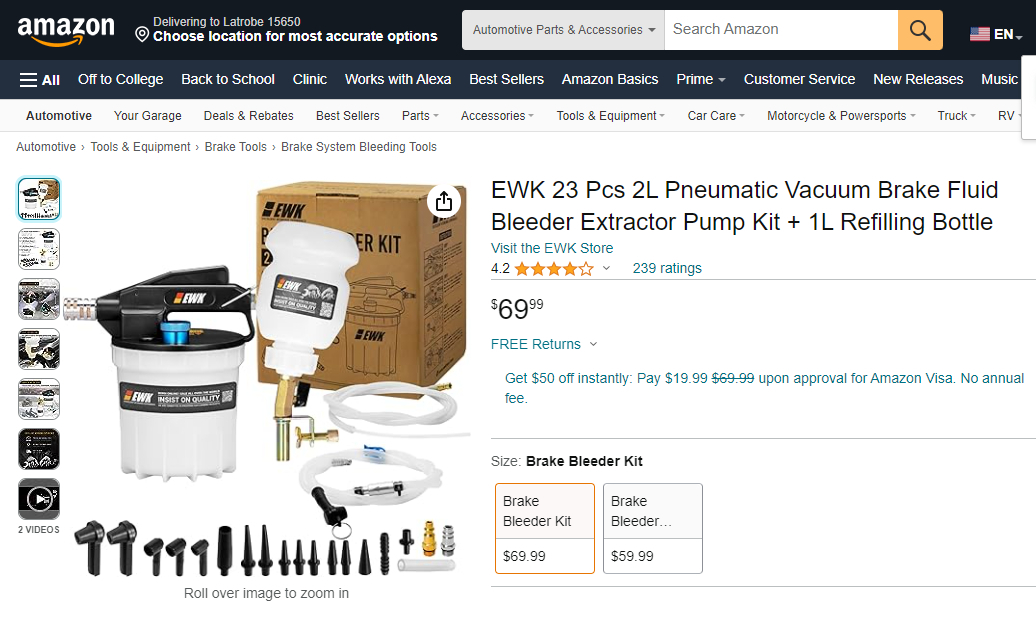
Another thing you could do is use a brake fluid vacuum bleeder and draw the old fluid out one wheel at a time. You would be able to see when the fluid goes from dirty to clean. I attached a pic below of what I'm referring to.

Let me know how things turn out for you. I'm interested in knowing.

Take care,

Joe

See pic below.
Sep 12, 2023 at 5:15 PM
Avatar
ALPHAA10
  • MEMBER
  • 232 POSTS
Here is a question from watching videos from a variety of sources about changing the front brake rotors and pads. The mechanics involved in the videos gave different torque specs on securing the two front brake pad frame bolts.
One mechanic said to use 75 FtLbs, but the other said 50 FtLbs. How could that happen, when the OEM spec does not vary ?
Sep 14, 2023 at 2:32 AM
Avatar
JACOBANDNICKOLAS
  • CERTIFIED EXPERT
  • 110,175 POSTS
Are you referring to the caliper to the caliper mount or the caliper mount to the steering knuckle?

Joe
Sep 14, 2023 at 6:21 PM
Avatar
ALPHAA10
  • MEMBER
  • 232 POSTS
This video specifies a torque value of 75 FtLb:
https://www.1aauto.com/how-to-replace-front-brakes-1997-2005-buick-century/video/45543

The mechanic refers to the mount secured by the bolts as a "pad bracket" (at 3:08), and at 4:36, says he will torque its bolts to 75 FtLb.
Sep 15, 2023 at 4:20 AM
Avatar
JACOBANDNICKOLAS
  • CERTIFIED EXPERT
  • 110,175 POSTS
Hi,

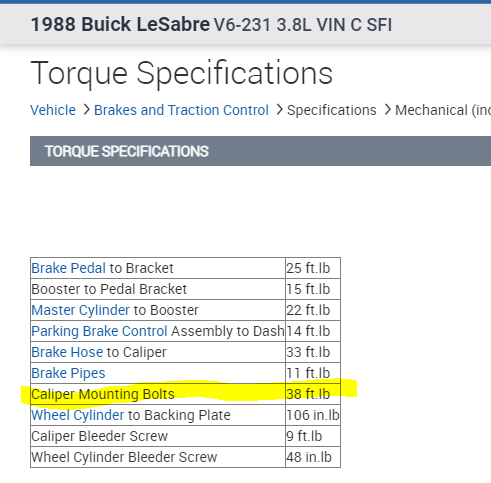
The caliper itself mounts on the caliper mount. That is the only torque specification I have. See below. As far as the caliper mount to the steering knuckle, 75 ft/lbs sounds right.

Let me know.

Joe

See pic below.
Sep 15, 2023 at 7:48 PM
Avatar
ALPHAA10
  • MEMBER
  • 232 POSTS
Thanks for clarifying the correct values on this operation, Joe.

BG

* Both of us suspect the vast majority of Do-It-Yourselfers do not bother
with a torque measurement, anyway.
Sep 16, 2023 at 9:44 PM
Avatar
JACOBANDNICKOLAS
  • CERTIFIED EXPERT
  • 110,175 POSTS
Hi,

LOL. My first shop teacher told us when torquing a cylinder head, grab the wrench and pull. When your feet come off the ground, it's tight. LOL

Take care,

Joe
Sep 16, 2023 at 10:17 PM
Avatar
ALPHAA10
  • MEMBER
  • 232 POSTS
Joe,
I just bought new front brake rotors for the Buick 1998 LeSabre, and in researching prior to the operation, have come across advice to prepare the rotor surfaces by removing any anti-rust coating on the rotor surface.
Although I never have read disc rotor anti-rust coatings could create an issue with the pad surfaces (ceramic), is there any validity to the suggestion to use 150-grit sandpaper to remove the film?

BG
Sep 17, 2023 at 8:12 PM
Avatar
JACOBANDNICKOLAS
  • CERTIFIED EXPERT
  • 110,175 POSTS
Hi,

Yes, to cleaning them, but no to the sandpaper. Spray them down well with brake cleaner and then wipe them off. That's all you need to do.

As far as cleaning them, if you don't, you will get a burning smell and may actually get some smoke from the coating.

Take care,

Joe
Sep 17, 2023 at 10:01 PM
Avatar
ALPHAA10
  • MEMBER
  • 232 POSTS
Excellent, logical advice, based on experience (or somebody else's).
I tend to trust experience.
Sep 18, 2023 at 2:24 PM
Avatar
ALPHAA10
  • MEMBER
  • 232 POSTS
Joe,
I hesitated to ask you another question, because I already have posted the question for general pickup (not wanting to overburden you). But after two days, no one has picked up the question below--
=================================

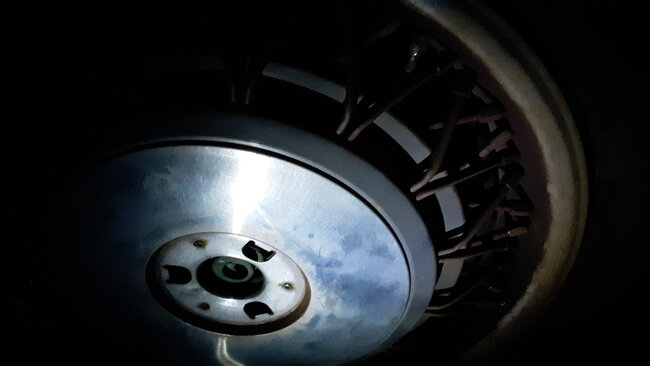
Working with the car listed above, I was all set to remove the wire wheel cover from both front wheels and begin the operation.

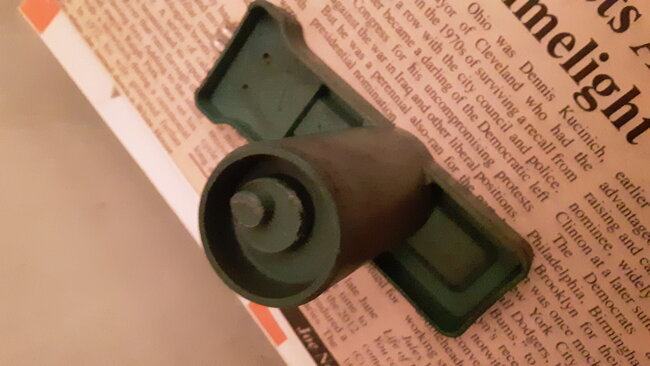
Using the special Buick tool to remove the cover, I had no problem with the passenger side wheel. But when I moved to the driver's side, the tool did not seat itself properly, and the does not move all the way inside the tool channel, for some reason. (see photo, below, of Buick OEM removal tool)

Of course, I made sure the raised post on the tool was exactly positioned over the cover's tool channel pilot hole before attempting to un-thread the plastic nut.

Because the tool kept slipping out of the hole, I halted operations until I had a better way to remove the driver side wheel cover's plastic nut.

Any suggestions on how to use the GM tool on a wheel cover whose tool channel does not permit me to seat the tool properly?

(To loosen the plastic cover assembly nut, I have sprayed the area with isopropyl alcohol, hoping it would penetrate the plastic nut threads. Liquid Wrench may work, but both the wheel nut and its threaded hub are of nylon, so I am not sure that would help.)

Photos are attached (from left to right)--

Photo 1-- shows plastic wheel cover unlocking tool. Note raised post on off-center/eccentric tool shaft.

Photo 2-- shows overall wheel cover assembly

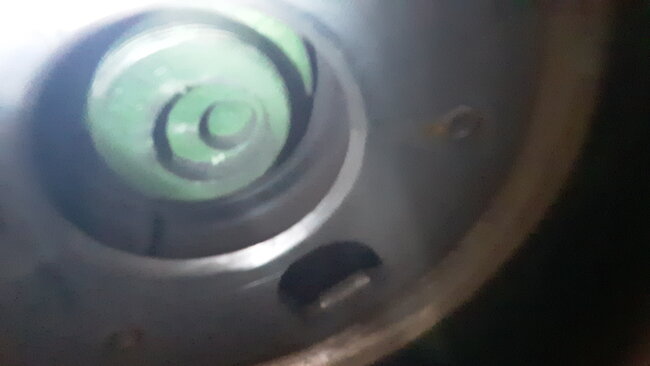
Photo 3-- shows wheel cover assembly, with shaft for insertion of wheel cover tool. Note the shaft has the same off-center/eccentric shape to match the tool.

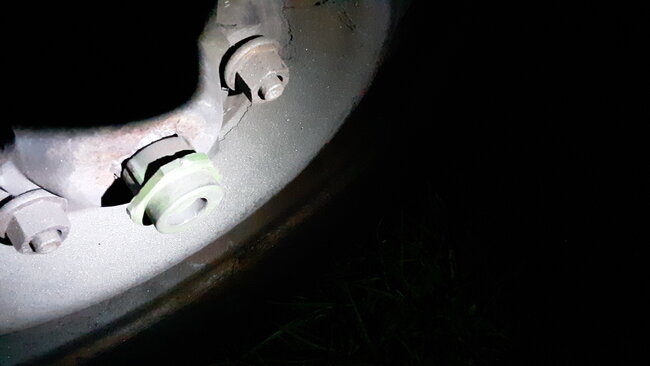
Photo 4-- shows nylon/plastic nut to fasten the plastic wheel cover assembly. This nut was removed successfully from the passenger front side but was re-threaded to show nut dimensions.

Removal of the driver side nut is the current problem, because the removal tool does not enter fully into the tool hole and slips out. I risk tool deformation if I continue to apply greater force to the tool.

Sep 21, 2023 at 9:55 AM
Avatar
ALPHAA10
  • MEMBER
  • 232 POSTS
Joe,

I finally un-threaded the plastic nut fastening the wheel cover. The green plastic security tool (photo 1, above) is designed supposedly to prevent theft of Buick / GM "wire" wheel covers, but effectively prevents the owner from tire maintenance / repair, and access to the front brakes.
The plastic wrench is not particularly sturdy, and stripping its tiny plastic post could prevent roadside tire replacement. Do you know of a sturdy metal equivalent to the GM wheel cover wrench?
Sep 21, 2023 at 4:56 PM
Avatar
JACOBANDNICKOLAS
  • CERTIFIED EXPERT
  • 110,175 POSTS
Hi,

LOL no problem whatsoever. Normally, we try to keep the threads specific to one topic. That way, they are more helpful to others.

So, since you already reposted, here is what I can tell you. The probability of finding a steel one is slim. Check to see if there is a part number on the original one and Google search it. If you are unable to find one, do this. When reinstalling the hubcap, first clean the threaded area on the bolt and the hubcap. Then, use anti-seize on the bolt's threads. Snug the hubcap enough to prevent it from coming loose, but don't overtighten it.

If you do this, the plastic one should do the job for a long time. If, on the other hand, it becomes corroded, it may break.

Let me know if that helps.

Joe
Sep 21, 2023 at 7:11 PM
Avatar
ALPHAA10
  • MEMBER
  • 232 POSTS
Thanks, Joe!

And, yes, I had posted this separately, but the post had brought zero response.
So, my familiar route of checking with you was a backstop, in case I was unable to do anything with the plastic nut.

It so happens I had planned to use NeverSeize on the plastic threads, if I ever managed to solve the wheel cover wrench problem. Unexpectedly, the wrench finally turned the nut-- but not without more damage to the wrench pilot post, as I had anticipated..

The wrench is labeled "PA66 CAV4", a wheel cover lock wrench. The search probably will require several days, but with sustained effort, something may pop up.

So, I'll let you know what I find-- this could benefit many others on this forum, as you point out.

BG
Sep 21, 2023 at 9:42 PM
Avatar
ALPHAA10
  • MEMBER
  • 232 POSTS
Search of eBay brought a few possibilities, but a refund from Seller is conditioned on whether the tool is "mounted" on the vehicle. Since mounting / use of the tool is the only way to establish it works, there is effectively no refund offered.

A visual inspection might suffice, but I prefer to wait until a more reasonable eBay Seller appears. There must be more than a few PA66b CAV4 metal wrenches circulating.
Sep 21, 2023 at 10:20 PM
Avatar
ALPHAA10
  • MEMBER
  • 232 POSTS
As a backup plan, I may take my green plastic original wrench to a machine shop,and have one of their more skilled staff make an aluminum copy. That should not be as hard as it sounds, but matching the eccentric placement of the shaft could make it an extra-cost job.

I'll let you know what develops.

BG
Sep 22, 2023 at 2:03 AM