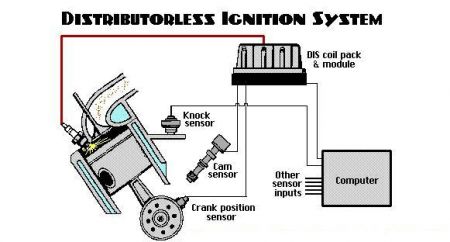
The crankshaft reluctor wheel is mounted on the rear of the crankshaft. The wheel is comprised of four 90 degree segments. Each segment represents a pair of cylinders at TDC , and is further divided into six 15 degree segments. Within each 15 degree segment is a notch of 1 of 2 different sizes. Each 90 degree segment has a unique pattern of notches. This is known as pulse width encoding. This pulse width encoded pattern allows the PCM to quickly recognize which pair of cylinders are at top dead center (TDC). The reluctor wheel is also a dual track-or mirror image-design. This means there is an additional wheel pressed against the first, with a gap of equal size to each notch of the mating wheel. When one sensing element of the CKP sensor is reading a notch, the other is reading a set of teeth. The resulting signals are then converted into a digital square wave output by the circuitry within the CKP sensor.
The camshaft reluctor wheel is either pressed onto the camshaft or part of the timing gear depending on the application. The feature-or target- is read in a radial or axial fashion respectively. The wheel is a smooth track, half of which is of a lower profile than the other half. This feature allows the CMP sensor to supply a signal as soon as the key is turned ON, since the CMP sensor reads the track profile, instead of a notch.
Jan 21, 2010 at 7:33 PM