When engine is running I can pump up pedal after two to three pumps but then hear a loud hissing

1998 CHEVROLET 1500
275,000 MILES • 5.7L • V8 • 2WD • AUTOMATIC
Avatar
TMINER
  • MEMBER
  • 49 POSTS
After replacing master cylinder twice (first new one shot fluid about three feet in the air when pushing down pedal) we flushed all lines and have all new fluid in the system. We then bled system using vacuum suction and we went from right rear and proceeded to left rear, right front and left front. When engine is running I can pump up pedal after two to three pumps but then hear a loud hissing (like air or vacuum) until I take my foot off pedal. Once I release pedal then press it, pedal goes back to floor. Checked for leaks and did not see any on any wheel. Blew out the combination valve and hear it clicking when doing so. When pressing brakes it will sometimes effect engine rpm's which to me is very odd. From what I am seeing online, I am guessing check valve and/or vacuum booster. Any better ideas before I spend $140.00 on a booster? Thanks in advance.
Dec 10, 2017 at 9:39 PM
Advertisement
Avatar
JACOBANDNICKOLAS
  • CERTIFIED EXPERT
  • 110,175 POSTS
Before getting a new booster (which is vacuum operated) check to see if it will hold vacuum. Follow this how to for checking for possible problems. I would suspect there is air in the lines. These guides can help you fix it.

https://youtu.be/w7gUsj2us0U

and

https://youtu.be/WDxvEQrMkBg

and

https://www.2carpros.com/articles/brake-pedal-goes-to-the-floor

Please run down these guides and report back.
Dec 11, 2017 at 6:38 PM
Avatar
TMINER
  • MEMBER
  • 49 POSTS
Trying all that, nothing was found. Running the engine and pressing the brake pedal down I get a hissing noise and pedal goes down a lot. After turning off the engine and pressing the pedal once it goes down due to stored vacuum pressure. After that initial press and I let back up then press down I get a good pedal and the rear brakes are heard working. It is hard to see the calipers so I do not know if fronts are working.
Dec 12, 2017 at 9:09 AM
Advertisement
Avatar
STRAILER
  • CERTIFIED EXPERT
  • 53,854 POSTS
Hello,

The hissing is a bad booster you must fix that which will probably solve the low pedal problem.

Here is a guide that will help you bleed the system as well

https://www.2carpros.com/articles/how-to-bleed-or-flush-a-car-brake-system

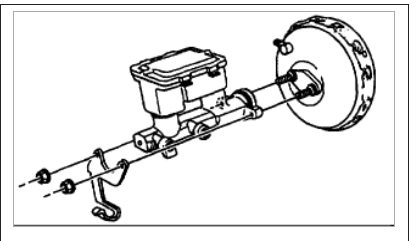
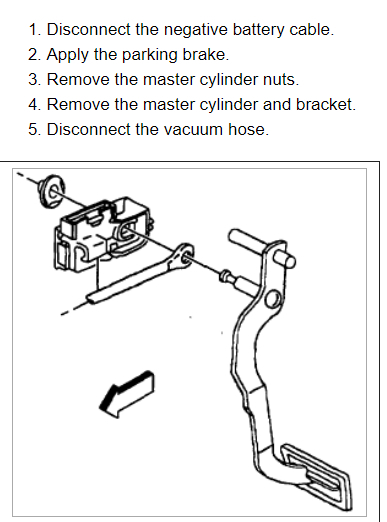
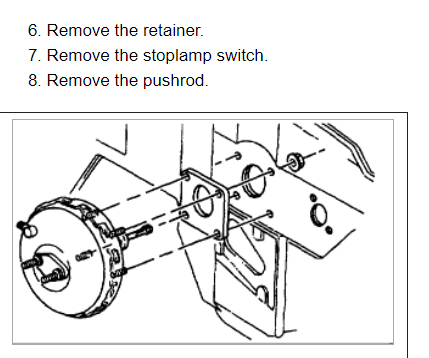
Here are diagrams to show you how to do the job.

Let us know what happens and please upload pictures or videos of the problem.

Cheers, Ken
Dec 17, 2017 at 2:57 PM
Avatar
TMINER
  • MEMBER
  • 49 POSTS
Booster has been replaced and it fixed the issue. Now I have another issue I will post a question for. Thanks all!!!
Mar 18, 2018 at 12:58 PM
Avatar
STRAILER
  • CERTIFIED EXPERT
  • 53,854 POSTS
Nice work, we are here to help, please use 2CarPros anytime.

Cheers, Ken
Mar 19, 2018 at 10:49 AM
Avatar
DYESCHICK
  • MEMBER
  • 1 POST
Replaced master cylinder booster, rear wheel cylinders and calipers bled several times. good pedal until engine is started. problem started after hitting a pothole. wheel bearings seem okay.
Apr 9, 2021 at 2:20 PM (Merged)
Avatar
TOUGHDIVER
  • CERTIFIED EXPERT
  • 224 POSTS
Hi,

The brake pedal will drop when you start the vehicle this normal and the pedal will fade a little when sitting in the service bay it will feel different when driving. If the brake goes to the floor there is a leak or the brake system has air in it. So check for brake fluid leaks and repair if necessary.

Bleed the system starting at the master cylinder very important to bleed all air from the master cylinder. Start bleed manually at the master cylinder waiting 10 seconds between bleed cycles. Do the same for all components that is to be bleed. please do not judge the pedal until it's on the road.. I'm attaching repair guides for you to reference to. Let us know if you need any more information.

https://www.2carpros.com/articles/how-to-bleed-or-flush-a-car-brake-system

https://www.2carpros.com/articles/brake-pedal-goes-to-the-floor..

Thank you,
Joe T.
Apr 9, 2021 at 2:20 PM (Merged)
Avatar
REDNECKDADDY0822
  • MEMBER
  • 1 POST
Hello. I have read several threads on this issue, but I have not an answer for my issue. I have the truck listed above (C1500). This is my daily driver. The last mechanical work I had done was about six months ago when I had the transmission rebuilt. Out of the blue about two weeks ago, I get in my truck and the pedal goes to floor at starting. I had not had any brake issues to this point; no soft or weak braking. When the engine is off, pressure builds but when I start the truck, to the floor goes the pedal. I replaced the master cylinder and bled all lines at the wheel today. The end result is still the same. I checked the booster and it appears to be operating properly. I am stumped and looking for advice. I am interested in the hydro upgrade but I do not have the funds available at this time. TIA!
Apr 9, 2021 at 2:20 PM (Merged)
Avatar
CARADIODOC
  • CERTIFIED EXPERT
  • 34,306 POSTS
Hydro-boost is definitely not an upgrade. It was the last-ditch effort to get decent power assist on diesel engines that don't have intake manifold vacuum. The early blocks were modified gas engine blocks with the hole for a distributor. They stuffed a camshaft-driven vacuum pump in there for the power brake booster.

In your case, the power booster is working just fine, as they usually do. They have nothing to do with how far the brake pedal goes, only how easily it goes there. GMs are well-known to need two men and a boy to push on their brake pedals when the engines are off. That's why it's so hard to notice the low pedal until the engine is started. To add to the misery, with a properly-working GM system, it is possible to push the brake pedal all the way to the floor when you're standing still. Had you been driving, that would equate to the wheels locked up and then some. This has the potential to lead to a master cylinder failure, especially given the age of the truck. Crud and corrosion build up in the lower halves of the bores in the master cylinder where the pistons don't normally travel. Pushing the brake pedal to the floor, whether bleeding improperly, surprised by a sudden leak, or just when standing still with the engine running, runs the pistons over that crud and can rip the rubber lip seals. That leads to a slowly-sinking brake pedal or no pressure buildup at all, and that may not show up for two or three days. This applies to any master cylinder over about a year old, on any brand of vehicle.

The web sites are full of GM truck owners complaining of low brake pedal, and I have yet to read about a solution common to all of them, besides the things we normally look for. Most of the time people have already replaced the master cylinder, the logical suspect, but still have the same problem. One thing you might look for is a rear drum brake shoe lining that rusted off its frame and is loose inside the drum. That will make the shoes need to move way too much and will result in a low pedal. Look for signs of wetness on the back side of the rear drum backing plates. That would indicate a leaking wheel cylinder. The clue to a leaking wheel cylinder or rusted steel line is the fluid level will continue to drop in the reservoir even after it has been refilled. With internal leakage in the master cylinder, fluid level in the reservoir will not drop.

There's a simple trick that prevents the need to bleed at the wheels when replacing a master cylinder, but since you did bleed there already, did you see any air bubbles come out the instant you opened the bleeder screw? Normally you'll need to run through enough brake fluid to get the air bubbles all the way down to the calipers. That takes some time. If you see air bubbles right away coming from a caliper, suspect a torn dust boot on it. I did see one that was drawing air into the caliper through that torn boot. That can't happen according to all of my training, but a rebuild kit took care of the mushy brake pedal that kept returning about every week.

Did you bench-bleed the new master cylinder before it was installed? If the truck has four-wheel anti-lock brakes, you may need a scanner to command the computer to open two valves so those chambers can be bled, especially if there was air in the lines from replacing the master cylinder. This doesn't apply to the rear-wheel, (RWAL) system that was more common for the time. Air will bleed through the dump valve to the rear brakes like normal with no special procedures.
Apr 9, 2021 at 2:20 PM (Merged)
Avatar
FELIXALEMAN0
  • MEMBER
  • 8 POSTS
So I have change the brake shoes, the spring for the drum brakes, the brake calipers, brake pads, brake lines, master cylinder, the brake booster, also bleed all the lines. Still have a spongy brake pedal after all of that. I don’t know what to do.
Apr 9, 2021 at 2:21 PM (Merged)
Avatar
ASEMASTER6371
  • CERTIFIED EXPERT
  • 52,796 POSTS
Good morning,

Did you do the automated bleed sequence for the ABS?

You need a scan tool to do this procedure or you will never get the air out of the ABS.

Roy

TWO PERSON PROCEDURE (PREFERRED)
Gravity and vacuum bleeding are not recommended for this ABS system.


PROCEDURE
1. Raise the vehicle to gain access to the system bleed screws. Install clear tubing on the bleed screws so that air bubbles in the fluid can be seen.

NOTE: Never pump the brake pedal as fluid cavitation may occur.

2. Begin by bleeding the system at the right rear wheel, then the left rear, right front and left front.
3. Open one bleed screw at a time 1/2 to 1 full turn.
4. Slowly depress the brake pedal until it reaches its full travel and hold until the bleed screw has been tightened. Release the brake pedal and wait 10-15 seconds for the master cylinder to return to the home position.

NOTE: Repeat steps 1 through 4 until approximately 1 pint of brake fluid has been bled from each wheel. Clean brake fluid should be present at each of the wheel bleed screws. Check the master cylinder fluid level every 4 to 6 strokes of the brake pedal to avoid running the system dry.

5. After bleeding all four wheels, use a Tech 1 Scan tool to run 4 functional tests while applying the brake pedal firmly.
6. Re-bleed all four wheels using steps 1 through 4 to remove the remaining air from the brake system.
7. Evaluate the brake pedal feel before attempting to drive the vehicle and re-bleed as many times as necessary to obtain appropriate pedal feel.
Apr 9, 2021 at 2:21 PM (Merged)
Avatar
FELIXALEMAN0
  • MEMBER
  • 8 POSTS
i'm trying to find a shop to do it but they don't want to do because they say that it is just going to be like that and it wont fix the issue. but i'm still trying to find other shops to do it.
Apr 9, 2021 at 2:21 PM (Merged)
Avatar
ASEMASTER6371
  • CERTIFIED EXPERT
  • 52,796 POSTS
Any shop with a scan tool can do this procedure.

Keep me updated.

Roy
Apr 9, 2021 at 2:21 PM (Merged)
Avatar
FELIXALEMAN0
  • MEMBER
  • 8 POSTS
not really because it need a special scanner tool that are for older trucks and they don't have it so that is probably why they tell me it wont work.
Apr 9, 2021 at 2:21 PM (Merged)
Avatar
ASEMASTER6371
  • CERTIFIED EXPERT
  • 52,796 POSTS
A lot of the newer scan tools for the GM have the old system built into it.

Roy
Apr 9, 2021 at 2:21 PM (Merged)
Avatar
FELIXALEMAN0
  • MEMBER
  • 8 POSTS
Found out that i need an ABS pump and i don't know where to get one from. is there a place where i can get one new or a rebuilt one?
Apr 9, 2021 at 2:21 PM (Merged)
Avatar
CANNON1349
  • CERTIFIED EXPERT
  • 861 POSTS
Hi,

I did the front brakes on this truck, new rotors and wheel bearings, and the pedal is very spongy. With the engine off I can get a pretty stiff pedal, maybe with enough pressure it can be spongy but the real sponginess is with the engine on. The master cylinder/brake booster is very squeaky and also I can see the fluid inside the reservoir slush and bubble.

I've bled all four wheels in the proper sequence, and even bled the ABS unit looking thing. I'm almost convinced it's a weak master cylinder, it's original. Also the seals at the reservoir are seeping, just not pushing fluid out but they are looking a little wet.

And, when bleeding the brakes, as I crack the bleeder valve the brake fluid doesn't rush out, it just flows nice and smooth out of the tube.
Apr 9, 2021 at 2:21 PM (Merged)
Avatar
JACOBANDNICKOLAS
  • CERTIFIED EXPERT
  • 110,175 POSTS
Hi,

It could be a master cylinder. When you bled the brakes, did you have a helper and what procedure did you follow? Also, this truck has rear drum brakes. Are you sure the brakes are properly adjusted? If they are out of adjustment, it will cause a spongy pedal.

Now, if the master cylinder reservoir is leaking at the rubber grommets, they need replaced. Also, can you explain what you mean by squeaky? One last thought, there shouldn't be bubbles in the brake fluid. I have a feeling there is air in the system at some point.

Let me know exactly what was done and how it was done.

Take care,
Joe
Apr 9, 2021 at 2:21 PM (Merged)

Avatar
ASEMASTER6371
  • CERTIFIED EXPERT
  • 52,796 POSTS
I see nothing listed for new or rebuilt.

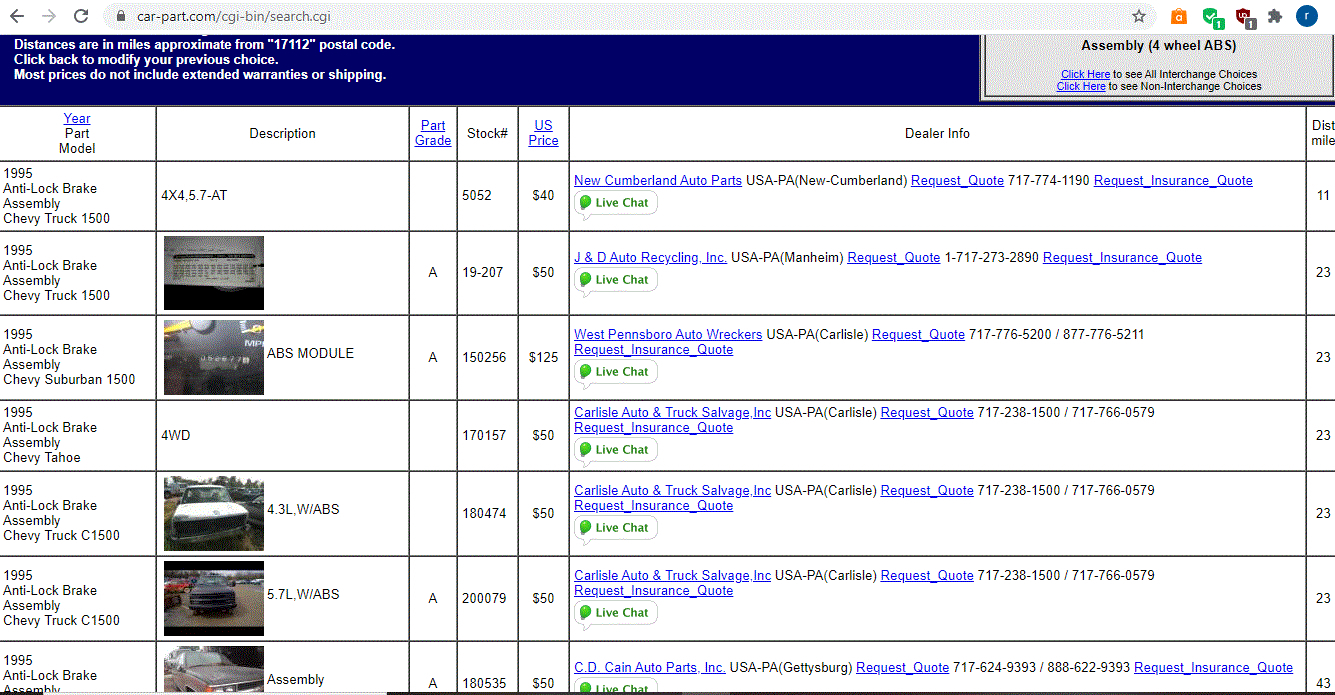
You can get a used one by going to this web site. WWW.car-part.com and enter your information.

I attached a partial page for you.

Roy
Apr 9, 2021 at 2:21 PM (Merged)
Avatar
CANNON1349
  • CERTIFIED EXPERT
  • 861 POSTS
The shoes in the drum are like new, still have numbers on the shoes but I didn't do those, at any point in time but seem okay in regards to drag and braking. I did have a helper hold down the pedal, crack the bleeder, close the bleeder, then release the pedal and pump 3 times. I did it in this order: RR, LR, RF, LF.

When pressing the brake pedal there's a squeak like a cabinet hinge that needs some wd-40, might be the arm in the booster. Who knows. It's not leaking per se, but is deteriorating and has a shiny/wet appearance.
Apr 9, 2021 at 2:21 PM (Merged)
Avatar
FELIXALEMAN0
  • MEMBER
  • 8 POSTS
so no one rebuilds ABS pumps?
Apr 9, 2021 at 2:21 PM (Merged)
Avatar
JACOBANDNICKOLAS
  • CERTIFIED EXPERT
  • 110,175 POSTS
Okay, the noise could even be where the brake pedal and push rod come together. That makes sense.

We have two things we can try. Since you have already manually bled the brakes (and it sounds like everything was done correctly), you can try pressure bleeding them or try to bleed the master cylinder. Since you are seeing bubbles in there, (if there is air in the system) that sounds like where it will be.

Here are directions for that. If this fails and there is no air in the system, chances are the master cylinder is bad.

______________________

1995 Chevy Truck C 1500 Truck 2WD V6-262 4.3L VIN Z TBI
Bleeding Master Cylinder
Vehicle Brakes and Traction Control Hydraulic System Brake Bleeding Service and Repair Procedures Master Cylinder Bleeding Without ABS System Bleeding Master Cylinder
BLEEDING MASTER CYLINDER
This procedure can be performed with master cylinder on or off vehicle.

1. Disconnect brake lines at master cylinder, if necessary.
2. Connect suitable lengths of brake lines to master cylinder and immerse other ends of lines in master cylinder reservoirs.
3. Apply master cylinder pushrod or brake pedal with full strokes until air bubbles have disappeared in reservoirs. It may require 20-30 applications to fully eliminate air bubbles.
4. Remove bleeding lines from master cylinder, then install master cylinder on vehicle, if necessary, and connect brake lines.

It is not necessary to bleed entire hydraulic system after replacing master cylinder, providing master cylinder has been bled and filled during installation.

_______________________________

Let me know if this helps.

Take care,
Joe
Apr 9, 2021 at 2:21 PM (Merged)

Avatar
ASEMASTER6371
  • CERTIFIED EXPERT
  • 52,796 POSTS
I imagine someone does but I have not found anyone who does it.

Roy
Apr 9, 2021 at 2:21 PM (Merged)
Avatar
FELIXALEMAN0
  • MEMBER
  • 8 POSTS
Okay, well thank your for the help.
Apr 9, 2021 at 2:21 PM (Merged)

Avatar
ASEMASTER6371
  • CERTIFIED EXPERT
  • 52,796 POSTS
You are welcome.

Always glad to help.

Roy
Apr 9, 2021 at 2:21 PM (Merged)

Avatar
MCTANK93
  • MEMBER
  • 15 POSTS
Brakes started to get soft, I figured it was time to replace the drum brakes. Found the wheel cylinder and axle seals were bad. replaced both on each side, drum brakes were fine. Bled the brakes, then the brake master cylinder popped a leak and replaced that. Front brakes are good as well. Bled them again, After all that I still have spongy brakes. My truck is listed above it is the Scottsdale model. It does have the anti-lock system (old ABS). Semi metallic brakes all around, disc in front drum in rear.

Thoughts?
Am I missing something?
Help.
Apr 9, 2021 at 2:21 PM (Merged)
Avatar
CARADIODOC
  • CERTIFIED EXPERT
  • 34,306 POSTS
There are a coupe of things to consider. First, many four wheel ABS systems need to have a pair of valves opened in the hydraulic controller so the air can be expelled. You need a scanner for that. Air in that unit should not be a problem if the reservoir never ran empty. The master cylinder also can be replaced without needing to bleed at the wheels. That will also prevent air from getting down to the hydraulic controller. If the truck has the more common rear-wheel ABS, no special bleeding procedures are required for those systems.

The second thing to look at is most trucks and minivans have a wide range of loading variables, from empty to fully-loaded. To put the most braking power where it is needed, they usually have a height-sensing proportioning valve in the rear, connected with a link between the frame and the axle housing. If you tried bleeding the rear wheel cylinders while the truck was jacked up with the rear axle hanging down, that would put the valve in the position of having no load in the rear. The height-sensing proportioning valve would limit the amount of brake fluid pressure going to the rear brakes, and that could reduce the effectiveness of your bleeding attempts. Fluid flow might be slow enough that some air got stalled at a high spot in the lines. If the truck is on a hoist, put a pair of jack stands under the rear axle, then let the truck down to raise the axle. That will help brake fluid to flow faster to the rear brakes.

One other thing that used to throw us years ago is it is normal on most GM vehicles to be able to easily push the brake pedal almost to the floor when standing still in the service bay, but if you were on the road, that would equate with the brakes locked up and tires skidding. We were fooled many times into thinking there was still something wrong, then out of desperation, a test-drive proved the brakes were okay.
Apr 9, 2021 at 2:21 PM (Merged)
Avatar
MCTANK93
  • MEMBER
  • 15 POSTS
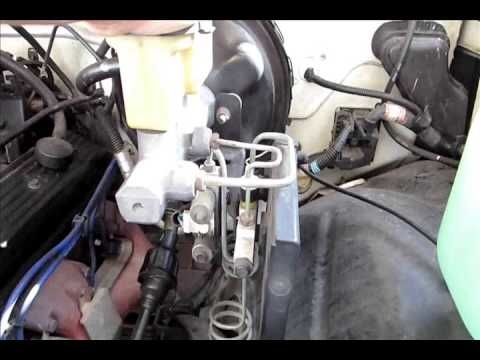
During test drive is still spongy, not sure if i have common ABS or not. When I replaced the rear wheel cylinders and axle seals it was on jack stands, I did the bleed process on the ground. I know when i noticed the leak from the master brake cylinder (the next morning) it was very low maybe two or three caps full with fluid in the little area of reservoir but almost full in the larger area in reservoir. Added a picture of the basic area of my brake cylinder and reservoir area. before all this, my brakes if you pushed the pedal only four inches you would almost be thrown into the window now It is almost to the floor in order to stop.
Apr 9, 2021 at 2:21 PM (Merged)
Avatar
CARADIODOC
  • CERTIFIED EXPERT
  • 34,306 POSTS
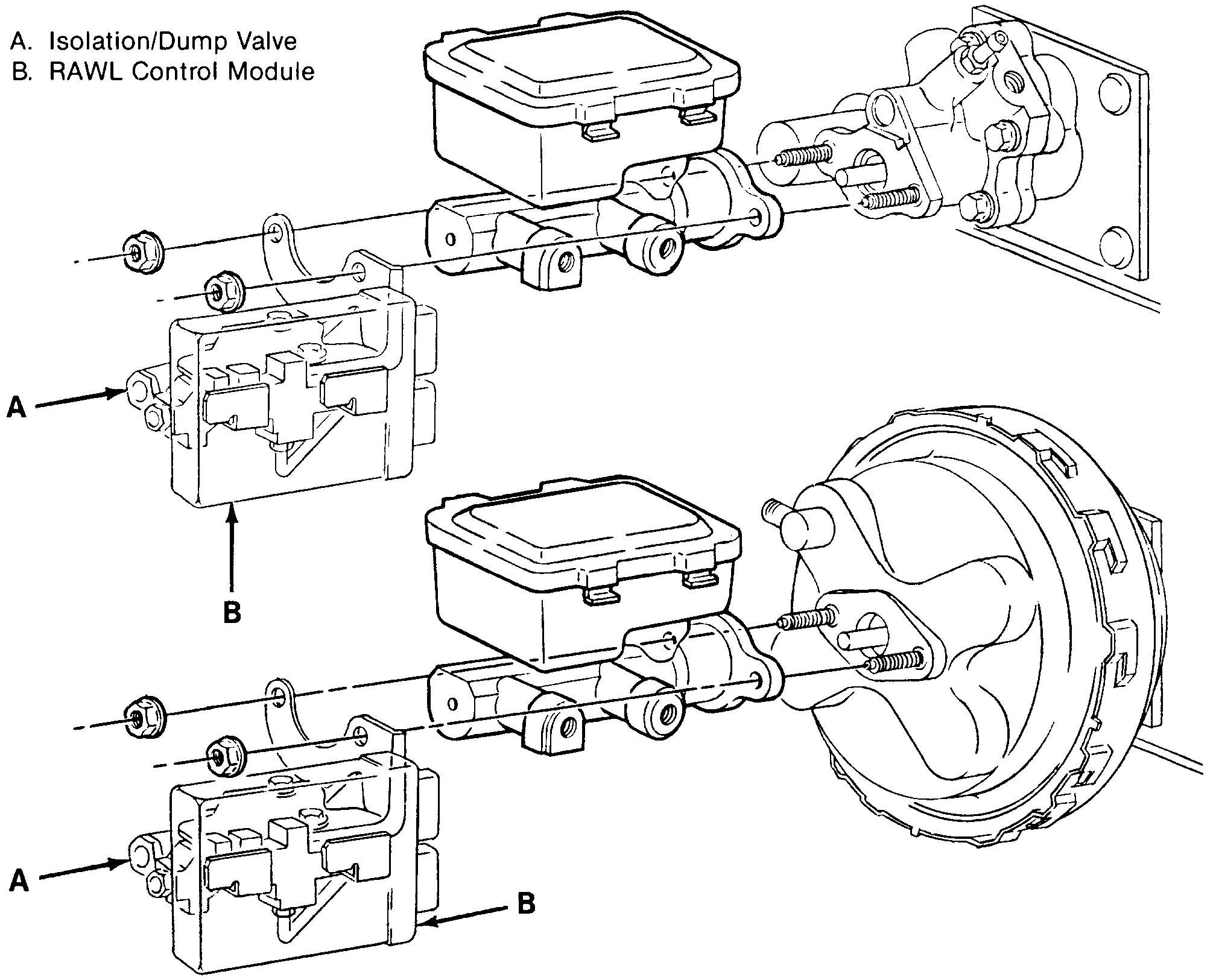
You have the RWAL system which was more common for the time. The dump valve and block valve are below and just to the right of the master cylinder in your photo. Next is the combination valve which is a standard part of all brake systems That is the brass block the two brake lines from the master cylinder go into. To the right of that is the ABS computer. That is the black rectangular box, about one inch wide. With this system, you bleed the brakes like normal, with no special procedures or scanner needed.

The next thing to look at is if the rear shoes are fully-adjusted. GM did not have much trouble with their self-adjusters, but look at the six "lands" on the backing plates. Those are the raised spots the shoes ride on. Most manufacturers bend tabs over on the shoe frames, then those tabs slide on the lands. Those should be lubricated with special high-temperature brake grease to prevent squeaks and wear. On GM's shoes, there are no tabs. The edges of the frames grind into those lands and cause grooves to form. Those can prevent a shoe from applying under light pedal pressure, and they can cause a shoe to stick and fail to release. Either condition can be overlooked and make it appear the shoes are adjusted properly, but when driving, they have to move too far to contact the drum. That will cause a low pedal.

While there are all kinds of things like this to look for, my suspicion is there is still air in the system. Did you bench-bleed the new master cylinder before it was installed? Have a helper push the brake pedal up and down a couple of inches repeatedly while you watch in the reservoir with the cover removed. If you see a few tiny air bubbles pop into the reservoir when the pedal is released, there is air in those lines. If that air did not get pushed down too far while bleeding previously, it will work its way out over time.

Also, look at the position of the shoes. Both of them must be contacting the large anchor pin at the top of the backing plate. If one is being held away from that pin, suspect the parking brake cable is rusted in the partially-applied position. That will prevent the shoes from self-adjusting. Next, look at the parking brake strut bar between the middles of the two shoes. You should be able to push that against the anti-rattle spring, toward the front of the truck about an eighth inch with thumb pressure. If it has no free play, again suspect a sticking parking brake cable.
Apr 9, 2021 at 2:21 PM (Merged)
Avatar
MCTANK93
  • MEMBER
  • 15 POSTS
Yes, i bench bleed the new reservoir. I will conduct these suggestions tomorrow and get back to you. Thanks for the help.
Apr 9, 2021 at 2:21 PM (Merged)
Avatar
MCTANK93
  • MEMBER
  • 15 POSTS
everything checks out had shop look at it. still spongy brakes. I do not know what to do. going to have to Flintstones it i guess, lol.
Apr 9, 2021 at 2:21 PM (Merged)
Avatar
CARADIODOC
  • CERTIFIED EXPERT
  • 34,306 POSTS
I do not like suggesting this, but consider pedal-bleeding with a helper, or better yet, use a bleeder ball if you can find one. I have only used gravity-bleeding for many years because I always have to do everything by myself. With pedal-bleeding, you will get more volume at a faster rate. That will push air out that otherwise might get trapped in a high spot. Check too if clear new fluid is coming out at each bleeder screw. If it is still dark, air near the master cylinder has not made it all the way to the end yet.

It is important to never push the brake pedal over half way to the floor. Crud and corrosion build up in the lower halves of the bores where the pistons in the master cylinder do not normally travel. Pushing the pedal to the floor runs the rubber lip seals over that crud and can rip them. That can result in a slowly-sinking brake pedal, and that often does not show up until two or three days later. I take every opportunity to mention this, but in your case, this does not apply because you have a new master cylinder. Keep that wondrous information for future brake work.

You also might consider using a hand-powered or air-powered vacuum bleeding system. Under a slight vacuum, any air will expand and be easier to pull out. Be aware though I have always been fooled the few times I have used these. If you have air in the system, the bubbles will come out and be seen as large bubbles or gaps in the fluid flow. If you see a constant, steady stream of very tiny bubbles, ignore them. That is air sneaking in past the threads of the bleeder screw.
Apr 9, 2021 at 2:21 PM (Merged)
Avatar
TODDLAWSON89CHEVY
  • MEMBER
  • 1 POST
My brakes are going all the way to the floor and sounds like a leak when brakes are applied and doesn't stop to good. not leaking and it has brake fluid. is there a diaphragm under the pedal it could be leaking air?
Apr 9, 2021 at 2:21 PM (Merged)
Avatar
JACOBANDNICKOLAS
  • CERTIFIED EXPERT
  • 110,175 POSTS
Welcome to 2CarPros.

If the pedal is going to the floor and there are no leaks, the master cylinder is most likely bad. There are plungers in them that fail over time and allow brake fluid to bypass them. The result is the pedal will either fade, meaning if you keep pressure on it, or it will go directly to the floor. Since the fluid level isn't changing and is remaining full, this is my first suspect.

Take a look through this link. It explains in detail what happens. As far as the noise you are hearing, chances are the booster is making noise because the pedal is going so far down.

https://www.2carpros.com/articles/brake-pedal-goes-to-the-floor

_________________________________

If you determine the master cylinder is bad, here is a link that shows in general how to replace one.

https://www.2carpros.com/articles/how-to-replace-a-brake-master-cylinder

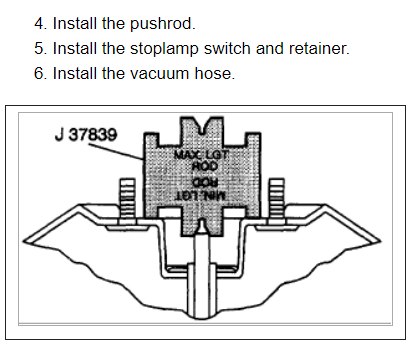
Here are the directions specific to your vehicle. The attached pictures correlate with the directions.

_______________________________

Master Cylinder
pic 1


CAUTION: Brake fluid will damage electrical connections and painted surfaces. Use shop cloths, drip pans and fender covers to prevent brake fluid from contacting these areas.

1. On vehicles with manual brakes, disconnect master cylinder pushrod from brake pedal.
2. On all models, disconnect all wire connectors from master cylinder components.
3. Disconnect brake lines from master cylinder. Cover the ends of the lines to prevent dirt from entering system.
4. Remove master cylinder mounting nuts, then the master cylinder.

CAUTION: Do not allow brake fluid to fall on the Anti-Lock control module, connectors or wiring.

For additional information see Notes, Warnings, and Hints. See: Brake Master Cylinder > Fundamentals and Basics

___________________________________________________

Install

1. Bench bleed master cylinder.
2. Install master cylinder and mounting bolts.
3. Connect brake lines to master cylinder.
4. Connect all wire connectors to master cylinder (if equipped).
5. On models with manual brakes, connect master cylinder push rod to brake pedal.
6. Bleed brakes.

_________________________________________________

Let me know if this helps or if you have other questions. Also, the link I supplied above (replacing a MC) explains how to bench bleed the new MC and system.

Take care,
Joe

Apr 9, 2021 at 2:21 PM (Merged)