No Spark, no start, new distributor

1997 CHRYSLER SEBRING
115,000 MILES • 2.5L • 6 CYL • 2WD • AUTOMATIC
Avatar
PEGGIESEBRING
  • MEMBER
  • 17 POSTS
The car above belongs to my daughter. I am in from out of town to fix it. AAA said that the car had a faulty distributor. I bought a new after market one from AM Auto Parts on eBay for $80.00. Installed the new one, no change. Proceeded to check the relays and fuses, including the three on fire wall. My next thought was the disabling alarm system could be engaged. I installed key in ignition and both doors switching key on to off six to eight times, no results.

Am using a good hot battery. A new starter was installed in October 2016. In May of 2016 the following work was also done on the car: Spark plugs and wires, timing belt with water pump, new crank shaft sprocket, timing belt tensioner, front cam shaft seal, new belts, both sides new valve cover gaskets, new oxygen sensors, new plenum gasket. Other work was done at this time but does not relate to charging or ignition systems. Oil changes regularly.

Possible note of interest: had a very bad positive battery terminal at battery on cable to starter. Repaired. Other connections seem good.

She drove it to work, went to leave seven hours later, and car would not start. Got it towed to house. Car has been sitting three months since.

Just to be sure, in my installation of distributor, I pulled off old one and aligned gears at bottom of distributor housing and put new one on. From my understanding, as long as engine was not turned over, I would not have to check TDC or set.

I am stumped from here. Correct me if wrong, the cam shaft sensor along with the coil is installed inside distributor housing, so it as well should be new. Seems to me only thing left would be ECM. AAA along with Firestone has not done anyone any favors with this car. The work done and prices charged is upsetting. Hopefully they are adequate enough to have installed timing gears and belts correctly. Although with the time passed and 7,000 miles later, I feel it would not be a concern.

Please help. I have to drive this car back home, and I am two days behind schedule already.

Just remembered, I hear fuel pump running seemingly appropriate. As well have not checked injector pulse. Thanks ahead
Jan 18, 2018 at 12:42 PM
Advertisement
Avatar
CARADIODOC
  • CERTIFIED EXPERT
  • 34,306 POSTS
The better suspect is a failed crankshaft position sensor. Do you have the convertible or hardtop model? The convertible is the domestic model and it has a camshaft position sensor on the driver's end of one of the cylinder heads. The convertible is a Mitsubishi product that has the camshaft position sensor inside the distributor.

Have you read and recorded the diagnostic fault codes? Do you know how to do that yourself? Have you checked for spark? When do you hear the fuel pump run? It should run for one second when you turn on the ignition switch.
Jan 18, 2018 at 5:46 PM
Avatar
PEGGIESEBRING
  • MEMBER
  • 17 POSTS
It is the LXI hardtop The Camshaft position sensor should be in the new distributor's. I have a OBD two code reader which shows no codes present at present time I would imagine if at the time of problem onset any codes that may have set at that time would have been erased as car set with drained battery during last three months. If I had my Snap-on mt2500 with me I might be able to pull up the history codes from ECM unfortunately I do not have with. Pulled I believe to be number plug and saw no fire as engine was turned.
Jan 18, 2018 at 9:24 PM
Advertisement
Avatar
PEGGIESEBRING
  • MEMBER
  • 17 POSTS
Sorry sent last reply before was finished with.
Spark was checked and number two plug none was seen feel pump initiates with turning ignition on and pumps for around one minute or until pressure is built.
Jan 18, 2018 at 9:28 PM
Avatar
PEGGIESEBRING
  • MEMBER
  • 17 POSTS
i really need help with this sobibcanvfet on the road. Thanks
Jan 19, 2018 at 1:18 PM
Avatar
PEGGIESEBRING
  • MEMBER
  • 17 POSTS
After researching more. I put a meter on the two wire plug going into distributor negative on battery negative meter positive on wire in coming from ECM through ASD relay. I got 13 volts for one second witch is the signal from cam sensor and 11.7 volts from crank sensor If I understand correctly.
the 11.7 volts from crank. Is a little low but instill think would make coil fire but I do not know. I need help. Some one please. Thank you.
Jan 19, 2018 at 4:41 PM
Avatar
CARADIODOC
  • CERTIFIED EXPERT
  • 34,306 POSTS
Chrysler does not use history fault codes. Well, they do, but we cannot get to them. Only they have the equipment to read them when a computer is returned for warranty purposes.

The fuel pump should not run for a minute. That would pose a serious fire hazard. Also, fuel pumps do not run until pressure is detected. The purpose of the system is to stop the pump if a fuel line is ruptured in a crash. This is where the camshaft position sensor and the crankshaft position sensor come in. The fuel pump will run for one second when the ignition switch is turned on to insure fuel pressure is up for starting, then it turns off. The engine computer turns the fuel pump relay and/or the automatic shutdown, (ASD) relay on again when the engine is rotating, cranking or running, and it knows that by the signal pulses from those two sensors.

If the fuel line is ruptured in a crash, there cannot be any fuel pressure in that line. No fuel will spray from the injectors, so the engine will stall. Once stalled, there will not be any signal pulses from the cam or crank sensors. In response, the computer turns the ASD and fuel pump relays off.

It is not uncommon to have no fault codes related to these sensors. They often do not set just from cranking the engine. They set when a stalled engine is coasting to a stop. I have a Chrysler DRB3 scanner for all of my vehicles. That lists each sensor with a "no" or "present" to indicate whether their signals are showing up during cranking. I cannot remember if your scanner shows that or not.

I never approve of throwing random parts at a problem, but given your situation, the crankshaft position sensor is the best suspect. Be aware that this one needs to have a very specific air gap. If you just stuff in a used sensor from a salvage yard, it is likely to be hit by the ring on the flex plate and will be damaged. New sensors from Chrysler have a thick paper spacer stuck on the end to set the gap. Push the sensor in as far as it will go, then tighten the bolts. The spacer will slide off as soon as you crank the engine. By that time, it is done doing its thing. You can buy these spacers from the Chrysler dealer's parts department. I cut them into four pieces to save money for my customers.

Some aftermarket sensors have a thin plastic rib molded onto the end to set the air gap. If you remove, then reinstall that style, you are supposed to cut off the remaining part of that rib, then use a paper spacer.

Be aware too that Chrysler made reading the diagnostic fault codes yourself much easier than any other manufacturer. Cycle the ignition switch from "off" to "run" three times within five seconds, leave it in "run", then watch the code numbers appear in the odometer display.

The 2.5L is not listed as an interference engine, but Chrysler does have a safety system built into many of their engine computers where it looks at the relationship of the signal pulses from the cam and crank sensors. If it sees the timing belt has jumped one tooth, it will turn on the check engine light and set a fault code for "cam and crank sync". If it jumps two teeth, the computer will shut the engine down by turning off the ASD relay.

The anti-theft system will be engaged when you charge a drained battery or reconnect the battery. To turn it off, cycle the door lock with the key. If that only works from one front door but not the other one, check for broken or frayed wires between the door hinges. Key in the ignition switch will not reset the system.

For my last comment of value, once you have spark and fuel, the idle speed is going to be too low, possibly to the point the engine will not start unless you hold the accelerator pedal down 1/4". All other data will be relearned except for "minimum throttle". The engine computer must relearn that to know when it must be in control of idle speed. To meet the conditions for the relearn to take place, drive at highway speed with the engine warmed up, then coast for at least seven seconds without touching the pedals.
Jan 19, 2018 at 5:08 PM
Avatar
PEGGIESEBRING
  • MEMBER
  • 17 POSTS
I appreciate your efforts and the information you have provided me with. If you would be so kind as to reread my initial question and the four comments I made afterwards. I feel like maybe some of them fell through the cracks in our communication.

I did press the accelerator pedal down 1/4 of an inch while trying to start it. It still would not crank. The voltage off the cam shaft is 13 and the voltage off the crank shaft it 11.7. I'm not sure if the crank shaft shaft voltage could be in question at that much under 12.

I own a computer reader but I left it because I assumed AAA would be right in their diagnostics. All I have is the code reader.
Jan 19, 2018 at 9:43 PM
Avatar
CARADIODOC
  • CERTIFIED EXPERT
  • 34,306 POSTS
I brought up the "cam / crank sync" fault code because the timing belt was replaced. There's plenty of opportunities to make a mistake that leaves the belt loose enough to jump a tooth or two, especially when the engine snaps backward when it's turned of. The idle speed is going to be too low because you had the battery cable off to repair that. Driving the car to work may have not met the conditions for the minimum throttle relearn to take place. The Engine Computer needs to see the very high vacuum of coasting for seven seconds, then it takes the reading from the throttle position sensor and puts that in memory. From then on, it knows it must be in control of idle speed any time it sees that same TPS voltage. Lack of that relearn taking place is a real common cause of a crank / no-start condition. Pressing the accelerator pedal just a fuzz is all it takes to overcome that.

The next thing is to determine if the automatic shutdown relay is turning on during cranking. Look for the wire that is the same color at every injector. Back-probe one of those with a test light. That works better than a digital voltmeter because meters don't respond fast enough. You should see the test light turn on for one second when you turn on the ignition switch. What is important is whether it turns on again during cranking. It should turn on within one or two seconds when the engine is rotating. If it does not, there's a problem with the crankshaft position sensor or with the camshaft position sensor in the distributor.

If the ASD relay does turn on during cranking but you have no spark, the best suspect is the ignition module in the new distributor. If the relay turned on for the first second, but not during cranking, the best approach is to connect a scanner so you can see which signal is listed as missing. That will tell you which sensor and its wires to check. It is common for those sensors to not set a fault code, or it can take an uncommonly long time to do that.
Jan 20, 2018 at 11:08 PM
Avatar
PEGGIESEBRING
  • MEMBER
  • 17 POSTS
Is the method of testing below adiquit to test asd relay, also should give info for cam sensor and crank sensor.

I put my negative from meter on negative battery terminal. positive on wire coming from ECM through ASD relay on the two wire plug on outside of distributor . I got 13 volts for one second witch is the signal from cam sensor and 11.7 volts from crank sensor If I understand correctly.
The 11.7 volts from crank. Is a little low but instill think would make coil fire but I do not know. I need help. Some one please. Thank you.
Jan 21, 2018 at 8:39 AM
Avatar
PEGGIESEBRING
  • MEMBER
  • 17 POSTS
without having a scanner at my disposal to check sync between cam and crank sensors with it being driven 7000 miles sinse the new timing belt was installed do you think a problem with its tightness would have showed up before now or just the opposite that it would have taken a while for any stretching to become in play if there was a problem with install.
Jan 21, 2018 at 2:46 PM
Avatar
CARADIODOC
  • CERTIFIED EXPERT
  • 34,306 POSTS
Any new part is a good suspect, even after 7,000 miles. Parts can fail prematurely. Lock bolts can be tightened insufficiently and work loose.

I don't know which wire at the distributor gets 12 volts from the ASD relay. I just searched to verify the injectors do because those are the easiest thing to find. You don't have to check at multiple places for that 12 volts. We just need to know if the relay is turning on during cranking.

It sounds like the wire you found at the distributor does indeed come from the ASD relay, but that is not from the camshaft position sensor. That 12 volts feeds the injectors, alternator field, oxygen sensor heaters, and the ignition coil. If your ignition coil is inside the distributor, that's why that 12 volts is there, and it should pulse on for just one second when the ignition switch is turned on, then again during cranking.

Chrysler and Mitsubishi do things close to the same way, so I'm deferring to my Chrysler experience. There's no 12 volts at the crankshaft position sensor. They are fed with 5.0 volts which is a common power supply to some of the other sensors, and they share a ground return wire that goes through the Engine Computer, THEN to ground. If the 5.0-volt feed wire or the ground wire had a problem, you'd have all kinds of diagnostic fault codes related to those multiple sensors. Since you don't have a pile of fault codes, that leaves the sensors and their individual signal wires.

You can't measure the signals coming off the cam or crank sensors with a digital voltmeter. The sensors put out a square-wave signal that switches from close to 0.00 volts to close to 5.0 volts. On the DC volts scale, the meter takes a reading, analyzes it, then displays it while it takes the next reading. One time it will see 5.0 volts, the next three times it might see 0.00 volts. The reading will bounce around and will be meaningless. Some people try to use the AC volts scale, but the meters are only accurate when reading a 60 Hz sine wave. They don't read square waves, and the frequency will vary all over the place and will also be meaningless. Some high-class meters read frequency and they can read that with square waves, but that won't tell you if the voltage of the signal is as strong as it's supposed to be. The meter could show you have a signal, but if it isn't correct and the Engine Computer doesn't accept it, you'll have a crank / no-start.

The other problem is very few position sensors generate a steady signal. The most common tone ring on Chrysler engines have three sets of three notches for V-6 engines. You get three square-wave pulses, a long gap, three more pulses, another long gap, then the last three pulses, for each crankshaft revolution. Those pulses from the crankshaft position sensor only tell the computer when a piston is coming up on top dead center on the compression / exhaust stroke. The camshaft position sensor is what tells the computer which piston is coming up on TDC.

Some engines have three notches, three notches, then four notches on the tone ring. The computer knows by the four signal pulses when a specific cylinder is coming up on TDC. Those still have a camshaft position sensor, but they can run in backup mode if the cam sensor fails.

Did you read the diagnostic fault codes yet? You can't determine anything related to a jumped timing belt with any meter. The computer learns the relationship between the signal pulses from both sensors. It sets the "cam / crank sync" code when that relationship changes too much, but since your engine is not an interference engine, I don't know if this applies to your car. I only mentioned it previously in case you found that code was set.

You found the 12 volt ASD wire at the distributor, but you didn't say if the 12 volts came back steady during cranking. Let me know what you find there or at the injectors.
Jan 21, 2018 at 11:06 PM
Avatar
PEGGIESEBRING
  • MEMBER
  • 17 POSTS
I appreciate very much you staying with me on this. Initially I got 13v for one sec from the cam sensor then was replaced by 11.7 witch maintained for duration of cranking. Indicating to me that both cam and crank sensors are working although the 11.7 is a little low. Witch could be caused by one of the other circuits that asd powers being shorted drawing power causing the low reading. You'll have to excuse if my wording is off as I am new the chrysler systems. and am not a mechanic anyhow. I made a mistake by not bringing my snap on m?2500 due to being rushed out the door. I'm inclined to believe you are right about the cam crank synk due to parts or workanship failure causing belt to jump a tooth maybe two as. Or their is an issue with possibly o2 sensor shorted caused voltage drop. The car has a history of o2 senor failures.
A couple dumb questions now. If it has jumped a tooth or two with that have to fixed and put back in time or can the coaralation synk be done with a scanner. Thanks again. I don't have the money to spend in the wrong direction so your help is much apprecited. Another couple notes. I had planned on pulling crank sensor and cleaning this am. As well i was gonna get someone to crank engine over while i listed for fuel pump at fuel cap. Will this tell anything helpful
Jan 22, 2018 at 5:26 AM
Avatar
PEGGIESEBRING
  • MEMBER
  • 17 POSTS
So to follow up from above. I went ahead and checked for 12v signal at injector. I got 12.7 for initiale sec from cam sensor then 11.3 from crank sensor. The voltage drop from readings from coil would I'm assuming be from leaving interior light on an hour or so couple days ago.
As well I listening and feeling for fuel pump operations. I do not hear or feel the fuel pump run after initial sec again til I turn key off and it pulses on again for about a sec.
Jan 22, 2018 at 7:16 AM
Avatar
CARADIODOC
  • CERTIFIED EXPERT
  • 34,306 POSTS
I don't understand why you keep referring to voltages coming from the cam and crank sensors. Those are signal voltages we can't measure. We have to let the Engine Computer tell us when there's a problem with them. You found 12 volts at an injector for the first one second after turning on the ignition switch. That single observation proves the ASD relay and its circuitry is working, and the computer has control of it. The second, and more important part of the test is whether that voltage comes back during cranking. It's going to be lower because battery voltage is being drawn down by the starter. The industry-standard is it must stay above 9.6 volts during cranking, but it's more common to find it's around 10.5 to 11.5 volts if the battery is good and fully-charged. The exact voltage is not important. What IS important is that it's there. In fact, since digital meters take too long to respond, I always recommend using a test light for this test. There's no way the exact voltage reading can become a confusing variable. With the test light, the voltage is there during cranking, or it isn't.

Since you have voltage at an injector during cranking, we know the crankshaft position sensor and the camshaft position sensor have to be working. We know that because the correct response from the Engine Computer is it turns the ASD relay on. That relay sends current to the alternator field, the oxygen sensor heaters, the injectors, and the ignition coil. All of this part of the system is responsible for about 95 percent of crank / no-start problems, but we just proved this part is okay. That leaves the other 5 percent of causes. Roughly three percent of the additional crank / no-starts are caused by fuel pump failures, and the last two percent by ignition system failures.

Where some confusion is added to this story is the camshaft position sensor is part of the input signal system that feeds the computer, then the computer feeds the ignition output system and the injector output system. Both the input system, (cam sensor) and the output system, (ignition coil) are inside the distributor. By looking at the 12 volts feeding the ignition coil, we have proven the input half is working, but if you don't have spark, it's the output half that is not working. Since there is also an electronic module built into the distributor that runs the ignition coil, that is the logical place to find the cause of the no-spark, meaning a defective new distributor.

Another way to look at this is when the computer sees the signal pulses from the cam and crank sensors, it turns on three circuits. One is the ASD relay which feeds 12 volts to the ignition coil, injectors, and other places. Basically, it turns on power for the entire engine. The second circuit is the group of wires that pulse the grounds to the individual injectors to open them and allow gas to spray into the engine. The third circuit is the ground for the ignition coil that is pulsed on and off. We need the 12 volt feed to the coil and injectors. We're getting that. Now we need the pulsing ground circuits for the injectors and ignition coil. We don't know if we're getting those, however, those outputs are also monitored by the computer and it will set a diagnostic fault code if a problem is detected. These two circuits cause very little trouble.

Inside the Engine Computer, the driver circuit for the ignition coil is going to cause even less trouble than normal, because instead of driving the ignition coil, which requires a lot of power, it is simply providing the tiny triggering pulse that tells the module inside the distributor when to fire the ignition coil. High-power circuits need high-power transistors, and that always translates into much lower reliability. A power transistor will fail thousands of times more often than a little signal transistor. What was done here is the circuit with the highest chance of failure was moved out of the expensive Engine Computer and put into the less-expensive distributor.

A "noid" light can be connected to one of the injector plugs to see if it is being pulsed by the computer during cranking. If it pulses, it proves the ASD relay is turning on and the computer is running that injector, both of which proves the cam and crank sensors are working. At that point, the no-start has to be caused by no spark OR no fuel pressure, but not both. If you hear the hum of the fuel pump for the first second when you turn on the ignition switch, we know that's working, and the cause has to be no spark. I've never tried this with a regular test light but it should be able to give you some indication as to whether the injectors are being pulsed. You found the wire that is the same color at every injector. That's the one that gets 12 volts from the ASD relay. Move the test light to the other wire, then see what happens during cranking. (This has to be done by back-probing the wire through the connector while that connector is plugged into the injector). I suspect you should see a bright light for one second, then it should be dimmer during cranking. Because the filament glows for a while, I don't think you will see it pulsing, but either dim or pulsing indicates the computer is running the injectors.

You had asked originally about adjusting ignition timing with the distributor. You don't have to worry about that. It's the pulses from the crankshaft position sensor that are very precise and are used for spark timing. Those pulses are very far advanced, in the order of 30 - 40 degrees. Based on engine speed, load, coolant temperature, rate of throttle change, and many other factors, the computer calculates the amount of delay it wants after a crank sensor pulse is received, then it triggers the ignition coil. That's how it achieves the desired amount of spark advance. The camshaft position sensor's signal only tells the computer when a certain cylinder is coming up on top dead center. Even if that were to be wrong, you still have the rotor in the distributor to send the spark voltage to the right spark plug. Even if the wires were mixed up, at worst, as long as the computer is triggering the ignition coil, you'd have spark, but at the wrong spark plugs at the wrong time.

You can test the operation of the ignition coil with Chrysler's DRB2 and DRB3 scanners, and I'm pretty sure you can do that with your MT2500 too. Under "actuator test mode", (ATM), you can select individual injectors or the ignition coil and command the Engine Computer to fire them. It will pulse the selected circuit about once per second. You'll have to listen next to the distributor for the clicking, indicating the ignition coil is firing. You can also remove the distributor cap, then lay a small jumper wire near the coil terminal, THEN continue the coil test while watching for spark. It's a good idea to stop the test while you're removing the cap because the spark voltage may insist on finding a path to ground before you get the jumper wire in place. Depending where that spark jumps to ground, it may leave a carbon track behind. Carbon conducts electrical current, and if that path is easier to follow, spark current will follow that short rather than go down the spark plug wires.

As long as I'm piling on a lot of information, I should mention too how the spark plug wires can be mixed up. This applies to the older Mitsubishi 3.0L too that was used on Caravans and some cars. You must go by the cylinder numbers molded on the top of the cap right next to each plug wire. The terminal the spark is coming out of does not correspond to where the tip of the rotor is under the cap. If you simply start with plug wire number one, then go around the cap in the firing order, four spark plug wires will be in the wrong places. Your symptom will be quite different than the crank / no-start you have now. You would have popping and backfiring which would verify you have spark, but at the wrong time.
Jan 23, 2018 at 1:09 PM
Avatar
PEGGIESEBRING
  • MEMBER
  • 17 POSTS
You should be picturing yourself as Michael Jordan flying , sailing from top of the key slamming down the ball as only b he could cause that was beautiful Truly !!! My daughter had had enough though and had it towed to AAA so i got a whole other problem now. They do not know wat they are doing and will not have an outside influence as to them they already know you know but as,I'm learning the are more worried about. Well not sure. But. I will let you know what is the verdict. Thank you for your efforts
Jan 23, 2018 at 11:41 PM
Avatar
CARADIODOC
  • CERTIFIED EXPERT
  • 34,306 POSTS
Darn the bad luck. I'm leaning toward a defective new distributor, but I wish I was there with my scanner to see it for myself. I have an extra plug-in card that lets my DRB3 work on cars all the way back to '83 models. It has a drop-down menu for crank / "No start" diagnosis, but it has been a real long time since I used that. As I recall, it just takes the pertinent dozen or so items from the list of about 50 things it monitors, and puts them on one screen. You still have to interpret the readings yourself to figure out which is wrong.

Having the scanner helps make the diagnosis easier, but it frustrates me that cars have become so unnecessarily-complicated. Please let us know what the final solution is so I can put that in my memory banks.
Jan 24, 2018 at 4:25 PM
Avatar
PEGGIESEBRING
  • MEMBER
  • 17 POSTS
Well AAA Is a joke service manager had said they would be glad to run diagnostics After getting car towed there i got no call backs ,hang up , excuses . Never seen such arrogant ,no delivery ,rude in this manner. Finally they told me their snap on diagnostic module had to have special hook ups that they didn't have to do any diagnostics for thus system. Idk but AAA custumer service towed car back fir free but now I've lost four days on car. Only info I got from them was they are two different distributors for these cars. Apparently they have different shafts sizes in the distributors. I figure I'll check the old distibitor components and if it did have the problem I will know the new is the current problem if I dont find anything with old one then I'm gonna check the negative side of the cam and crank sensors for pulse. As well im not hearing fuel pump run after the crankshaft sensor takes over would it be running if prime was already made by initial one second run from can sensor. Or should it be running regardless from from crank sensor. Thanks
Jan 25, 2018 at 1:30 PM
Avatar
CARADIODOC
  • CERTIFIED EXPERT
  • 34,306 POSTS
Sorry that I didn't explain it better. The Engine Computer turns the ASD relay on two times. The first time is the one second when you turn on the ignition switch. That is to insure fuel pressure is up for running in case it bled down over days or weeks. That one second activation has nothing to do with the cam and crank sensor signals. It will occur regardless if the sensors are good or bad.

The second activation is any time the crankshaft is rotating. That can be while cranking an engine that won't start or run, OR when the engine is running. During cranking and during running is when the cam and crank sensor develop signal pulses. Both sensors are a coil of wire wrapped around a magnet. Whether it's this type of sensor on the engine, a wheel speed sensor, a generator or alternator, you always need three things to generate a voltage. That is a wire, (a coil of wire is more efficient), a magnet, and most importantly, movement between the two. That's why alternators have to be spun by the belt.

In the case of the cam and crank sensors, the movement between the coil of wire and the magnetic field comes from disturbing that magnetic field. That is done in your cam sensor by a piece of metal passing near the tip of the magnet. For your crankshaft position sensor, that is done by passing a hole in a metal plate past the tip of the magnet. Regardless how it's done,, it's the movement that is needed for the sensors to generate a voltage pulse, and that means you have to be cranking the engine.

When the signal pulses show up from both sensors, the Engine Computer knows the crankshaft is rotating and it's time to turn the ASD relay back on. That powers up the ignition coil and injectors so the engine will run. This is when we want to know if the 12 volts reappears on that wire at the injector. If it does, the cam and crank sensors have to be generating their signals, and we have a problem in the ignition system OR the fuel system, but not both. When the ASD relay does not turn on again during cranking, it's because the computer didn't turn the ASD relay back on. We won't have spark AND we won't have fuel pump and injector pulses. That's when we have to figure out which sensor signal is missing. Sometimes we get lucky and the computer will set a diagnostic fault code to indicate which signal is missing, but most of the time we have to use a scanner to see that. Each sensor will be shown as "No" when the ignition switch is on, then they should switch to "Present" as soon as you start cranking the engine. When one sensor circuit isn't working, it will not switch to "Preset". It will continue to say "No". That's the circuit we need to diagnose.
Jan 25, 2018 at 5:04 PM
Avatar
PEGGIESEBRING
  • MEMBER
  • 17 POSTS
We know the vCard computer is turning the asd on for both cam and crank sensors signals at the coil and injectors . What powers the fuel pump it is only coming on initially. Should it be running or not when cranksign ass l takes over.
Jan 26, 2018 at 12:51 AM
Avatar
PEGGIESEBRING
  • MEMBER
  • 17 POSTS
And my old coil did check out good using ohmmrter. Not sure how to check the I other components in old distributor.
Jan 26, 2018 at 12:55 AM
Avatar
CARADIODOC
  • CERTIFIED EXPERT
  • 34,306 POSTS
With your system, the Engine Computer uses two separate terminals to turn the relays on, one for the ASD relay and one for the fuel pump, but they should both turn on at the same time. That is for one second when the ignition switch is turned on, then again when the engine is rotating. You can usually hear the hum of the fuel pump for that one second, but not during cranking because the starter motor is too loud. Anyway, if you hear the hum for that first one second, the fuel pump, its circuitry, and the relay are working.

I'm worried there is still some confusion about the cam and crank sensors. In your first sentence, you said, "We know the vCard computer is turning the asd on for both cam and crank sensors".

Think of a crossing guard at a grade school. The guard holds up his hands, then sees the cars come to a stop. That is the signal that tells him to motion the kids to cross the road. When you say, "turning the asd on FOR both cam and crank sensors", I'm worried you're equating that to the crossing guard's purpose for being there is to stop cars. It's not. His purpose is to know when to let kids cross the road, and he knows that by seeing the cars have stopped. The Engine Computer's job is to turn on the ASD and fuel pump relays, and it knows when to do that by observing there are signals showing up from those sensors.

Once the computer has turned on those two relays, we're way past the cam and crank sensors. They're working and don't get any more attention from us. Now we have to look at what the ASD relay powers up; in this case the ignition coils and injectors. You found 12 volts way back earlier at one of the injectors, during cranking. That proved the computer turned on the ASD relay, and that proved we're getting signal pulses from both sensors. Since we know the sensors are working, their pulses are also used to tell the computer exactly when to fire an injector and an ignition coil. We're supposed to be getting injector pulses and spark from the ignition coil, but we're missing spark. Injector pulses are harder to tell. It works best to use a special "noid" light, but few of us have them. I never invested in them because there is so little need of them.

Once both sensor signals are showing up at the computer, it is usually pretty good about firing the ignition coil. That circuitry is quite robust and has a real low failure rate. In your model, however, that high-stress circuit is moved to inside the distributor where it sits right next to the ignition coil. Because it is a high-stress circuit that uses high-power transistors, it is a real good candidate for failure, even when it's brand new. That's why, from everything we've figured out so far, while I never want to believe a new part can be bad, that is what it looks like.
Jan 26, 2018 at 6:48 PM
Avatar
PEGGIESEBRING
  • MEMBER
  • 17 POSTS
I didnt get oppurtunity to work on car today.
Before I contact am autoparts about a bad distributor I want to check the pulse at injectors. Sinse I don't have a test light with me I am gonna go ahead and buy a noid light. To do test

The fuel pump and its circuit do seem to be working properly still I have a question about the pump not working when the crankshaft sensor signal has taken over for cam sensor signal I raised backseat so to be able to feel the vibration of pump and for sure it works initially for one second when switch is on but then does not work during cranking but does come back on for one second when turning switch off
Lastly is there a way to test the ignition module I believe that's what you called it inside nee distributor that you feel is bad ?
Jan 27, 2018 at 6:41 PM
Avatar
CARADIODOC
  • CERTIFIED EXPERT
  • 34,306 POSTS
I've never found anyone who knows if the ignition module can be tested, and you'll almost always find the only way to get it is to buy the distributor.

I'm trying to find a classroom manual for your engine. For the domestic version, if the fuel pump doesn't turn on again during cranking, there won't be spark or injector pulses either. Since you have the 12 volts from the ASD relay turning on during cranking, you should be missing spark, injector pulses, OR fuel pump, but not all three. Your observation proves the fuel pump is working, and even when it doesn't resume running, there's enough volume and pressure in the line for the engine to run for a few seconds. We aren't even getting that, so we have to missing spark or injector pulses.

What I'm questioning is on the domestic engine, signal pulses are needed from both the cam and crank sensors for the computer to turn on the ASD relay. Many newer engines need only one sensor to work for spark, and both sensors to work for everything else.
Jan 27, 2018 at 6:59 PM
Avatar
PEGGIESEBRING
  • MEMBER
  • 17 POSTS
0k i decided to go with one of the new test lights that shows a different color for neg and pos wires. Witch turns out was the right call. there is a short somewhere cross feeding the negative and positive . I was getting a ground on both wires with switch not on and it left and no pulse on negative or positive as well i was getting voltage feeds on negative and positive from cam and crank sensors. question now is were to start chasing this down. i feel ive already made this way more difficult than it should have been but ive learned a whole lot in the proccess. and again want to thank you for your patients. im guessing from the Asd to the where?
Jan 28, 2018 at 7:10 AM
Avatar
CARADIODOC
  • CERTIFIED EXPERT
  • 34,306 POSTS
If you're measuring on the ASD wire at the ignition coil or injector, when everything is turned off, it is normal to read something to ground. It's reading through other stuff that's connected to that circuit. On the domestic models, that would be the fuel pump's motor. On others, that could be through the oxygen sensor heaters or some solenoids in the emissions system.

Lets go back to one of the injectors. Probe the wire that is the same color at every injector. You should see 12 volts there for one second when you turn on the ignition switch. If you see that, next we need that 12 volts to come back steady during cranking. If it does not, the problem is with the crankshaft position sensor or the camshaft position sensor. The only way I know how to tell which one has the problem is with a scanner. Mine shows those sensors in a list of up to 50 other things. They are shown as "No" when the ignition switch is on, then they switch to "Present" when I crank the engine. If one of them doesn't switch to "Present", that is the one that needs to be diagnosed. About half of the time that is caused by a failed sensor, and the other half it's due to a wire or connector terminal problem.

I'm working on a drawing at home that might explain better how the two sensors are involved in this system. I'll try to post that in the next day or two.
Jan 28, 2018 at 5:43 PM
Avatar
CARADIODOC
  • CERTIFIED EXPERT
  • 34,306 POSTS
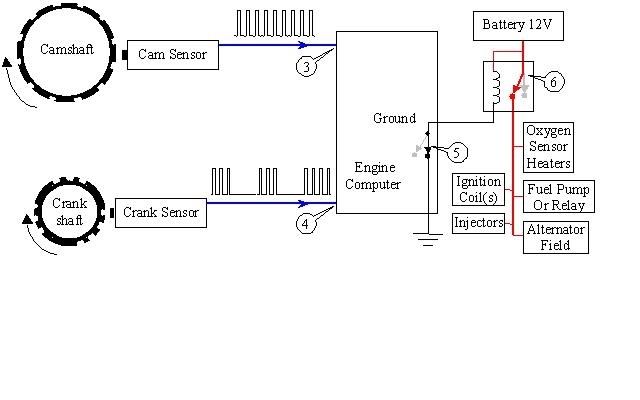
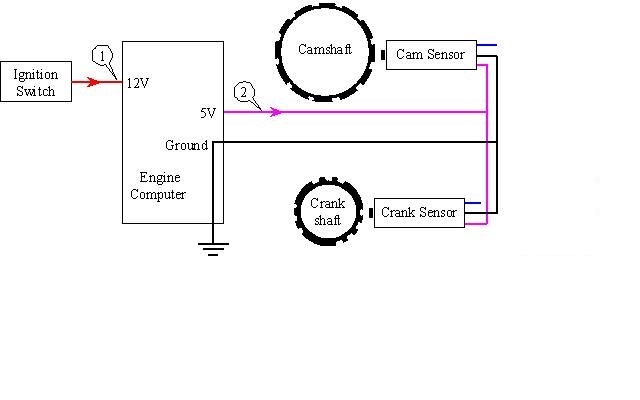
1. In the first drawing, the ignition switch is turned to the "run" position. 12 volts shows up at the Engine Computer to turn it on. (Cute little number "1" in the circle).

2. The computer generates a carefully-regulated 5.0 volt power supply to run multiple sensors, including the cam and crank sensors. That 5.0 volts feeds the two sensors on the purple wire. The ground return wire is common to all the sensors on the engine. It goes through the computer so it can be monitored. At this point, the sensors are waiting to start detecting movement of their sprockets or tone rings by looking at the notches cut into those sensor rings.

In the second nifty drawing, the sprockets are rotating, either from the starter cranking the engine, or because the engine is running. Each time a notch passes by the tip of the sensor, a pulse of voltage is generated. It is amplified by each sensor's internal circuitry to send out pulses that switch between 0.0 and 5.0 volts.

3. The camshaft sprocket is shown with 12 notches, but the actual number will vary between engines and years. I think yours only generates two pulses per revolution. When an engine uses an ignition coil pack with two, three, or four individual coils, the notches will have offset spaces and gaps so the computer can figure out which piston is coming up on top dead center. That's how it knows which coil to fire. When you have a distributor, it's up to the position of its rotor to send spark voltage to the correct spark plug. The computer only has to know when to fire the one ignition coil. It doesn't know which cylinder it's firing.

4. The crankshaft sprocket has three groups of notches with a different number of notches per group. With this arrangement, the computer knows which pair of pistons are coming up on top dead center. One will be on the compression stroke, and one will be on the exhaust stroke. Both spark plugs fire at the same time. Once the crankshaft rotates at least one full revolution, the computer will know which ignition coil to fire when it sees the oddball number of notches.

With this design, the signal pulses from the crankshaft position sensor just tell the computer which cylinders to fire next. It's the signal from the camshaft position sensor that tells it very precisely when to fire that spark plug. The opposite is true for some other engines. It can be the camshaft position sensor that tells the computer which coil to fire, and the crankshaft position sensor is the one that dictates the precise spark timing. Some engines use one signal for precise spark timing and the other one for precise injector timing. We don't need to know that. We only care that both signals are there.

5. When the computer sees both signals at "3" and "4", it turns on its internal switch to ground the coil inside the automatic shutdown, (ASD) relay.

6. Energizing the ASD relay turns on its high-current switch, ("6"), and that sends current, on the red wires, to all the circuits shown.

The fuel pump is grounded already, so it runs. The computer grounds the oxygen sensor heaters to make them operate. It grounds the injectors for a very short, pre-programed amount of time to allow them to spray fuel into the intake manifold, then that ground is turned off until the next squirt of fuel is needed. The ignition coils are just the opposite but work the same way. The computer keeps them grounded so a nice big electromagnetic field builds up inside them, then it turns that ground off the exact instant it wants that coil to fire a spark plug. The magnetic field built up relatively slowly when the ground was turned on, but when the ground is turned off, that really strong magnetic field has no choice but to collapse instantly. That really fast movement of that collapsing magnetic field is what induces the really high voltage in the primary part of the ignition coil, then that is seriously-multiplied in the secondary part where the spark voltage is developed. The computer turns the ignition coil's ground off at the precise time it wants a spark, then it turns that ground back on as soon as possible to give the magnetic field plenty of time to build up for the next event.

The purpose of this system is if the fuel line is ruptured in a crash, the electric fuel pump would keep on dumping raw gas onto the ground where it would be a major fire hazard. With a broken fuel line, there can't be any pressure in it. With no pressure, no fuel will spray from the injectors. That causes the engine to stall. Once the crankshaft and camshaft are no longer rotating, the two sensors stop generating signal pulses. The computer sees that as it's time to turn the ASD relay off. That kills the 12 volts going to the fuel pump.

The only difference on your car is the fuel pump is fed its 12 volts through its own fuel pump relay instead of through the ASD relay. Both relays get turned on and off at the same time, just by different circuits in the computer.

There's three ways the engine can have a crank / no-start problem. The least common is when the ignition coil fails, as it appeared was the case with your car. The symptom is no spark. The next way is the fuel pump fails. The symptoms are you'll have spark, but no fuel pressure. By far, the most common failure is when one of the sensors fails. The computer turns off the ASD relay, so that results in no spark AND no fuel pump, AND no injector pulses. Where many people become confused is the pump still runs for one second each time the ignition switch is turned on, and that is why there is fuel pressure in the line, when it is checked.
Jan 29, 2018 at 7:25 PM
Avatar
PEGGIESEBRING
  • MEMBER
  • 17 POSTS
I'm gonna try a crankshaft position sensor I'm confused and I thought leaning I wasn't getting injector pulse would have helped
Jan 31, 2018 at 11:56 PM
Avatar
MITCH THOMPSON
  • MEMBER
  • 1 POST
CARADIODOC, holy cow those are some detailed explanations. I'm troubleshooting the exact same problem, exact same steps. I have fuel (lord I can smell it in the exhaust) so I know the cam / crank sensors are happy. There is no spark. Everything points to the distributor but I can't find single thing wrong with it. I checked the FET inside and it reads ok. The coil checks out ok 1.3 ohms per coil. I am at a loss why there's no spark. Guess I'll have to go over it all again!

Edit: manually tested the coil, it doesn't spark. I bought the incorrect replacement (Mitsubishi Colt, almost identical but the spark output is a little shorter). Tested the new coil using a 12v power supply and got a beautiful little 4mm spark and a nice jolt up my arm. Means the old one is definitely toast. Gonna reorder. $16 part!

Edit: I might add that the "bad" coil read ok on a multimeter but didn't actually work. Readings were identical to the new one!
Apr 28, 2021 at 7:11 PM
Avatar
CARADIODOC
  • CERTIFIED EXPERT
  • 34,306 POSTS
So you're saying it's work9ing now, or are you still waiting for parts?

As for testing parts like ignition coils and injectors, we never measure their resistance to do a diagnosis, only later if we wish to learn why that part wasn't working. The problem with measuring them is very often they'll measure out-of-specs, but still be working just fine, especially with injectors. Numbers given in the service manual are just for reference. When you take a properly-working part, then measure its resistance just for the fun of it, you'll find it reads out-of-specs just as often as one reads in-specs.

The other problem, mostly with ignition coils, is carbon-tracking can develop internally. That has such a high resistance that you'll still be reading mainly the coil of wire itself, but in service the voltage will find it easier to jump across that carbon tracking than to jump the spark plug's gap. This is where you might get a real weak spark from the coil. The only other way to get weak spark is for a good percentage of the loops of wire in the secondary coil to be shorted together. That is physically pretty hard to have happen. In that case you would find its resistance to be much too low, but that would be a very uncommon failure.

Please let me know when you have this solved.
Apr 28, 2021 at 9:33 PM