No fuel pressure, injectors dripping fuel

1989 CHEVROLET 1500
206,000 MILES • 5.7L • V8 • 2WD • AUTOMATIC
Avatar
JOE UTLEY
  • MEMBER
  • 13 POSTS
I have changed the fuel pump twice, rebuilt the TBI with new injectors, new fuel filter, new distributor and changed a bunch of sensors/ECM. The injectors are still dripping fuel. I hooked up a fuel pressure gauge right after the fuel pump and I’m not getting any fuel pressure. So I’m stumped. What do I do next?
Jul 6, 2020 at 5:55 PM
Advertisement
Avatar
ASEMASTER6371
  • CERTIFIED EXPERT
  • 52,796 POSTS
Good morning,

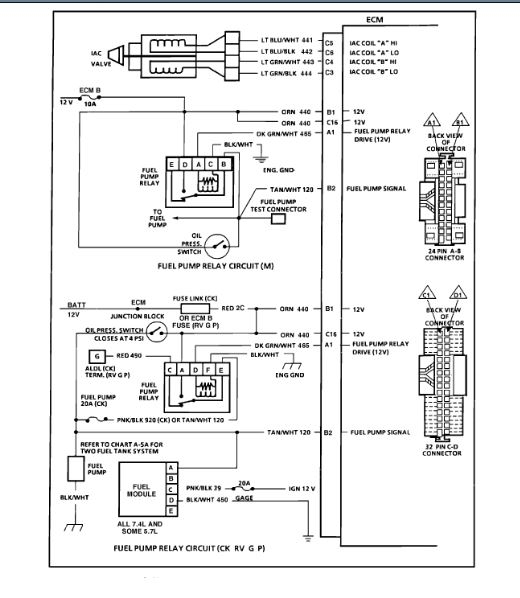
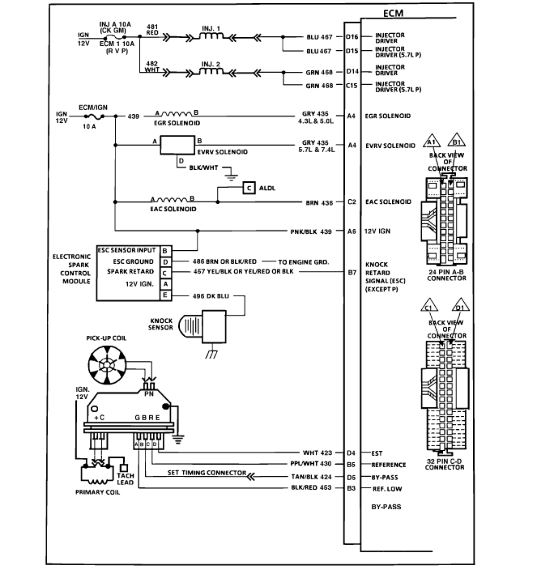
I attached a wiring diagram for you to view. We need to verify power to the pump to find out why you have no pressure.

https://www.2carpros.com/articles/how-to-check-wiring

https://www.2carpros.com/articles/how-to-check-an-electrical-relay-and-wiring-control-circuit

By dripping, do you mean the injector is dripping from the pindle or the mounts?

With no pressure, they should not drip at all.

Roy

Jul 7, 2020 at 6:10 AM
Avatar
JOE UTLEY
  • MEMBER
  • 13 POSTS
Hello. Thanks for the reply. The injectors are dripping from the pintle.
Jul 7, 2020 at 9:46 AM
Advertisement
Avatar
ASEMASTER6371
  • CERTIFIED EXPERT
  • 52,796 POSTS
If you have no pressure, they should not be doing that.

Did you do a pressure test? You can rent a tester at a parts store.

https://www.2carpros.com/articles/how-to-check-fuel-system-pressure-and-regulator

Roy
Jul 7, 2020 at 10:25 AM
Avatar
JOE UTLEY
  • MEMBER
  • 13 POSTS
So I went to start it up with the fuel pressure gauge attached and the truck won’t crank. I had the starter tested and it’s not the starter. so now I’m going to change the ignition switch. Could the two issues be related?
Jul 7, 2020 at 12:43 PM
Avatar
ASEMASTER6371
  • CERTIFIED EXPERT
  • 52,796 POSTS
Maybe but in my first response, I asked if you checked for power to the fuel pump. Did you ever do that?

Why do you think it is the ignition switch?

Roy
Jul 7, 2020 at 12:52 PM
Avatar
JOE UTLEY
  • MEMBER
  • 13 POSTS
Yes, the pump is getting power. The meter said it’s receiving 7.95 volts. That’s at the pump connector. I think the starter solenoid isn’t receiving power from the ignition switch. That was my first thought because the starter is good.
Jul 7, 2020 at 1:01 PM
Avatar
ASEMASTER6371
  • CERTIFIED EXPERT
  • 52,796 POSTS
That was not the pump. That was for the sending unit.

The fuel pump must have battery voltage to work.

With the key on, it will have power for 2 seconds for priming. When cranking, it will have power all the time.

It should be the purple wire.

Roy

Jul 7, 2020 at 1:09 PM
Avatar
JOE UTLEY
  • MEMBER
  • 13 POSTS
It has power from the purple wire “0.35.
Jul 7, 2020 at 1:33 PM
Avatar
ASEMASTER6371
  • CERTIFIED EXPERT
  • 52,796 POSTS
That is not power. It needs a minimum of 12 volts for the pump to work.

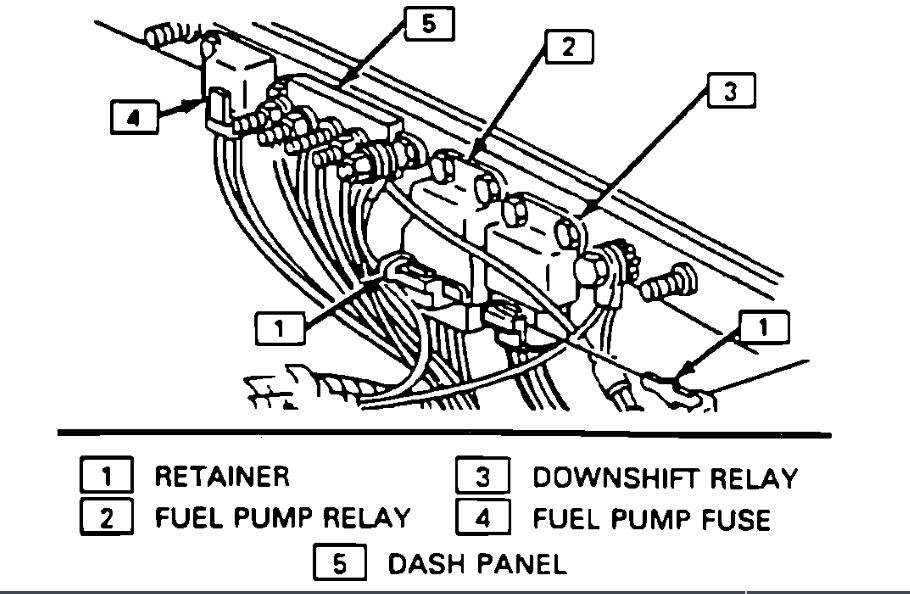
I attached a picture and location of the relay. We need to find out why there is no power at the pump.

Do you have a test light or voltmeter for some testing?

https://www.2carpros.com/articles/how-to-check-an-electrical-relay-and-wiring-control-circuit

Roy
Jul 7, 2020 at 1:42 PM
Avatar
JOE UTLEY
  • MEMBER
  • 13 POSTS
Yes, I have a voltage meter.
Jul 7, 2020 at 1:43 PM
Avatar
ASEMASTER6371
  • CERTIFIED EXPERT
  • 52,796 POSTS
Go to the fuel pump relay and remove it.

Test for battery voltage with the key on a one terminal.

If you have power, then you need to test for power when the key is first turned on to another terminal. It will last for only 2 seconds.

Roy
Jul 7, 2020 at 1:48 PM
Avatar
JOE UTLEY
  • MEMBER
  • 13 POSTS
Okay. I found a constant power on the fuel pump relay connector and it has 12 volts. I also found the 2 second source and that one has 11.75 volts for 2 seconds.
Jul 7, 2020 at 1:59 PM
Avatar
JOE UTLEY
  • MEMBER
  • 13 POSTS
I cannot try to start the truck though because the truck won’t turn over.
Jul 7, 2020 at 2:23 PM
Avatar
ASEMASTER6371
  • CERTIFIED EXPERT
  • 52,796 POSTS
Okay, good.

Put the relay back in and turn the key to on and see if the relay clicks.

Roy
Jul 7, 2020 at 2:49 PM
Avatar
JOE UTLEY
  • MEMBER
  • 13 POSTS
Yes the relay clicks.
Jul 7, 2020 at 2:51 PM
Avatar
ASEMASTER6371
  • CERTIFIED EXPERT
  • 52,796 POSTS
Okay, with the relay in have someone turn the key to on and test the purple wire when the relay clicks in.

Roy
Jul 7, 2020 at 2:54 PM
Avatar
JOE UTLEY
  • MEMBER
  • 13 POSTS
I have 0.35 at the purple wire, but I can hear the fuel pump turn on for those 2 seconds. I also have 8.5 volts coming from the pink wire that connects to the purple wire at the connector .
Jul 7, 2020 at 3:24 PM
Avatar
ASEMASTER6371
  • CERTIFIED EXPERT
  • 52,796 POSTS
The purple wire should have battery voltage, not .35 volts. The pump will not run with that voltage.

Please recheck.

Roy
Jul 7, 2020 at 3:49 PM
Avatar
JOE UTLEY
  • MEMBER
  • 13 POSTS
I cannot get my prob to go in deep enough to get a good reading. Any ideas on how to get a good reading?
Jul 7, 2020 at 5:34 PM
Avatar
ASEMASTER6371
  • CERTIFIED EXPERT
  • 52,796 POSTS
You need a set of back probes. They are thin enough to get to the wire while it is hooked up to the relay from underneath.

You can get a set of them cheap at a parts store.

https://www.harborfreight.com/test-probe-set-5-pc-61872.html

Roy
Jul 7, 2020 at 5:38 PM
Avatar
JOE UTLEY
  • MEMBER
  • 13 POSTS
I have confirmed that the purple wire doesn’t have power.
Jul 7, 2020 at 6:43 PM
Avatar
JOE UTLEY
  • MEMBER
  • 13 POSTS
Correction. I tested the gray wire and that has 12 volts to the pump. The purple wire which is my fuel level gauge has no power. So the fuel pump is getting power and I now have 5 lbs of fuel pressure. The injectors are dripping still and the truck will run with starting fluid only.
Jul 7, 2020 at 9:32 PM
Avatar
ASEMASTER6371
  • CERTIFIED EXPERT
  • 52,796 POSTS
Okay, thanks.

You need 9 to 13 pounds of fuel pressure to run.

You need a fuel pump. If the injectors are leaking, remove the connector and see if it still leaks.

https://www.2carpros.com/articles/how-to-replace-an-electric-fuel-pump

If it does, replace the injectors. If it does not, you could need an ECM or you have a wiring issue from the ECM to the injectors.

Roy

CAUTION:

a. Each fuel injector is serviced as a complete assembly only.

b. Use care in removing the fuel injectors to prevent damage to the electrical connector terminals, the injector filter, and the fuel nozzle. The fuel injector is serviced as a complete assembly only. Also, since the injectors are electrical components, they should not be immersed in any type of liquid solvent or cleaner as damage could occur.

REMOVAL:

1. Disconnect electrical connectors to fuel injectors. (Squeeze plastic tabs and pull straight up.)
2. Remove fuel meter cover assembly, refer to FUEL METER COVER ASSEMBLY.
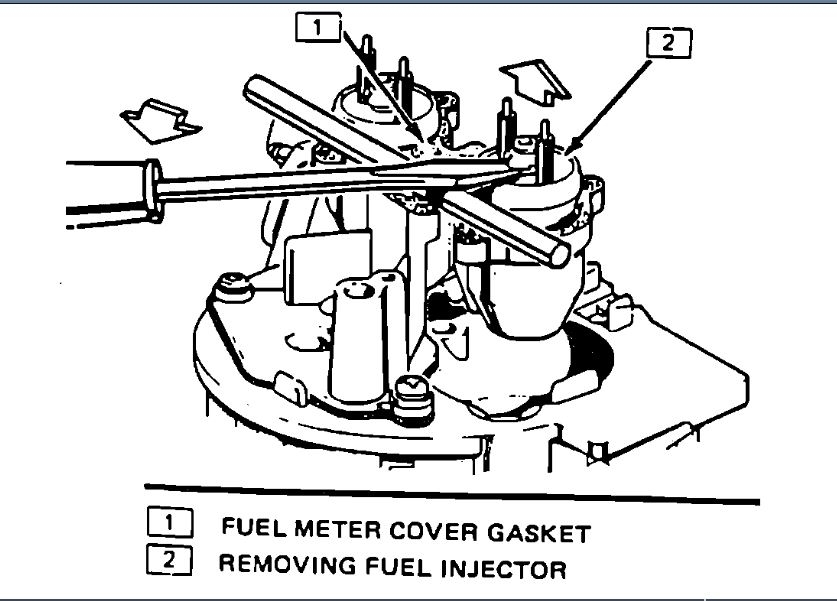
3. With fuel meter cover gasket in place to prevent damage to casting, use a screwdriver and fulcrum to carefully lift out each injector.
4. Remove lower (small) O-rings from nozzle of injectors and discard.
5. Remove fuel meter cover gasket and discard.
6. Remove upper (large) O-rings and steel backup washers from top of fuel injector cavity and discard.

INSPECTION:

Fuel injector filter for evidence of dirt and contamination. If present, check for presence of dirt in fuel lines and fuel tank. If dirt is present refer to MAINTENANCE PROCEDURES/FUEL SYSTEM CLEANING.

Fuel Injector Part Number Location
imageOpen In New TabZoom/Print


Be sure to replace the injector with an identical part. Different injectors with different flow rates will fit this unit, but are calibrated for different flow rates.


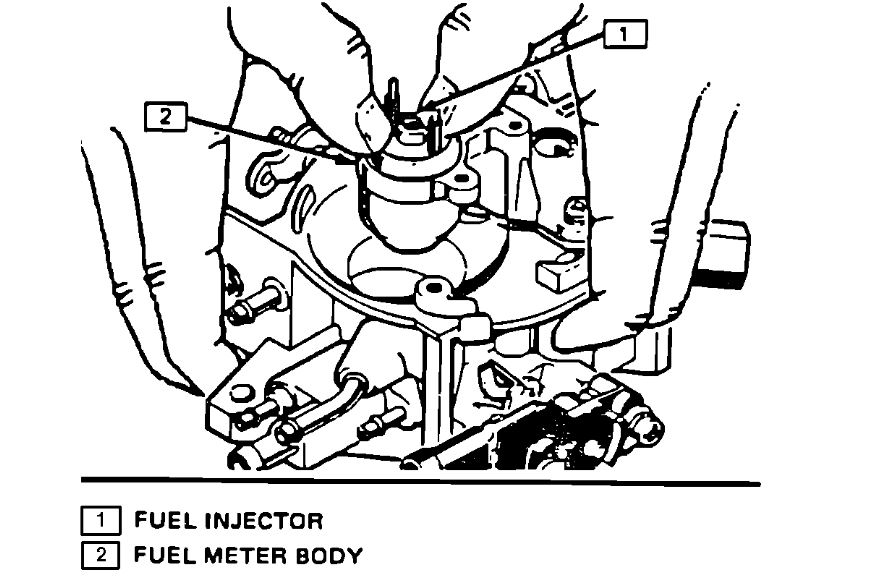
Fuel Injector Installation
imageOpen In New TabZoom/Print


INSTALLATION:

1. Lubricate new lower (small) O-rings with automatic transmission fluid and push on nozzle end of injector until it presses against injector fuel filter.
2. Install steel injector back up washer in counterbore of fuel meter body.
3. Lubricate new upper (large) O-rings with automatic transmission fluid and install directly over the back up washer. Be sure the O-ring is seated properly and is flush with top of fuel meter body surface.
NOTE: Backup washers and O-rings must be installed before injectors, or improper seating of large O-rings could cause fuel to leak.
4. Install injector, aligning raised lug on each injector base with notch in fuel meter body cavity. Push down on injector until it is fully seated in the fuel meter body. (Electrical terminals of the injector should be parallel with throttle shaft).
5. Install fuel meter cover gasket.
6. Install fuel meter cover.
7. Reconnect electrical connectors to fuel injectors.
8. With engine OFF and ignition ON, check for fuel leaks.
Jul 8, 2020 at 3:35 AM