OBD code P1750

1997 MITSUBISHI GALANT
Avatar
ROME237
  • MEMBER
  • 3 POSTS
Four cylinder front wheel drive automatic 111,000 miles.

Hello,

So the car goes into a neutral limp mode type state when switching from third to fourth gear. The only code popping up is P1750.

In detail what does this code mean?

Where exactly is the fault located?

How do I fix it?

Also, where exactly is the transmission dipstick/add port?


Thank you sincerely in advance.
Jan 16, 2009 at 2:47 AM
Advertisement
Avatar
IMPALASS
  • CERTIFIED EXPERT
  • 3,112 POSTS
Hello,

According to the information this is a solenoid assembly malfunction. It could be the converter clutch solenoid, shift control solenoid, pressure control solenoid or engine control module has failed.

If you would like to see if I can provide some information that maybe you can check it out for yourself without certain test equipment first, I would be glad to. If you do , then to better assist you please be more specific on your vehicle model is it a DE, ES or LS?
be sure to please give me your engine size in liter.
Jan 16, 2009 at 7:39 AM
Avatar
ROME237
  • MEMBER
  • 3 POSTS
Thank you,

1996 Galant S which is a 2.4 liter.

I need to know where the transmission dipstick is?

Also, which solenoid assembly is it? How do I find out?

Where is it located?
Jan 16, 2009 at 11:59 AM
Advertisement
Avatar
IMPALASS
  • CERTIFIED EXPERT
  • 3,112 POSTS
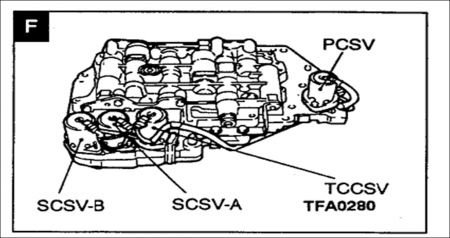
Hello, The dip stick I do not have a picture or does it mention the location. You might try checking right under the battery that is where many are. It is really hard to see and check. I have put a test for the converter clutch solenoid.


https://www.2carpros.com/forum/automotive_pictures/248015_Torque_Control_1.jpg


https://www.2carpros.com/forum/automotive_pictures/248015_Torque_Control_2_1.jpg

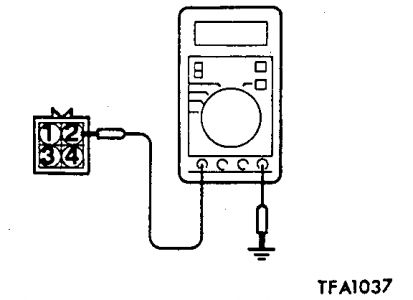
INSPECTION: 1. Disconnect the Torque Converter Clutch (TCC) solenoid connector. 2. Measure the resistance between the TCC solenoid side connector terminal 2 and the body ground. Standard value: Approximately 13 ohms [at 20 °C (68 °F)] 3. If the resistance is outside the standard value, replace the solenoid valve assembly. I have attached info for the shift solenoid.......use the first pic for the location.


https://www.2carpros.com/forum/automotive_pictures/248015_Shift_1_1.jpg

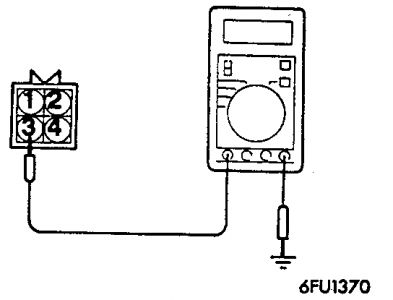
SHIFT CONTROL SOLENOID VALVE A (SCSV-A) CHECK: 1. Disconnect the SCSV-A connector. 2. Measure the resistance between the SCSV-A side connector terminal 3 and the body ground. Standard value: Approximately 22 ohms [at 20 °C (68 °F)] 3. If the resistance is outside the standard value, replace the solenoid valve assembly.


https://www.2carpros.com/forum/automotive_pictures/248015_Shift_2_1.jpg

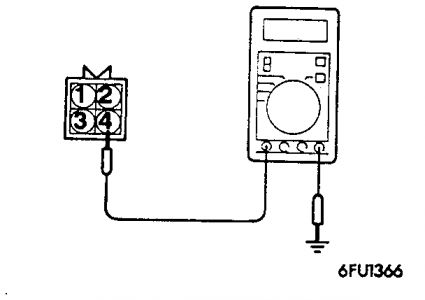
SHIFT CONTROL SOLENOID VALVE B (SCSV-B) CHECK : 1. Disconnect the SCSV-B connector. 2. Measure the resistance between the SCSV-B side connector terminal 4 and the body ground. Standard value: Approximately 22 ohms [at 20 °C (68 °F)] 3. If the resistance is outside the standard value, replace the solenoid valve assembly. Use the first picture, this is the test for the pressure solenoid.


https://www.2carpros.com/forum/automotive_pictures/248015_Pressure_1_1.jpg

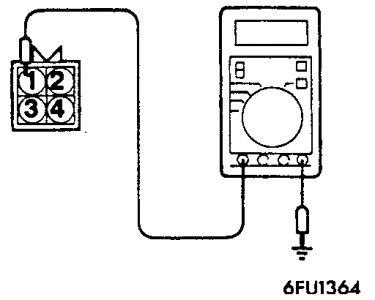
INSPECTION: 1. Disconnect the Pressure Control Solenoid Valve (PCSV) connector. 2. Measure the resistance between the PCSV side connector terminal 1 and the body ground. Standard value: Approximately 3 ohms [at 20 °C (68 °F)] 3. If the resistance is outside the standard value, replace the solenoid valve assembly.
Jan 17, 2009 at 1:29 PM