Loud front noise

2008 KIA RIO
100,000 MILES
Avatar
LOU20
  • MEMBER
  • 83 POSTS
When driving I keep hearing a loud squealing noise. Especially if I accelerate at high speed. I had my struts change, tire rods, back brakes, A/C belt, and timing belt. I have no idea what else can be causing this.
Mar 8, 2020 at 6:35 PM
Advertisement
Avatar
JACOBANDNICKOLAS
  • CERTIFIED EXPERT
  • 110,175 POSTS
Hi,

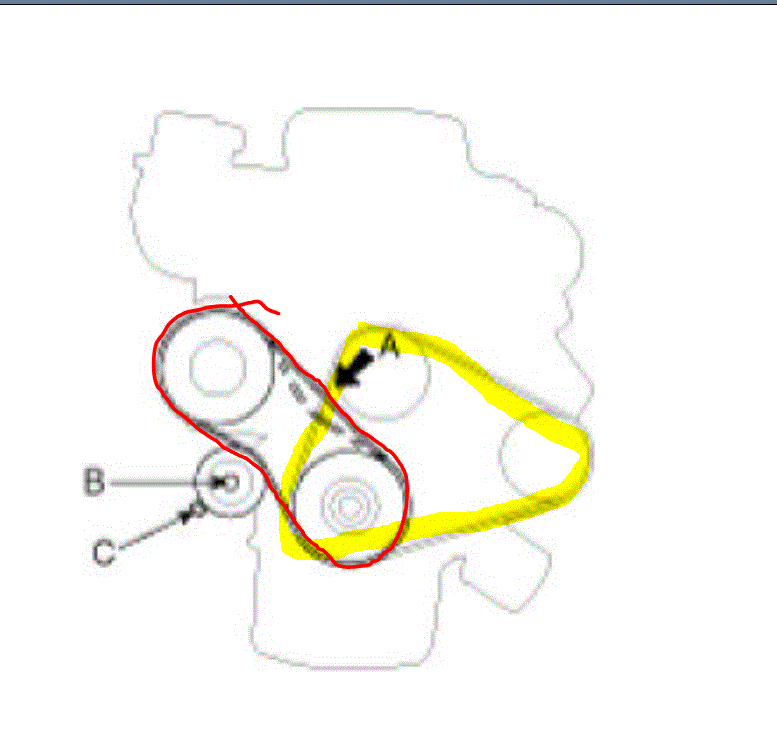
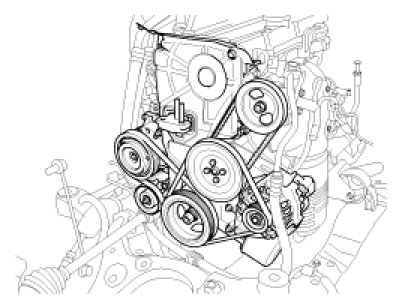
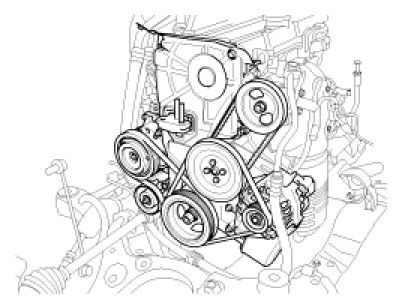
A squealing noise is usually a belt. I realize the A/C belt has been replaced already, but there are two belts on the vehicle that can cause an issue. Also, the A/C belt isn't an automatic tightening belt, so it may have stretched and come loose.

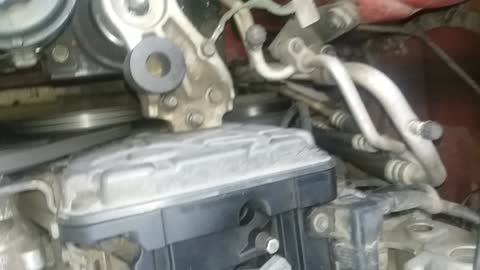
If you take a look at the attached picture, you will see both belts. The one I circled in red is the A/C belt. I need you to check that both are tight. Do this and let me know what you find.

Take care,
Joe
Mar 9, 2020 at 6:25 PM
Avatar
LOU20
  • MEMBER
  • 83 POSTS
I had this noise before I put the new belt.
Mar 9, 2020 at 6:36 PM
Advertisement
Avatar
JACOBANDNICKOLAS
  • CERTIFIED EXPERT
  • 110,175 POSTS
Was only one belt replaced? There are two. Also, is it possible for you to record what you hear with your phone and upload it for me to hear?
Mar 9, 2020 at 9:10 PM
Avatar
LOU20
  • MEMBER
  • 83 POSTS
Are you saying there is two A/C belts? I also changed the alternator belt and timing belt. I can try to record the noise.
Mar 10, 2020 at 4:48 AM
Avatar
JACOBANDNICKOLAS
  • CERTIFIED EXPERT
  • 110,175 POSTS
No. There are a total of two accessory drive belts. One for the AS and the other the alt. I didn't realize both were replaced. Also, the timing belt won't squeal. Now, although both accessory drive belts have been replaced, you could have a tension issue. In other words, the belt isn't tight enough.

If possible, record it so I can hear it. I should be able to tell if it is a belt noise.

Joe
Mar 10, 2020 at 8:31 PM
Avatar
LOU20
  • MEMBER
  • 83 POSTS
I try uploading a video but I'm having trouble.
Mar 11, 2020 at 12:00 PM
Avatar
JACOBANDNICKOLAS
  • CERTIFIED EXPERT
  • 110,175 POSTS
Is there every any noise when the vehicle is at an idle? I'm not sure why it won't upload for you. Can you explain what is happening?

Joe
Mar 11, 2020 at 6:57 PM
Avatar
LOU20
  • MEMBER
  • 83 POSTS
You can put it in park and step on the gas and still hear noise.
Mar 12, 2020 at 4:31 AM
Avatar
JACOBANDNICKOLAS
  • CERTIFIED EXPERT
  • 110,175 POSTS
I feel confident it is related to one of the accessory drive belts. When you rev the engine, one is most likely slipping. Have you checked to see if they seem loose?

With the engine off, simply see if one of the belts seems loose. I suspect there is an issue with tension.

Let me know.
Joe
Mar 12, 2020 at 4:34 PM
Avatar
LOU20
  • MEMBER
  • 83 POSTS
I was also told to check my pulley.
Mar 13, 2020 at 7:19 PM
Avatar
JACOBANDNICKOLAS
  • CERTIFIED EXPERT
  • 110,175 POSTS

The belts on this vehicle are tightened manually. Here are the directions. The attached pic correlates with the directions.

________________

2008 Kia Rio L4-1.6L
Adjustments
Vehicle Engine, Cooling and Exhaust Engine Drive Belts, Mounts, Brackets and Accessories Drive Belt Adjustments
ADJUSTMENTS
ADJUSTMENT

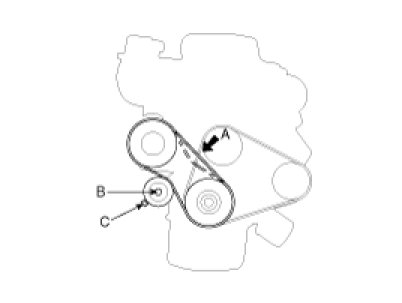
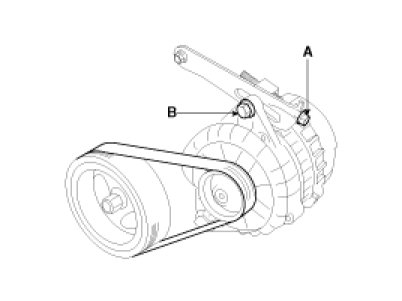
1. Loosen the tension mounting bolt (B).
2. Turn the adjusting bolt (C) to obtain the proper belt tension, and then retighten the mounting bolt (B).
3. Recheck the deflection of the A/C compressor belt.


Pic 1

______________________

Here are the directions for adjusting the alternator belt.
2008 Kia Rio L4-1.6L
Alternator
Vehicle Engine, Cooling and Exhaust Engine Drive Belts, Mounts, Brackets and Accessories Drive Belt Testing and Inspection Component Tests and General Diagnostics Alternator
ALTERNATOR
GENERATOR BELT INSPECTION AND ADJUSTMENT

NOTE:
When using a new belt, first adjust the deflection or tension to the values for the new belt, then readjust the deflection or tension to the value for the used belt after running engine for five minutes.

Deflection method:
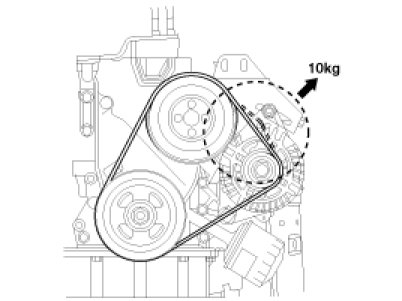
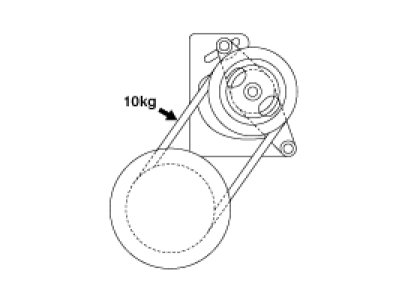
Apply a force of 98N (10kg, 22lb), and measure the deflection between the generator and the water pump pulley.

Deflection
Used belt: 4.2 - 4.7 mm (0.1654 - 0.1850 in)
New belt: 3.3 - 3.7 mm (0.1299 - 0.1457 in)


NOTE:
If the belt is worn or damaged, replace it.


pic 2


Belt tension gauge method:
Attach the belt tension gauge to the belt and measure the tension. Follow the gauge manufacturer's instructions.

Tension
Used belt: 392.3 - 490.3N (40 - 50kg, 88.2 - 110.2lb)
New belt: 637.4 - 735.5N (65 - 75kg, 143.3 - 165.3lb)


NOTE:
If the belt is worn or damaged, replace it.


pic 3


If adjustment is necessary:
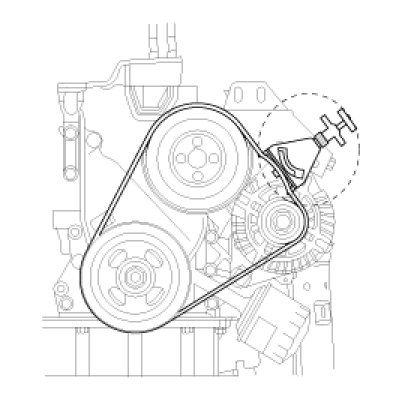
1. Loosen adjusting bolt (A) and the lock bolt (B).
2. Move the generator to obtain the proper belt tension, then retighten the nuts.


pic 4

3. Recheck the deflection or tension of the belt.

NOTE:
For the power steering pump belt and A/C compressor belt adjustments, refer to power steering pump and air compressor.

_______________________

Here are the directions for the power steering.

2008 Kia Rio L4-1.6L
Steering
Vehicle Engine, Cooling and Exhaust Engine Drive Belts, Mounts, Brackets and Accessories Drive Belt Testing and Inspection Component Tests and General Diagnostics Steering
STEERING
SERVICE ADJUSTMENT PROCEDURE

CHECKING POWER STEERING BELT TENSION
1. Press the V belt, applying a pressure of 98N (10kg, 22lb) at the specified point and measure the deflection to confirm that it is within the standard value.

Standard value
V belt deflection : 7 - 10 mm (0.27 - 0.39 in)


pic 5

2. If the belt deflection is beyond the standard value, adjust the belt tension as follows.
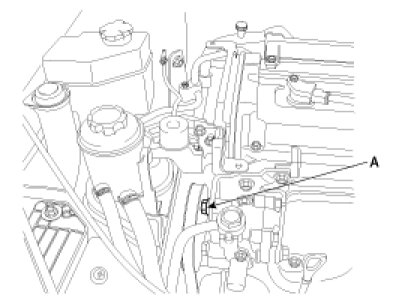
(1)Loosen the bolt(A) adjusting the power steering V belt tension.


pic 6

(2)Put a bar or equivalent, between the bracket and the oil pump and adjust the tension so that the belt deflection is within the standard value.
(3)Tighten the bolt adjusting the power steering V belt tension.
(4)Check the belt deflection and adjust it again if necessary.

CAUTION:
After turning the V belt in the normal rotation direction more than once, recheck the belt deflection.

____________________________

Let me know if this helps. Also, since the belts were replaced, it isn't uncommon for them to stretch a bit. They most likely need readjusted.

Let me know if I can help or if you have other questions.

Joe
Mar 13, 2020 at 10:08 PM
Avatar
LOU20
  • MEMBER
  • 83 POSTS
Here is the noise:
Apr 4, 2020 at 5:58 AM
Avatar
JACOBANDNICKOLAS
  • CERTIFIED EXPERT
  • 110,175 POSTS
Hi,

I am hearing a wining noise. Is that what you are referring to? If it is, it sounds like the alternator working. Not really anything out of the ordinary.

Let me know if that is what you referring to. If it is, I honestly don't think there is anything to worry about.

Let me know.
Joe
Apr 4, 2020 at 7:06 PM
Avatar
LOU20
  • MEMBER
  • 83 POSTS
Yes I'm referring to that noise.
Apr 4, 2020 at 7:26 PM
Avatar
JACOBANDNICKOLAS
  • CERTIFIED EXPERT
  • 110,175 POSTS
I have to be honest. It sounds normal to me. If you were to remove the alternator belt, I suspect that noise would stop. I wouldn't allow it to worry you unless it start getting louder.

Listen, if anything starts happening or changing, I will be here. Get back to me and I'll do my best to help. At this point, however, I don't see an issue. I actually wish my truck was that quiet. LOL

Take care and let me know if you need anything.

Joe
Apr 4, 2020 at 7:29 PM
Avatar
LOU20
  • MEMBER
  • 83 POSTS
The noise is extremely loud especially when I'm driving.
Apr 4, 2020 at 7:32 PM
Avatar
JACOBANDNICKOLAS
  • CERTIFIED EXPERT
  • 110,175 POSTS
Okay, maybe it isn't as noticeable when recorded. Do me a favor. When you drive it, see if anything makes it louder or quieter. For example, turn the head lamps, A/C fan on high, wipers on, and see if it gets louder.

Let me know.
Apr 4, 2020 at 7:56 PM
Avatar
LOU20
  • MEMBER
  • 83 POSTS
It only get louder when I accelerate.
Apr 4, 2020 at 7:57 PM
Avatar
JACOBANDNICKOLAS
  • CERTIFIED EXPERT
  • 110,175 POSTS
At this point, the only thing we can do to confirm if one of the belt driven accessories is making the noise is to remove the belts and start the engine for a few seconds to see if the noise goes away. Or, if you go to an automotive parts store, you can get an automotive stethoscope and check if the noise is coming from different components such as the alternator, ac compressor, power steering pump and so on.

Let me know which you would like to do. I'll help you through it. Please remember if you are checking things when the engine is running, make sure to keep everything away from the belts and pulleys to prevent injury.

Let me know.
Joe
Apr 4, 2020 at 8:09 PM
Avatar
LOU20
  • MEMBER
  • 83 POSTS
Someone also told me to check the belts or pulley.
Apr 4, 2020 at 8:12 PM
Avatar
JACOBANDNICKOLAS
  • CERTIFIED EXPERT
  • 110,175 POSTS
Are the belts new?
Apr 4, 2020 at 8:48 PM
Avatar
LOU20
  • MEMBER
  • 83 POSTS
Yes A/C belt, timing belt, alternator belt.
Apr 5, 2020 at 3:12 AM
Avatar
JACOBANDNICKOLAS
  • CERTIFIED EXPERT
  • 110,175 POSTS
Okay, then chances are it isn't a belt, unless they are loose. So, the next thing I suggest to confirm if it is a belt driven accessory is to remove the belts and start the engine for a couple seconds to see if the sound is gone.

Let me know if you need help.

Joe
Apr 5, 2020 at 5:33 PM
Avatar
LOU20
  • MEMBER
  • 83 POSTS
A mechanic check my car and I was told it was the injector.
Apr 14, 2020 at 6:06 AM
Avatar
JACOBANDNICKOLAS
  • CERTIFIED EXPERT
  • 110,175 POSTS
Hi,

Was the part replaced and did it solve the issue? An injector can make a clicking or ticking, but I never heard one make a squealing noise.

If you can, let me know.

Joe
Apr 14, 2020 at 9:30 AM
Avatar
LOU20
  • MEMBER
  • 83 POSTS
It was not replaced yet but he did used a stethoscope. The noise was coming from the area where the injectors are.
Apr 14, 2020 at 11:29 AM
Avatar
JACOBANDNICKOLAS
  • CERTIFIED EXPERT
  • 110,175 POSTS
Okay. If you have the chance, could you let me know if that takes care of the problem. It will help others in the future that are experiencing the same issues. And honestly, I will be really interested in knowing if that takes care of the issue.

Thanks,
Joe
Apr 14, 2020 at 5:23 PM
Avatar
LOU20
  • MEMBER
  • 83 POSTS
Will let you know.
Apr 14, 2020 at 5:24 PM
Avatar
JACOBANDNICKOLAS
  • CERTIFIED EXPERT
  • 110,175 POSTS
Thank you. Interestingly, 35 years in the business and I have never heard such a sound from an injector, so I am really interested in knowing. Also, if your car does it, someone else is having the same problem, so your info will be helpful to others as well.

Thanks again,
Joe
Apr 14, 2020 at 5:57 PM
Avatar
LOU20
  • MEMBER
  • 83 POSTS
Hopefully the mechanic is correct, but the noise is coming from area by the injector because he gave it gas you hear the noise. I'm no expert but the sound is not coming from the belt area. So I have no clue what it can be if the noise stay after the injector is changed he also mentioned about spraying something.
Apr 15, 2020 at 2:57 PM
Avatar
JACOBANDNICKOLAS
  • CERTIFIED EXPERT
  • 110,175 POSTS
I hope he is as well. However, I never heard an injector make a squealing noise. As far as spraying something, he likely is referring to the belt with a belt dressing.

What you could do is take a small amount of water and pour it on the belt when the vehicle is running to see if the sound changes. Just make sure to protect your eyes and clothing because water will spray.

Let me know.
Apr 15, 2020 at 6:46 PM
Avatar
LOU20
  • MEMBER
  • 83 POSTS
I have to change the intake gasket and water pump.
Apr 16, 2020 at 6:53 PM
Avatar
JACOBANDNICKOLAS
  • CERTIFIED EXPERT
  • 110,175 POSTS
Okay, the water pump makes sense because it can make a squealing noise or cause a drag on the belt. As far as the intake, I'm not sure that was the source of the noise. Regardless, here are the directions for replacing both. The attached pics correlate with the directions. I will start with the intake manifold.

_____________________________________________________

2008 Kia Rio L4-1.6L
Repair Procedures
Vehicle Engine, Cooling and Exhaust Engine Intake Manifold Service and Repair Removal and Replacement Repair Procedures
REPAIR PROCEDURES
REMOVAL

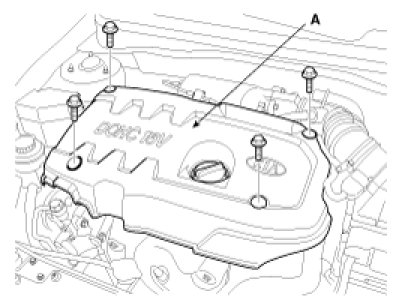
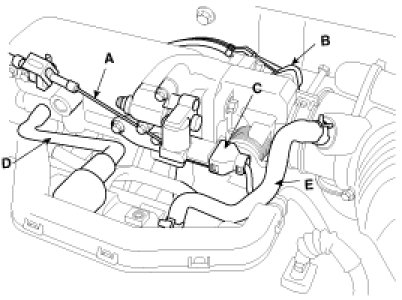
1. Remove the engine cover(A).


pic 1

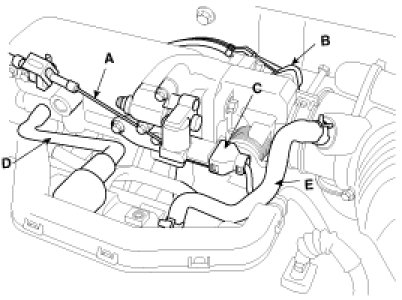
2. Remove the accelerator cable(A).
3. Disconnect the TPS (Throttle Position Sensor) connector (B).
4. Disconnect the ISA(Idle Speed Actuator) connector(B).
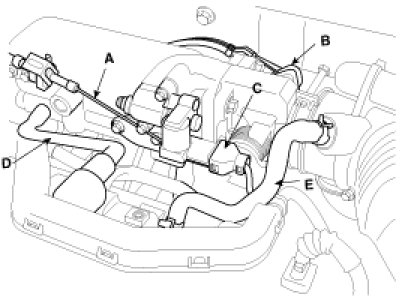
5. Disconnect the PCV(Positive Crankcase Ventilation) hose(D) and breather hose(E).


pic 2

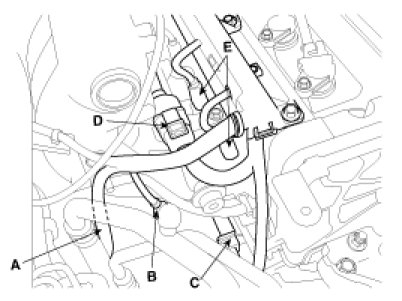
6. Disconnect the injector connector (No. 3, 4) (A).
7. Disconnect the injector connector (No. 1, 2) (B).


pic 3

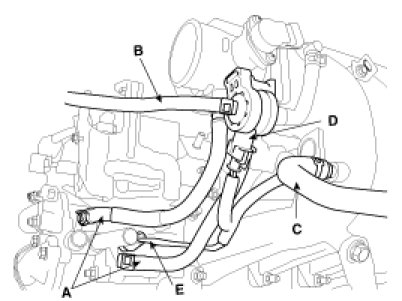
8. Remove the heater hose(A), PCSV(Purge Control Solenoid Valve)(B) and the brake vacuum hose(C) from throttle body and intake manifold.
9. Disconnect the PCSV(Purge Control Solenoid Valve) (D) and water temperature sensor connector(E).


pic 4

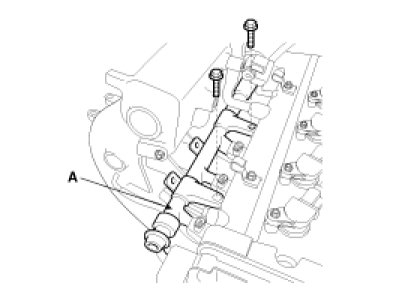
10. Remove the delivery pipe(A).

Tightening torque :
18.6 - 27.5N.m (1.9 - 2.8kgf.m, 13.7 - 20.3lb-ft)


pic 5

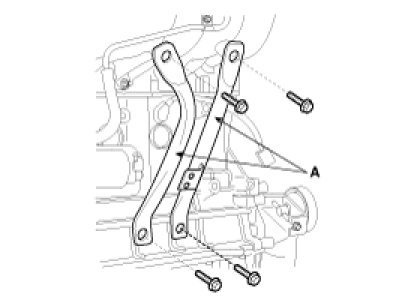
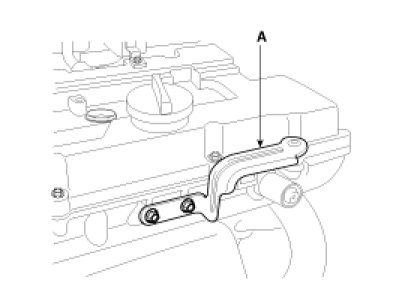
11. Remove the intake manifold stay(A).

Tightening torque :
17.7 - 24.5N.m (1.8 - 2.5kgf.m, 13.0 - 18.1lb-ft)


pic 6

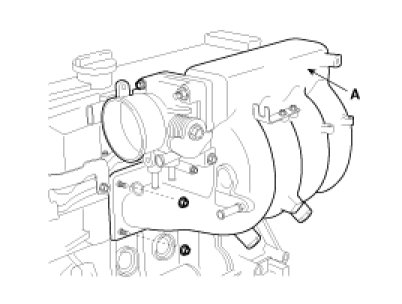
12. Remove the intake manifold.

Tightening torque :
14.7 - 19.6N.m (1.5 - 2.0kgf.m, 10.8 - 14.5lb-ft)


pic 7
13. Installation is in the reverse order of removal with new gasket.

_________________________________________________

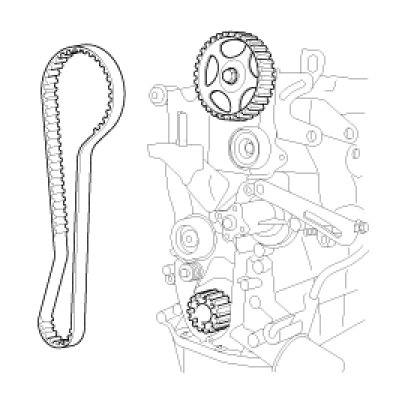
Here are the directions for the pump. This is a bigger job than normal because the pump is run by the timing belt. I will include directions for timing belt removal and replacement last.

_________________________________________________

2008 Kia Rio L4-1.6L
Repair Procedures
Vehicle Engine, Cooling and Exhaust Engine Water Pump Service and Repair Removal and Replacement Repair Procedures
REPAIR PROCEDURES
REMOVAL

WATER PUMP
1. Drain the engine coolant.

WARNING:
System is under high pressure when the engine is hot.
To avoid danger of releasing scalding engine coolant, remove the cap only when the engine is cool.

2. Loosen the water pump pulley bolts.
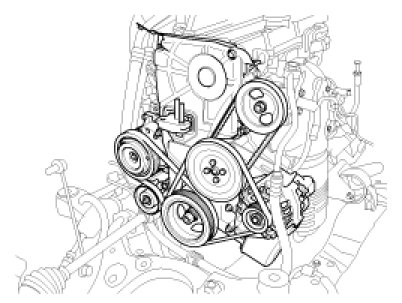
3. Remove the drive belts.


pic 8

4. Remove the water pump pulley.
5. Remove the timing belt.
6. Remove the timing belt idler.
7. Remove the water pump.
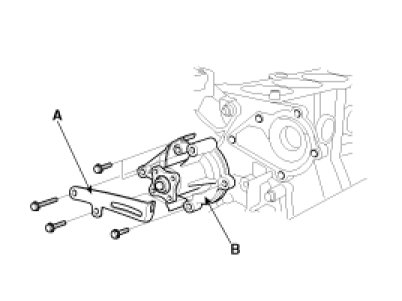
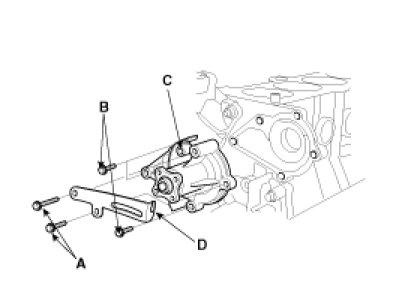
(1)Remove the 2 bolts and alternator brace(A).
(2)Remove the 3 bolts and remove the water pump(B) and gasket.


pic 9


INSTALLATION

WATER PUMP
1. Install the water pump.
(1)Install the water pump(C) and a new gasket with the 3 bolts(B).

Tightening torque :
11.8 - 14.7 N.m (1.2 - 1.5 kgf.m, 8.7 - 10.8 lb-ft)


pic 10

(2)Install the alternator brace(D) with the 2 bolts(A).

Tightening torque :
19.6 - 26.5N.m (2.0 - 2.7kgf.m, 14.5 - 19.5lb-ft)


2. Install the timing belt idler.
3. Install the timing belt.
4. Install the water pump pulley.
5. Install the drive belts.
6. Tighten the water pump pulley bolts.

Tightening torque :
7.8 - 9.8 N.m (0.8 - 1.0 kgf.m, 5.8 - 7.2 lb-ft)


7. Fill with engine coolant.
8. Start engine and check for leaks.
9. Recheck engine coolant level.
__________________________________________________________

Timing belt

2008 Kia Rio L4-1.6L
Repair Procedures
Vehicle Engine, Cooling and Exhaust Engine Timing Components Timing Belt Service and Repair Removal and Replacement Repair Procedures
REPAIR PROCEDURES
REMOVAL

Engine removal is not required for this procedure.
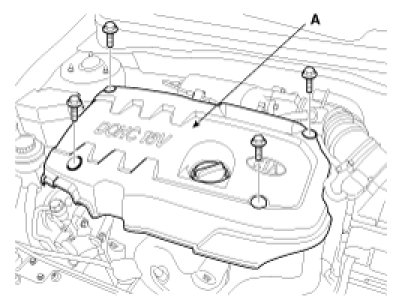
1. Remove the engine cover(A).


pic 11

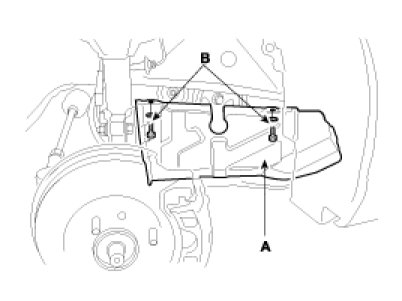
2. Remove the RH front wheel.
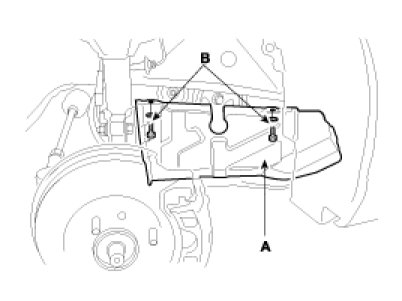
3. Remove the 2 bolts(B) and RH side cover(A).


pic 12

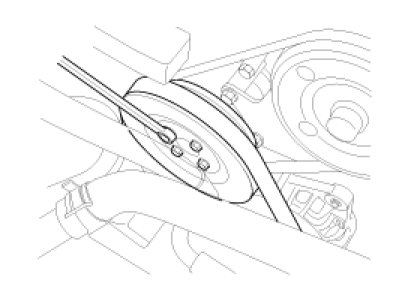
4. Temporarily loosen the water pump pulley bolts.


pic 13

5. Remove the alternator drive belt(A).

image 6. Remove the air conditioner compressor drive belt(B).

7. Remove the power steering pump drive belt(C).

8. Remove the 4 bolts and water pump pulley.
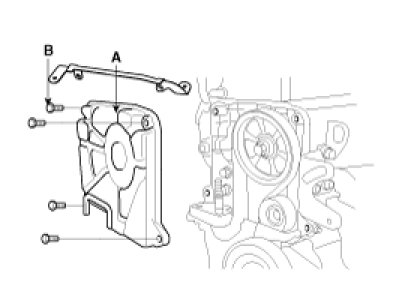
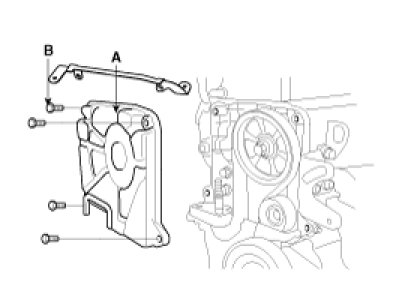
9. Remove the 4 bolts(B) and timing belt upper cover(A).


pic 14

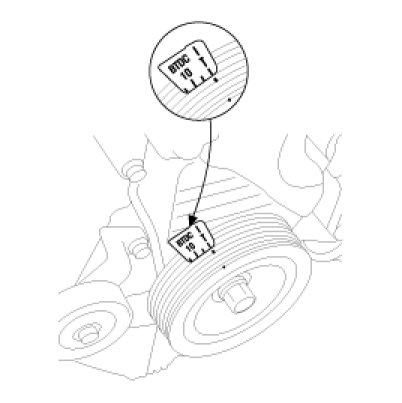
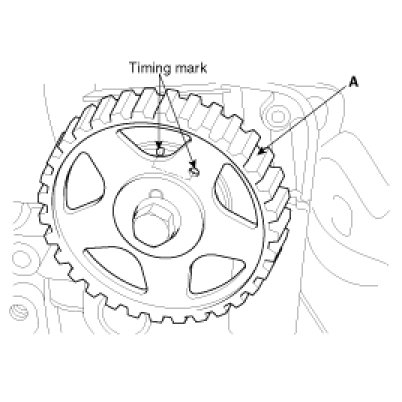
10. Turn the crankshaft pulley, and align its groove with timing mark "T" of the timing belt cover. Check that the timing mark of camshaft sprocket is aligned with the timing mark of cylinder head cover. (No.1 cylinder compression TDC position)


pic 15


pic 16

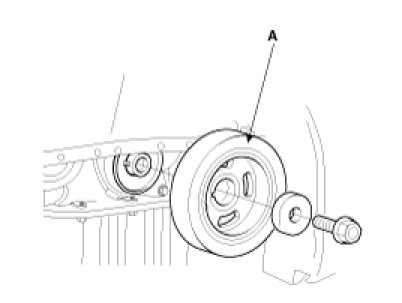
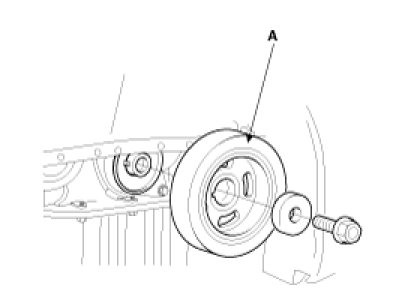
11. Remove the crankshaft pulley bolt and crankshaft pulley(A).


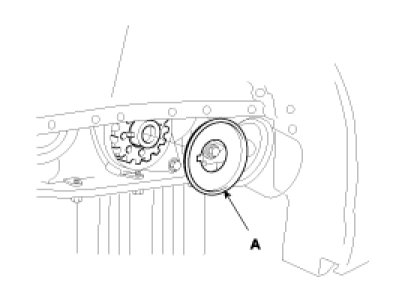
pic 17

12. Remove the crankshaft flange(A).


pic 18

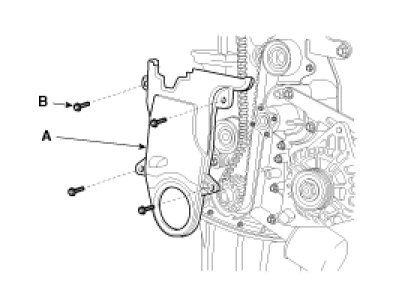
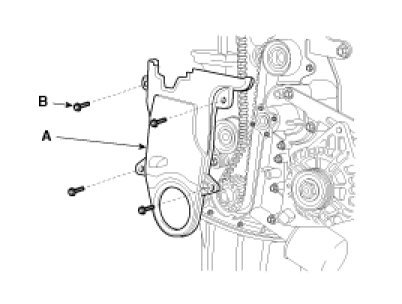
13. Remove the 4 bolts(B) and timing belt lower cover(A).


pic 20

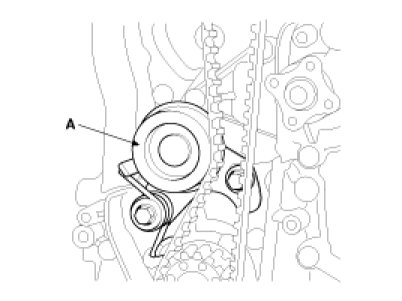
14. Remove the timing belt tensioner(A) and timing belt.


pic 21


pic 22


NOTE:
If the timing belt reused, make an arrow indicating the turning direction to make sure that the belt is reinstalled in the same direction as before.

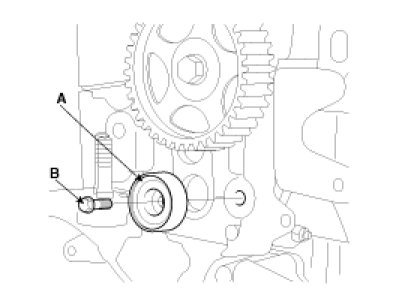
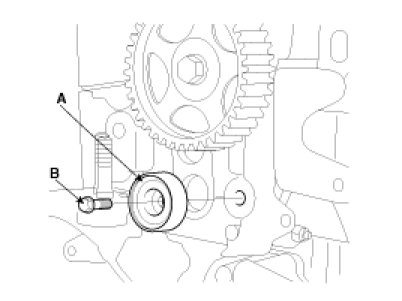
15. Remove the bolt(B) and timing belt idler(A).


pic 23

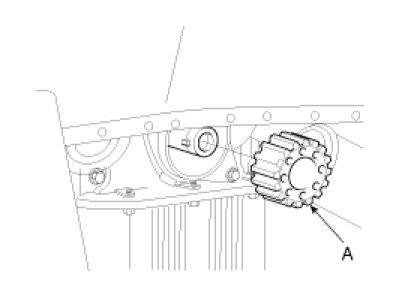
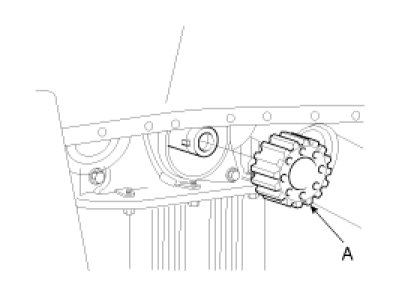
16. Remove the crankshaft sprocket(A).


pic 24

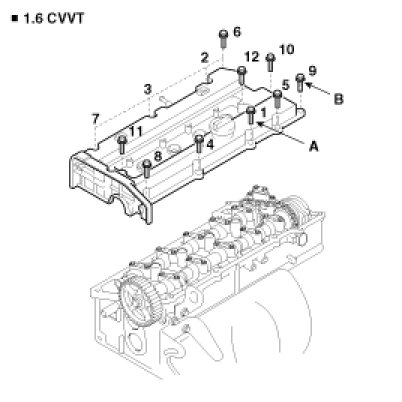
17. Remove the cylinder head cover.
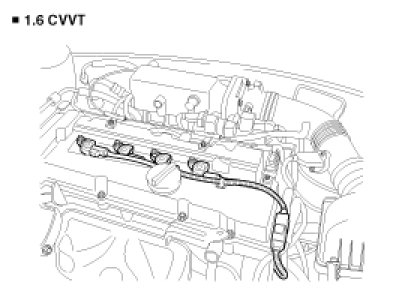
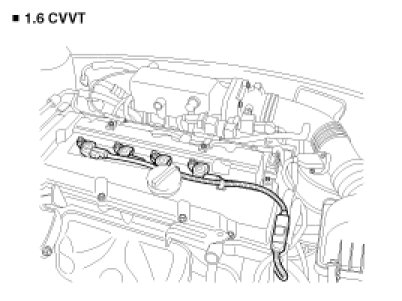
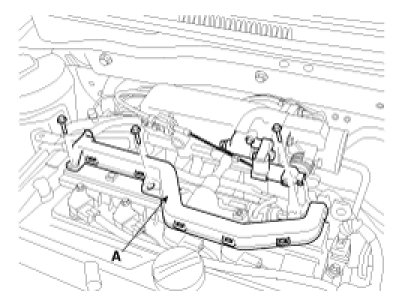
(1)Remove the wire harness bracket(A).

image (2)Remove the ignition coil.


pic 25

(3)Remove the PCV (Positive Crankcase Ventilation) hose(A) and the breather hose(B) from the cylinder head cover.


pic 26

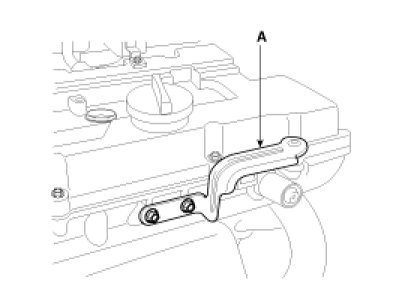
(4)Remove the engine cover bracket(A).


pic 27

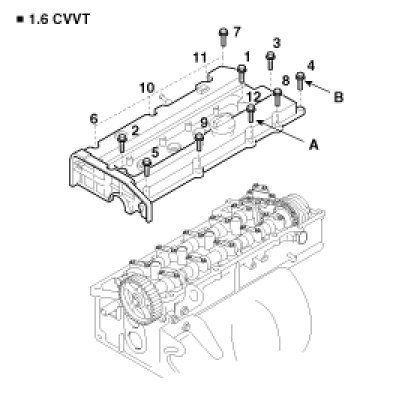
(5)Loosen the cylinder head cover bolts(B) and then remove the cover(A) and gasket.


pic 28

18. Remove the camshaft sprocket.
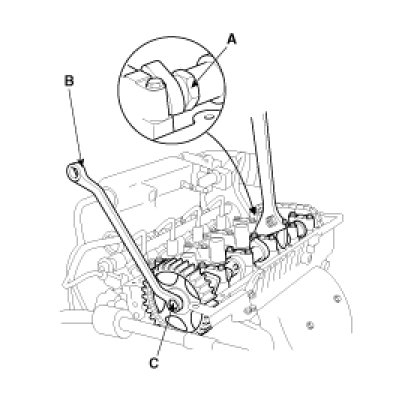
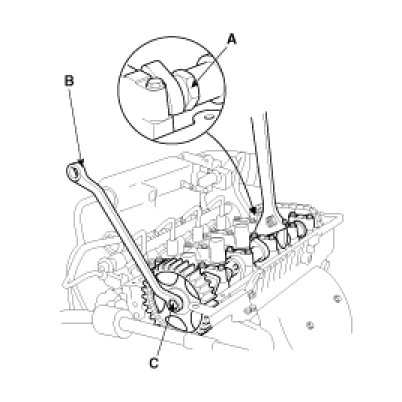
(1)Hold the portion(A) of the camshaft with a hexagonal wrench, and remove the bolt(C) with a wrench(B) and remove the camshaft sprocket.


pic 29


CAUTION:
Be careful not to damage the cylinder head and valve lifter with the wrench.

INSTALLATION

1. Install the camshaft sprocket and tighten the bolt to the specified torque.
(1)Temporarily install the camshaft sprocket bolt(C).
(2)Hold the portion(A) of the camshaft with a hexagonal wrench, and tighten the bolt(C) with a wrench(B).

Tightening torque :
78.5 - 98.1N.m (8.0 - 10.0kgf.m, 57.9 - 72.3lb-ft)


pic 30

2. Install the cylinder head cover.
(1)Install the cylinder head cover(A) and bolts(B).

Tightening torque :
7.8 - 9.8N.m (0.8 - 1.0kgf.m, 5.8 - 7.2lb-ft)


pic 31

(2)Install the engine cover bracket(A).


pic 32

(3)Install the PCV(Positive Crankcase Ventilation) hose(A) and breather hose(B) to the cylinder head cover.


pic 33

(4)Install the ignition coil.


pic 34

3. Install the crankshaft sprocket(A).


pic 35

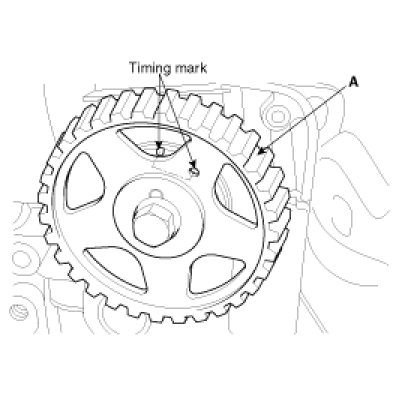
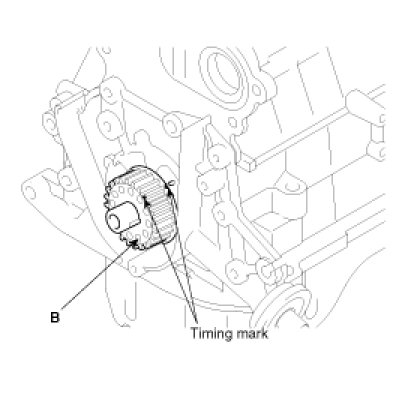
4. Align the timing marks of the camshaft sprocket(A) and crankshaft sprocket(B) with the No.1 piston placed at top dead center and its compression stroke.


pic 36


pic 37

5. Install the idler pulley(A) and tighten the bolt(B) to the specified torque.

Tightening torque :
42.2 - 53.9N.m (4.3 - 5.5kgf.m, 31.1 - 39.8lb-ft)


pic 38

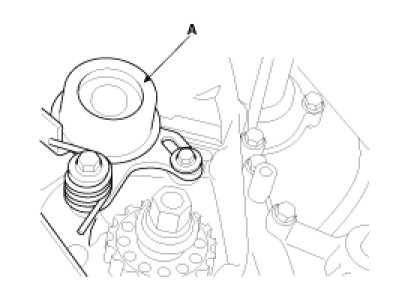
6. Temporarily install the timing belt tensioner(A).


pic 39

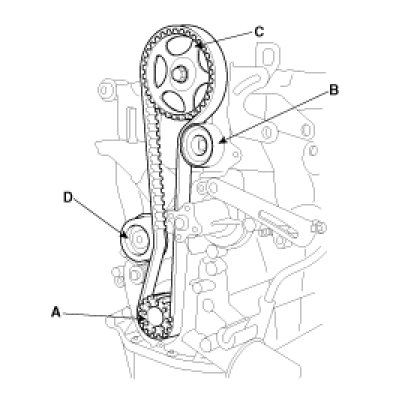
7. Install the belt so as not give slack at each center of shaft. Use the following order when installing timing belt.
Crankshaft sprocket(A) ->idler pulley(B) ->camshaft sprocket(C) ->timing belt tensioner(D).


pic 40

8. Adjust the timing belt tension.
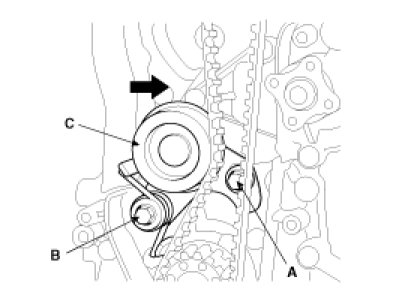
(1)Loosen the tensioner pulley mounting bolt and apply tension to the timing belt.


pic 41

(2)After checking the alignment between each sprocket and each timing belt tooth, tighten the mounting bolt (A) and (B) one by one.

Tightening torque :
19.6 - 26.5N.m (2.0 - 2.7kgf.m, 14.5 - 19.5lb-ft)


(3)Then recheck the belt tension.
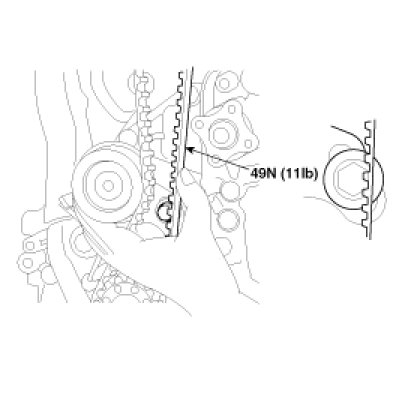
Verify that when the tensioner and the tension side of the timing belt are pushed in horizontally with a moderate force [approx. 49N (11lb)], the timing belt cog end is approx. 1/2 of the tensioner mounting bolt head radius (across flats) away from the bolt head center.


pic 42

(4)Timing belt tension measuring procedure
(by a sonic tension gauge)
Rotate crankshaft in clockwise direction to set 1st piston on top dead center (TDC) and rotate crankshaft in counterclockwise to 90° then measure the belt tension in the middle of tension side span (in arrow direction of above illustration) by free vibration method.

CAUTION:
Avoid rotating the crankshaft in a counter clockwise direction.
Engine damage could occur.

Conversion equation of frequency into tension :
T = (4 / 9.8) x S2 x M x W x f2 / 100000000

S : Measured belt span (mm)
M : Unit weight of belt (kgf/cm2)
W : Belt width (mm)
f : Transverse natural frequency of belt (Hz)


Timing Belt Specifications


pic 43


9. Turn the crankshaft two turns in the operating direction (clockwise) and realign crankshaft sprocket and camshaft sprocket timing mark.
10. Install the timing belt lower cover(A) with 5bolts(B).

Tightening torque :
7.8 - 9.8N.m (0.8 - 1.0kgf.m, 5.8 - 7.2lb-ft)


pic 44

11. Install the flange and crankshaft pulley(A), and then tighten crankshaft pulley bolt.
Make sure that crankshaft sprocket pin fits the small hole in the pulley.

Tightening torque :
137.3 - 147.1N.m (14.0 - 15.0kgf.m, 101.3 - 108.5lb-ft)


pic 45

12. Install the timing belt upper cover(A) with 4 bolts(B).

Tightening torque :
7.8 - 9.8N.m (0.8 - 1.0kgf.m, 5.8 - 7.2lb-ft)


pic 46

13. Install the water pump pulley and 4 bolts.
14. Install the power steering pump drive belt(C).

pic 47
Install the air conditioner compressor drive belt(B).

16. Install the alternator drive belt(A).
17. Install the RH side cover(A) with 2 bolts(B).


pic 48

18. Install the RH front wheel.

Tightening torque :
88.3 - 98.1N.m (9.0 - 10.0kgf.m, 65.1 - 72.3lb-ft)


19. Install the engine cover with bolts.

Tightening torque :
3.9 - 5.9N.m (0.4 - 0.6kgf.m, 2.9 - 4.3lb-ft)


pic 49


Let me know if this helps or if you have other questions.

Take care,
Joe
Apr 16, 2020 at 7:22 PM
Avatar
LOU20
  • MEMBER
  • 83 POSTS
Wow, this will take hours of work.
Apr 16, 2020 at 8:21 PM
Avatar
JACOBANDNICKOLAS
  • CERTIFIED EXPERT
  • 110,175 POSTS
Hi,

Yes, it's a lot of work, but believe it or not, if you take it to a shop, their labor shouldn't be that high. I think the timing belt calls for about 2 hours plus add on for the pump, maybe a half hour more. The intake will be roughly another 3 hours.

Let me know if you have questions or need additional help.

Take care,
Joe
Apr 16, 2020 at 8:32 PM
Avatar
LOU20
  • MEMBER
  • 83 POSTS
Will running my car with a bad water pump cause other damage?
May 13, 2020 at 6:22 AM
Avatar
JACOBANDNICKOLAS
  • CERTIFIED EXPERT
  • 110,175 POSTS
Hi,

If the pump fails or is leaking, it will cause the engine to overheat. Plus, since this one is driven by the timing belt, if it would lock up, yes, it could certainly cause other issues. Note that if this is a single overhead cam engine (and I believe it is), it shouldn't cause internal engine damage. However, if it is a dual overhead cam, it is an interference engine. If something causing the timing belt to break, internal engine damage will likely occur.

Let me know if you have other questions.

Joe
May 13, 2020 at 7:42 PM