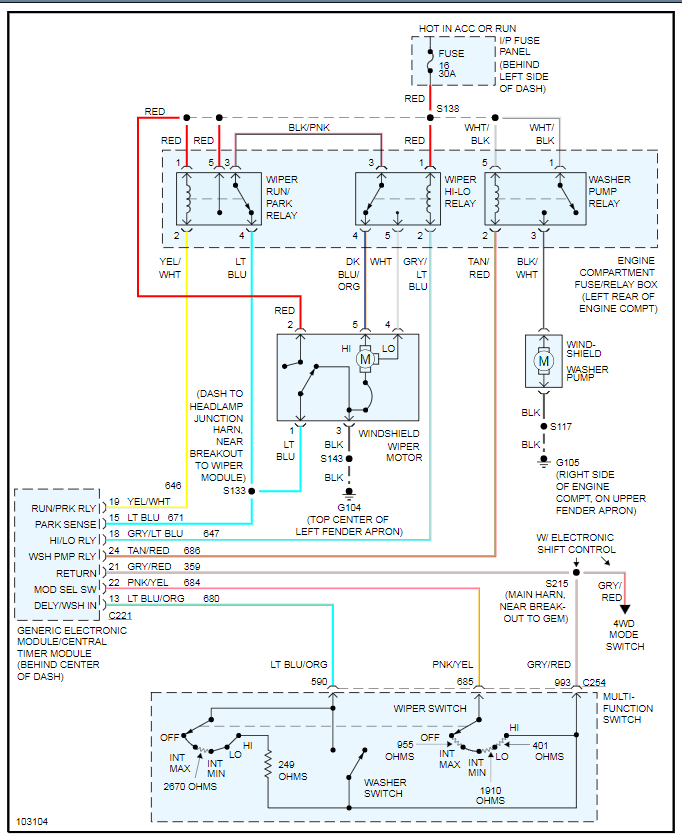
Hi guys. I'm late to the party and don't know how long ago this question started, but all the way reading through it, a common cause on Chrysler products kept coming to mind, and I haven't seen it mentioned. That is a poor ground on the wiper motor. The easiest way to verify that is to turn the wiper switch to one of the constant speeds, slow or fast, not an intermittent or "pulse" setting. When turned on and the wiper motor doesn't run, grab one of the wiper arms and pull it up to make it swipe across the glass. If the motor suddenly starts running, add a new ground wire.
On the Chryslers, the wiper motor is bolted to a metal plate, then that plate is mounted to the cowl with three bolts that go through rubber isolator bushings to dampen vibration. A ground strap is riveted to that plate, with the other end going under one of those bolt heads. Arcing and pitting develops under that strap. Sometimes the slightest irritation, like tugging on connectors under the dash, can cause enough movement to start the motor running.
The fix for this is to drill a small hole in the mounting plate so a self-tapping screw can be used to attach a new ground wire. Attach the other end somewhere on the body sheet metal. I use 10-gauge wire, but 12-gauge should be sufficient.
I've never done this on a Ford model, but I suspect they have a similar way of mounting to lessen the motor's vibration.
Another way to find this is when the motor doesn't run and the switch is set to "low" or "high", measure the voltage on the wiper motor's metal housing. Obviously, it should always be 0.00 volts, but when the ground strap has a bad connection, you'll find 12 volts there. To be valid, the volt meter's ground probe has to be somewhere other than on that mounting plate. Best is to use the battery's negative post, if possible, otherwise a paint and rust-free point on the body or engine will work too.
You can also check for voltage on the motor with a test light. If you use a high-class light such as from Snapon or MAC, they use incandescent bulbs good for up to as much as 36 volts. That means they will pass very little current while giving an accurate reading. If you use a really cheap test light like I use, they use standard bulbs that pass more current, and you may actually find they pass enough to cause the motor to start to run very slowly at first. That little movement can be enough to bother the ground strap until it suddenly starts working. If it does start running, you'll see the test light's bulb go out.
Regardless if the motor starts running or not, if the bulb lights up even a little, the ground strap needs attention.
Feb 23, 2026 at 9:05 AM