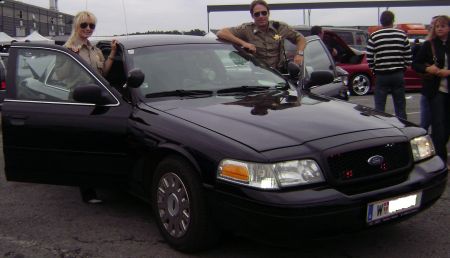
2003 Ford Crown Victoria P-71 bad fuel injectors?

2003 FORD CROWN VICTORIA
125,000 MILES • V8 • 2WD • AUTOMATIC
Avatar
FRONTPUSHBAR
  • MEMBER
  • 24 POSTS
Beside the LCM and multifunction switch troubles I have got another little problem:

When I bought the car about 2 years ago (100.000 miles) I realized that the engine sometimes started to sputter at about 30 - 50 mph when you press gently on the accelerator within this speed range but his didn´t happen very often.

I also realized that the car engine doesn´t run all round on sloping roads at 30 mph. This happens e.g. when you drive down a hill in the city without using the accelerator. But this was sometimes hard to sense.

I tried to solve the problem by changing the spark plugs, the ignition coils, the air filter and fuel filter. It didn´t help. No problems when you push the pedal to the metal or under/above this speed range.

I also tried a fuel system cleaner and this seemed to
improve the driving ability for some time but I can´t
say it for sure.

Maybe the California Highway Patrol used bad fuel? They put on 100.000 miles in 3 years on that Ford.

I kept on driving and ignored the problem. But after about 25.000 miles and during the last few weeks the problems have become bigger:

The Ford sputters now much rougher within the described speed range and this happens very often.

It seems that the idling is also slightly affected.

Are these symptoms for bad fuel injectors?

Your answers are really appreciated!!!

[img:054ac7c7aa]http://www.2carpros.com/forum/automotive_pictures/348741_Ford_Crown_Vic_bearb_2.jpg[/img:054ac7c7aa]
Apr 26, 2009 at 3:31 AM
Advertisement
Avatar
MERLIN2021
  • CERTIFIED EXPERT
  • 17,250 POSTS
I think if you solve the more serious issue of electricl circuit malfunctions, these symtoms will clear up...have you scanned for codes yet? Do it even if the check engine light is off, it may have freeze frame data that can help. Also check this out.
You may have a vacuum leak, get a can of spray throttle body cleaner, spray the vac lines and maniflod area, when the idle changes, youve found the leak! You want the engine running and spray on the outside but do direct the stream onto the hoses, if it is a vacuum leak, the engine idle will change speed, then you have detected a leak, repair the vacuum leak and see how it runs! If that doesnt do it, you may need a new idle air control valve, it's bolted to the throttlebody.
Apr 26, 2009 at 10:12 AM
Avatar
FRONTPUSHBAR
  • MEMBER
  • 24 POSTS
Thanks for your fast answer!

Has my sputter problem within the speed range from 30 to 50 miles anything to do with bad fuel injectors or is it probably just a vacuum leak?
Apr 26, 2009 at 10:29 AM
Advertisement
Avatar
ATKAPARKING
  • MEMBER
  • 64 POSTS
It could be a symptom of either, or a completely separate issue. Isn't car repair fun? Unfortunately shops are often in the same position--you don't know for certain if a component is an issue until you replace it. Merlin is absolutely correct--scan this system for trouble codes and freeze frame data. It sounds like you are pretty mechanically competent--if you took this problem into a shop, you'd probably spend as much as if you invested in a scan tool. I recommend buying OBDII cables and the software so you can use your laptop to communicate with your car. This stuff can be had fairly cheap, 200-250$. I just bought this software and am pleased with the results so far. I think you will go a long way to solving your problem when you can view data streams in real time.
Apr 30, 2009 at 11:51 AM
Avatar
FRONTPUSHBAR
  • MEMBER
  • 24 POSTS
Repairing is fun thats for sure!

During my 8 hours highway driving time to The Tyrol
this weekend I have noticed the following symptoms:

The first 3 hours driving were fine. The sputter
happend just once within a construction zone
at 45 miles.

I have to say that I went between 60 and 100
miles per hour (the speed limit is about 85 mph on
Austrian highways and I also drove through parts
of Germany - they don´t have any speed limit).

I stayed most of the time at about 90 mph.

After 3 hours the sputter became heavier.

The engine sputtered from 40 to 100 mph during
acceleration phases with half throttle. At 40 mph
it did it really rough and it didn´t stop until I reached
85 mph.

Even at acceleration phases with full throttle I noticed
an uneven acceleration movement. It didn´t sputter
but the car didn´t accelerate in a smooth way - it
seemed that it didn´t accelerate with full power.

That was the first time that this happened between
50 and 100 mph.

The same on the way back to Vienna:

The car sputtered just once during the first three hours and than the sputter became harder
during the speed range as described above.

It sputtered really hard at 50 miles when the highway
went up a hill.

I have read on the internet that the 2003 Ford
interceptors are famous for fuel pump failures.

Maybe it´s the fuel pump?

OR

Maybe the PCV valve is blocked?

Ford recommends to exchange the PCV valve at
120.000 miles. I have not done it yet.

To be continued...
May 3, 2009 at 11:25 AM
Avatar
MERLIN2021
  • CERTIFIED EXPERT
  • 17,250 POSTS
If no codes check the pump pressure, and hook up so you can drive it and watch the gauge. PCV isnt a bad idea either.
May 3, 2009 at 11:43 AM
Avatar
FRONTPUSHBAR
  • MEMBER
  • 24 POSTS
Thanks for your answer!

PCV valve is already ordered.

Fuel pump pressure is going to be tested as you
recommended.

Results will follow.
May 3, 2009 at 12:04 PM
Avatar
MERLIN2021
  • CERTIFIED EXPERT
  • 17,250 POSTS
I'll be watching out!
May 3, 2009 at 12:17 PM
Avatar
FRONTPUSHBAR
  • MEMBER
  • 24 POSTS
I replaced the PCV. No improvement. The engine started to sputter really rough yesterday and it did it all the time. Suddenly the "check engine" light came on for the first time. I hardly managed it to drive to a mechanic who has got a U.S. Ford code scanner. It read: "engine misfire cylinder 1" He erased the code and made a testdrive with linked scanner. The code appeared again. Then he put a professional fuel system cleaning fluid in the tank and the sputter symptoms improved in a way so I was able to drive home. He said that he had the same scanner code indication with a Pontiac Trans Am and after the fuel injector replacement the problem was solved. I have already changed igniton coils, spark plugs, air/fuel filter and PCV valve. So the problem seems to be the fuel injectors. I have already ordered 8 new ones. I ´ll keep you informed.


https://www.2carpros.com/forum/automotive_pictures/348741_Ford_Crown_Vic_bearb_3.jpg

May 16, 2009 at 1:07 AM
Avatar
FRONTPUSHBAR
  • MEMBER
  • 24 POSTS
I replaced the fuel injectors today and now the
engine purrs like a cat - no sputter anymore!!!

The problem is solved.
Jun 3, 2009 at 1:19 PM
Avatar
MERLIN2021
  • CERTIFIED EXPERT
  • 17,250 POSTS


https://www.2carpros.com/forum/automotive_pictures/62217_Cop_Car_2.gif

On the road again, I just cant waitr to get on the road again! How about the other problems?
Jun 3, 2009 at 5:32 PM
Avatar
FRONTPUSHBAR
  • MEMBER
  • 24 POSTS
Not so good...

I have discovered that my brake lights have started
to go off again, even when my foot is on the pedal...

(see headlight problems continue)
Jun 8, 2009 at 12:49 PM
Avatar
MERLIN2021
  • CERTIFIED EXPERT
  • 17,250 POSTS
See reply in headlight post!
Jun 8, 2009 at 6:07 PM
Avatar
FRONTPUSHBAR
  • MEMBER
  • 24 POSTS
Do you remember when I said that the problem is
solved...that was an error!

About ten days ago the engine started to sputter
again and the "Check Engine" light went on.

The code reader said: engine misfire bank 1 and 2.

So I remembered your advice and checked
the pressure of the fuel pump again.

This time the pressure was unstable.

I have replaced the fuel pump and from then it
seemed that this was finally the problem, no sputter
anymore and the idling was hardly noticeable.

Unfortunately the "Check Engine" light went on
again today, but the car seems to run absolutely
normal.

What could this be?

Maybe the exhaust gas oxygen
sensor?

I have not yet read the code...
Jun 28, 2009 at 4:12 PM
Avatar
MERLIN2021
  • CERTIFIED EXPERT
  • 17,250 POSTS
You need the code...post the "P" code for me, did you buy a code reader? They are available by clicking on the link in my signature file.
Jun 28, 2009 at 5:12 PM
Avatar
FRONTPUSHBAR
  • MEMBER
  • 24 POSTS
Thanks for your answers!

A mechanic has got the code reader but his
shop is out of town.

I´m going to see him by the end of this week...
Jun 28, 2009 at 11:59 PM
Avatar
MERLIN2021
  • CERTIFIED EXPERT
  • 17,250 POSTS
I'll be checkin in!
Jun 29, 2009 at 4:02 PM
Avatar
FRONTPUSHBAR
  • MEMBER
  • 24 POSTS
Checked the codes today:

Two codes P0172 and P0175, "system too rich"

Flashed codes and drove home (about 25 miles).

"Check Engine" light has not appeared again yet...

Engine runs without any problems.
Jul 4, 2009 at 3:43 PM
Avatar
MERLIN2021
  • CERTIFIED EXPERT
  • 17,250 POSTS
Reset the PCM? And check engine light and so far so good?
Jul 5, 2009 at 2:50 PM
Avatar
FRONTPUSHBAR
  • MEMBER
  • 24 POSTS
Yes, my mechanic has erased the code.

But today after a couple of starts the "Check Engine"
light went on again...

Car is running normal.

Could it be the exhaust gas oxygen sensor(s)?
Jul 7, 2009 at 3:40 PM
Avatar
MERLIN2021
  • CERTIFIED EXPERT
  • 17,250 POSTS
Use a scantool that can read live sensor data, I think in your case buying one, is a good idea! Then read the long and short term fuel trims, also the 02 sensor voltages. A bad ECT(engine coolant temp) sensor or MAF can cause the injector pulse width to widen (stay open) longer, thus rich running. This can even happen without setting a code. I think the PDF I sent you has the testing info for both the MAF and ECT.
Jul 7, 2009 at 4:11 PM
Avatar
FRONTPUSHBAR
  • MEMBER
  • 24 POSTS
Hello! The story continues...

In August 2009 I bought 4 new CO2 sensors and
cleared the codes. Thought that this would solve
the problem.

In October 2009 the check engine light went on
again, but this time the reader displayed only one code: P0172. P0175 was gone.

Erased it, but after a couple of days the check
engine light went on again.

Engine seemed to run normal. I erased P0172
a couple of times and then I gave up. I didn´t care
about the check engine light and drove with the car as usual.

3 month ago I realized that the engine started to
choke when backing up. As soon as I shifted into
reverse the engine almost stopped and the alternator
lamp was flickering. The symptoms stopped when
I pressed gently on the accelerator applying the brake
at the same time. No problems when driving in "D"
mode. So I ignored this and kept on driving.

Last week I changed the mass airflow sensor hoping
to get rid of the check engine light and to improve
the instable engine running when backing up. No
improvement. Check engine light went on after a
few miles. Reader still displayed the code P0172.

Today it was very hot - about 95 F. So I used the
A/C which I haven´t done for a long time and
this time the engine stopped 3 times during
slow rolling in "D" mode and one time at 25 mph
which was very annoying. I was able to prevent
more engine stops by stepping on the acc. in that
moment when I saw the alternator lamp starting
to flash.

No problems when driving over 30 mph or idling.

I have also noticed that the engine is idling at high
rpm right after starting and runs normal as soon as
you engage "D". When you let the engine idle
right after the starting the rpm slowly goes down
to a normal rate.

But I´m used to this symptoms since I have bought
the car so I don´t know if this has anything to do
with my current problem...

So please give me some advice. Thank you.
Jul 10, 2010 at 2:27 PM
Avatar
MERLIN2021
  • CERTIFIED EXPERT
  • 17,250 POSTS
P0172 System too rich, bank one= passenger side, check the new O2 sensor, and sensor wiring harness, check fuel pressure (too high) stuck injector.
41) For Continuous Memory Only DTC P0171, P0172, P0174 Or P0175: Fuel System At Corrected Fuel Trim All Continuous Memory ignition and misfire DTCs must be serviced prior to servicing any fuel trim DTCs. DTCs P0171, P0172, P0174 and P0175 indicate a concern when adaptive fuel strategy senses a lean or rich condition beyond minimum or maximum calibrated limit. Fuel system DTC identification is as follows:  Bank No. 1 DTCs P0171 (lean), and P0172 (rich).  Bank No. 2 DTCs P0174 (lean), and P0175 (rich). Possible causes for these faults are:  Fuel System Excessive fuel pressure, leaking or contaminated fuel injectors, leaking fuel pressure regulator, low fuel pressure or engine running out of fuel or vapory recovery system fault.  Induction System Air leaks after MAF sensor, air intake system obstructions, vacuum leaks, PCV system or improperly seated engine oil dipstick.  EGR System Leaking gasket, stuck EGR valve or leaking diaphragm or EVR.  Engine Mechanical Engine oil overfilled, cam timing, cylinder compression or exhaust leaks before or near HO2S. Inspect engine for obvious defects in specified systems. Repair as necessary. If no faults are found, go to TEST DC, step 25). 42) Perform KOER Self-Test Turn ignition switch to OFF position. Connect scan tool to Data Link Connector (DLC). Disconnect fuel vapor hose from intake manifold and plug fitting at intake manifold. Start engine, and operate at 2000 RPM for 5 minutes, then allow to return to idle. Perform KOER ON-DEMAND SELF-TEST and proceed as follows:  If KOER DTCs P0040, P0041, P1127, P1128 or P1129 are present, go to appropriate system test. See DIAGNOSTIC TROUBLE CODE DEFINITIONS .  If KOER DTC (P1131, P2195) or (P1151, P2197) is present, go to next step.
KOER ON-DEMAND SELF-TEST Description KOER on-demand self-test is a functional test of PCM performed with ignition key on, engine running. A check of certain inputs and outputs is made during operating conditions and normal operating temperature. The Brake Pedal Position (BPP) switch, Power Steering Pressure (PSP) switch and Transmission Control Switch (TCS) tests are part of KOER on-demand self-test and must be performed during this operation (if applicable). See BPP, PSP & TCS TEST PROCEDURES . A fault must be present at time of testing for KOER on-demand self-test to detect a fault. BPP, PSP & TCS Test Procedures This test ensures EEC-V system is able to detect a change of state in brakelight switch, TCS and PSP switches. During KOER on-demand self-test, the brake pedal must be applied and then released, TCS must be cycled, and steering wheel must be turned at least 1/4 of a revolution. Performing Self-Test To perform self-test, turn ignition switch to OFF position. Ensure test equipment is properly attached. Program scan tool using the following steps:  Select VEHICLE & ENGINE SELECTION menu.  Select NEW VEHICLE, YEAR & MODEL.  Select DIAGNOSTIC DATA LINK.  Select POWERTRAIN CONTROL MODULE.  Select DIAGNOSTIC TEST MODE.  Select KOER ON-DEMAND SELF-TEST.  Start engine and allow to idle.  Perform BPP, PSP & TCS TEST PROCEDURES when instructed by scan tool.  Record DTCs and perform appropriate system test. See DIAGNOSTIC TROUBLE CODE DEFINITIONS . After KOER on-demand self-test is complete, cycle ignition switch before performing other self-tests or driving vehicle.
Jul 11, 2010 at 5:57 AM