
1989 Ford Bronco Engine runs like S***

1989 FORD BRONCO
Avatar
WOODTHINGS
  • MEMBER
  • 13 POSTS
Engine Performance problem
1989 Ford Bronco V8 Four Wheel Drive Automatic N/A miles

302 fuel injected, custom installed 3" exhaust from the "Y" back, duals after the converter.

I blew my engine and the bronco sat for at least a year. It ran fine before it blew. I finally had a new jasper engine installed. From the day I got it back I felt like it didn't have the upper end power I felt it should have. As the months went by, It has gotten worst. Now it seems as the engine warms up it runs worst. To me it feels like it is running on 4-6 cylinders. I have a check engine light. The machanic that put the engine in and the dealer said it had to do with a lean mixture, egr code, O2 senser. Between the three of us, we changed the egr and 02 senser twice, didn't make a diff. Also chanced the temp. sensor, map sensor, Tps, (can't recall the name) some other sensor on the air intake. The mechanic that put the engine in had the bronco for the past month trying to figure it out. He tried a new fuel regulator, fuel filter. remover the injectors and had them sent out to be tested and cleaned.
Any and all help would be greatly appretiated, I have spent probably 800.00 on this problem and its not fixed.

Thank you in advance
Leo

P.S. also tried a new computer
May 22, 2009 at 10:37 PM
Advertisement
Avatar
RASMATAZ
  • CERTIFIED EXPERT
  • 75,992 POSTS
A lean fuel condition can be caused by:

* Low fuel pressure due to a weak pump or leaky fuel pressure regulator. (use a fuel pressure gauge to check fuel pressure at idle)

* Dirty fuel injectors. (try cleaning the injectors)

* Vacuum leaks at the intake manifold, vacuum hose connections or throttle body. (Use a vacuum gauge to check for low intake vacuum)

* Leaky EGR valve. (Check operation of EGR valve)

* Leaky PCV Valve or hose. (Check valve and hose connections)

* Dirty or defective Mass Airflow Sensor (MAF). (Try cleaning the MAF sensor wires or filament with aerosol electronics cleaner. Do NOT use anything else to clean the sensor, and do not touch the sensor wires)

Lean Condition may sometimes appear because of a bad Differential Pressure Sensor (DPFE). This sensor monitors EGR flow, and is located on the engine near the EGR valve. There are two hoses that connect the sensor to the tube that runs from the exhaust manifold to the EGR valve. The sensor misreads EGR flow and the computer increases EGR which has a leaning effect on the fuel mixture. The fix is to replace the DPFE sensor.
May 22, 2009 at 10:43 PM
Avatar
WOODTHINGS
  • MEMBER
  • 13 POSTS
As statedin first post the fuel pressure regulator was replaced. The mech. said the old one was putting out 44-45 psi and the new one dropped it to 35 psi what he said it should be. Also as in first post the injectors were all pulled out and sent to be cleaned and tested. EGR and EGR solionoid been replaced.
Whats the diff. between MAP and MAF, Do I have both?
I will check the Maf and DPFE and get back with you.

Thanks.

P.S. The last few days since I got it back from the garage I notice when I try to excelerate hard from a stop it back fires a little through the intake. Not real hard or loud. Idles baddly.
May 25, 2009 at 1:40 PM
Advertisement
Avatar
RASMATAZ
  • CERTIFIED EXPERT
  • 75,992 POSTS
There's no MAF sensor-check the idle speed control air bypass solenoid, Did he do a vacuum leak check?
May 25, 2009 at 4:00 PM
Avatar
WOODTHINGS
  • MEMBER
  • 13 POSTS
He said he did and found none. But I don't know how much I can trust from him since like I said I spent about $800.00 + with him and he has not been able to fix it.
Whats the best way to do this, is it something I can do? (vacuum leak test).
The last thing he told me he wanted to check out before I took it back (had enough of him) was check ign. system, something in the dist. and ign. modual. would these be a possible problem?
May 25, 2009 at 10:55 PM
Avatar
RASMATAZ
  • CERTIFIED EXPERT
  • 75,992 POSTS
Hook up a vacuum gauge to the intake manifold make sure its full vacuum not ported/venturi vacuum

When was the last tune-up??

Wanted to check the ignition system he's probably going after the coil hinting it might be weak. While he's there have check the engine compression
May 25, 2009 at 11:47 PM
Avatar
WOODTHINGS
  • MEMBER
  • 13 POSTS
Its a year old Jasper Engine. He contacted jasper and they gave him a bunch of stuff to check on the engine, comp. was one thing, he said everything they told him to check , checked good.
He never mentioned the coil, it was something in the dist. don't recall the name...
May 26, 2009 at 9:00 AM
Avatar
RASMATAZ
  • CERTIFIED EXPERT
  • 75,992 POSTS
He never mentioned the coil, it was something in the dist. don't recall the name... It could be the distributor pick-up coil/stator or the thick film integrated ignition module he's talking about.
May 26, 2009 at 2:23 PM
Avatar
WOODTHINGS
  • MEMBER
  • 13 POSTS
Are the pick up coil/ stator or ignition moduel possible colprits to the problem. I don't think the modual is intergrated, I have a sqaure metal cased box mounted on the wheel well I beleive is the ign. modual.
May 26, 2009 at 2:32 PM
Avatar
RASMATAZ
  • CERTIFIED EXPERT
  • 75,992 POSTS
I've checked in the Mit1 ondemand5 maybe wrong info and yes they are normally place where you stated dull looking gray square box with 2 pigtails with a bunch of wires coming out of it. This one has to be grounded properly to function correctly or its on its way out-could be it
May 26, 2009 at 2:47 PM
Avatar
WOODTHINGS
  • MEMBER
  • 13 POSTS
I was wrong too, my ign. module is mounted to the side of dist.
The vac. is 13-14 at idle, checked at the ports in the intake horn just behind the throttle boby
May 27, 2009 at 1:22 PM
Avatar
WOODTHINGS
  • MEMBER
  • 13 POSTS
I slowly increase idle to 2500-3000 rpm and vac. fluctuates between maybe 8-13 if I just release the throttle from 3000 rpm the vac jumps to about 25 then engine stalls.
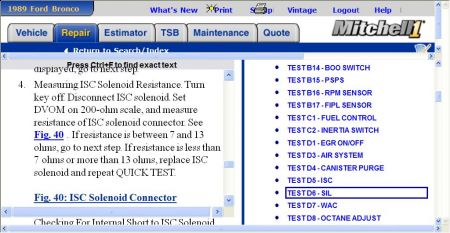
Also I checked the idle speed control: it had 10-10.5v, the motor resistance was closed, the book said 7-13 ohms. When I unplug it with the engine running it stalls out.
May 27, 2009 at 3:00 PM
Avatar
RASMATAZ
  • CERTIFIED EXPERT
  • 75,992 POSTS
Recheck the ISC solenoid


https://www.2carpros.com/forum/automotive_pictures/12900_isc_solenoid_1.jpg

May 27, 2009 at 4:37 PM
Avatar
WOODTHINGS
  • MEMBER
  • 13 POSTS
Sorry wrong info again. first time only had a needle ohm meter.
When rechecked with a DOVM set on 200 I got 9.5 resistance.
So what about my vac. readings in last post, (good, bad, indifferant).
May 28, 2009 at 7:03 AM
Avatar
RASMATAZ
  • CERTIFIED EXPERT
  • 75,992 POSTS
Vacuum fluctuating at 8-13 inch points to weak valve springs or late valve timing
May 28, 2009 at 4:09 PM
Avatar
WOODTHINGS
  • MEMBER
  • 13 POSTS
Does that mean cam was not lined up with crank when installed, or dist. timing off
May 28, 2009 at 6:15 PM
Avatar
RASMATAZ
  • CERTIFIED EXPERT
  • 75,992 POSTS
The vac. is 13-14 at idle, checked at the ports in the intake horn just behind the throttle boby

Sounds like you have an intake leak. Might wanna check the valve and ignition timing if its lined proeprly.
May 28, 2009 at 6:22 PM
Avatar
WOODTHINGS
  • MEMBER
  • 13 POSTS
I've been telling the mech. that put the eng. in for a few months now that I thought it might have an intake leak, but he keeps saying he did a smoke check and found nothing. Would a propane leak check find this?
May 28, 2009 at 6:32 PM
Avatar
RASMATAZ
  • CERTIFIED EXPERT
  • 75,992 POSTS
Using the propane method is a good idea.

Propane can also be used in conjunction with an exhaust analyzer (do NOT use carburetor cleaner or you may damage your analyzer!). Engine vacuum leaks almost always cause fluctuating HC readings, so an infrared exhaust analyzer can (1) tell you if there is indeed a leak, and (2) where the leak is using the propane procedure.

Two types of vacuum leaks can be diagnosed with an analyzer. The first kind is a general vacuum leak (PCV hose, brake booster, etc.) that leans out the mixture and causes a very low CO reading and only a slightly higher fluctuating HC reading. The O2 reading will also be high. The second kind of vacuum leak is a "point" leak that affects only one or two cylinders (a leaky manifold gasket or a crack or porosity leak in one of the manifold runners). This will be indicated by a normal or low CO reading combined with high fluctuating HC readings. O2 will again be high.

To find a leak, feed propane at suspected leak points until you note an improvement in idle quality and/or a change in the HC/CO/O2 readings. When you have found the leak, the idle should smooth out, HC and O2 should drop and CO rise.

It is important to note that an overly lean idle mixture will also cause a fluctuating HC reading the same as a vacuum leak. To tell one from the other, there is a simple "trick" you can use. Momentarily enrich the idle mixture to 1.5 to 2.0% CO by placing a clean shop rag over the top of the carburetor. If the engine smooths out and HC drops and remains stable, the problem is a lean idle mixture adjustment. If HC still fluctuates, however, the engine is still too lean in one or more cylinders indicating a vacuum leak
May 28, 2009 at 6:46 PM
Avatar
WOODTHINGS
  • MEMBER
  • 13 POSTS
the rag over the carb is not a preceedure if you have fuel injection, "correct"
May 28, 2009 at 6:54 PM
Avatar
MERLIN2021
  • CERTIFIED EXPERT
  • 17,250 POSTS
No, the other thing to check is exhuast restrictions, either the converter bed broke up and pieces are wedged in the pipes or muffler, or a pipe or muff is crushed?
May 30, 2009 at 9:32 AM
Avatar
WOODTHINGS
  • MEMBER
  • 13 POSTS
As in my first submission the exhaust is only a couple years old, custom 3" from the "Y" back with SS converter and muffler. "Magna flow"
May 30, 2009 at 1:51 PM
Avatar
RACEFAN966
  • CERTIFIED EXPERT
  • 5,029 POSTS
Not to butt in, but I would do a leak down test and check for vacuum leaks with a spray bottle of water. Go around the intake and the upper plenum and throttle body and egr vavle. I had an 89 F-150 and now a 95 F-150 and the both had a leaking egr vavle. I would also check the knock sensor if it is retarding the timing it also will not run good. To test the knock sensor simply hook up a timing light and tap the engine block (lightly) with a hammer near the sensor and see if the timing will retard. Hope this is helpful.
Jun 1, 2009 at 10:45 AM
Avatar
WOODTHINGS
  • MEMBER
  • 13 POSTS
Over the weekend I turned the dist. clockwise about a 1/4 inch (advancing it I think) and the acceleration is 75% better, but still have a bad engine surge at idle (acts like a radical cam). Didn't have a timing light with me at the time, so I don't know what the timing is set at right now. How do you do the leak down test?
Jun 1, 2009 at 11:18 AM
Avatar
RACEFAN966
  • CERTIFIED EXPERT
  • 5,029 POSTS
Ok great it is better but still check the knock sensor when you get a timing light in hand ok. A leak down test is putting air into the cylinder with both valves closed. What this tells us is a lot actually. This is something the engine shop should have asked the mechanic to do. What you do is put air to the cylinder like I said when both valves are closed and then you remove the oil cap and see if there is air coming out if so a ring or rings are bad if no air comes out then rings are fine. Then you listen at the exhaust pipe if air come out the exhaust bad valve if no air all it good. Now open the throttle and listen for air, if air come out bad intake valve if no air then it is good. You do this for each cylinder.
Jun 2, 2009 at 10:46 AM
Avatar
MERLIN2021
  • CERTIFIED EXPERT
  • 17,250 POSTS
Surging usually means an intake manifold leak, either under the throttle body, or the intake itself...Using propane tool hunt for the leak, then when engine smoothes out, you have found it. EGR opening at the wrong time can be a problem too, check the EGR solenoid, it's got vac and an electrical connector on it, called EVR.
Jun 3, 2009 at 2:55 AM