Possible blown head gasket

2018 FORD MUSTANG
8,900 MILES • 2.3L • 4 CYL • TURBO • 2WD • AUTOMATIC
Avatar
ADF020
  • MEMBER
  • 9 POSTS
I have recently been seeing white smoke come out of my exhaust when I start my car in the morning. It is garage-kept. The car has been well maintained. I have a tune on it as well as an aftermarket cold air intake.

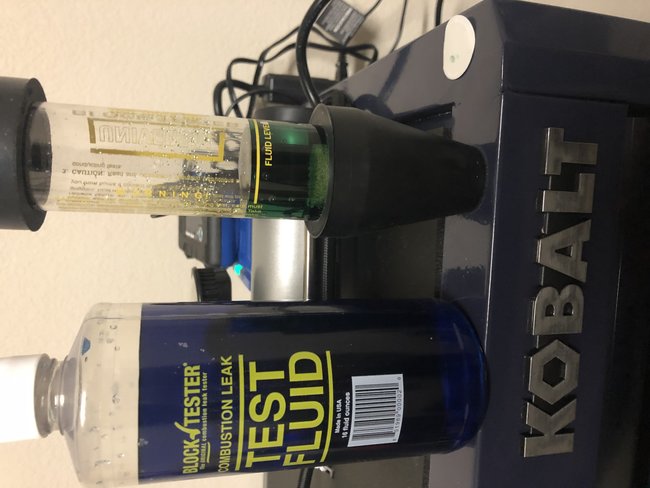
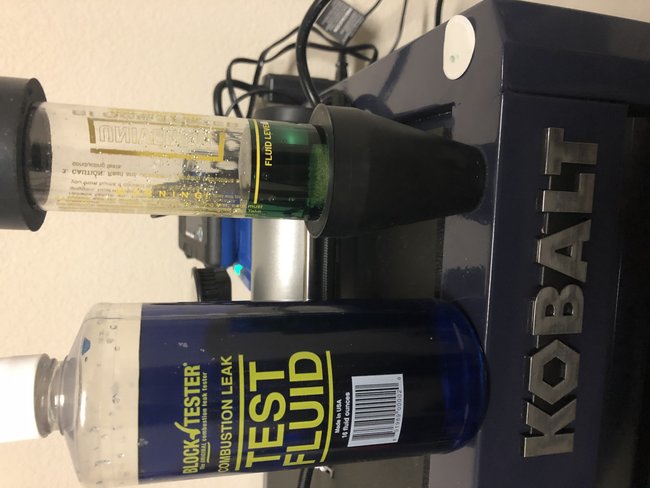
Due to the smoke, I purchased one of those chemical head gasket leak testers where the fluid will turn from blue to yellow if you have exhaust gasses in the coolant reservoir. My result is in the image below. It isn't yellow, but it isn't blue either.

I was going to buy a gas analyzer to test for hydrocarbons, but they are $1,000.00+. What is my best bet here? Do you think I have a head gasket leak with a car so new?

I doubt Ford would warranty it due to the tune on it.

If you think I need a replacement gasket, can you link to how to preform the DIY for the 2018 mustang ecoboost? Can't find any videos on it.
Jan 29, 2019 at 9:23 PM
Advertisement
Avatar
DANNY L
  • CERTIFIED EXPERT
  • 5,648 POSTS
Hello, I'm Danny.

Just a question first. Have you been noticing a loss of coolant? Do you have to keep adding to the overflow or radiator? Here is a tutorial about white smoke:

That looks like a positive test, but I also noticed the fluid is above the fill line. Any coolant in the test will contaminate it

Does it run rough at all when cold started?

Any overheating?

Does it blow coolant into the overflow when warmed up?

Do you notice excessive cooling system pressure when its fully warmed up? (Upper hose swelling)

https://www.2carpros.com/articles/white-smoke-or-steam-coming-from-the-exhaust-pipe

Hope this helps and thanks for using 2CarPros.
Danny-
Jan 29, 2019 at 9:33 PM
Avatar
ADF020
  • MEMBER
  • 9 POSTS
No loss of coolant is noticed. Just the white smoke and the chemical test. I did check the coolant reservoir and it had some sandy stuff in it. I read that could be due to poor flushing process from manufacturing? I think that is unrelated.
Jan 29, 2019 at 10:00 PM
Advertisement
Avatar
ADF020
  • MEMBER
  • 9 POSTS
But, what is your advice? Do you think it is a blown gasket? Do you have any guide to replace a head gasket myself for this car or can you ping someone who knows onto this thread?
Jan 29, 2019 at 10:09 PM
Avatar
KASEKENNY
  • CERTIFIED EXPERT
  • 18,907 POSTS
Just to jump in. I have seen this a number of times when the fluid does not change from blue to yellow but green instead. However, if you go back to 1st grade, blue and yellow make green so this means you have a small leak in the head gasket that is only allowing a small amount of hydrocarbons into the coolant.

Here is a guide that talks about this:

https://www.2carpros.com/articles/head-gasket-blown-test

Also, here is a guide that talks about the white smoke:

https://www.2carpros.com/articles/white-smoke-or-steam-coming-from-the-exhaust-pipe

Clearly Danny already provided the instructions on the head gasket but these guides will help others confirm a head gasket if they visit the site. Thanks
Dec 1, 2020 at 12:39 PM
Avatar
ASEMASTER6371
  • CERTIFIED EXPERT
  • 52,796 POSTS
Good evening,

I attached the procedure and pictures for you of the process for replacing the head gasket.

I would have a leak down test done to confirm to be sure it is the issue.

Roy


303-01A Engine - 2.3L EcoBoost (231kW/314PS) 2018 Mustang
Removal and Installation
Cylinder Head
Base Part Number: 6051
Special Tool(s) / General Equipment

Oil Drain Equipment
Hose Clamp Remover/Installer
Removal

NOTICE: Do not loosen or remove the crankshaft pulley bolt without first installing the special tools as instructed in this procedure. The crankshaft pulley and the crankshaft timing sprocket are not keyed to the crankshaft. The crankshaft, the crankshaft sprocket and the pulley are fitted together by friction. For that reason, the crankshaft sprocket is also unfastened if the pulley bolt is loosened. Before any repair requiring loosening or removal of the crankshaft pulley bolt, the crankshaft and camshafts must be locked in place by the special service tools, otherwise severe engine damage can occur.

NOTICE: During engine repair procedures, cleanliness is extremely important. All parts must be thoroughly cleaned and any foreign material, including any material created while cleaning gasket surfaces, that enters the oil passages, coolant passages or the oil pan, can cause engine failure.

With the vehicle in NEUTRAL, position it on a hoist.
Refer to: Jacking and Lifting - Overview (100-02 Jacking and Lifting, Description and Operation) .
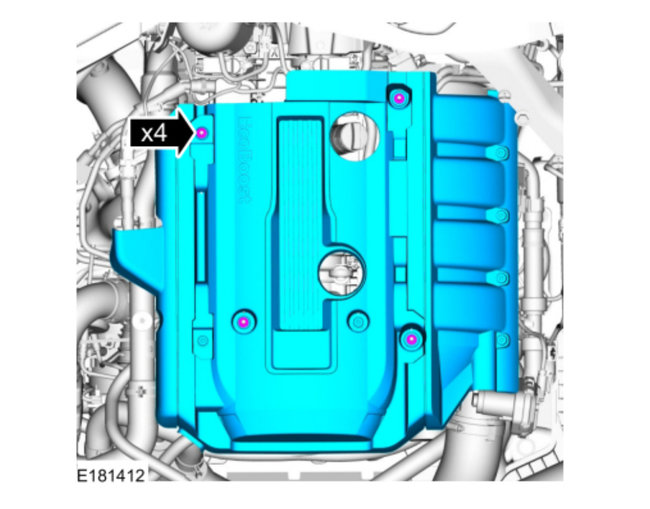
Remove the nuts and the engine appearance cover.
image
Release the fuel system pressure.
Refer to: Fuel System Pressure Release (310-00A Fuel System - General Information - 2.3L EcoBoost (231kW/314PS), General Procedures) .
Disconnect the battery ground.
Refer to: Battery Disconnect and Connect (414-01 Battery, Mounting and Cables, General Procedures) .
Drain the cooling system.
Refer to: Cooling System Draining, Vacuum Filling and Bleeding (303-03A Engine Cooling - 2.3L EcoBoost (231kW/314PS), General Procedures) .
Remove the following items:
Remove the turbocharger.
Refer to: Turbocharger (303-04D Fuel Charging and Controls - Turbocharger - 2.3L EcoBoost (231kW/314PS), Removal and Installation) .
Remove the intake manifold.
Refer to: Intake Manifold (303-01A Engine - 2.3L EcoBoost (231kW/314PS), Removal and Installation) .
Remove the camshafts.
Refer to: Camshafts (303-01A Engine - 2.3L EcoBoost (231kW/314PS), Removal and Installation) .
NOTE: If the valve tappets are to be reused, note the location of the valve tappets to make sure they are assembled in their original positions.

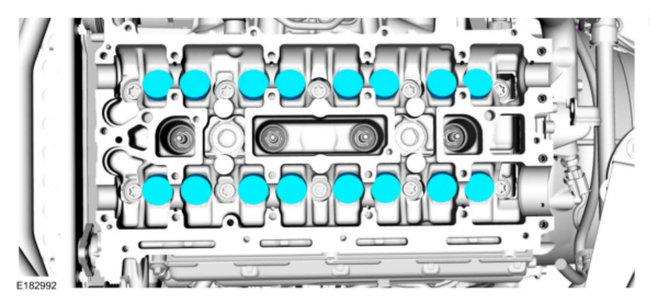
Remove the valve tappets.
imageOpen In New TabZoom/Print


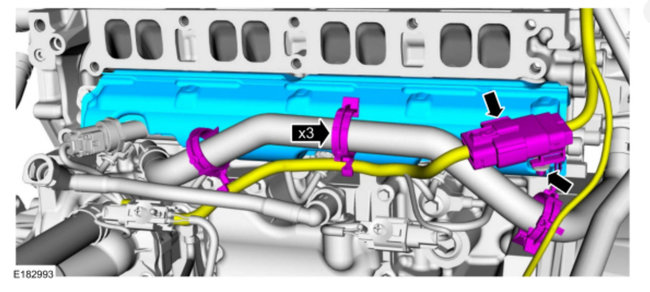
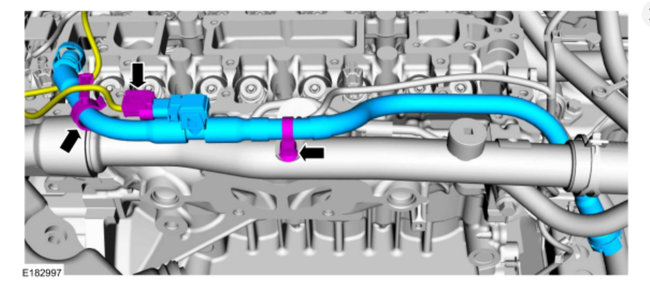
Detach and disconnect the fuel rail electrical connector.
Detach the wiring harness retainers.
Remove the fuel rail insulator shield.
image


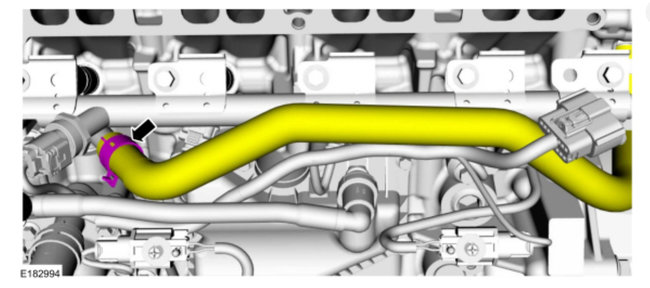
Disconnect and position the coolant tube aside.
Use the General Equipment: Hose Clamp Remover/Installer
imageOpen In New TabZoom/Print


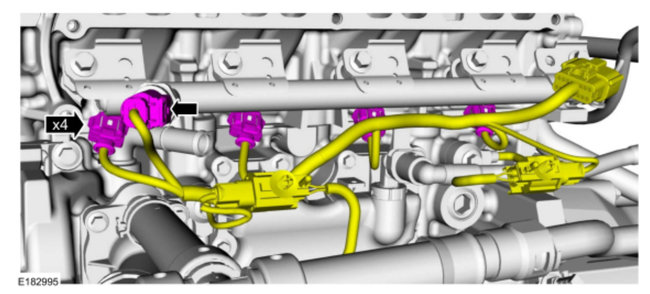
Disconnect the fuel injector and the FRP sensor electrical connectors.
image


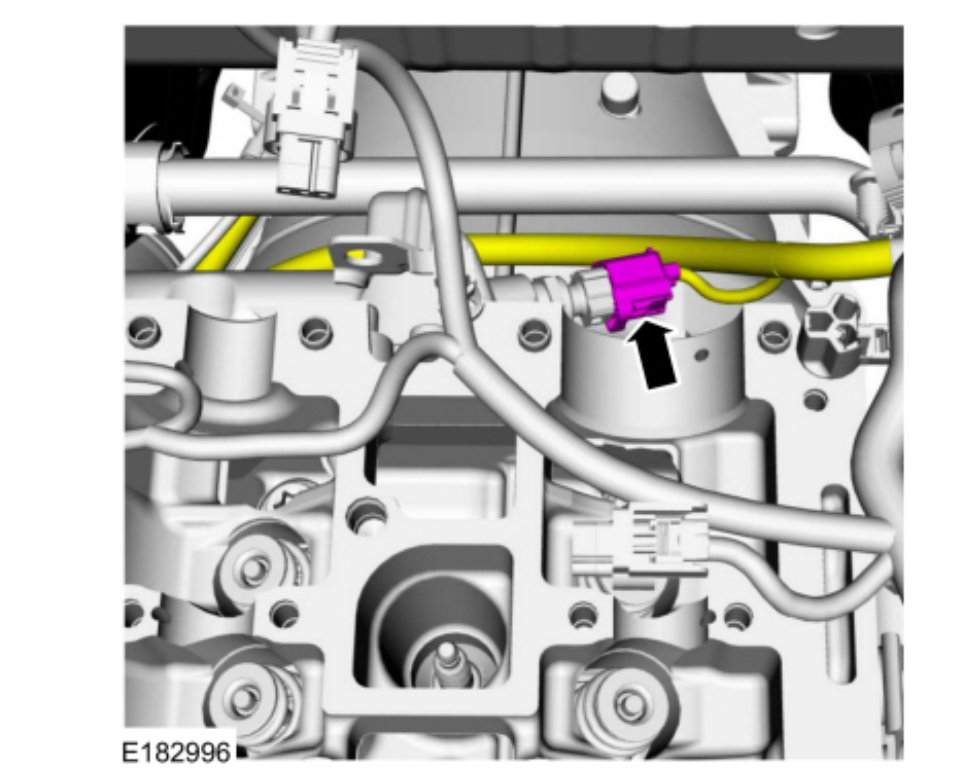
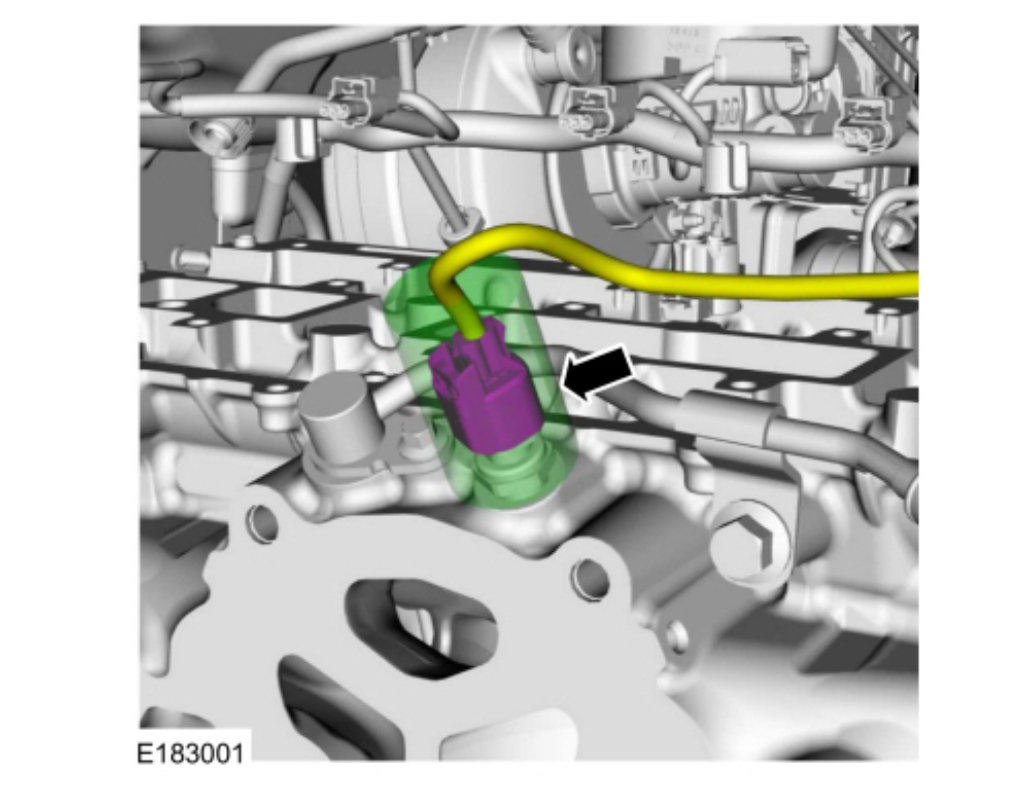
Disconnect the ECT sensor electrical connector from the back of the engine.
imageOpen In New TabZoom/Print


Disconnect the crankcase vent tube sensor electrical connector and wire harness retainer.
Detach the crankcase vent tube retainer and remove.
image


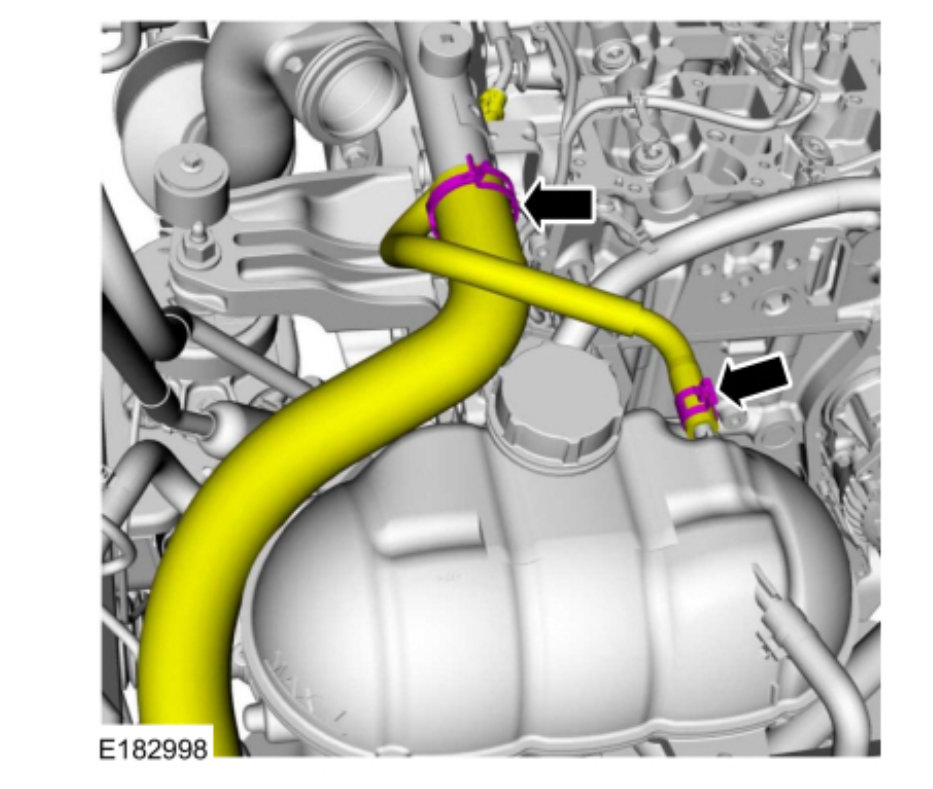
Disconnect the upper radiator hose from the coolant outlet tube.
Use the General Equipment: Hose Clamp Remover/Installer
Disconnect the coolant by-pass hose from the degas bottle.
Use the General Equipment: Hose Clamp Remover/Installer
imageOpen In New TabZoom/Print


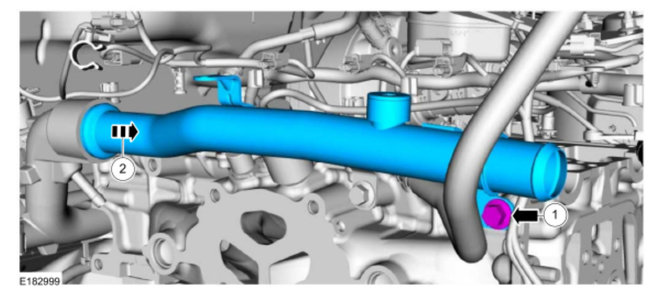
Remove the bolt from the cylinder head and remove the coolant tube from coolant outlet.
image


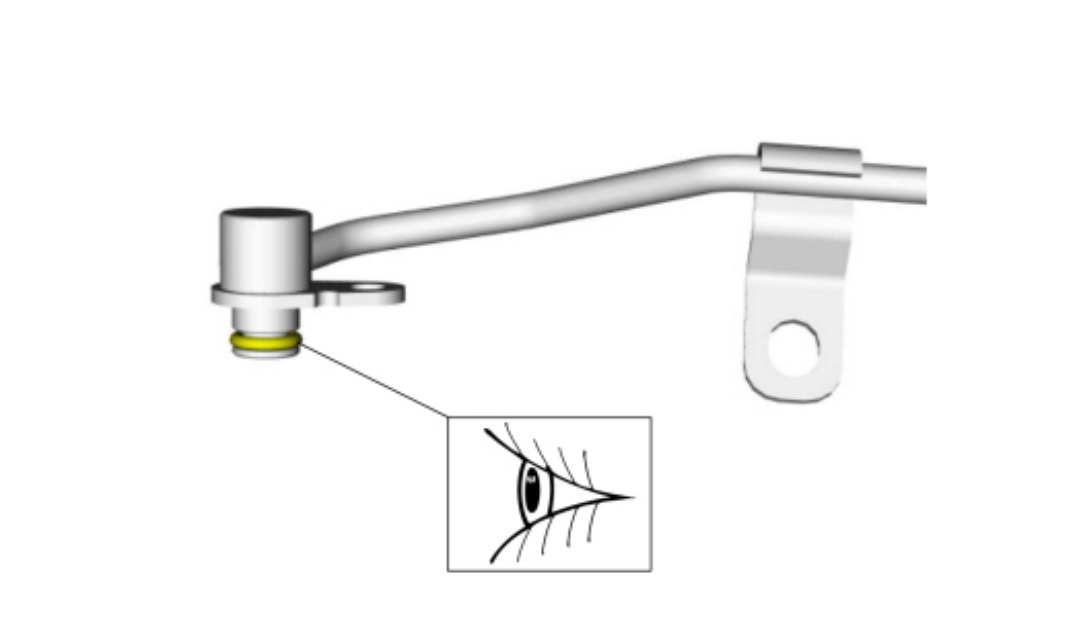
Remove and discard the coolant tube O-ring seal.
imageOpen In New TabZoom/Print


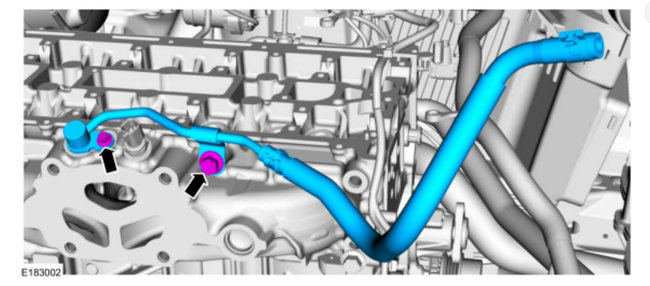
Slide the insulator up and disconnect the CHT sensor electrical connector.
image


Remove the bolts and the coolant tube.
imageOpen In New TabZoom/Print


Inspect the coolant tube O-ring seal and replace if necessary.
image


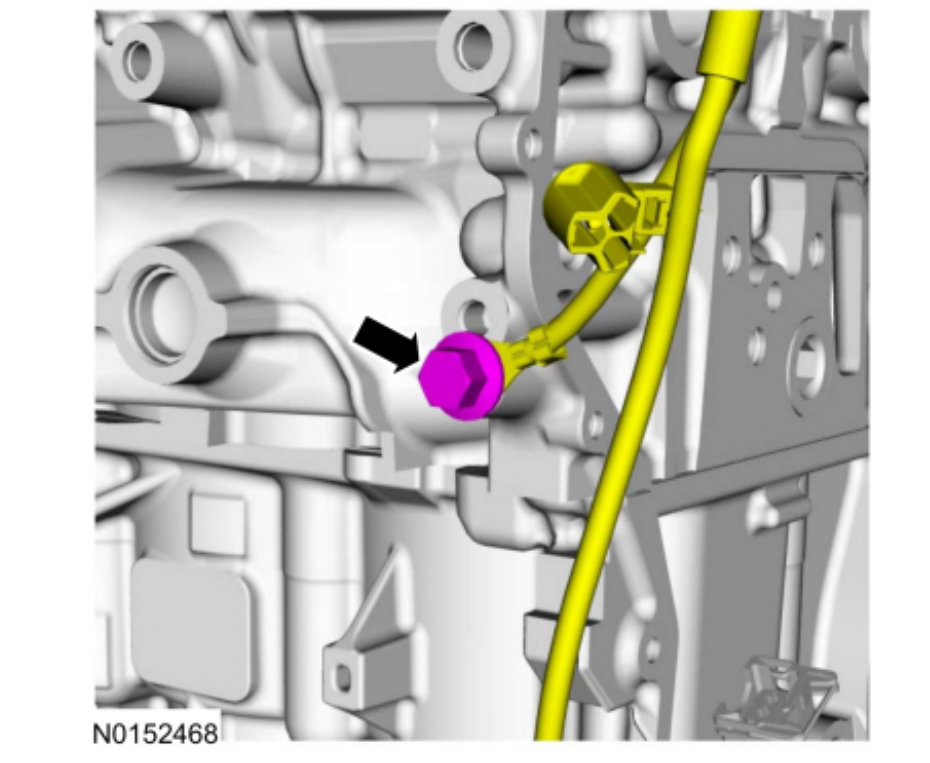
Remove the bolt and the ground wire.
imageOpen In New TabZoom/Print


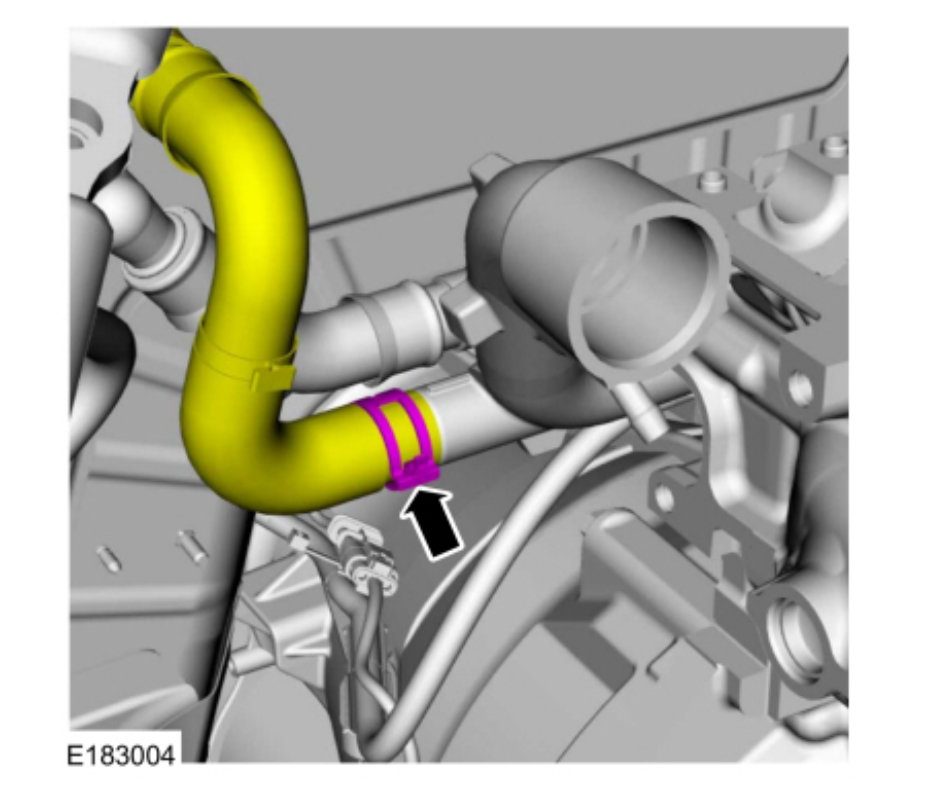
Disconnect the heater hose from the coolant outlet.
Use the General Equipment: Hose Clamp Remover/Installer
image


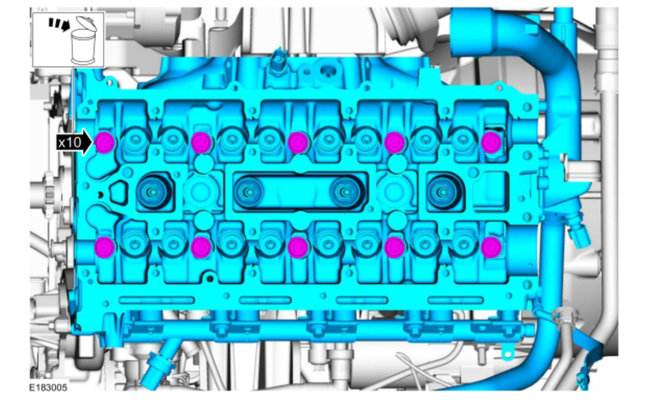
Remove the bolts and the cylinder head.
Discard the bolts.
imageOpen In New TabZoom/Print


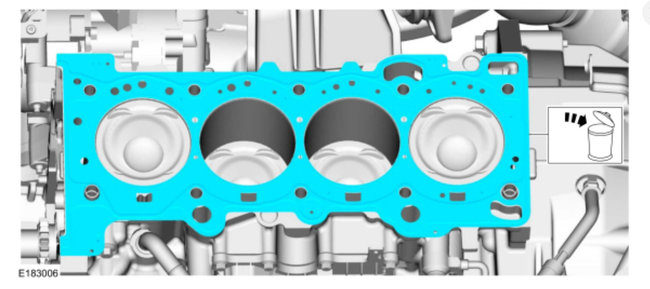
Remove and discard the cylinder head gasket.
image


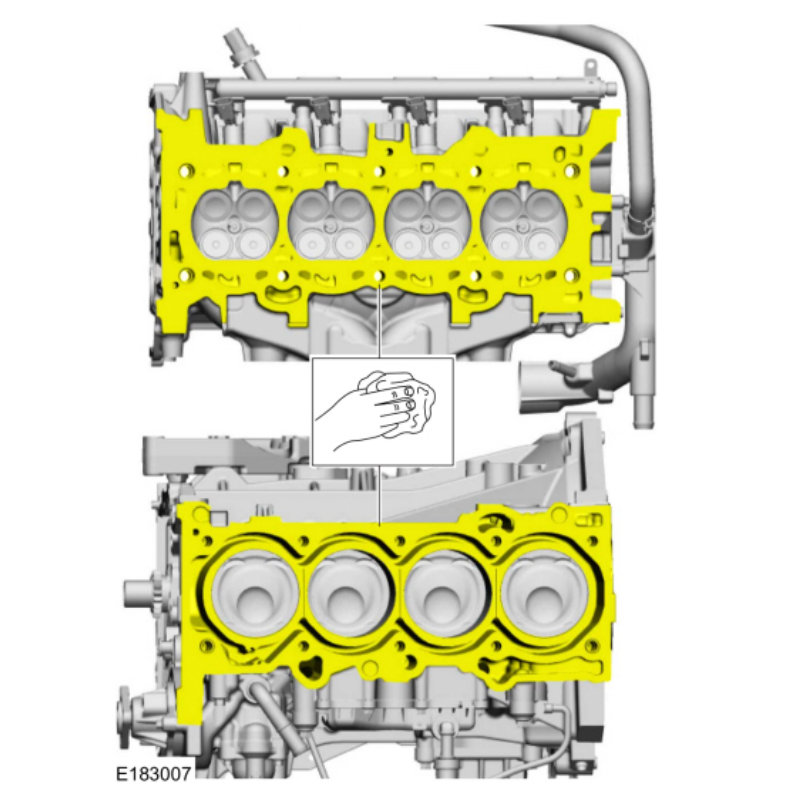
NOTICE: Do not use metal scrapers, wire brushes, power abrasive discs or other abrasive means to clean the sealing surfaces. These tools cause scratches and gouges that make leak paths. Use a plastic scraping tool to remove all traces of the head gasket.

NOTE: Clean the cylinder head bolt holes in the cylinder block. Make sure all coolant, oil or other foreign material is removed.

Make sure that the mating faces are clean and free of foreign material.
imageOpen In New TabZoom/Print


Check the cylinder head distortion.
Refer to: Cylinder Head Distortion (303-00 Engine System - General Information, General Procedures) .
Check the cylinder block distortion.
Refer to: Cylinder Block Distortion (303-00 Engine System - General Information, General Procedures) .
Installation

Install the cylinder head gasket.
image


NOTE: The cylinder head bolts are torque-to-yield and must not be reused. New cylinder head bolts must be installed.

Install the cylinder head and the new bolts.
Torque :
Stage 1: 62 lb.in (7 Nm)
Stage 2: 133 lb.in (15 Nm)
Stage 3: 41 lb.ft (55 Nm)
Stage 4: 90°
Stage 5: 90°
Dec 1, 2020 at 2:20 PM
Avatar
RANDALL ROJAS
  • MEMBER
  • 1 POST
Hello, with a small head gasket leak, had anyone tried blue devil, bars stop leak, bars head gasket fix, or Steel seal?
Dec 2, 2020 at 9:01 AM (Merged)
Avatar
ASEMASTER6371
  • CERTIFIED EXPERT
  • 52,796 POSTS
Good morning.

I never recommend any add in sealant as they rarely work. The only correct repair is to replace the head gasket.

The sealants clog the radiator and the heater core and do nothing but create more issues.

I hear many people the blue devil works but if it does, and I doubt it, it will be very temporary.

Roy
Dec 2, 2020 at 9:01 AM (Merged)
Avatar
2CP-ARCHIVES
  • MEMBER
  • 4,540 POSTS
Hi I am looking at buying a 2005 mustang gt and the owner says he changed the head gaskets on the car cause these engines are known to sweat a lot should I be worried? If he blew the head gasket is the car toast? Anyways give me your opinion thanks
Dec 2, 2020 at 9:01 AM (Merged)
Avatar
HMAC300
  • CERTIFIED EXPERT
  • 48,601 POSTS
if it doesn'tuse oil and the coolant level is full it may be ok, have it pressure tested for an internal leak if it was done right it should last for quite a while.
Dec 2, 2020 at 9:01 AM (Merged)
Avatar
DAISYGRUMBLER
  • MEMBER
  • 4 POSTS
I am thinking about buying my brothers 2002 ford mustang. He was overheating so he took it to a shop and they changed the radiator now it only over heats when the air conditioner is on. The shop said they were not sure but the head gasket might be starting to go bad but they did not do a compression test. I dont want to buy it if the head may go bad, how can a shop say it may be starting to go bad but it may be just fine? it has plenty of power , oil is good has no water in oil or anything like that it does not smoke or anything. How can you actually tell if the head is going to go bad or not? also i heard of something called blue devil that prevents the head from going bad. Have you ever used blue devil or heard anything good or bad about it?
Dec 2, 2020 at 9:02 AM (Merged)
Avatar
HMAC300
  • CERTIFIED EXPERT
  • 48,601 POSTS
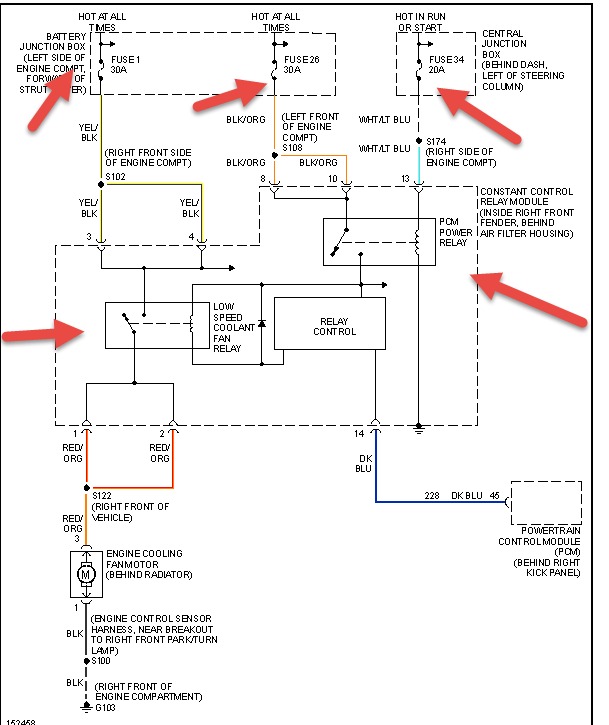
have the cooling system pressure checked to see if the head/intake gasket is bad. also check to see if your cooling fans come on when the a/c is on they should. check the items in pic then have it scanned to see if fan module is ok.
Dec 2, 2020 at 9:02 AM (Merged)
Avatar
AWDEVORE
  • MEMBER
  • 2 POSTS
I was told I probably have a blown head gasket as my car started smoking and there is a leak in the radiator. It probably ran hot for a few moments although I was watching closely. Anyway, my question is how difficult is this job if I get an excellent manual. I can put computers and furnature together, but only have changed an oil and my thermstat on my car. I can follow instructions, but I want to know your opinion?
Dec 2, 2020 at 9:02 AM (Merged)
Avatar
TAURUSWHEEL
  • CERTIFIED EXPERT
  • 718 POSTS
Find a reputable repair shop, the Ford Dealer maybe, and get a leakdown test performed to confirm a blown headgasket.. specify you want a leakdown test... don't tear it apart until you have a confirmed diagnosis of whatever the issue is.. if the headgasket is indeed bad, the heads should be checked for warpage also while it's apart.. did you overheat the engine??? Worst thing you can do to an engine short of no oil.. A smoking engine and a leaky rad are two seperate issues, what color was the smoke?? Oil= blue, coolant= white, gas= black.. if you think you're burning coolant stick your nose down by the tailpipe, take yourself a nice whiff, you may be able to catch a whiff of antifreeze in the exhaust, you'll know the smell, not scientific by any means though
Dec 2, 2020 at 9:02 AM (Merged)
Avatar
SPOOKYCC
  • MEMBER
  • 1 POST
Oil droplets small amount in reservoir. Mechanic does not want me to spend money on tracking down internal leak. New head gasket and cylinders machined two years ago. No head gasket symptoms. Runs fine, does not overheat.

I want to use Bars coolant system fix. It says to put in radiator if possible. If my radiator is full should I drain some and then add the coolant fix product? Or put it in the overflow reservoir? I never use leak stops as a rule but we are just trying to get as many miles as we can before I replace the car.

Thanks so much!

Colleen
Dec 2, 2020 at 9:02 AM (Merged)
Avatar
HARRY P
  • CERTIFIED EXPERT
  • 2,292 POSTS
As a general rule I stay away from putting stop leak in a cooling system. As its job is to plug up little holes, what it often ends up doing is plugging up the little passages through the radiator, making it easier for your car to overheat, and still leak anyways. If you are going to use it though, I would suggest letting a little coolant out by either opening the drain cock on the bottom of the radiator tank (passenger side) or by taking off the lower hose for a few seconds and then putting it back on, then put the stuff in. I know several people who swear by Blue Devil Head Gasket Sealant. https://www.amazon.com/BlueDevil-Head-Gasket-Sealer-ounce/dp/B000NOO798.
I kind of doubt that it actually works, but could be worth a shot.
Dec 2, 2020 at 9:02 AM (Merged)
Avatar
STEVE W.
  • CERTIFIED EXPERT
  • 15,113 POSTS
Blue Devil works but only for true head gasket leaks. In this case oil getting into the coolant I would not use it. Why? Because it is the same chemical that was used during the cash for clunkers fiasco. Water glass aka sodium silicate, If it gets into the oiling system it will destroy the engine in a very, very short time and it will not be repairable.

I would suspect that it is a front cover leak and not top end as there are no pressurized oil passages through the head gaskets, just drain back ports.
Unless this is a supercharged engine, those have an engine oil cooler in the radiator that could leak.
Dec 2, 2020 at 9:02 AM (Merged)
Avatar
HARRY P
  • CERTIFIED EXPERT
  • 2,292 POSTS
Hmmm, I guess it is true that you learn something new every day. Thanks for that Steve!
Dec 2, 2020 at 9:02 AM (Merged)
Avatar
OSCR72
  • MEMBER
  • 1 POST
How much work is involved in changing the head gasket and what would the parts normally cost? Is this a project that anybody can do themselves or is this a job for a mechanic?
Dec 2, 2020 at 9:03 AM (Merged)
Avatar
BLACKOP555
  • CERTIFIED EXPERT
  • 10,386 POSTS
if you have the tools your self. some patients. a decent set of tools then you should be able to do it yourself no problem. it shouldnt cost more then 200 bucks parts.
Dec 2, 2020 at 9:03 AM (Merged)
Avatar
FORDRACING24
  • MEMBER
  • 65 POSTS
A couple hundred bucks for the head gaskets and a torque wrench with a basic set of tools and you should be just fine.
Dec 2, 2020 at 9:03 AM (Merged)