Dead battery 2012 jeep liberty?

2012 JEEP LIBERTY
40,000 MILES • 3.7L • V6 • 4WD • AUTOMATIC
Avatar
STRICTLYDIMES
  • MEMBER
  • 26 POSTS
Just purchased a 2012 jeep liberty with the v6 engine. 40,000 miles. Automatic transmission. 4x4.

Truck has been sitting a few months. Battery was dead.

When I put my battery jump starter pack on it, it starts right up.
When I remove one cable off the jumper battery pack, the truck shuts off.

No alternator light or any other light on the dash.

Could it be just a bad battery or is it something else that I should be checking.

Thanks in advance
Apr 3, 2026 at 9:58 AM
Advertisement
Avatar
CARADIODOC
  • CERTIFIED EXPERT
  • 34,306 POSTS
Charge the battery at a slow rate for a few hours with a portable charger. You have a pretty good jumper pack if it will crank an engine with a dead battery. Once running, the engine should continue to run on the alternator, however, a couple of things could have happened. First, there is going to be a rather large fuse bolted into the under-hood fuse box. That is for the very high-current alternator output circuit. Without looking at the diagram, that fuse will be in the order of a 125-amp. You can visually inspect it through the clear plastic cover.

Second, when a battery is totally discharged, it will take some time for the acid to become electrically conductive and START to take a charge. If you use a small portable charger with an amp meter, you'll see charging current stays near 0 amps for five to fifteen minutes, then it will slowly start to climb. Ideal charging current is ten amps or less for a few hours. I consider a battery done charging when current drops down to five amps.

This is for a small portable charger. Don't use a larger wheel-type charger unless it has a very low setting. Battery chargers vibrate the battery's plates. On older lead-acid batteries, that accelerates the natural flaking off of lead from the plates, which eventually is what shorts a cell and kills the battery. On newer "absorbed glass mat", (AGM) batteries, charging rate is monitored in the vehicle to keep the charge rate low. All batteries give off explosive hydrogen gas. It's harder for those gas bubbles to dissipate when there's no liquid acid. Reducing the charge rate gives the battery time to expel that gas gradually. I have a 2014 Ram and a 2014 Grand Caravan. Both came with AGM batteries. It's a good bet your Jeep did too.

Also be aware a real lot of computer damage can be done by disconnecting a battery cable while the engine is running. Running the engine with a totally discharged battery is close to doing the same thing. All AC generators develop three-phase output. That is very efficient but includes "ripple" voltage. That is small variations in output voltage. The battery is responsible for smoothing that out. When the battery is dead, depending on the charging system circuitry, the voltage regulator in particular, some will respond to the lower voltages and try to bump that up. As long as at least a dead battery is there, the engine typically keeps running. Some regulators respond to the small voltage rises and try to cut back on that. Often they cut back so far that the engine stalls due to a slowed fuel pump or weak injector voltage pulses. That alone doesn't cause damage, but it explains why an engine will stall even though the charging system is working just fine.

All of this can be overcome by just charging the battery for a few hours. If it won't crank the engine after that without the jumper pack, it has probably failed. Chrysler used to say a good, fully charged battery will be strong enough to crank an engine fast enough to start after sitting for three weeks. Today that is the industry standard unless specified otherwise by the vehicle manufacturer. That is due to all of the computer memory circuits drawing a very small current to keep their memories alive. What I found two winters in a row while my Caravan was in storage, is after about two months, the battery was totally dead, then they froze and were ruined. Now I put a small battery maintainer on them.
Apr 3, 2026 at 10:48 AM
Avatar
STRICTLYDIMES
  • MEMBER
  • 26 POSTS
Wow, thanks for that very informative reply. I’m going to look for that fuse, and will charge the battery, (it doesn’t seem very old) . Am I correct is assuming that since there is no alternator light on the dashboard that the alternator is most likely good?
Apr 3, 2026 at 11:17 AM
Advertisement
Avatar
CARADIODOC
  • CERTIFIED EXPERT
  • 34,306 POSTS
Yes. The proper way to test the charging system is to measure the battery voltage with an inexpensive digital voltmeter. Do that first with the engine not running. A good, fully charged battery will read very close to 12.6 volts. It will read higher right after charging due to "surface charge". That's an accumulation of electrons in the electrolyte that haven't been absorbed into the plates yet. To dissipate that surface charge to get a more accurate reading, just turn on the headlights for a few seconds.

A good battery that is run down will read around 12.2 volts. If you find it's closer to 11.0 volts or less, it has a shorted cell and must be replaced.

Next, measure the battery voltage again with the engine running. Now it must be between 13.75 and 14.75 volts. It might be a little higher if the battery is considerably discharged and the charging system is being run harder to charge it up. Don't get excited if you find it's around 15.0 to 15.3 volts. It should come down gradually over the next few minutes.

If these voltage tests are okay, that only means it is okay to do the rest of the tests, but those require a professional load tester. It will also measure full-load output current and "ripple" voltage. Here's a link to an article that explains it better:

https://www.2carpros.com/articles/how-to-check-a-car-alternator

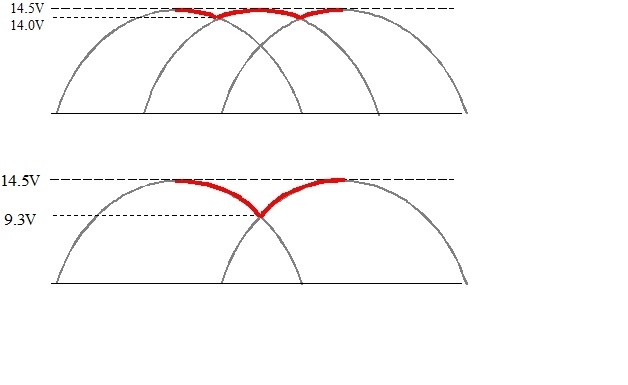
I put this drawing together to show what ripple voltage is. That's the red line in the top drawing. Every AC generator, (technically, "alternator" is a Chrysler term), has at least six "diodes". Those are one-way valves for electrical current flow. If all six are good, you'll get the top waveform, and under test, this is the only time the alternator will develop the maximum current it is designed for. You can find the listings on the Rock Auto web site, but I'd be pretty sure yours is rated for at least 120 amps.

When one diode has failed, you'll get the lower waveform in my sad drawing. Ripple voltage here is "high" and will be shown as such with a series of flashing lights on most testers. The other symptom is the alternator will only be able to develop exactly one third of its rated current. That can be enough to keep the engine running, but it's usually not enough to meet the demands of the entire electrical system and charge the battery. The battery will have to make up the difference as it slowly runs down over days or weeks. High ripple voltage also commonly shows up as an irritating whine on AM radio, that changes pitch with changes in engine speed.

Most vehicles today have voltmeters on the instrument cluster. They are notoriously inaccurate as far as voltage readings go, but are very good at showing when you see something out of the ordinary. Once you see where it normally sits, watch what happens when you turn on more and more high loads such as head lights and heater fan. If your alternator has a defective diode, it won't be able to keep up with demand and you'll see the voltmeter drop as system voltage approaches normal battery voltage of 12.6 volts. If the reading holds steady, the diodes are most likely okay and the charging system is working properly. I talk about failed diodes a lot because that is what we commonly see when alternators fail, but in fact, those failures are not especially common.

Be aware too, all generators are very inefficient at low speeds. You may see the voltage drop when you turn on those multiple loads, but it should come back up right away when you raise engine speed. You may also the voltage changes by watching the brightness of the head lights.
Apr 3, 2026 at 2:01 PM

Avatar
STRICTLYDIMES
  • MEMBER
  • 26 POSTS
Thanks I will check that out. Much appreciated.
Apr 3, 2026 at 6:40 PM
Avatar
STRICTLYDIMES
  • MEMBER
  • 26 POSTS
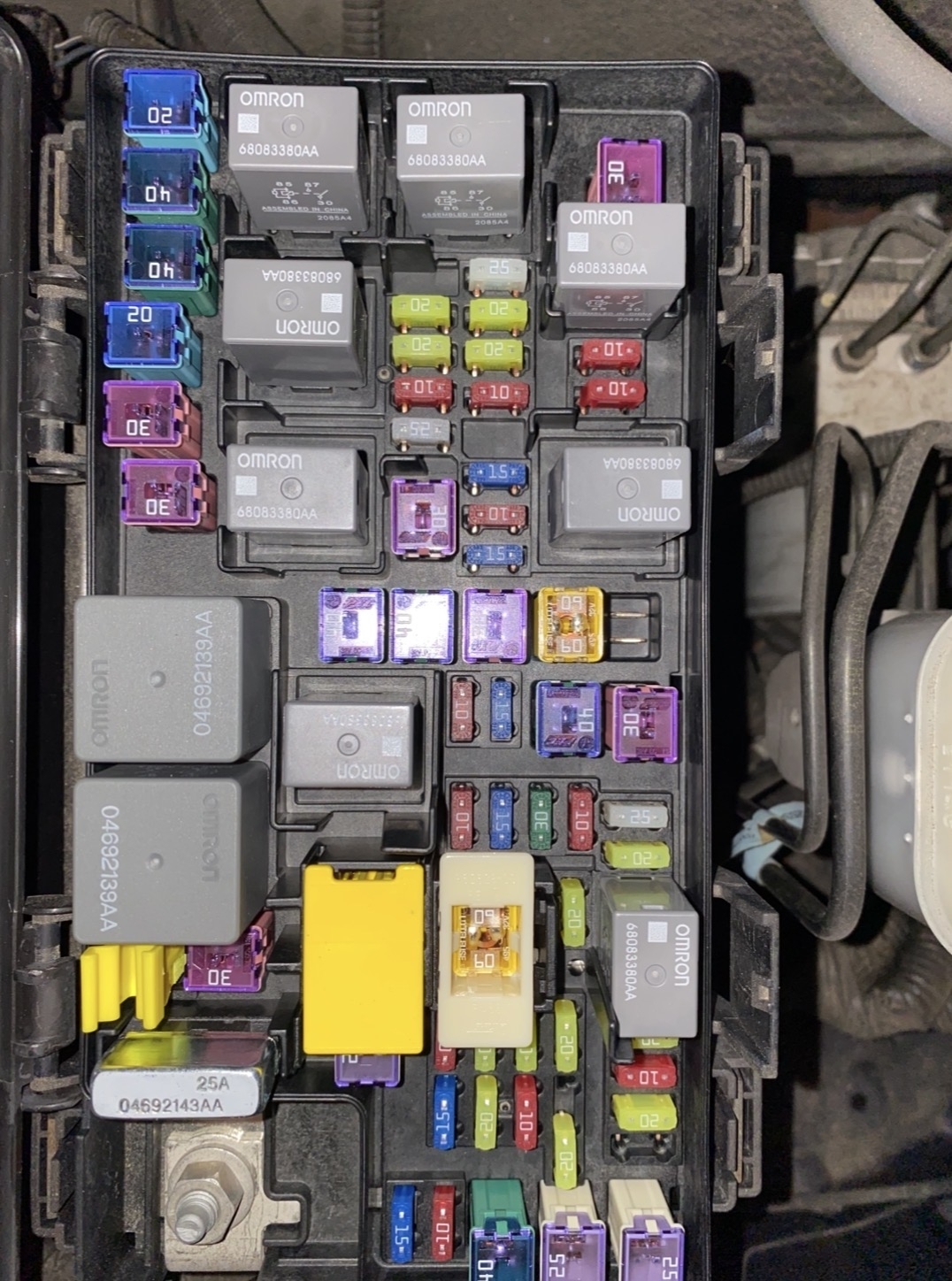
One more question, regarding the “very high-current alternator output circuit” you mentioned earlier, do you know where it is / have a diagram? I removed the black plastic fuse box cover next to the battery but don’t see anything of a 125-amp. (See pic). Thanks for your continued help.
Apr 4, 2026 at 12:01 AM
Avatar
CARADIODOC
  • CERTIFIED EXPERT
  • 34,306 POSTS
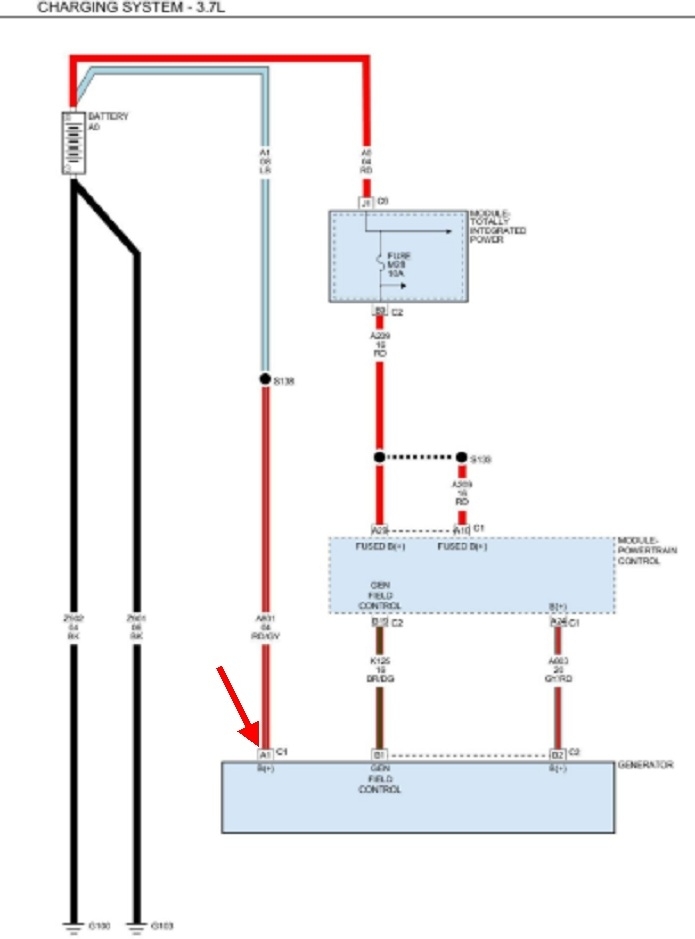
You're right. I don't see that fuse on the diagram either. It looks like they were still using a fuse link wire. That would be the gray section of the wire in this diagram. They show it here as being connected to the battery's positive cable, but I usually see them attached to the fuse box. Regardless, there's two ways to test it if it is necessary. If you can find it, just tug gently on it. If it acts like a wire, it's okay. If it's burned out, it will act like a rubber band.

The faster way is to measure the voltage right on the large stud on the back of the alternator when the engine is not running. There should be full battery voltage there all the time. That's at the red arrow in the diagram.

Of course, if the previous battery voltage test shows the charging system is working, that fuse link has to be okay.

Fuse link wires are just a regular piece of wire, but they are of a slightly smaller diameter than the circuit they protect, making them the weak link in the chain. Their insulation is designed to not melt or burn, so they must be replaced with the same type of wire. You can buy these links at any auto parts store. They usually are about 12" long, so you can cut them to make two or three repairs. Buy the same color insulation as that denotes their current rating, just like they do with fuses.
Apr 4, 2026 at 3:49 PM