Creaking when braking and stopping?

2013 HYUNDAI SONATA
180,000 MILES
Avatar
BOBWRIGHT26
  • MEMBER
  • 23 POSTS
I had a mechanic friend tell me it was due to slider pins not being lubed. I lubed them and sound went away for a while. I came back about a week later. Took wheel off and checked pins. Still lubricated. I greased pads on contact points as well. Compressed piston and put caliper back on. The sound went away for a while again and came back. Friend suggested new pads and rotors. Still have sound. Seems like the only thing helping noise is compressing the piston. Sound goes away for a few days then returns. Creak sounds almost like an old door opening and closing.
Oct 13, 2024 at 12:33 PM
Advertisement
Avatar
CARADIODOC
  • CERTIFIED EXPERT
  • 34,306 POSTS
Better suspect is a suspension bushing. To work on the brakes, you have to jack up that corner of the car, and that lets the suspension hang down, twisting the rubber bushings to their limit, meaning further than during normal driving. That excessive twisting can grind rust loose that doesn't come back for a couple of days. To prove if I'm on the right track, when the noise comes back next time, jack the front end up for a few minutes, but don't bother removing the wheel. Just set it back down and see if the noise is gone.

Another clue is you may be able to make the noise occur by bouncing the corner of the car. If that works, the brakes aren't involved with the noise.

Regardless if that leads to anything, a good tool to find the cause of an elusive noise is called the "Chassis Ear". There are a few different models including some with wireless microphones. I have the oldest model that uses six wired microphones. You clip them to suspect points, run the wires inside to a switch box, and you wear a set of headphones while driving. By switching between the microphones and by moving them around, you can zero in on the source of the noise.

I found the tool on eBay for around $200.00. Don't know what the cost is for the models with wireless microphones. You might find this at an auto parts store that rents or borrows tools.

Let me know what you find.
Oct 13, 2024 at 12:59 PM
Avatar
BOBWRIGHT26
  • MEMBER
  • 23 POSTS
I've tried bouncing the corner and don't hear any noise.
Oct 13, 2024 at 1:03 PM
Advertisement
Avatar
CARADIODOC
  • CERTIFIED EXPERT
  • 34,306 POSTS
Rats. I'd pursue the Chassis Ear next. I forgot to mention, as you switch from one microphone to the next, one will make you think you're getting close, but when you switch to one that's on the noise source, it will be real obvious. You can clip one to the brake caliper, but you'll have to be careful when running the wires that they don't get caught in anything rotating. I like to tie up the wires so if a microphone pops off, it won't drag on the ground.

Don't forget to try just jacking the front end up, then setting it back down, then let me know what happens.
Oct 13, 2024 at 1:12 PM
Avatar
BOBWRIGHT26
  • MEMBER
  • 23 POSTS
Okay, I'll do that tomorrow. My wife has car at work now.
Oct 13, 2024 at 1:24 PM
Avatar
CARADIODOC
  • CERTIFIED EXPERT
  • 34,306 POSTS
Dandy. I'm here every day, normally in the early to late evenings. Will wait to hear some good news.
Oct 13, 2024 at 1:32 PM
Avatar
BOBWRIGHT26
  • MEMBER
  • 23 POSTS
Sorry it took so long to reply back. I tried jacking up and seeing if the noise went away. It did not. Again, after taking wheel of and taking caliper off and back on and all that the noise went away.
Oct 20, 2024 at 10:01 AM
Avatar
CARADIODOC
  • CERTIFIED EXPERT
  • 34,306 POSTS
Do you mean temporarily, or will the noise come back?

I see you lubed the backs of the pads where they contact the piston and caliper's fingers. Another place that needs lube is where the pads sit on their mounting surfaces. Lube on those points is more to reduce wear than to prevent noise, but if the rotor becomes just slightly warped, as most new ones do once, that makes the caliper and pads walk back and forth a little once per wheel revolution. If grooves wear into the pads' mounting surfaces, they can make a clicking noise when the brakes are applied. The pads are held tightly against one surface as they shift left and right a little and go into and out of those grooves.
When those grooves aren't worn in yet, a low growl can occur during braking.

One clue to look for is how the squeal occurs. The first thing I thought of was a worn rubber bushing. That can make a horrendous squeak, but only while the front of the vehicle is in motion moving downward, just at the start of the braking cycle. After that, the noise will only occur some more if the tire hits a bump or pothole. During a long stop, the squeak will only occur at the start of braking.

If the squeak remains constant as long as the vehicle is still moving, it has to be caused by something that is rotating. The frustrating part is that noise can be much too low to hear directly, but if it gets transmitted into the caliper, that mass can really amplify it to the point it's very easy to hear. That's actually why we put special high-temperature brake grease on the backs of pads. Disc brake pads a going to vibrate, period. There's nothing we can do to stop that. The grease allows the pads to vibrate, or slide back and forth against the piston and caliper fingers without transmitting the noise into the caliper.

A problem every brake system specialist has run into more than once is a bent backing plate, or splash shield. It should have a good 1/8" clearance from the edge of the rotor. If that clearance is too small, it can cause a noise only during braking due to the number of different forces acting on the caliper, rotor, and wheel bearing. You'd find this pretty quickly with the Chassis Ear. Sometimes there's a telltale shiny ring worn onto the backside of the rotor where it was touching the splash shield, but we usually see that only after the actual cause is found.

Another clue that points to a suspension bushing is the noise seems to always disappear for a few days right after any brake service is performed. The only thing that occurs consistently is that corner of the vehicle has to be jacked up, allowing the suspension to hang down and stretch the bushings. Same is true of ball joints. The extended travel redistributes the grease, making the squeaking go away for a while. A squeaking ball joint will occur at the same times as a rubber bushing would squeak. You can eliminate those as suspects if the noise is constant during braking.

A creaking noise that threw me for a loop a few years ago was caused by a stamped metal wheel cover. It could be heard occurring very lightly while walking slowly alongside the moving car, but the driver couldn't hear it until braking occurred. That put more weight on the front wheels, and the braking forces caused the wheel to flex more than normal. A very light film of axle grease around the wheel on the wheel cover contact points solved that. The creaking sounded exactly like a worn rubber bushing, except it was constant during braking until the car stopped moving.

The last thing I can think of used to effect mostly GM front-wheel-drive cars, but it could apply to any brand. Typically, right after a normal front brake job, a grinding noise would develop, but mainly while turning, and not so much from braking. It was found the rotors were flexing under the wheel and lug nuts, even though everything was fine and the lug nuts were torqued to specs. The noise was solved by placing a light coating of axle grease on the hub where the center hole of the rotor sits. That allowed the flexing to occur without creating that grinding or crunching noise. Now it's standard practice to put a little lube on the hub whenever the rotor is reinstalled. I like to use Spray White Lube. That's a lithium-based grease, but be careful to not allow any overspray to get on the rotor's or pads' friction surfaces. I consider this more of a preventive maintenance for the one out of a hundred vehicles that might develop that noise.
Oct 20, 2024 at 7:34 PM
Avatar
BOBWRIGHT26
  • MEMBER
  • 23 POSTS
The noise will come back. It now sounds more like a popping sound when braking rather than a squeak. I'm still thinking it may be the caliper.
Oct 21, 2024 at 2:49 AM
Avatar
BOBWRIGHT26
  • MEMBER
  • 23 POSTS
My mechanic friend claims it's the sound normally made by caliper pins sticking, but they are not sticking.
Oct 21, 2024 at 2:50 AM
Avatar
BOBWRIGHT26
  • MEMBER
  • 23 POSTS
Also, have a faint squeaky noise when going around turns at a slow speed.
Oct 21, 2024 at 5:45 AM
Avatar
BOBWRIGHT26
  • MEMBER
  • 23 POSTS
One more thing, I've noticed is an excessive amount of brake dust on that wheel.
Oct 21, 2024 at 5:49 AM
Avatar
CARADIODOC
  • CERTIFIED EXPERT
  • 34,306 POSTS
Have you given any thought to locating a Chassis Ear? This is exactly what they were designed for. Instead of buying one on eBay, you might be able to borrow one from an auto parts store. In my city, they make you buy it, but you get a full refund when you return it. If you choose to keep it, you still return it, then they give or order you a brand new one.
Oct 21, 2024 at 9:41 PM
Avatar
BOBWRIGHT26
  • MEMBER
  • 23 POSTS
None of the shops around me have them and I don't have the money to spend to get one.
Oct 22, 2024 at 12:17 PM
Avatar
CARADIODOC
  • CERTIFIED EXPERT
  • 34,306 POSTS
Would it be possible to upload a video clip with the noise occurring?
Oct 23, 2024 at 9:01 PM
Avatar
BOBWRIGHT26
  • MEMBER
  • 23 POSTS
I took it to a shop and the diagnosis was I need a new CV axle.
Oct 24, 2024 at 3:17 AM
Avatar
CARADIODOC
  • CERTIFIED EXPERT
  • 34,306 POSTS
I'll believe that after you post a follow-up that it solved the noise. Outer CV joints make a clicking noise when they're worn, most commonly when turning and backing up. Worn inner CV joints can cause an elusive steering wheel oscillation when under load or moderate acceleration, but they don't cause noises. I guess anything is possible, but you might consider getting a second opinion.
Oct 24, 2024 at 6:03 PM
Avatar
BOBWRIGHT26
  • MEMBER
  • 23 POSTS
While I agree, I do need the axle as well. It's got a rip in the boot.
Oct 25, 2024 at 2:47 AM
Avatar
BOBWRIGHT26
  • MEMBER
  • 23 POSTS
While I agree, I do need the axle as well. It's got a rip in the boot. I'm still thinking it's a caliper issue. Because yesterday I took out pins and re greased and noise is gone again for the time being. My vehicle has two different pins. One with a bushing and one without. Wondering if the position they go in matters.
Oct 25, 2024 at 2:49 AM
Avatar
CARADIODOC
  • CERTIFIED EXPERT
  • 34,306 POSTS
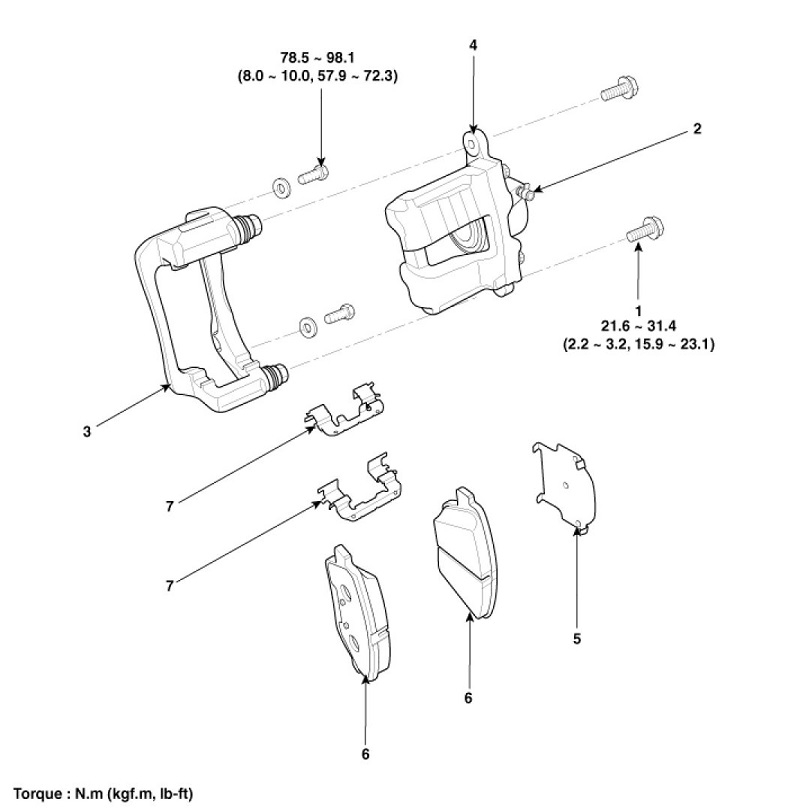
When I work on an unfamiliar vehicle, I do just one side at a time so I have the other one for reference when my mind falters and I forget. Before you take that other side apart, check out this drawing.

When lubricating parts stops a noise for a little while, that's a clue, but not a fix. It does suggest you found the right cause. If you look on Rock Auto or any auto parts store, the caliper parts are available in complete kits. Installing one of those repair kits might put an end to this aggravation.
Oct 25, 2024 at 5:01 PM
Avatar
BOBWRIGHT26
  • MEMBER
  • 23 POSTS
So I've been thinking about my issue. I know I need the CV axle. Definitely leaking grease. What I originally thought was a lot of brake dust on my rim is actually grease assuming from the axle. And I've had grease on my rotor that I've cleaned up with brake cleaner every few days. Could that grease on rotor and pads possibly be causing the brake noise? Because every time I have wheel off and lube contact points and whatnot, I also have sprayed everything off with the brake cleaner. Which might be why the noise goes away for a few days before coming back. I get axle done tomorrow morning, so I guess we'll see.
Oct 27, 2024 at 11:34 AM
Avatar
CARADIODOC
  • CERTIFIED EXPERT
  • 34,306 POSTS
My first thought is that grease will not get on the rotor. There's a splash shield behind the rotor. Those are made of steel on all brands except Ford that often uses plastic. Those commonly break off, then CV joint grease could get on the rotor. We do get pretty excited about contamination on all of the friction surfaces, including fingerprint grease, so it is common to wash everything with Brake Parts Cleaner. As the story goes, you're okay if any contamination is washed off before the parts go through a heat cycle. Once the parts get hot from normal braking, grease soaks into the linings and will never come out. That is one cause of that annoying high-pitched brake squeal. That squeal can go away when the parts warm up, it can be worse when hot, and it usually is worse on humid days. The only fix I know of for that is to replace the pads again, and take a light cut on the rotors on a brake lathe. Rotors are made of cast iron which is porous, so it will let contaminants soak in. There was even one shop manager who insisted his mechanics throw away any new pads he found to have grease on them, and get a new set. He was that concerned about a squeal.

By the way, another way to prevent a brake squeal is to grind off the leading edges of the pads. That removes the "fingernails-on-the blackboard" effect. I used to grind them on a bench grinder to take off about 1/8". Later I just used a flat file to put a 45 degree bevel on that leading edge. Now I have it down to simply dragging the edges across a concrete floor a couple of times. Seems if you remove enough material to prevent a squeal during the couple hundred-mile break-in period, they won't squeal after that when the linings have worn past that bevel. Some vehicles, GMs in particular, come with pads that have a really huge bevel, sometimes close to an inch on each end. That can prevent the squeal, but it also destroys the squeegee action after driving through deep water. Water left on the rotors leads to one form of brake fade.

A lot of imports that use very small pads will often have what looks like a hacksaw cut through the middle of the linings. That turns each lining into two smaller pads that are supposed to produce squeals too high in frequency for us to hear. You'll have to ask your dog if that's true.

All of this pertains to that miserable high-pitched squeal. That's very different from a creaking noise like with tight door hinges in a horror movie. Squeals and vibrations have to be caused by something that is rotating. Creaking just needs two parts moving against each other.
Oct 28, 2024 at 6:36 PM
Avatar
BOBWRIGHT26
  • MEMBER
  • 23 POSTS
So after my axle replacement, I took the wheel off and cleaned up any grease that was on back of wheel etc. I noticed that the puddle under wheel from brake cleaner had a green tint to it. What would cause that?
Oct 30, 2024 at 1:12 PM
Avatar
BOBWRIGHT26
  • MEMBER
  • 23 POSTS
Got the green tint from brake pads and rotor as well.
Oct 30, 2024 at 2:15 PM
Avatar
CARADIODOC
  • CERTIFIED EXPERT
  • 34,306 POSTS
The first thing that came to mind was a dye used to search for fluid leaks. That shows up bright yellow under a black light, but it does usually look green in the bottle. The only other thing would be the brake grease you're using. I used to use "Rusty Lube" which is copper-colored, but there are many other brands. One of the characteristics of brake grease is it doesn't travel like petroleum-based products do. That prevents it from migrating over to the friction surfaces.

Boot kits for CV joints include packets of the correct amount of grease. Sometimes that grease is gray, but most commonly it's dark green. When the boot gets a tear in it, the grease from the outer joint sprays around that area and looks kind of like coconut frosting where it lands. The spray pattern is very close to the rotor and caliper. Could you be seeing that grease?
Oct 30, 2024 at 6:10 PM
Avatar
BOBWRIGHT26
  • MEMBER
  • 23 POSTS
That could be it and was my first thought that it was from that torn boot in the axle. And I do have video of the noise when braking that I took the other day. I'll upload it.
Oct 30, 2024 at 6:17 PM
Avatar
CARADIODOC
  • CERTIFIED EXPERT
  • 34,306 POSTS
The sound appears to have gone out on my 'puter. Will have to listen the next time I'm visiting my relative.
Oct 30, 2024 at 6:59 PM
Avatar
CARADIODOC
  • CERTIFIED EXPERT
  • 34,306 POSTS
Aha! That's not a creaking noise. That's a loud clicking once per wheel revolution. That's caused by one of two things. The more common is loose lug nuts. It's important to always use a torque wrench on the lug nuts. Overtightening is just as bad as under tightening. Under-torqued nuts leads to them backing off from wheel movement and grinding away of the contact surfaces. Once that begins, there's no stopping it and the nuts will never remain tight after that. If you do tighten them again, the clicking noise will go away for a little while, but will return withing a few miles. That's the clue. The only repair is to replace the wheel and the lug nuts.

The other cause is a combination of a warped rotor and grooves worn into the pads' mounting surface. Rotors can warp in one of two ways. One way is "thickness variation". The thickness is different at different sections of the rotor. As the thicker area enters the pads, it pushes the piston back into the caliper. That pushes brake fluid up and pushes the brake pedal toward you. You feel that as a pedal pulsation.

The other, probably more common type of warping is the thickness is nice and even all the way around, but the entire friction surface is not perfectly parallel to the mounting surface. Think of the carnival sideshow where the performer is spinning plates on top of long sticks. The plate is the same thickness in all areas, but it's wobbling as it slows down. If the wobbling of the rotor gets bad enough, its mass will tug back and forth on the steering linkage, so you'll feel that in the steering wheel, but possibly not in the brake pedal.

The clicking in this case comes from grooves worn in the knuckle the pads rest on. While driving, the rotor is still wobbling, but the caliper and pads are free to walk back and forth freely, so no noise occurs. It's during braking that very high force pushes the pads against the mounting surface, and they'd rather not move sideways because of that force. Since the rotor is wobbling back and forth a little, it forces the pads under pressure to be forced into and out of those worn spots twice per wheel revolution. That creates the clicking noise.

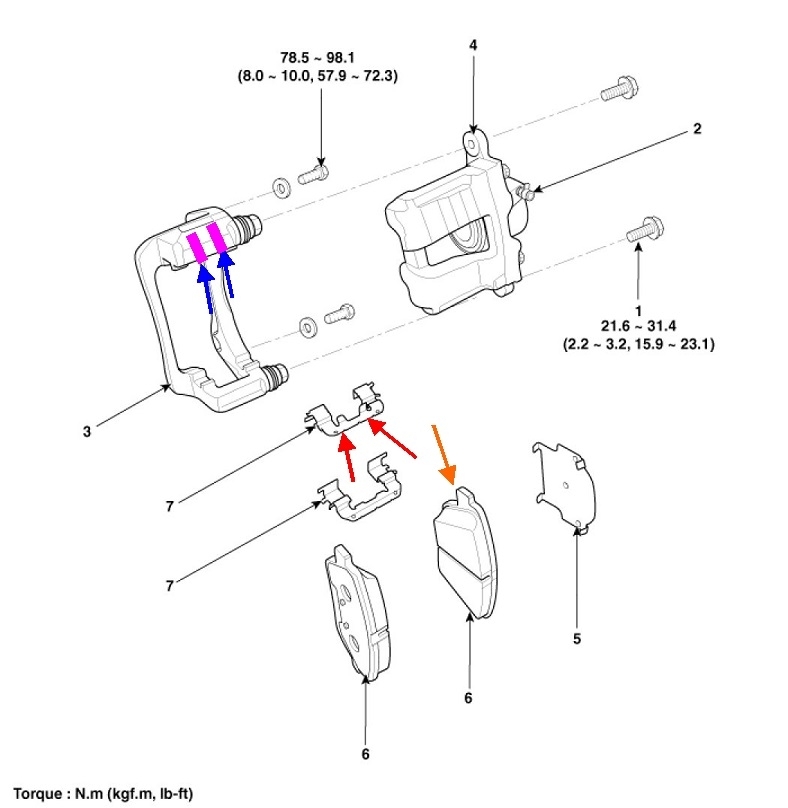
I added some nifty arrows to the exploded view to try to describe this better. The orange arrow is pointing to one of the mounting ears for the inner pad. That ear is pressed against the mounting bracket by the pink spot on the right, (blue arrow). That's one of the places we grease. When the rotor is warped, even a little, that ear grinds back and forth during braking, wearing the pink grooves into the surface. Even that may not cause a noise yet because the pads are remaining within those worn spots. It's when anything changes where the pads ride that can setup the clicking noise. New, thicker pads will push the inner pad's backing plate closer to the caliper, (away from the rotor), placing the mounting ear outside that worn area. Now, as the rotor wobbles back and forth, it pushes the pad's ear into and out of that worn spot. That makes the clicking noise.

There's a number of ways to address this. For most domestic vehicles, the easiest is to replace the mounting bracket or steering knuckle. For most imports this isn't a concern because they use stainless steel inserts to become the wear surfaces. The two red arrows are pointing to one of those inserts. This is the one that gets the forces put on it when braking going forward. Those inserts stand up to wear really well, but you still usually get new ones with new pads. If you don't, they are available as a repair kit.

The less-desirable repair method is only used on rare vehicles when replacement parts are hard to come by. That is to heat the wear surfaces for a long time with an acetylene torch, then fill in the worn spots with a wire-feed welder. Grind those surfaces smooth and flat to restore the original shape. These mounts are made of cast iron which is porous. They will crack or shatter when trying to weld to them. The preheating prevents that, but I've seen people take up to three hours of preheating to repair cracked exhaust manifolds. I've made this type of repair a half dozen times, and preheating for as little as 20 minutes was enough to prevent shattering. I've done this on these pad mounting surfaces, and with cracked anti-lock brake tone rings on outer CV joints.

The first vehicle I ran into with this clicking noise was on a Dodge Dakota 4wd in the late '90s. The final observation was we ran the vehicle, in gear, on a hoist, with the left front wheel off, and we could easily see the caliper walking left and right as the rotor went around. Replacing the knuckle and lubing those points solved the noise. Machining the rotor prevented a repeat failure.

Be aware, related to this, most new rotors are made in China and will warp within the first three months. Unlike the thickness variation I mentioned earlier, this type of warping creates excessive "lateral runout". When we make parts from cast iron, we set them aside for three months to age before they get their final machining. The Chinese cast 'em, machine 'em, pack 'em, and ship 'em, then they age on your vehicle. Once they warp, as most will do, a simple light machining on a brake lathe is the final solution. The people at most auto parts stores will do this for you for free. Those who demand new rotors under warranty will have the same problem in another three months. This usually only happens once.

Given that your system uses these stainless steel inserts, I'm growing more suspicious the lug nuts and mating contact points on the wheel are worn. A sure-fire way to prove this is when the noise is occurring, stop and retighten the lug nuts. The clicking noise will be gone for anywhere from a few miles to a day or two. Over-tightening won't help because the contact points between the nuts and wheel have to match perfectly, and there must be no grease on those points. When those surfaces no longer match, the friction that holds the nuts tight is gone. That's why the nuts and wheel have to be replaced.

It's okay to put a very light film of grease on the wheel studs for most domestic vehicles, but more is not better. The nuts should be run on by hand, then tightened with a torque wrench. When too much grease is used, or when the nuts are spun on with air tools, the grease can build up ahead of the nut, then get flung onto the friction surface. Those surfaces have to be kept dry to hold the nuts tight.

Most import vehicles use anodized wheel studs. That's a silver, light blue, or light gold coating that is a lubricant. No grease must be used on those studs. Grease will dissolve the coating, leading to galling, and stripped threads the next time the nuts are removed.

Nov 2, 2024 at 4:12 PM

Avatar
BOBWRIGHT26
  • MEMBER
  • 23 POSTS
Did you hear at the end of braking there is a creak after the clicking. Right at the stop sign. It's click, click, click followed by the creak.
Nov 2, 2024 at 4:54 PM
Avatar
BOBWRIGHT26
  • MEMBER
  • 23 POSTS
If it was Lugnut issue wouldn't it make noise all the time and not just during braking?
Nov 2, 2024 at 5:01 PM
Avatar
CARADIODOC
  • CERTIFIED EXPERT
  • 34,306 POSTS
You're right, but it still shouldn't be overlooked. GM had a problem with the rotors on their front-wheel-drive cars where the rotors would make a crunching noise even though everything was assembled and torqued correctly. The fix was easy; it just required a light film of grease around the rotor's center hole.

I didn't hear the creak at the end, but I was listening for and expecting to hear one more click as you came to a stop. Could what you're hearing be that last clicking pad drawn out as the caliper is moving sideways slowly?

I'd consider removing the wheel, then put on at least two lug nuts to hold the rotor tight. Run it in gear and watch to see if the caliper is moving back and forth. If it is, it is either warped a little, or there can be a piece of rust or scale caught between the hub and the rotor's mounting plate. If you don't see the caliper shifting back and forth, have a helper press the brake pedal lightly while keeping the speed up. If the caliper is working nice and freely, the piston may get pushed enough that the caliper no longer gets pushed back and forth by the wobbling rotor. Pressing the brake pedal will keep that piston out and adjusted so the movement will be easier to see.
Nov 2, 2024 at 5:50 PM
Avatar
BOBWRIGHT26
  • MEMBER
  • 23 POSTS
Thanks I will try that. Thanks for all your insight.
Nov 2, 2024 at 5:56 PM
Avatar
BOBWRIGHT26
  • MEMBER
  • 23 POSTS
I may have actually stumbled on a possible solution. Saw a YouTube video about issues when applying too much lube to slide pins. I admit I go a little too crazy with it. Apparently, it caused a vacuum type of effect if used too much. So tomorrow I'm going to redo the pins how this video shows and see what happens.
Nov 2, 2024 at 7:24 PM
Avatar
CARADIODOC
  • CERTIFIED EXPERT
  • 34,306 POSTS
The only way I could see that creating a noise is if the grease is forming a seal between the pins and the rubber boots, then vacuum or pressure develops inside the boots and pops when it releases. I've never run into that, but even that would only occur if the rotor was warped and the caliper was sliding back and forth a lot on the pins. Will wait to hear what you find.
Nov 3, 2024 at 3:07 PM
Avatar
BOBWRIGHT26
  • MEMBER
  • 23 POSTS
Well, I ordered a new caliper. My friend that works for GM thinks that's the main culprit. So we'll find out in a few days.
Nov 3, 2024 at 3:11 PM
Avatar
STRAILER
  • CERTIFIED EXPERT
  • 53,854 POSTS
CARADIODOC is one of our best! please let us know.
Nov 6, 2024 at 9:09 AM
Avatar
BOBWRIGHT26
  • MEMBER
  • 23 POSTS
So the caliper hasn't come yet, but I did remove caliper and wipe off pins and lightly regressed and cleaned out bores in bracket. Since then (Sunday) no brake noise.
Nov 6, 2024 at 9:21 AM
Avatar
STRAILER
  • CERTIFIED EXPERT
  • 53,854 POSTS
Glad you could get it fixed, thanks for letting us know. Please use 2CarPros anytime we are here to help.
Nov 6, 2024 at 9:28 AM