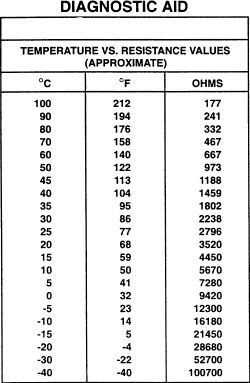
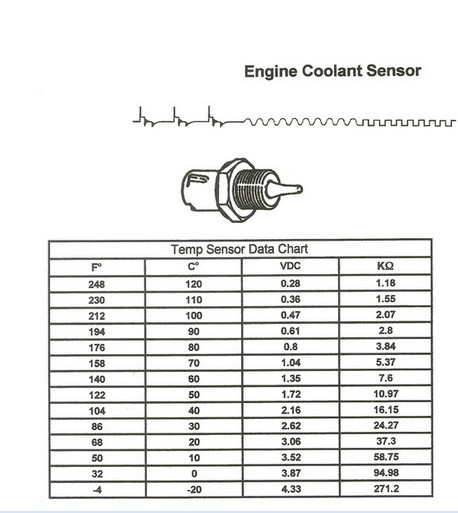
coolant temperature sensor, it have a purple top with 2 prong, [car wont start]

1986 BMW 528E
2.7L • 6 CYL • 2WD • MANUAL
Avatar
ATKINS
  • MEMBER
  • 4 POSTS
1986 bmw 528e 2.7, this is the sensor that run the ecu. iam getting no ohms reading when I check the sensor,should it show some type of resistance, so the ecu can read
Feb 6, 2015 at 2:40 PM
Advertisement
Avatar
CARADIODOC
  • CERTIFIED EXPERT
  • 34,306 POSTS
Are you measuring at the sensor or from the computer's connector? The typical coolant temperature sensor, as I recall, will measure somewhere between a few thousand ohms to perhaps as much as 100,000 ohms.
Feb 6, 2015 at 2:57 PM
Avatar
WRENCHTECH
  • CERTIFIED EXPERT
  • 20,761 POSTS
This may help you.

These are a couple of charts that very slightly but will get you close.
Feb 6, 2015 at 3:20 PM
Advertisement
Avatar
WRENCHTECH
  • CERTIFIED EXPERT
  • 20,761 POSTS
Redo
Feb 6, 2015 at 3:23 PM
Avatar
ATKINS
  • MEMBER
  • 4 POSTS
measuring the sensor it self,unplug
Feb 6, 2015 at 4:28 PM
Avatar
CARADIODOC
  • CERTIFIED EXPERT
  • 34,306 POSTS
Thanks Wrenchtech.

The thing to understand is it is extremely uncommon for a two-wire temperature sensor to read a wrong value because there's just one component in it. When they do read too high, it's more likely to be due to severe corrosion on the terminals.

An instructor I used to work with forced his kids to memorize these resistance values, but that is a big waste of time. Not every sensor will measure exactly the same resistance at a given temperature. Their individual characteristics is part of what Engine Computers learn by comparing various sensor readings and operating conditions. What you need to look for is if you have something or an open circuit. Even an open circuit isn't common. If you DO get a resistance reading, you can compare it to the charts, but don't get excited if it isn't exactly what is listed.

A better test is to plug the sensor in, then back-probe through the rubber seal next to the signal wire, and measure the voltage. On all the cars I'm familiar with, the voltage will start near 4.2 to 4.5 volts, and go down as the engine warms up. It may get to around 2.0 to 2.5 volts well before full operating temperature is reached, then it may pop back up to, as I recall, around 3.5 volts, then go slowly down again.

That transition back to a higher voltage is due to the computer kicking in a different internal resistor to cause the sensor's reading to have more accuracy. As you can see, I know the theory better than the actual operation because we only test these circuits after the computer has already detected a problem, set a fault code, and we're just verifying it or looking for the cause.
Feb 6, 2015 at 8:18 PM

Avatar
ATKINS
  • MEMBER
  • 4 POSTS
coolant temperature sensor only, by itself
Feb 7, 2015 at 12:37 PM
Avatar
CARADIODOC
  • CERTIFIED EXPERT
  • 34,306 POSTS
And by "no ohms reading", you mean you're getting an infinite reading on the meter's highest scale? You don't mean a reading of 0 ohms, do you? If you're reading infinite right on the sensor's terminals, I would have to agree that it's open and needs to be replaced. The proof would be by back-probing the wires when they're plugged in, you'll find approximately 0.2 volts on the ground wire and 5.0 volts on the signal wire instead of something between 0.5 and 4.5volts.
Feb 8, 2015 at 3:37 PM
Avatar
ATKINS
  • MEMBER
  • 4 POSTS
thank you,that what I wanted to know, iam getting a infinity reading on my ohms meter at the sensor ,when I unplug ,to test it,instead of a resisitance reading
Feb 9, 2015 at 3:46 AM
Avatar
JOHNNY G.JR
  • CERTIFIED EXPERT
  • 320 POSTS
Bad sensor
Jan 1, 2017 at 6:20 AM
Avatar
WRENCHTECH
  • CERTIFIED EXPERT
  • 20,761 POSTS
The previous responder is not a registered expert at this site.

Since this question hasn't seen activity in 2 years, the problem is likely resolved already and shouldn't have been answered anyway but before condemning the sensor, lets make sure you actually have either a self ranging meter or have it set to the correct range for the reading you are expecting.
Jan 1, 2017 at 6:52 AM