Good afternoon,
The code is for the canister purge valve under the hood.
https://www.2carpros.com/articles/evap-system-code-repair
The easiest way to check it is to remove the electrical connector from the valve, remove the hose that goes to the fuel tank and with the engine running, see if you feel vacuum at the open port of the valve.
Roy
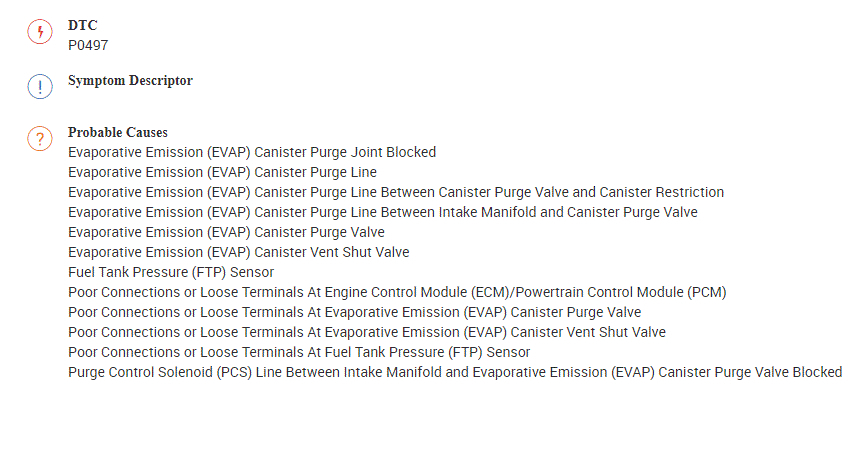
DTC P0497: EVAP System Low Purge Flow
Special Tools Required
Vacuum/pressure gauge, 0 - 4 in.Hg, 07JAZ-001000B
Vacuum pump/gauge, 0 - 30 in.Hg, Snap-on YA4000A or equivalent, commercially available
NOTE: Before you troubleshoot, record all freeze data and any on-board snapshot, and review the general troubleshooting information.
1. Check the fuel fill cap installation.
Is the fuel fill cap installed and properly tightened?
YES - Go to step 2.
NO - Properly install the fuel fill cap (the cap must say "Tighten to click"). If should turn 1/4 turn after it's tight, then go to step 23.
2. Turn the ignition switch ON (II).
3. Clear the DTC with the HDS.
4. Do the EVAP FUNCTION TEST in the INSPECTION MENU with the HDS.
Is the result OK?
YES - Intermittent failure, system is OK at this time, Check for poor connections or loose terminals at the FTP sensor, the EVAP canister purge valve, or the EVAP canister vent shut valve and the ECM/PCM.
NO - Go to step 5.
5. Check for a loose or damaged EVAP canister purge line between the intake manifold and the EVAP canister purge valve.
Is the line OK?
YES - Go to step 6.
NO - Reconnect or repair the EVAP canister purge line, then go to step 23.
imageOpen In New TabZoom/Print
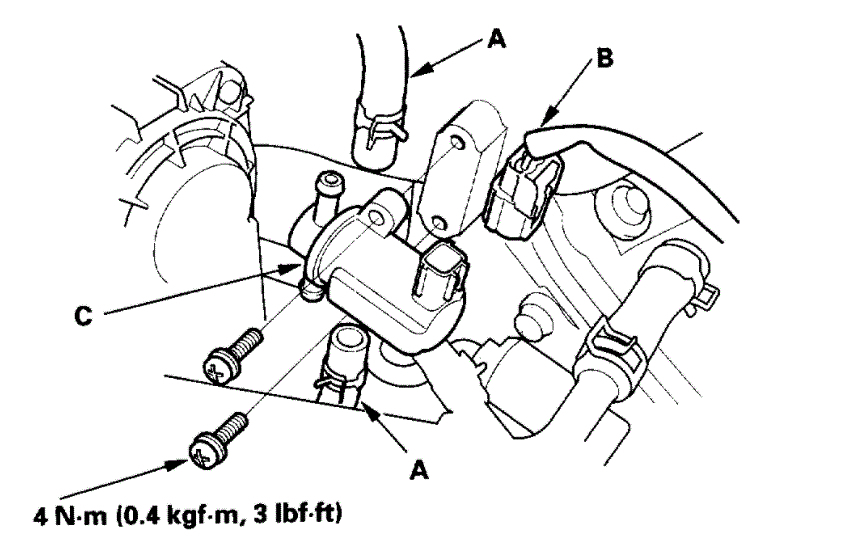
6. Disconnect the vacuum hose (A) from the EVAP canister purge valve joint (B) in the engine compartment, and connect a T-fitting (C) from the vacuum gauge and the vacuum pump/gauge, 0 - 30 in.Hg, to the vacuum hose (A) as shown.
7. Do the EVAP PCS on in the inspection menu with the HDS.
8. Slowly apply about 0.6 in.Hg (15 mmHg) of vacuum to the hose.
Does it hold vacuum?
YES - Check for blockage in the PCS line between the intake manifold and the EVAP canister purge valve, and the line between the EVAP canister purge valve and the EVAP canister purge joint. If the vacuum hoses are OK, replace the EVAP canister purge valve, then go to step 22.
NO - Go to step 9.
9. Reconnect the vacuum hose to the EVAP canister purge joint.
imageOpen In New TabZoom/Print
10. Disconnect the vacuum hose from the EVAP canister purge line (EVAP canister side), and connect a T-fitting (A) from the vacuum gauge and the vacuum pump/gauge, 0 - 30 in.Kg, to the hose as shown.
11. Do the EVAP PCS ON in the INSPECTION MENU with the HDS.
12. Slowly apply about 2 kPa (0.6 in.Hg, 15 mmHg) of vacuum to the hose.
Does it hold vacuum?
YES - Check for a restricted EVAP canister purge line between the EVAP canister purge valve and the EVAP canister, then go to step 22.
NO - Go to step 13.
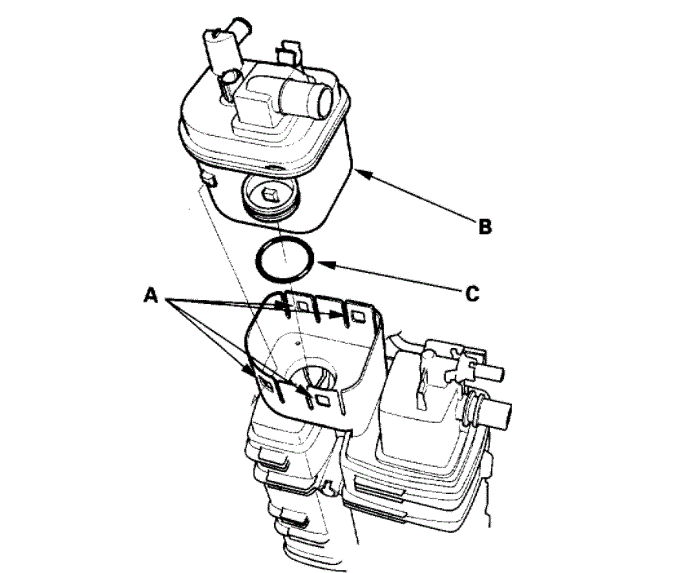
13. Remove the FTP sensor with its connector connected.
imageOpen In New TabZoom/Print
14. Connect a T-fitting (A) from the vacuum gauge and a commercially available vacuum pump/gauge, 0 - 30 in.Hg, to the FTP sensor (B) as shown.
15. Check and record the FTP SENSOR reading in the DATA LIST with the HDS.
16. Slowly apply about 1.3 kPa (0.4 in.Hg, 10 mmHg) of vacuum to the hose.
17. Check the FTP SENSOR in the DATA LIST with the HDS.
Is the difference more than 1.1 kPa (0.31 in.Hg, 8 mmHg) before and after applying vacuum?
YES - Go to step 18.
NO - Replace the FTP sensor, then go to step 22.
18. Reconnect the vacuum hoses to the EVAP canister purge line (EVAP canister side), and reinstall the FTP sensor.
imageOpen In New TabZoom/Print
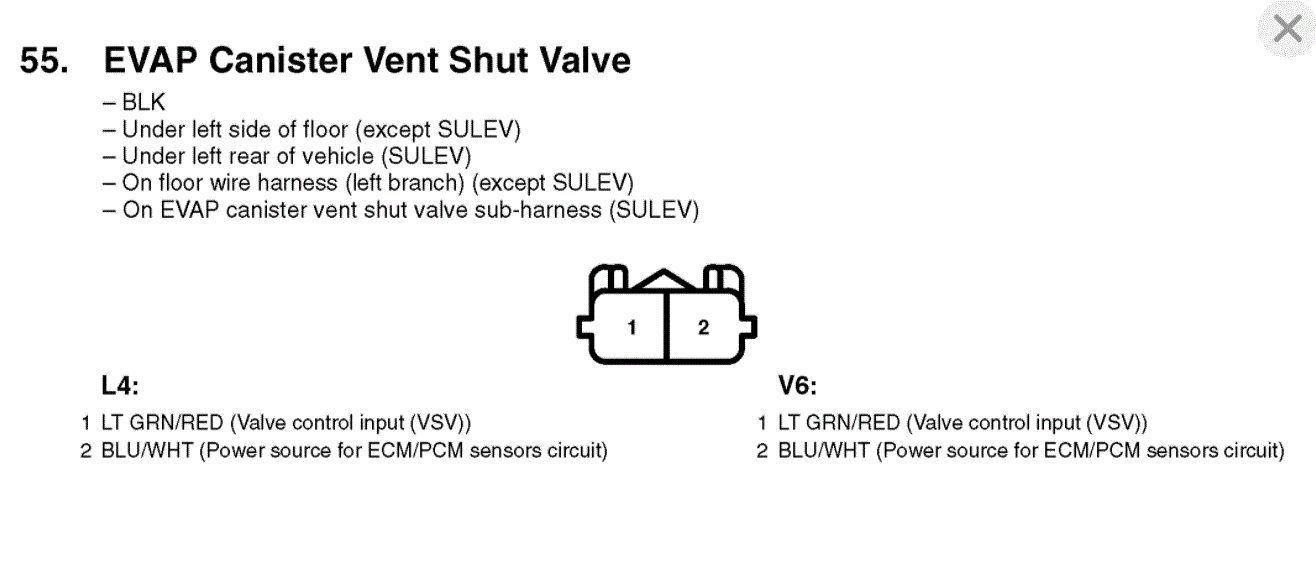
19. Disconnect the vacuum hose (purge line) (A) from the EVAP canister purge valve (B), and connect a T-fitting (C) from the vacuum gauge and the vacuum pump/gauge, 0 - 30 in.Hg, to the hose as shown.
20. Do the EVAP CVS ON in the INSPECTION MENU with the HDS.
21. Slowly apply about 2 kPa (0.6 in.Hg, 15 mmHg) of vacuum to the hose.
Does the hose hold vacuum?
YES - Check for blockage on the EVAP canister purge joint, then go to step 22.
NO - Replace the EVAP canister vent shut valve, then go to step 22.
22. Reconnect all hoses.
23. Turn the ignition switch ON (II).
24. Reset the ECM/PCM with the HDS.
25. Do the ECM/PCM idle learn procedure. See: Engine Control Module > Programming and Relearning
26. Do the EVAP function test in the inspection menu with the HDS.
Is the result OK?
YES - Troubleshooting is complete.
NO - Check for poor connections or loose terminals at the FTP sensor, the EVAP canister purge valve, or the EVAP canister vent shut valve and the ECM/PCM, then go to step 1.
Images (Click to enlarge)
Sep 10, 2020 at 9:46 AM