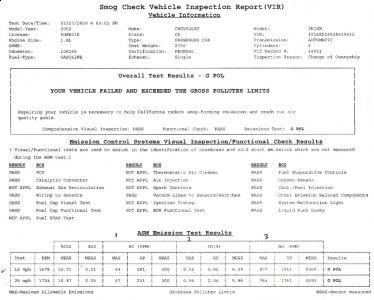
Greetings. I recently had a vehicle smog checked in California and the vehicle not only failed, but was classified as a "gross polluter." When my car failed I was shocked and failed to mention a crucial detail to the technician, and this is that the car had not been driven for seven months. The vehicle has had all of its scheduled preventive maintenance and the "check engine" light has never come on. It never overheats and has had a mechanical issue which required service.
I posted a question re: the lack of being driven to 2carpros.com and whether that could affect the results of the smog. This car passed four years earlier with flying colors, and it was off the charts this time when it came to being classified as a gross polluter. The kind follow-up I received from the technician who responded said that the fact that the car was not driven for so long could certainly be a factor. He said that the gas deteriorates after a month and that varnish could build up in the fuel system. He recommended driving every day for a couple of weeks, and add "SeaFoam to the tank.
This seems very fair and I appreciated the response, and my question is related to the above. I drove the car to the point where the old gas in the tank was nearly all used (I drove until the "low gas" gauge on the dash lit up). I filled the tank with premium and drove many more (thirty or so) miles (city and freeway). I then took it to Jiffy Lube, where I have done all my previous routine maintenance, and got my oil changed and a new air filter. I informed the tecnician of my failed smog check and he informed me that everything was up to date and there was not another single thing I needed. At this point I am almost convinced it was simply the length of time undriven and that there is nothing that requires repair on my car. However, I do not want to lay down another $50.00 for a new smog to find that I am not quite there. Would it be recommended, based on the statements above, to drive a significant amount of additional miles before a new smog, and based on the old gas being used and a new tank of premium to go on, that I should still get some SeaFoam?
Any thoughts or direction on the above would be greatly appreciated.
And this is such a great service!
Thank you,
Vince
I posted a question re: the lack of being driven to 2carpros.com and whether that could affect the results of the smog. This car passed four years earlier with flying colors, and it was off the charts this time when it came to being classified as a gross polluter. The kind follow-up I received from the technician who responded said that the fact that the car was not driven for so long could certainly be a factor. He said that the gas deteriorates after a month and that varnish could build up in the fuel system. He recommended driving every day for a couple of weeks, and add "SeaFoam to the tank.
This seems very fair and I appreciated the response, and my question is related to the above. I drove the car to the point where the old gas in the tank was nearly all used (I drove until the "low gas" gauge on the dash lit up). I filled the tank with premium and drove many more (thirty or so) miles (city and freeway). I then took it to Jiffy Lube, where I have done all my previous routine maintenance, and got my oil changed and a new air filter. I informed the tecnician of my failed smog check and he informed me that everything was up to date and there was not another single thing I needed. At this point I am almost convinced it was simply the length of time undriven and that there is nothing that requires repair on my car. However, I do not want to lay down another $50.00 for a new smog to find that I am not quite there. Would it be recommended, based on the statements above, to drive a significant amount of additional miles before a new smog, and based on the old gas being used and a new tank of premium to go on, that I should still get some SeaFoam?
Any thoughts or direction on the above would be greatly appreciated.
And this is such a great service!
Thank you,
Vince
May 3, 2009 at 10:21 PM