1989 Chevy Camaro cold hard start

1989 CHEVROLET CAMARO
110,000 MILES • V8 • 2WD • AUTOMATIC
Avatar
GARY W SWANSON
  • MEMBER
  • 5 POSTS
After finally starting, engine will "hunt" between 500 &
750 RPMs until it achieves normal operating temperature. Always starts fine when warm, even after
6-7 hours. Runs beautiful when warm. Fuel pressure gauge shows 40-44 lbs at first, then slowly drops to 0
within about one-half hour. Pulled vacuum hose off fuel
pressure regulator, no sign of gas. Crimped fuel return
hose, pressure dropped as before. Checked resistance
of each injector, all were between 16.0 & 17.0 ohms.
Must be a leaking injector(s), but how to diagnose which? Thank you.
Aug 21, 2010 at 8:59 PM

Advertisement
Avatar
JACOBANDNICKOLAS
  • CERTIFIED EXPERT
  • 110,175 POSTS
Have you removed the injectors to see if there is any visable sign of a leak? Also, if there is no leak there, there is a check valve in the fuel pump that could be bad.
Aug 21, 2010 at 9:48 PM
Avatar
GARY W SWANSON
  • MEMBER
  • 5 POSTS
No, I have not removed the injectors. How do I go
about that? Please supply step-by-step instructions.
I don't see how the problem could be attributable to
the check valve in the fuel pump, since I described in
my original description of the problem that I had
crimped the fuel return hose, with the result that the
fuel pressure dropped as it had before. Please explain
what further tests I could perform to either rule out
the check valve or that would prove that it is the
check valve. Thank you.
Aug 22, 2010 at 9:32 AM
Advertisement
Avatar
JACOBANDNICKOLAS
  • CERTIFIED EXPERT
  • 110,175 POSTS
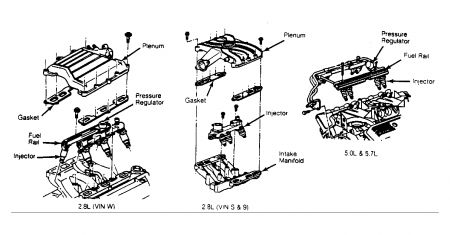
If you pinched off the hose coming from the pump and it still lost pressure, it's either a leaking injector or the regulator is bad. As far as the injectors, on the V8, first disconnect the battery. Unbolt the fuel rail retaining bolts and injectors will come off with it. If you need to remove the injectors from the rail, there is a retaining clip. Just rotate it to the unlock position. NOTE: There are rubber O-rings on the injectors. Make sure not to damage them or you will create a new leak. Let me know what you find. If you haven't checked the regulator yet, do that before going through removing the rails. Here is a picture of the injectors and fuel rails. The V8 set up is on the right. Let me know if it helps.


https://www.2carpros.com/forum/automotive_pictures/249084_5_53.jpg

Joe
Aug 22, 2010 at 10:19 PM
Avatar
GARY W SWANSON
  • MEMBER
  • 5 POSTS
In my original question, I stated that I pulled the vacuum hose on the regulator and found no sign of fuel. Is there any other way to check the regulator?
If not, then I'll pull the plenum, runners, and finally the fuel rail. How do I identify the injector(s) that is
leaking? (By the time I get all those parts off, any
remaining fuel will have evaporated, won't it?). I am
not a mechanic, and I must proceed slowly because I
have never done this before. Also, my time to spend
on this repair is limited, so it will take some time to pull those parts off.
When I lift the fuel rail off, will the injectors come with the rail? And where will the o-rings be - on the injectors or left on the engine? Also, are there o-rings on the top of each injector? Thanks.
Aug 22, 2010 at 10:48 PM
Avatar
JACOBANDNICKOLAS
  • CERTIFIED EXPERT
  • 110,175 POSTS
Yes the injectors will be on the rail and the o-rings will be at the base of the injector. Once off, turn the key to the run position so the fuel pump builds pressure and check for any of them leaking.

As far as the regulator, you can check if it is bad. When checking fuel pump pressure, remove the vacuum hose and the pressure should increase around 5 to 10 psi.
Aug 22, 2010 at 11:55 PM
Avatar
GARY W SWANSON
  • MEMBER
  • 5 POSTS
Thank you. Now, when I pull the fuel rail, and turn the ignition key to "on", if an injector leaks fuel, do I replace the injector, the o-ring, or both? If just one injector is leaking, do I replace the other 7 O-rings too? And what about the injector connection to the fuel rail - is there an o-ring there for each injector also? I suppose if one of those were leaking, there would have been visible fuel
spraying into the air. Since that does not appear to
be the case, do you think I must replace all those o-rings also? Additionally, do you think all injectors should be replaced, even if just one is leaking? It appears that to remove the plenum, runners, and fuel rail is a lot of work for one leaking injector. How
much does one injector cost? If I replace just the one leaking injector, with 110,000 miles on the engine, how likely would it be that another would
start leaking soon after? Thank you, Gary Swanson
Aug 23, 2010 at 10:58 PM
Avatar
JACOBANDNICKOLAS
  • CERTIFIED EXPERT
  • 110,175 POSTS
If the O-rings are in good condition, they should be fine. Also, if there is one leaking, only replace it. The others should last for a long time.
Aug 24, 2010 at 12:26 AM
Avatar
GARY W SWANSON
  • MEMBER
  • 5 POSTS
All right, I think I am near the end of my questions.
Assuming I find one leaking injector, should that be
replaced with an OEM injector, or are there aftermarket
injectors that are an improvement that would be a better choice? Thanks, Gary Swanson
Aug 24, 2010 at 9:26 AM
Avatar
JACOBANDNICKOLAS
  • CERTIFIED EXPERT
  • 110,175 POSTS
I would recommend staying with OEM parts. Many aftermarket ones are imported and not that great.
Aug 24, 2010 at 9:33 PM