Changing brake fluid?

2005 FORD FIVE HUNDRED
175,000 MILES • V6 • 4WD • AUTOMATIC
Avatar
DAVENOOB
  • MEMBER
  • 286 POSTS
I need to replace brake fluid on this car. It seems pretty straight forward. Empty lines, master cylinder, refill new brake fluid, bleed brakes, top off cylinder. Is there anything else I need to be aware of or watch out for?
Apr 8, 2026 at 10:34 AM
Advertisement
Avatar
CARADIODOC
  • CERTIFIED EXPERT
  • 34,306 POSTS
Absolutely. Do not empty the lines or let the reservoir run empty, especially if the car has anti-lock brakes. If air gets into the hydraulic controller, it can pool in two chambers, then require a helper and a scanner that can tell the computer to open two valves to allow the air to escape and be bled out. The procedure takes just a few seconds, but can be nearly impossible without the scanner, on most models.

Also be careful to not allow the slightest hint of a petroleum product to get into the fluid or touch any rubber parts that contact brake fluid. That can result in an extremely expensive repair that could exceed the value of the car. This includes engine oil, transmission fluid, power steering fluid, axle grease, and penetrating oil. Professionals even wash their hands with soap and water before handling brake parts that will contact brake fluid, to avoid getting fingerprint grease on them. If you have to poke the rubber bladder seal back into the reservoir cap, use a clean knuckle, or be sure there's no film of grease on your fingertip.

All manufacturers have a recommended service interval when they want the brake fluid to be replaced, but most people ignore that because the systems are so trouble-free. Over time, moisture works its way in. That promotes corrosion of metal parts from the inside, and it lowers the boiling point from well over 400 degrees Fahrenheit to closer to 212 degrees. Under normal braking, the brakes can get hotter than 212 degrees. That heat will migrate into the brake fluid where the moisture will boil and vaporize, leading to one form of brake fade.

The best procedure is to use a clean turkey baster to suck out as much old brake fluid as possible from the reservoir, then refill it with fresh, clean fluid from a sealed container. Open one bleeder screw at a time and let that circuit gravity-bleed. If you start with the left front brake, you'll get new fluid coming out before the reservoir runs empty. Close that bleeder screw, refill the reservoir, then go to the next wheel. During the bleeding, leave the reservoir cap slightly loose so no vacuum builds up that would impede the free flow of fluid.

If it should get away from you and the reservoir runs empty, don't panic, and don't try to run that air down to the wheels. Rather, just fill the reservoir again, then stroke the brake pedal just an inch or two a few times. That will push fluid down the lines and let the air bubbles float back up. As you release the pedal, air bubbles will wash up into the reservoir.

Also, during any brake work, be careful to never push the brake pedal more that halfway to the floor. Crud and corrosion build up in the lower halves of the bores in the master cylinder where the pistons don't normally travel. Pushing the pedal to the floor, as even many experienced mechanics do, runs the rubber lip seals over that crud and can rip them. That causes a slowly sinking brake pedal, and it commonly takes two or three days to show up. This doesn't apply to a new or rebuilt master cylinder that's less than about a year old.

When you're done, fill the reservoir to the same level it was at when you started. Don't fill it to the "full" mark unless the brake pads are fairly new. As disc brake pads wear, the pistons move out of the calipers to self-adjust. Brake fluid fills in behind those pistons, so the level in the reservoir will go down. Lately, calipers seem to not need to be rebuilt during a routine brake job, so we just push the pistons back in to make room for the new, thicker pads. Doing that pushes the brake fluid back up into the reservoir. If someone topped off the brake fluid before that, it is going to overflow, making a mess. Brake fluid eats paint too, so wash it off right away with water.

For the last step, I like to wash out the closed bleeder screws to get the brake fluid out of them. If you removed rubber caps from the screws, put those back on after the Brake Parts Cleaner has evaporated. When bleeder screws get rusted tight, it is not from water getting into the threads. It is from water going down the center hole, then forming rust through the small hole. Brake fluid left in the screw causes that rust to develop much faster.

Let me know if that answers your questions. Keep me updated on your progress.
Apr 8, 2026 at 1:29 PM
Avatar
DAVENOOB
  • MEMBER
  • 286 POSTS
So start off to wheel closest to the reservoir and work my way away right? Would dirty brake fluid cause calipers to keep failing? I would assume so but this is the problem I'm trying to diagnose.
Bleed the lines until I see new fluid?
Apr 8, 2026 at 1:53 PM
Advertisement
Avatar
DAVENOOB
  • MEMBER
  • 286 POSTS
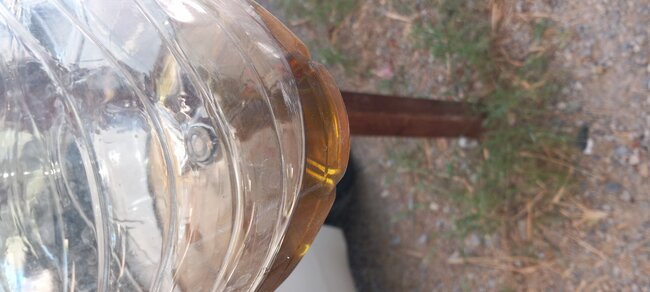
Definitely needed to be done, Wow!
Apr 8, 2026 at 2:42 PM
Avatar
DAVENOOB
  • MEMBER
  • 286 POSTS
My bleeder is at the top of the caliper not the bottom. Only a little bit of fluid came out into the tube and stopped. Is that all it's supposed to gravity feed?
Apr 8, 2026 at 2:59 PM
Avatar
DAVENOOB
  • MEMBER
  • 286 POSTS
Got it going. How much am I supposed to let feed out?
Apr 8, 2026 at 3:49 PM
Avatar
CARADIODOC
  • CERTIFIED EXPERT
  • 34,306 POSTS
Some service manuals tell you to start with a specific wheel. That mainly applies to GM front-wheel-drive vehicles, but the instructions are pointless. The procedure claims to prevent a valve from tripping inside their master cylinders, but if that procedure were true, it wouldn't trip to stop a leak either. For cars like yours and mine, I always start bleeding with the wheel I'm standing closest to. I mentioned, "if you start with the left front", only because that is the shortest run and you'll usually get clean fluid coming out of that bleeder screw long before the reservoir runs empty. For the other wheels, keep a close eye on the reservoir so it doesn't run empty.

Some people put the seal on the piston first, then use that piston as a handle to set the seal in place. As the piston is pushed in, it holds the seal in place. I like to press the seal into the caliper first so I can be sure it is seated all the way around, then I set the piston on top of it, then blow in compressed air to blow the seal up over the piston. This method isn't for the timid. The piston can bounce up and down and shred your knuckles if you don't hold onto it and force it down. For the really lazy, you press the seal in first into the caliper housing, then spread it open with a special pliers, then just drop the piston in. There's two different sizes of those pliers for different size pistons.

In every case, it used to be all too common for the seal to pop out of the groove in one area and get overlooked. That's all it takes for the piston to not retract properly, leading to a dragging and overheating brake. Fords were more difficult in this area. Often I had to take them back apart and put them together two or three times. When the seal is properly seated in the groove all the way around, the piston can be pressed in the rest of the way by hand very easily.

The biggest problem we had years ago was a ring of rust or dirt would form on the piston just outside of where the seal was holding it. That rarely, if ever, caused leakage, but it did prevent the seal from pulling the piston back in. It got much worse when we tried to push the piston in to make room for the new, thicker pads. The clue here is to use a flat-blade screwdriver as a small pry bar to fully retract the piston before you unbolt and remove the caliper. If you can't do that with one hand, plan on rebuilding that caliper or replacing it. You may see some people using a C-clamp to force that piston in. If that is the only way to do it, it's going to cause dragging brakes and nothing but frustration.

To remove the piston, I use compressed air to blow them out, with a piece of wood in place of the pads and rotor. Don't stick your fingers in there. If the piston is stuck, when it finally lets go, you may not have all your fingers! The cheaters way is to unbolt the caliper from its mount, then pump the brake pedal, (no more than halfway to the floor), repeatedly to push the piston out. You'll lose a lot of brake fluid that way, so only do it if you want to replace the fluid anyway.

The biggest problem we see now with cars as new as yours has to do with the caliper mounts. Most manufacturers have gone to a pair of chrome-plated bolts for the caliper to slide on as the outer pad wears. Any hint of rust on those bolts means they must be replaced. All of these rebuild kits and mounting hardware are available at any auto parts store. The bolts usually slide through rubber tubes or O-rings. Those get replaced when the calipers are rebuilt. If you buy the lower-cost rebuilt calipers, they may cost less because you have to buy that hardware separately. Most quality calipers come with a package of replacement hardware included. Even some new pads come with that hardware.

Those mounting bolts should be coated lightly with a special high-temperature brake grease. One trade name I'm very familiar with is "Rusty Lube". It's copper-colored. There are many others, most commonly they're black or dark gray. This is a special grease that contains molybdenum disulfide. It will not travel like wheel bearing grease does. That brake grease should also be applied to the backs of the pads where they contact the caliper fingers for the outer pad, and the ring of the piston for the inner one. Pads are going to vibrate, period, and there's nothing we can do to stop that. The grease allows them to vibrate freely without transmitting the noise to the caliper which would amplify it to the point we can hear it as an annoying squeal.

If you get any grease, including fingerprint grease, on the friction surfaces, meaning the linings and the part of the rotor they run against, wash that off before driving the car. If that grease is there when the brakes get hot, it will soak into the linings and the rotors and never come out. Rotors are made of cast iron which is porous. I've known at least one service center manager who insisted his mechanics throw away brand new pads if they got grease on them. He didn't allow cleaning them if they got contaminated. Actually, as long as the parts are washed with Brake Parts Cleaner before they get hot, there won't be a squeal.

New rotors almost always come with a cosmoline coating to prevent rust while they're in storage. That has to be washed off, otherwise it will form a glaze on the pads. Old rotors that are machined will have grooves that can grind that glazing off, but it's better to not allow that to develop in the first place.

Every year I did a demonstration for my students where I put a wheel cylinder lip seal into each of two beakers filled with new brake fluid. I added one drop of power steering fluid to one of them, then let them sit for one week. After that week, the contaminated seal had grown by about 25 percent and was slimy-feeling. If it was washed off, it shrunk back to normal size in a few days, but it remained very soft compared to the uncontaminated seal. The point is the contamination never comes out.

If you find contaminated brake fluid, there is only one proper repair. That is to remove every part that contains rubber parts that contact brake fluid, flush and dry the steel lines, then install all new rubber parts. This includes the master cylinder, calipers and wheel cylinders, rubber flex hoses, and combination valve. The combination valve is at the end of the two lines coming out of the master cylinder. It sits right under the master cylinder, usually mounted on the frame rail. That has rubber O-rings in it. Many cars today don't have a combination valve when they have anti-lock brakes. The hydraulic controller for the ABS is filled with O-rings too, so it has to be replaced. In addition, due to the wide range of loading variables on trucks and minivans, it's common to find a height-sensing proportioning valve with a linkage connected to the rear axle. Those have rubber O-rings so they also must be replaced.

Don't try to replace just some of the contaminated parts one day, then the rest later. If any rubber part is not removed, the contamination will leach out of it and recontaminate the new brake fluid. You can see why this gets to be a very expensive repair.

If you simply want to replace the old brake fluid and there's no other problems, gravity-bleeding is the safest method, but often the fluid is reluctant to start flowing. It's okay to "irritate" the brake pedal by hand a little to get it started. If you want to speed things up and pedal-bleed, the fastest is to use a helper to run the brake pedal while you open and close a bleeder screw. If you open a bleeder screw, then try to pump the pedal yourself, it will just suck air back into the caliper when you release the pedal. Remember to tell the helper to not push the pedal over halfway to the floor. When he hollers that the pedal is halfway down, just put your finger over the bleeder screw, then holler to him to release the pedal. The master cylinder will take a new bite of fluid rather than pulling in air into the caliper.

The last thing I can think of, for vehicles that have that height-sensing proportioning valve in the rear, those limit brake fluid pressure to the rear brakes under hard braking to prevent rear-wheel lockup, and they allow higher fluid pressure when there's a lot of weight in the back, It's not uncommon to find no fluid comes out of the rear brakes when the vehicle is on a hoist or jacked up with the rear wheels hanging down. That mimics light rear loading and the need to partially block fluid flow to the rear. When that happens, set the rear down on jack stands to push the rear wheels up. That's usually easier than disconnecting the valve's linkage and manipulating it by hand.

Here's links to some dandy related videos that might be of interest:

https://youtu.be/w7gUsj2us0U

https://youtu.be/ye64wlARgcs

I have a few more secrets and hints if they become necessary. Let me know when you make some progress or have more questions. I'm here almost every day about this time.
Apr 8, 2026 at 4:32 PM
Avatar
CARADIODOC
  • CERTIFIED EXPERT
  • 34,306 POSTS
I'm not sure what you're asking in your last reply. If the fluid doesn't want to flow, be sure the reservoir cap is a little loose so no vacuum develops in there. That will stop the fluid from flowing.

Years ago it was common for Fords to not freely flow fluid from the front brakes. If you follow the steel lines out of the master cylinder down to the combination valve, you'll see a small stem sticking out from the front of that brass block. That is part of the "metering" or "hold-off" valve. You'll only have that if you have drum brakes in the rear. That valve's job is to block fluid flow to the front wheels until the rear shoes have had time to move out and contact the drums, then, as pressure continues to build, the metering valve opens and lets fluid flow to the front wheels. In that way, all four brakes apply at the same time. When the bleeder screws are all tightened and everything is assembled, if you have a helper push the brake pedal, you can see that stem push out a little as the valve opens. For gravity-bleeding purposes, there is a special tool to hold that valve open. It's nothing more than a V-shaped strip of spring steel. You squeeze it to fit over a groove in that stem, then the spring pressure holds the valve open. If you forget to remove the tool when you're done, the front brakes will apply too soon and the rear brakes won't do enough of the stopping. No one I used to work with bothered to buy that tool. When we had Ford trade-ins at the dealership that needed brake work, we just grabbed a coworker to pump the pedal a few times.
Apr 8, 2026 at 4:46 PM
Avatar
DAVENOOB
  • MEMBER
  • 286 POSTS
Awesome thank you. The calipers keep locking so grinding when driving. Luckily I have lifetime warranty calipers from autozone so the rebuild isn't an issue. I am one of the c-clamp people lol. So just pry the piston back with screwdriver before removing. You saw the pic of the fluid it's pretty gross. I live in high heat super fine dust desert so things aren't forgiving. The rusty lube goes on the slide bolts, back of brakes where they are touched?
Apr 8, 2026 at 4:51 PM
Avatar
CARADIODOC
  • CERTIFIED EXPERT
  • 34,306 POSTS
Very often you'll get a tiny plastic tube of that grease with the more expensive sets of pads. The first place you want it is on the metal pad backing plates where they touch something. It's just as easy to put a little on the caliper's outer fingers before setting that outer pad in place, and put a light coating on the rim of the piston. Sometimes you'll find pads come with a thick cardboard shim to stick on the backs of the pads, or they're already stuck on them from the supplier. When you remove a pad that had those shims, you'll find the inner one is bunched up inside the piston. That proves the pads are vibrating and sliding back and forth slightly. I'm not a fan of those cardboard shims. The grease works better.

There are also some glues designed for brake pads. Most commonly those are dark blue or orange. I've seen bright yellow too. I don't think that stuff is of any use. Glue will not stop the pads from vibrating. Only the special high-temperature grease lets the sliding occur without transmitting the noise to the calipers.

The caliper is going to slide roughly 3/8" over the life of the pads. It also moves back and forth a tiny amount each time the brake pedal is pressed and released. Whatever the caliper is mounted on and slides on is what needs to be greased. Older Chryslers had large flat surfaces for the caliper to sit on. There was plenty of free play for them to slide. The normal play in the wheel bearings allowed the rotor to wobble enough to push the pads away when released and prevent dragging. Ford had a similar design but the engineer must have stayed awake nights dreaming up ways to make it bad. They too sat on flat surfaces, but then a slide and wedge were pounded in making it nearly impossible for the caliper to slide and self-adjust. It was not uncommon to need new pads in as little as 7,000 miles, especially if dried mud found its way in there.

Your car uses a pair of bolts with long, smooth stems for the caliper to slide on. Those smooth sections are what you want to grease. This design gives very little trouble unless one of the bolts gets some rust on it. You can clean off impacted debris, but if there's rust, replace them.

By "locking", if you mean the brakes drag and get hot, when that happens, stop on a slight incline, shift to "neutral", place a block about a foot downhill of one tire so you won't look funny chasing after the car, then crawl underneath and open a bleeder screw. If you get a little spurt of fluid and the brake releases, fluid is being trapped and can't release back to the reservoir.

Do that again, but this time use a line wrench, (aka flare nut wrench), to loosen the lines at the master cylinder. If THAT lets the brakes release, we have to consider contaminated fluid and the blockage is the lip seals in the master cylinder have grown past the fluid return ports.

In this story, the better result is the brakes release when opening a bleeder screw, but not a line at the master cylinder. The problem then is often a constricted rubber flex hose to a front brake. Two things can happen to them. One is the inner lining gets torn from hanging the caliper by the hose. That can create a flap that becomes a one-way valve. The other is less likely on your car. That is rust builds up inside a metal bracket that's curled around the hose. Your car doesn't use that design, but I've had this happen to three hoses on my Caravans over the years. Fortunately it's an easy fix to just bend the crimp open a little with a large flat-blade screwdriver. The clue here is the brake pedal will be higher and harder than normal. Brake fluid can be forced through the restriction from high pedal effort, but then the fluid can flow freely back to the reservoir. It gets trapped, gets hot, expands and applies that brake even harder. In its worst state, like with my Edsel, the car may barely move. I started out with a full tank of gas, drove 55 miles to the nation's second largest old car show, then only 25 miles back toward home and ran out of gas. Couldn't push it the last ten feet to the gas pump. When I got the rest of the way home, one front tire skidded on my granite driveway. It was dragging that bad. And this was with drum brakes which are less likely to get that bad.

I've heard of this happening on import vehicles too, but not with that metal mounting bracket crimped around the hose. Rather, rust builds up inside the crimp where the rubber hose attaches to a metal pipe that is part of the assembly. If you're in a dry state, this is likely not the problem. I live in northern Wisconsin where they throw a pound of salt on an ounce of snow. I run my vehicles until the life is used up, then for a few more years, so rust is a big problem. In fact, the one I loved the most, an '88 Grand Caravan, was so rusty, the carpet was the only thing holding the front and rear together.
Apr 8, 2026 at 5:51 PM
Avatar
CARADIODOC
  • CERTIFIED EXPERT
  • 34,306 POSTS
Forgot to mention, brake fluid gets dark from being hot, so color alone isn't something to worry about.
Apr 8, 2026 at 5:53 PM
Avatar
DAVENOOB
  • MEMBER
  • 286 POSTS
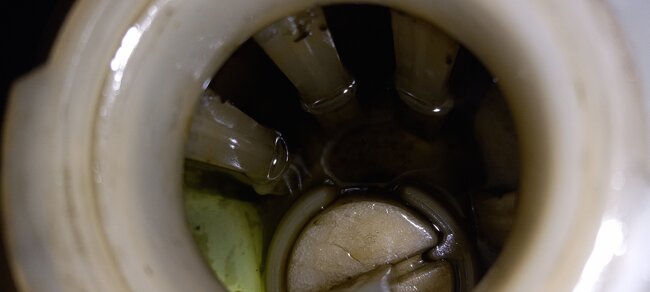
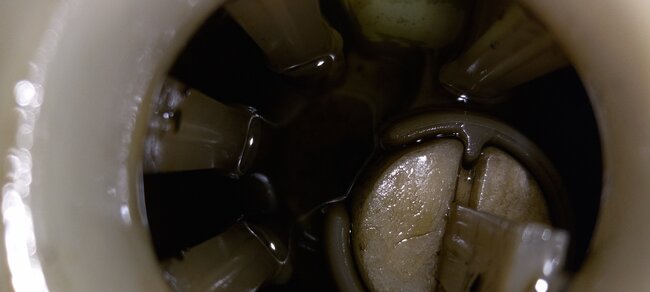
There is hard reddish chunks in the bottom of my fluid catch. So this could lead to the dragging feeling?
Apr 8, 2026 at 7:10 PM
Avatar
DAVENOOB
  • MEMBER
  • 286 POSTS
I've also hung the calipers that way once or twice. Now I use gardening wire and string it through the whole caliper and spring.
Apr 8, 2026 at 7:12 PM
Avatar
CARADIODOC
  • CERTIFIED EXPERT
  • 34,306 POSTS
There shouldn't be chunks in the old fluid. I don't know where those could come from.

Where hanging by hoses is most likely to result in a damaged hose is when the caliper is unbolted, then set on top of the rotor, then it falls off and is caught by the hose. That puts a lot of force on the crimped connections. I like coat hanger wire as it won't unbend under the weight of the caliper. Of course, anything similar is fine.
Apr 9, 2026 at 11:23 AM
Avatar
DAVENOOB
  • MEMBER
  • 286 POSTS
Does this require brake bleeding afterwards or does the bubbles rising into master cylinder have the effect? Here is a few pics of the inside of the rez. It's hard to see but looks like stuff at the bottom.
Apr 9, 2026 at 11:37 AM
Avatar
CARADIODOC
  • CERTIFIED EXPERT
  • 34,306 POSTS
Bubbles in the reservoir mean the air is working its way out of the main bore and lines. That is far more desirable than having to push those bubbles all the way down to a wheel.

If you can grab a piece of that debris and rub it between your fingers, then it dissolves into nothing, it is residue that has built up over time and is breaking off now.
Apr 9, 2026 at 1:28 PM
Avatar
DAVENOOB
  • MEMBER
  • 286 POSTS
I should have explained situation better. I went to drive the car today and brakes were not really there. Okay so I should just gravity bleed them again until I think bubbles are all out? The pieces of stuff in the fluid did break down a bit.
Apr 9, 2026 at 2:07 PM
Avatar
CARADIODOC
  • CERTIFIED EXPERT
  • 34,306 POSTS
You have to explain, "brakes were not really there" better. If the brake pedal is solid and as high as normal, but the car doesn't stop is easily as normal, the linings on the pads could be glazed. That's all too common with brand new pads. They haven't worn yet to match the microscopic grooves in the rotors, so braking power is reduced. That means we push harder on the pedal to stop, and that increases the amount of heat being dissipated. The higher temperatures melts the binders and resin in the lining material, causing that glazing. That glaze is like a hardened varnish with less friction, so braking power is reduced more, and we push still harder on the pedal to stop. When this gets bad enough, we scrub the new pads with a wire brush or sandpaper to remove that coating. Another trick is to lightly machine the rotors to true them up and form small grooves. Those grooves will grind the coating off the pads.

The best way to prevent glazed rotors and pads is to perform a test-drive after installing them. That test-drive includes two or three rather aggressive stops from highway speed, with time in between for the parts to cool down. That gets the linings worn to match the rotor so they make full contact, then the increased friction means it takes less pedal pressure to stop, and the brakes run cooler.

Braking power could also be weak yet just because the pads are new or the rotors were just machined. Anything that changes the amount of pad surface that contacts the rotor's surface reduces friction and stopping power. If the brakes don't become overheated, braking power will gradually come back to normal. In fact, we tell customers to brake carefully for the first 100 - 200 miles to give the new linings time to seat.

One thing that should not be an issue is the quality or composition of the pads and shoes. All manufacturers put a real lot of resources into developing brake systems that are balanced front-to-rear. The variables include master cylinder piston diameter, caliper piston diameter, rear wheel cylinder diameter, pad and shoe lining surface area, and weight distribution including with or without air conditioning. The weight distribution variable is handled with the spring-loaded valving in the combination valve and, when used, the rear height-sensing proportioning valve. All of these things work together to ensure the front and rear brakes do their share of stopping with no tendency for easy wheel lock-up. One variable that gets factored in is the "coefficient of friction" of the lining material. That means how well it grabs the rotor and tries to stick to it. Every manufacturer of aftermarket replacement shoes and pads has to adhere to those values. If their material has a higher coefficient of friction than the original parts, the surface area will be smaller to offset that. This is why we don't believe advertising that says their pads will stop faster. The best you can do is have a brake lock up and the tire skids. The cheapest pads and shoes will do that, so how can you have some replacement part that stops faster?

What some aftermarket replacement pads and shoes CAN do is be less susceptible to another type of brake fade. That involves "off-gassing" of the lining material when it gets hot. That's the same high heat that can cause glazing, but before that happens, the gasses given off act like a layer of tiny ball bearings between the rotors and linings. The symptom is you can push harder and harder on the brake pedal, but the vehicle doesn't reduce speed any quicker. This is most likely to show up in mountain driving when the linings don't get a chance to cool down.

At the same time, when the pads get that hot to cause off-gassing, that heat migrates into the brake fluid and when it gets over 212 degrees, any moisture will boil and vaporize, leading to a different type of brake fade. Since air can be compressed, it causes a low and soft brake pedal. Couple a mushy brake pedal with ineffective pads and shoes, and you can see why overheated brakes don't stop well.

When glazing hardens, it can become sticky, leading to brakes that grab too easily. If one front brake is affected more than the other side, it can cause a brake pull on some car models. Most front-wheel-drive vehicles use a "split-diagonal" hydraulic system, meaning the left front and right rear brakes are on the same hydraulic circuit. If a leak develops in one circuit, this leaves you with 50 percent of your brakes. With the older front-rear systems, if a leak developed in the front circuit and you only had rear brakes, you'd have roughly 30 percent braking power with rear-wheel-drive cars and only about 20 percent with front-wheel-drive cars. They have a higher percentage of weight in the front. The split-diagonal system ensures you still have one working front brake.

In older rear-wheel-drive vehicles, if you'd block off fluid flow to one front brake, the one working brake would tear the steering wheel out of your hands with enough force to break wrists. Two working brakes offset each other when the wheels are tied together through the steering linkage. With the split-diagonal systems, and a leak in one side leaving you with just one working front brake, the geometric relationship of the suspension parts and alignment angles have been modified so the braking forces cause that wheel to pull toward the center of the car. That offsets the hard brake pull that's making the wheel turn away from the car. Chrysler has that so well perfected that the only way to know there's a leak in the system is by the red "Brake" warning light on the dash. For most other manufacturers, if you pay attention, the most you might see is a tiny wiggle in the steering wheel, but the car will still stop in a straight line.

The suspension geometry is also important when the model is available with anti-lock brakes. The ABS Computer will block fluid flow to a wheel that's slowing down faster than two of the others, then bleed off fluid pressure if necessary to get that wheel back up to speed, then reapply stored or pedal-supplied pressure to reapply that brake. This "block, bleed, apply" sequence can occur as fast as 30 times per second but 15 is more common. That's what causes the buzzing you hear and feel in the pedal when the system activates. The point is a normal condition is to modulate brake fluid pressure to just one brake. You don't want to have a brake pull when that happens, so the geometry of the suspension system parts works for anti-lock brakes as well as for the split-diagonal system.

As a point of interest, vehicles with anti-lock brakes will usually come with rear disc brakes. Caliper pistons require very little movement to apply its brake so they respond quickly to modulating brake fluid pressure. Drum wheel cylinders and shoes have to move a lot to push the shoes out to the drums before any braking force can be developed. That typically takes way too long for ABS function to be effective. The exception to this is on trucks with the less-involved rear-wheel-ABS, (RWAL) systems. Those use a dump valve under the driver's seat area, on the frame rail. All they do is when the two rear wheels slow down too quickly, the valve blocks additional brake fluid pressure to the rear wheels, or it dumps the fluid pressure until the rear wheels get back up to speed. It's okay that this takes longer to activate. The goal is only to prevent the rear of the truck from trying to pass the front. Skidding tires have no traction, so their stopping power is gone. Stopping distance is increased, but directional control is maintained. The goal of four-wheel-ABS systems is not to reduce stopping distances, although that is an additional benefit on many models. Instead, the goal is to maintain steering control by preventing skidding tires, so you can steer around the car that ran the red light.

One of the more frustrating and confusing causes of poor brakes due to a low and mushy pedal on vehicles with anti-lock brakes is air that gets trapped in the hydraulic controller. Brake fluid flows back and forth through the bottom of some chambers with valves at the top, where, coincidentally, is where air can get trapped. The only way to expel that air is to open the valve, then push that air all the way to the wheels to bleed it out. Those valves can be made to open while driving the car and putting it into a skid, but without the bleeder screws open, the air can't travel to them. The only way to get that air out is to perform a brake bleeding procedure with a scanner. With that, you can talk to the ABS Computer and command it to open the valves. The steps are listed on the scanner's display. It will tell you to open one bleeder screw while your helper is pushing on the brake pedal, then do that again at a second wheel. This all takes less than a minute but it's the only way to get that air out. To my knowledge, only the Bendix-9 system on GM vehicles and the Bendix-10 on Chryslers, all from the early 1990s, will bleed without a scanner or any special procedures. There are likely some other systems, but the majority do need the scanner. This is why it is so desirable to remove air without allowing it to flow down to the wheels. If the calipers are replaced, the air in them can be bled out like normal. That air won't go backward into the hydraulic controller unless the hoses are left disconnected so long that the brake fluid drips out of them.

To get back to your question about bleeding, the only reason to do that is if there's air in the system. Even very small bubbles in the lines leading out of the master cylinder can be ignored. They aren't going to float down to the ABS controller or the wheels. When you push the brake pedal, brake fluid goes down the lines, then the air floats back up. When the pedal is released, the air bubbles wash up into the reservoir with the fluid that's rushing back. This is one of the tricks I briefly mentioned earlier. It has to do with replacing the master cylinder. I can go into more detail, but it works best for car models other than Fords. It still works, but many Ford models have four lines leading out of the master cylinder instead of just two. Regardless, it is pretty easy to replace a master cylinder without having to bleed at the wheels. That eliminates a lot of heartache and frustration when air gets pedal-pumped down to the wheels and gets trapped in the ABS hydraulic controller.

In your case, when you're just replacing old brake fluid with new, there's no reason air should get into the system if you don't let the reservoir run empty. Just run new fluid through to each wheel until you see reasonably clean fluid show up.

You also made a comment a while back about the bleeder screw being on top of the caliper. That is correct as that's where the air will be. Chrysler, for one, is famous for parts interchangeability, and as such, you will commonly find calipers with two flats where the hole can be drilled for the bleeder screw. The only difference between the left and right calipers is the location of that bleeder screw and hose connection. The result is either caliper can be mounted on either side. I actually ran into one that had a left caliper on the right side. Come to find out the auto parts store didn't have one side in stock, so the owner put the wrong one on, and held it upside down to bleed it. GM is famous for just the opposite. They like to make mirror images of their parts so nothing can interchange from side to side.
Apr 10, 2026 at 7:22 AM

Avatar
DAVENOOB
  • MEMBER
  • 286 POSTS
Ok bled the brakes and everything is running smoothly. Apparently I didn't get the air out. Anyways breaks aren't sticking or locking, got good pedal, and no more steering column shaking! Thanks for the help and have a great weekend.
Apr 17, 2026 at 9:25 AM
Avatar
CARADIODOC
  • CERTIFIED EXPERT
  • 34,306 POSTS
Dandy. Very happy to hear you have this solved. Please come back to see us again.
Apr 17, 2026 at 3:20 PM