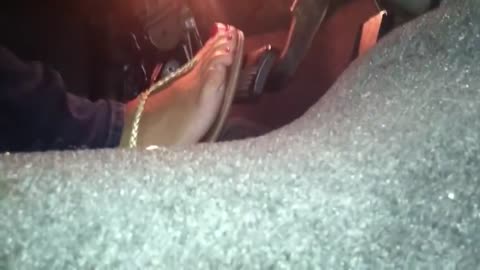
I have to press the brake pedal very early for the car to stop

2015 FORD F-350
3,500 MILES • 4WD • AUTOMATIC
Avatar
NATALIE SARAPOVIC
  • MEMBER
  • 21 POSTS
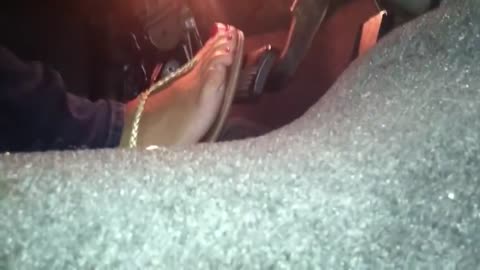
Hi, when I drive I have to press the brake pedal very early for the car to stop. For example; if there is a stop, I have to press the brake pedal 12m before the stop sign. Sometimes I have to pump continuously the brake pedal for the car to stop. I do not know what is the problem. Brake pedal not hard.
Jan 12, 2019 at 10:43 AM
Advertisement
Avatar
JACOBANDNICKOLAS
  • CERTIFIED EXPERT
  • 110,175 POSTS
Hi and thanks for using 2CarPros.

First, I need to know if it is a diesel or gas model vehicle. Next, this truck has four wheel disc brakes, so there is nothing to adjust. That leads me to the next questions. First, is the brake fluid full and clean? Have you identified or noticed any leaks? If you hold pressure on the brake pedal, will it slowly go to the floor? And this will require a helper. At each wheel, a rubber brake hose will attach to the brake caliper. Apply the brakes and hold them while a helper watches each of the rubber brake hoses to see if one is expanding. I would suspect there is air in the lines. These guides can help you fix it.

https://youtu.be/w7gUsj2us0U

and

https://youtu.be/WDxvEQrMkBg

and

https://www.2carpros.com/articles/brake-pedal-goes-to-the-floor

Please run down these guides and report back.
Jan 12, 2019 at 3:11 PM
Avatar
NATALIE SARAPOVIC
  • MEMBER
  • 21 POSTS
It is a diesel truck. brake fluid full, clean, I don't know. When I hold the brake pedal is goes through but does not touch the floor. found no leaks. I don't clearly know for the miles.
Jan 12, 2019 at 8:03 PM
Advertisement
Avatar
JACOBANDNICKOLAS
  • CERTIFIED EXPERT
  • 110,175 POSTS
You know, it sounds like an issue with the master cylinder. However, before I would jump to that conclusion, I would suggest raising each wheel from the ground to confirm they are all working. If you find that both front or both rear don't work, then the master cylinder is my first suspect.

Try that and let me know what you find.

Joe
Jan 12, 2019 at 10:05 PM
Avatar
NATALIE SARAPOVIC
  • MEMBER
  • 21 POSTS
Am sorry. What should I do after I raise each wheel from the ground?
Jan 12, 2019 at 10:11 PM
Avatar
JACOBANDNICKOLAS
  • CERTIFIED EXPERT
  • 110,175 POSTS
Spin each wheel and have a helper press the brakes to see if the brakes are working.

Let me know what you find.

Joe
Jan 12, 2019 at 10:21 PM
Avatar
NATALIE SARAPOVIC
  • MEMBER
  • 21 POSTS
Yes they are working.
Jan 12, 2019 at 10:28 PM
Avatar
JACOBANDNICKOLAS
  • CERTIFIED EXPERT
  • 110,175 POSTS
If all of them are working, then I have to ask if the brake system was opened for any reason that may have allowed air to get into it?
Jan 12, 2019 at 10:28 PM
Avatar
NATALIE SARAPOVIC
  • MEMBER
  • 21 POSTS
What will happen if there is air in the system?
Jan 12, 2019 at 10:30 PM
Avatar
JACOBANDNICKOLAS
  • CERTIFIED EXPERT
  • 110,175 POSTS
You will get a soft pedal and brakes will not work evenly or properly. Has the system been opened for anything?
Jan 13, 2019 at 10:26 AM
Avatar
NATALIE SARAPOVIC
  • MEMBER
  • 21 POSTS
I don't know, maybe.
Jan 16, 2019 at 9:02 PM
Avatar
NATALIE SARAPOVIC
  • MEMBER
  • 21 POSTS
Is there another way air can enter the system?
Jan 16, 2019 at 9:03 PM
Avatar
JACOBANDNICKOLAS
  • CERTIFIED EXPERT
  • 110,175 POSTS
Welcome back:

If the system has been opened, you really should try bleeding the air out. Here are the directions specific to your vehicle for the process.

___________________________________________

Brake System Bleeding

General Equipment
Brake/Clutch System Pressure Bleeder/Filler
Fluid Container and Hose
Pressure

WARNING: Do not use any fluid other than clean brake fluid meeting manufacturer's specification. Additionally, do not use brake fluid that has been previously drained. Following these instructions will help prevent system contamination, brake component damage and the risk of serious personal injury.

WARNING: Carefully read cautionary information on product label. For emergency medical information seek medical advice. In the USA or Canada on Ford/Motorcraft products call the Poison Control Center at: 1-800-959-3673. For additional information, consult the product Material Safety Data Sheet (MSDS) if available. Failure to follow these instructions may result in serious personal injury.

WARNING: Do not allow the brake master cylinder to run dry during the bleeding operation. Master cylinder may be damaged if operated without fluid, resulting in degraded braking performance. Failure to follow this instruction may result in serious personal injury.

NOTICE: Do not spill brake fluid on painted or plastic surfaces or damage to the surface may occur. If brake fluid is spilled onto a painted or plastic surface, immediately wash the surface with water.

NOTE: Pressure bleeding the brake system is preferred to manual bleeding.

NOTE: The HCU bleeding procedure and a second brake system pressure bleed must be carried out if a new HCU has been installed.

All Vehicles

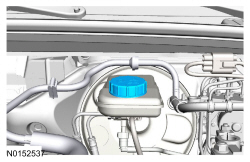
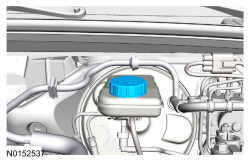
NOTE: Make sure the area around the master cylinder cap is clean and free of foriegn material.

Picture 1

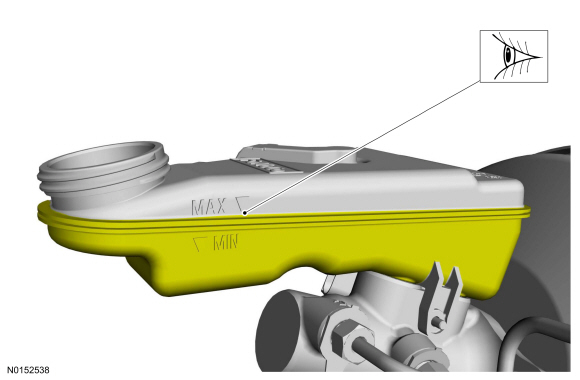
Fill the reservoir with clean, specified brake fluid. Refer to Specifications in this section.
Picture 2

NOTE: Master cylinder pressure bleeder adapter tools are available from various manufacturers of pressure bleeding equipment. Follow the instructions of the manufacturer when installing the adapter.

Install the bleeder adapter to the brake master cylinder reservoir and attach the bleeder tank hose to the fitting on the adapter.
NOTE: Make sure the bleeder tank contains enough specified brake fluid to complete the bleeding operation. Refer to Specifications in this section.

Open the valve on the bleeder tank.
Apply 207-345 kPa (30-50 psi) to the brake system.
With the vehicle in NEUTRAL, position it on a hoist. Section 100-02 .
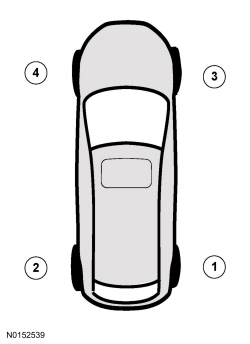
Bleeding steps must be followed in the order indicated in the graphic.

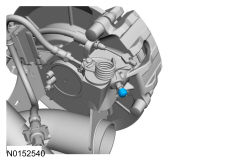
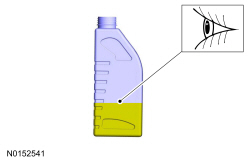
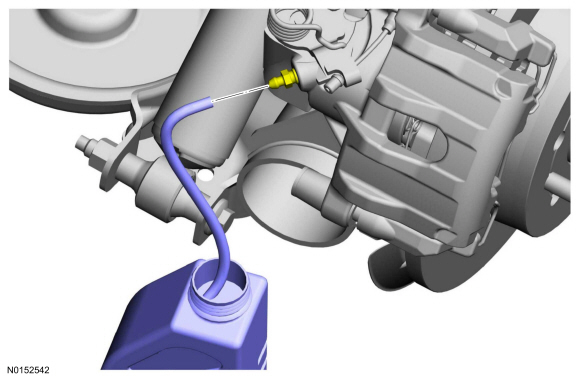
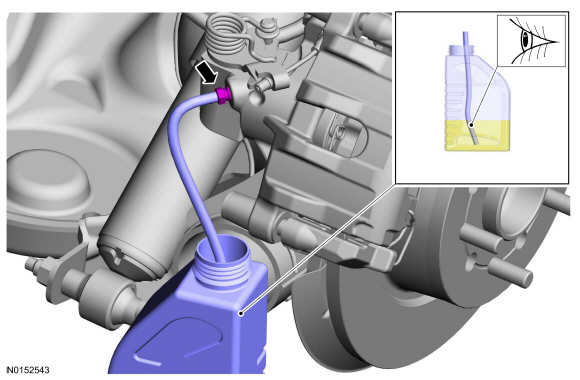
Pictures 3 - 6

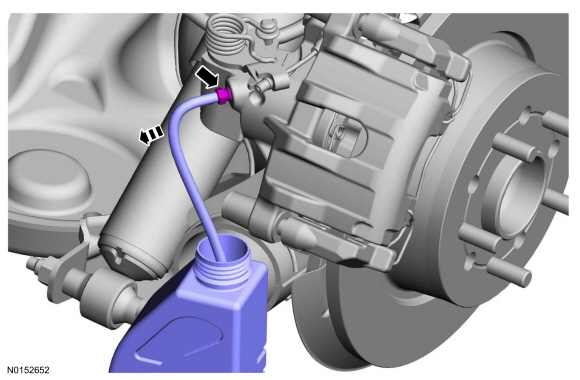
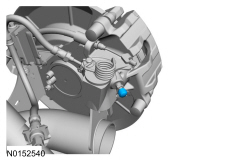
Loosen the bleeder screw 180° and leave open until clear bubble free brake fluid flows and then tighten the bleeder screw.

see pic 7

Vehicles with rear integral parking brake calipers

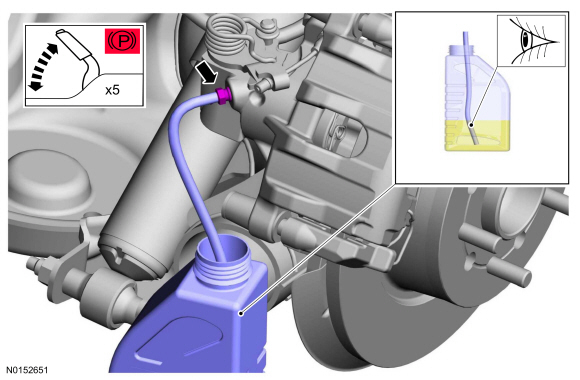
NOTE: Due to the complexity of the fluid path within the rear integral parking brake calipers, it is necessary to press and release the parking brake during the bleed procedure.

Apply and release the parking brake 5 times. Loosen the rear bleeder screw. Leave open until clear, bubble-free brake fluid flows, then tighten the rear bleeder screw.
Repeat until clear, bubble-free fluid comes out.

See picture 8

All vehicles

Tighten the bleeder screw to specification. Refer to Specifications in this section.
Remove the fluid container and hose.

See pictures 9 - 10

Repeat steps 7-13 at the remaining wheel ends.
Close the bleeder tank valve and the pressure. Remove the tank hose from the adapter and remove the adapter.
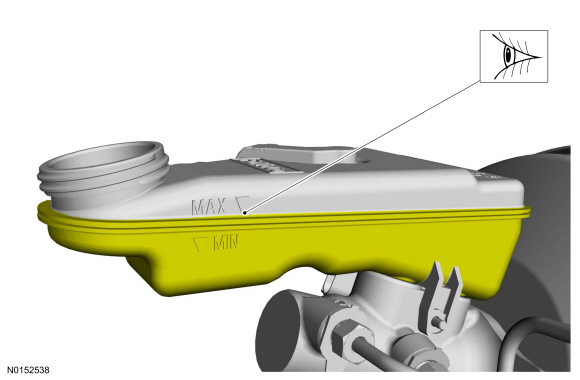
Fill the reservoir with clean, specified brake fluid. Refer to Specifications in this section.

See pictures 11 - 12

Vehicles with a new HCU installed.

NOTE: The HCU bleeding procedure and a second brake system pressure bleed must be carried out if a new HCU has been installed.

Using the diagnostic scan tool, follow the ABS Service Bleed instructions.
Repeat the brake system pressure bleeding steps.

____________________________________________________

Let me know if this helps.

Take care,
Joe
Jan 16, 2019 at 9:12 PM
Avatar
NATALIE SARAPOVIC
  • MEMBER
  • 21 POSTS
Will the brake fail completely if continue to drive with it?
Jan 23, 2019 at 10:54 PM
Avatar
JACOBANDNICKOLAS
  • CERTIFIED EXPERT
  • 110,175 POSTS
I can't answer that without knowing what is actually causing the problem. However, it already seems unsafe.
Jan 24, 2019 at 4:53 PM
Avatar
NATALIE SARAPOVIC
  • MEMBER
  • 21 POSTS
I was driving yesterday and the brake was like this
Jan 24, 2019 at 9:10 PM
Avatar
JACOBANDNICKOLAS
  • CERTIFIED EXPERT
  • 110,175 POSTS
Hi:
I have a feeling it deals with the master cylinder, but I can't be sure. I have to be honest, I'm a bit concerned. If there are no leaks, the brakes are good, brake hoses are good, and no air got into the system, that leaves the master cylinder. If it is getting worse and you're not sure how to check the things I suggested, you really should have it checked before something happens.
Jan 25, 2019 at 5:26 PM
Avatar
NATALIE SARAPOVIC
  • MEMBER
  • 21 POSTS
How will the master cylinder affect the brakes?
Mar 1, 2019 at 12:09 AM
Avatar
JACOBANDNICKOLAS
  • CERTIFIED EXPERT
  • 110,175 POSTS
Welcome back:

They can leak internally into the booster, the plungers which force fluid can be bad an allow fluid to bypass giving you a soft pedal and require pumping of the brakes and based on what is actually wrong with it, you could lose the majority of braking ability.
Mar 1, 2019 at 7:21 PM
Avatar
NATALIE SARAPOVIC
  • MEMBER
  • 21 POSTS
If I rest my foot on the brake pedal while driving will it be a good solution?
Mar 13, 2019 at 11:08 AM
Avatar
JACOBANDNICKOLAS
  • CERTIFIED EXPERT
  • 110,175 POSTS
No, If it is the master cylinder, it needs fixed. It could lead to brake loss. Natalie, I have no reason to try and sell something. It doesn't benefit me at all. I am concerned and feel the problem needs identified and repaired. Although we don't know each other, I still don't want anything bad to happen. Brakes are something you must have properly working.
Mar 13, 2019 at 5:48 PM
Avatar
NATALIE SARAPOVIC
  • MEMBER
  • 21 POSTS
Yes, I understand you. But the mechanic is too far from where I live and I have to drive to go there.
Mar 20, 2019 at 5:08 AM
Avatar
JACOBANDNICKOLAS
  • CERTIFIED EXPERT
  • 110,175 POSTS
Is it possible to have it towed?
Mar 20, 2019 at 9:00 PM
Avatar
NATALIE SARAPOVIC
  • MEMBER
  • 21 POSTS
I can't it is the only car I have.
Mar 21, 2019 at 12:17 AM
Avatar
JACOBANDNICKOLAS
  • CERTIFIED EXPERT
  • 110,175 POSTS
Welcome back:

It's your call. However, if it is unsafe, you should have it taken care of before something happens. Please keep in mind, I am not there to experience what is happening, so you have to make the decision.

Take care and be careful.

Joe
Mar 21, 2019 at 6:22 PM