After replacing the brakes, the brake pedal still goes to the floor?

2017 JEEP PATRIOT
147,374 MILES • 2.0L • 4 CYL • 2WD • AUTOMATIC
Avatar
MELISSA ACOSTA
  • MEMBER
  • 53 POSTS
I recently replaced my brake calipers and the pads and today I replaced the master cylinder. However, my pedal is still going to the floor, and I have to use the emergency brake to stop. I'm getting really frustrated here. Can you please tell me what could be doing this and how I could fix it before I burn this truck to the ground?
May 13, 2023 at 5:47 PM
Advertisement
Avatar
JACOBANDNICKOLAS
  • CERTIFIED EXPERT
  • 110,175 POSTS
Hi,

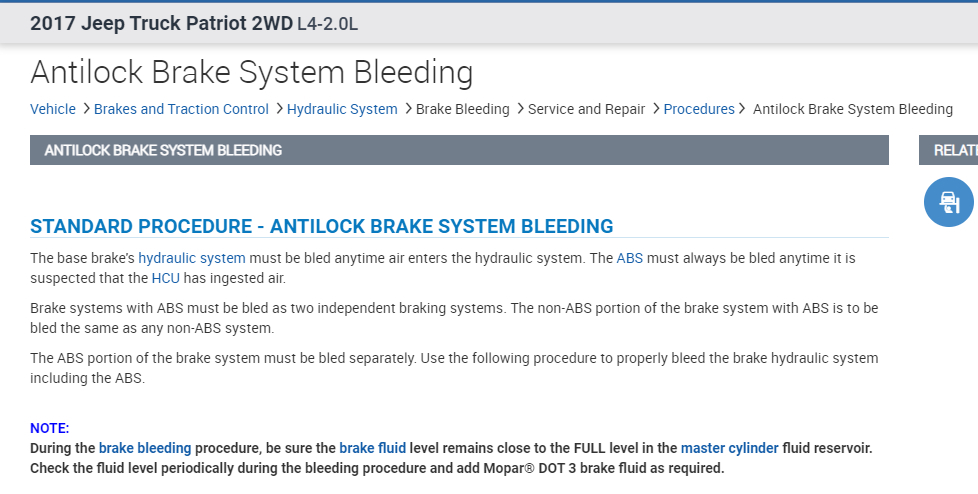
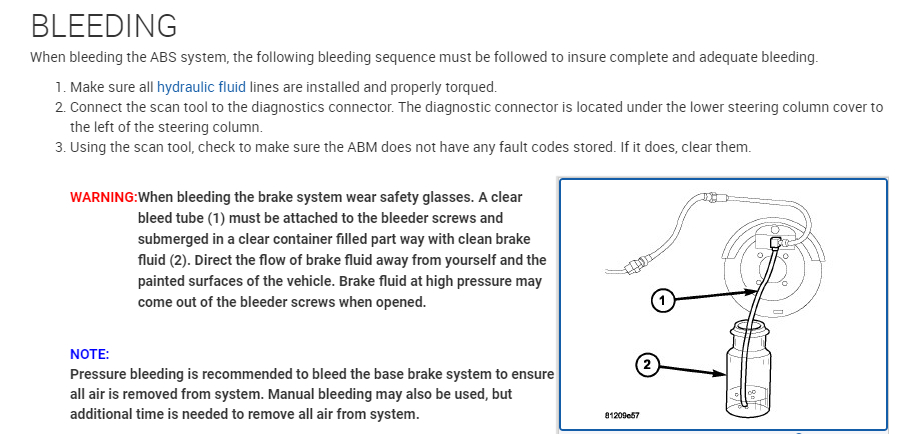
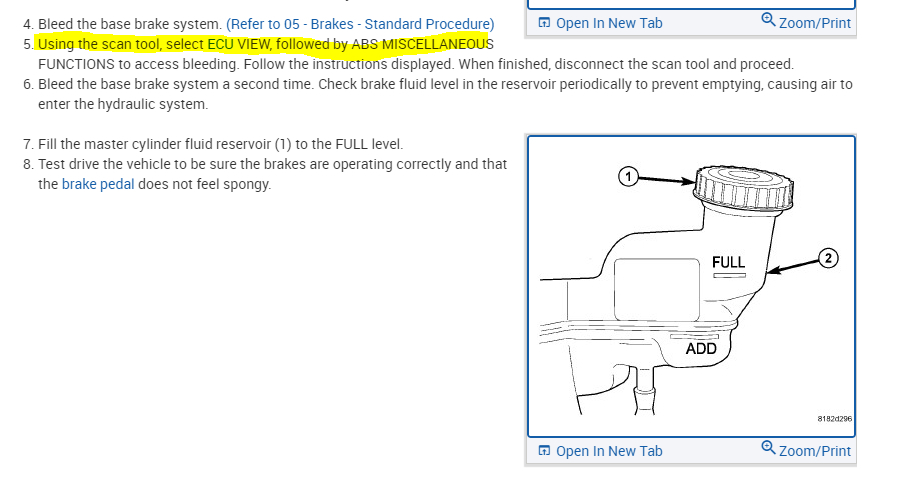
If the brake master cylinder was allowed to get too low, chances are you have air in the ABS hydraulic unit.

As a result, you will need to perform an automated bleed procedure. This requires a bidirectional scan tool that can communicate with the module.

If you look below, I attached the directions. Let me know if this helps or if you have questions.

Take care,

joe

See pics below.
May 14, 2023 at 10:01 PM
Avatar
MELISSA ACOSTA
  • MEMBER
  • 53 POSTS
I was changing the oil pan yesterday and was under my truck for some time scraping the gasket sealer off and I noticed what the problem is. On the new caliper the bleeder is leaking. The bad part about it is I got it from Rockauto, refurbished in a complete package with rotors and pads and the other caliper I received was leaking because where the brake line connects to it was curved. That was noticeable but this isn't as noticeable, and I don't think they will give me the money back for it now.
May 15, 2023 at 7:23 AM
Advertisement
Avatar
JACOBANDNICKOLAS
  • CERTIFIED EXPERT
  • 110,175 POSTS
You should be able to purchase a bleeder at any parts store. Have you checked?

Let me know.

Joe
May 15, 2023 at 7:05 PM
Avatar
MELISSA ACOSTA
  • MEMBER
  • 53 POSTS
I have replaced the master cylinder to my brakes on my truck and I have gotten new calipers for my truck as well. The problem was still air in the lines even though I did the bench bleed for the master cylinder, and I bled the brakes for what seemed like the entire system. So, it just goes to show me that even though I did everything correctly I didn't do it as much as I should have and it is never too much when it comes to bleeding your brakes. If you think you have done it enough, do it a lot more because you will pay for it if you don't.
Jul 27, 2023 at 11:42 PM
Avatar
JACOBANDNICKOLAS
  • CERTIFIED EXPERT
  • 110,175 POSTS
Hi,

Thanks for the update. It sounds like everything is working properly now, correct? If so, good job.

Take care and feel free to come back anytime in the future.

Joe
Jul 28, 2023 at 6:46 PM
Avatar
MELISSA ACOSTA
  • MEMBER
  • 53 POSTS
Yes, as far as my brakes are concerned, I am finished. Everything is good and I am done but everything else with this vehicle is making me sick. Something has to be bent as far as the frame, but I can't find it and the dealership lied to me. I really wish I could make them pay for what they have done.
Jul 28, 2023 at 7:15 PM
Avatar
JACOBANDNICKOLAS
  • CERTIFIED EXPERT
  • 110,175 POSTS
Hi,

Bent frame? That isn't good. If you have a thrust angle alignment, they should be able to tell if something is off.

Joe
Jul 28, 2023 at 7:45 PM
Avatar
MELISSA ACOSTA
  • MEMBER
  • 53 POSTS
I don't have a thrust angle alignment and I don't think I have ever heard of it before. What is it and what does it do?
Jul 29, 2023 at 1:09 AM
Avatar
CARADIODOC
  • CERTIFIED EXPERT
  • 34,306 POSTS
If I might stick my nose in here, years ago only the two front wheels were aligned, and it was assumed the rear axle and wheels where perfectly straight and parallel. If that wasn't the case, the rear wheels would steer the car into a turn. You had to counteract that by turning the front wheels the same way to make the car go straight down the road. That meant the steering wheel was off-center.

The next innovation was the thrust alignment. Mirrors were added at the rear wheels so the mechanical alignment equipment could show us how to compensate for rear wheels steering off to one side. "Thrust angle" refers to the direction the rear wheels are steering. It's extremely rare to find a car with 0.00 degrees thrust angle. Instead, almost every vehicle has some thrust angle, but it is way too small to see when you're watching the car in front of you. It is enough to make the steering wheel off-center. By looking at that thrust angle, the alignment equipment shows where to adjust the front wheels so we'll end up with a straight steering wheel.

All modern alignment computers offer the option to perform a thrust alignment which, again, just looks at the rear wheels to tell us where to set the front wheels to get the straight steering wheel. Today the standard is the "four wheel alignment". That has nothing to do with four-wheel-drive or all-wheel-drive vehicles. It simply means the computer is going to show us all four wheels, not just the front two. Even if we don't or can't make adjustments to the rear wheels, the computer looks at them, then calculates where it wants us to set the front wheels.

That's the overly-complicated explanation of how we achieve a straight steering wheel during the alignment. The standard four-wheel alignment does everything a thrust alignment does, and more. The reason Joe specified the thrust alignment is the computer is going to show exactly which way each of the wheels is steering. Remember, steering a little to either side is common and acceptable, but we're looking for something excessive or unusual to point to a bent frame or other damage to steering and suspension parts.
Jul 29, 2023 at 4:58 PM
Avatar
MELISSA ACOSTA
  • MEMBER
  • 53 POSTS
Caradiodoc, I will give you my number at the email because I would really like to talk to you about my Patriot and find out what I can do because I really love my truck but I know that it had to have been wrecked and the dealership never reported it so that it would pass a Carfax report. I have looked at the frame but if I have a better idea of what to look for and where I know I can fix it. I'm just that stubborn. Thank you
Jul 30, 2023 at 2:26 AM
Avatar
CARADIODOC
  • CERTIFIED EXPERT
  • 34,306 POSTS
I'm not trying to take over your question. I'm just following along in hopes of learning the solution to the original problem, but it has turned to one of my specialty areas.

The first thing to do is analyze the tire wear patterns. This article may be of help:

https://www.2carpros.com/articles/how-car-tires-work

The next thing is a little trickier, but I have a hint. That is to check for excessive dog-tracking. Someone following you on the highway might be able to see that, but it can be misleading unless you're on a motorcycle so you can switch from side to side to compare them. A quick clue can be found, assuming the steering wheel is centered now when you're driving straight ahead. Stop, then turn the steering wheel as far as possible each way. Compare the position of the steering wheel at each limit. If you can rotate the wheel, let's say, two revolutions to the left, but only one and a half revolutions to the right, the steering gear is off-center when the steering wheel is straight. That's an indication the rear wheels are steering to one side excessively. This is where the thrust alignment or a four-wheel alignment would have compensated for that and left it with a straight wheel. This can also be caused by nothing more than a bent steering arm or linkage. That can make the steering wheel off-center, which was the clue, but it can usually be adjusted out during the alignment. To say that a different way, the steering gear can be off-center due to frame damage or simply due to a bent steering system part.

The next thing is the alignment. Be sure to ask for a printout of the results. I always made a copy to keep, and one that I put on the passenger seat, with the items I changed or adjusted highlighted. All alignment computers can make printouts but most mechanics don't bother because they know the average driver won't understand it. The most common page to print shows the three main alignment angles for the front wheels and the two angles for the rear wheels. I'd rather see the more detailed and comprehensive report. It will include the "Before" and "After' readings with a long list of items. One of them is "Steering Axis Inclination", or "SAI". This is a real good indicator of frame damage in the front, or of very careful and accurate crash repair.

There's a lot of misinformation when it comes to CarFax reports. First, it only covers major things, and only from businesses that report these things. It will include anything that involved a police report, but there's a real lot that never gets reported. I have a friend with a body shop where he specializes in rebuilding smashed one and two-year-old Dodge trucks.
There's always a half dozen in his yard waiting until he has time to work on them. Some have frame damage that he handles himself. Part of that repair involves using special measuring equipment indexed off the holes underneath in the frame rails or unibody sheet metal. That can show if the frame is bent, diamond-shaped, or straight. With even a little damage that you or I would never see, doors, fenders, and hood would not fit right. The gaps between panels will be wrong, and sometimes bolt holes don't line up. It actually takes less work to pull a frame straight than it takes to cobble the parts bolted to it to make them fit.

My friend does insurance work, so those vehicles usually had some type of police report. A lot of what he does involves the farmers in his area. They tear up driveshafts and transfer cases, back into them with their tractors, and get them stuck on tree stumps. CarFax won't show that type of damage, but you aren't likely to get involved with a vehicle like that. They typically keep those vehicles running until the wheels won't stay on.

Don't blame the dealership for hidden or unknown damage. They often buy cars from dealer-only auto auctions, and they never know the vehicle's history other than it might have been a turn-in from a rental agency or was previously a police car or taxi.

For another example, my mother chased down a light pole a few years ago in the Walmart parking lot. Unfortunately, she caught it. Basically just needed a new bumper cover and radiator, but it still came to $2500.00. My friend did the repairs. No police report, no insurance company involvement, and nothing on CarFax about it. The only way an expert would know something was repaired would be by the sticker on the radiator.

My 2014 Ram is another example. It was a rebuilder. I definitely do not have the talent for body work, but I do know how to spot some repairs. The only thing anyone can see is a little yellow paint from the used door hinge peeking out where the new paint didn't get to. That door came from his sister's truck after she crashed it. Before that, it was a rebuilder that he repaired for her, so my door is on its third truck.

The point of this sad story is I am no longer afraid of crash-repaired vehicles because I know from helping my friend what to look for. Beefing up damaged areas can be just as bad as not repairing them properly because you may lose the designed-in crumple areas that absorb forces in a crash. There's a lot of liability issues involved with these repairs, so most shops are very careful to do a proper job.

If you do have an alignment performed, post a photo of the printout. I can explain what each item is and if any of them are pointing to a potential problem. When they list "Before" and "After" values, those refer to what the vehicle came in with before anything was adjusted, and after the alignment was finished, what the final values were when the test-drive was performed.
Jul 30, 2023 at 7:54 PM
Avatar
MELISSA ACOSTA
  • MEMBER
  • 53 POSTS
When I had the vehicle for only a few months I kept losing air in both passenger side tires and I still had a warranty, so I took it back to the dealership to have them look at it and find out what was wrong. They tried to tell me that I ran over a nail and got both tires when I knew there were no holes in my tires because I did the water test on both tires. They replaced both tires even though they weren't covered in the warranty. Then my passenger side CV axle went bad, and I replaced it myself and I found at least 20 zip ties holding the boot on it. They even had zip ties inside the boot that they tightened and missed the cup on the end of the boot where the clip is supposed to be. Now I just do a little bit of mechanical work on my vehicles even though I have rebuilt a 72 Nova, 69 Cutlass SS, and a 68 Buick. I have pulled the motors and rebuilt them and the transmissions as well as the body and interior, but these newer vehicles are all computerized and I'm learning a lot about them because of nice people like you and the other professionals at 2carpros. I know enough about this one and dealerships to know that when they took the wheels off any mechanic worth a damn would have seen those zip ties and found the problem with the CV axle. I also know that no dealership will cover the cost of not one but two tires that aren't covered in the warranty unless they are hiding something. That's why I blame the dealership. I really appreciate everything all of you have done for me and I will be getting the alignment done soon because I had to replace the outer tie rod and I have a year of free alignments with the company I got my tires with. So, I will get the printouts for you and myself so you can help me figure this out once and for all. It's about to cost me my relationship with my fiancée because I have spent so much money on it and his car needs some work because he has a lot of rust under his car and it is over 200,000 miles and the parts are needing replaced, but I keep trying to fix mine because I want to be able to park his and use mine. I appreciate everything and I will get back to you when I get the printouts done. Thank you
Jul 30, 2023 at 9:10 PM
Avatar
CARADIODOC
  • CERTIFIED EXPERT
  • 34,306 POSTS
A common tire repair for nail holes is to plug them with inserts. I suspect you're familiar with them, but if you're not, they're a dandy fix to carry with you. I have almost a dozen of them in the tires on my truck. I seem to pick up nails in my friend's driveway. One tire has been losing air since I got the truck with only 4,200 miles. Funny thing is I have to pump it up about once every other month in the summer and every few days in the winter. I find most of my leaks when I park in a puddle, but even with soapy water, we haven't been able to find this one. Corrosion on cast rims is common too, and that can cause a spot to leak or not depending on which part is on the ground when the truck is parked.

It's also common to patch tire leaks, but that requires dismounting it from the wheel. That repair still leaves the hole where water and salt can get in to rust the wires of the steel belts. The best repair is to do both. The plug goes in first to seal the hole, then the tire is dismounted, the exposed part of the plug gets cut off, and the patch goes over the hole and plug. Not many people take the time to do that.

Tires are not supposed to be repaired with either patches or plugs if the hole is on the sidewall or near the edge of the tread. That's because it is felt there's too much flexing and the repair will fail. I have done a few plugs near the edge of the tread on my tires, and they've held up fine. I wouldn't do that on a customer's tire though, for liability reasons.

Let us know what you find with the alignment.
Aug 1, 2023 at 6:43 PM
Avatar
MELISSA ACOSTA
  • MEMBER
  • 53 POSTS
Yeah, but this wasn't a hole in my tires. When I took the rims off of my truck, I could clearly see the dents in both rims, but you couldn't see it with the tires on. They were black rims, and the dents were undetectable with tires.
Aug 2, 2023 at 10:01 AM
Avatar
JACOBANDNICKOLAS
  • CERTIFIED EXPERT
  • 110,175 POSTS
Hi Melissa,

I noticed that you haven't been contacted for a couple of days. As far as the rims, if they were bent, certainly that could cause a leak. I also read the post above about the zip ties on the CV axle. That doesn't sound good.

I'm not sure where you left it with my counterpart, but wanted to ask if there is anything I can do to help.

Let me know.

Joe
Aug 4, 2023 at 7:44 PM
Avatar
CARADIODOC
  • CERTIFIED EXPERT
  • 34,306 POSTS
Hi brother Joe. I didn't mean to take over your question. The topic shifted to an alignment issue, and of course I had to stick my nose in. I'll add my next comment of value if and when it is warranted.
Aug 4, 2023 at 9:00 PM
Avatar
MELISSA ACOSTA
  • MEMBER
  • 53 POSTS
I appreciate all the help I can get. Right now everything is on hold. I'm traveling for work. Finished a show in West Memphis and right now I'm in Ohio and we're packing to go to Indiana. That's why I need a reliable vehicle. I've got to go so we can make it because we have to go to work at 4 pm today. I'll keep you posted about my vehicle. Thank you
Aug 6, 2023 at 8:27 AM
Avatar
JACOBANDNICKOLAS
  • CERTIFIED EXPERT
  • 110,175 POSTS
Hi,

Thanks for the update, Melissa. Let us know if we can help. And Caradiodoc, please feel free to jump in anytime. Your input is always appreciated.

Take care,

Joe
Aug 7, 2023 at 12:58 PM
Avatar
MELISSA ACOSTA
  • MEMBER
  • 53 POSTS
I just got back from the road and went to get an alignment and guess what. The outer tie rods we just replaced before the trip need to be replaced again and one of my sway bar links too. This is getting ridiculous; the auto shop couldn't do the alignment until I get both replaced. So, I have the parts and waiting for my truck to cool down then we'll change them and go back so I can get the printout for you.
Aug 15, 2023 at 8:50 AM
Avatar
JACOBANDNICKOLAS
  • CERTIFIED EXPERT
  • 110,175 POSTS
Hi,

If you have worn steering components, they honestly can't do it. Well, they could, but it wouldn't be right.

How long did the tie rods last? One trip?

Joe
Aug 15, 2023 at 8:55 PM
Avatar
MELISSA ACOSTA
  • MEMBER
  • 53 POSTS
Not even, my fiancée hit a bump in the road in Arkansas and the tie rod broke and we had to buy another one. We traveled from Arkansas to Ohio and then to Indiana and then home to Florida. I bought a new tie rod and sway bar link but with a heat index of 112° yesterday I was not going to change them in the sun and heat. I'll do it in the morning and take it back. I promise to keep you updated.
Aug 16, 2023 at 12:26 AM
Avatar
MELISSA ACOSTA
  • MEMBER
  • 53 POSTS
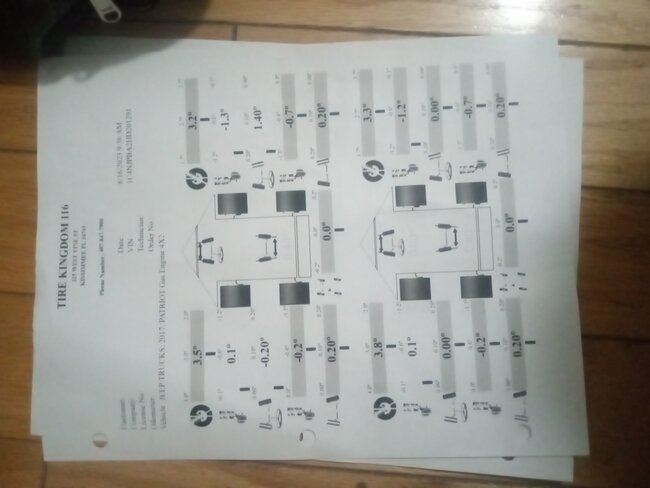
Just got home from getting the alignment done, finally. Yay. Here are the printouts for you. I really hope you can help with this, and I can finally figure out why all of the parts on the front of my truck keep going bad.
Aug 16, 2023 at 8:17 AM
Avatar
CARADIODOC
  • CERTIFIED EXPERT
  • 34,306 POSTS
There's a different page I would rather see that just lists a whole pile of numbers, but that's more for checking for proper crash damage repair. I can offer a few comments related to this printout.

First, while it doesn't say it, it appears the top drawing is the "Before" readings, meaning what the vehicle came in with, and the bottom one is the "After" readings once all the adjustments were completed.

The top number on each side is for "caster". Visualize how the fork on a bicycle angles rearward at the top. When you put weight on the tire, it makes the wheel want to squirt out straight ahead. That is what allows you to ride no-handed. Caster on the car has to do with the upper ball joint or the upper strut mount being further rearward than the lower ball joint. Those are the two steering pivots. Being offset from the center of the tire, "positive caster" which is the upper pivot behind the lower pivot, makes each front wheel want to turn toward the center of the vehicle. The higher the caster, the harder that wheel wants to turn in when vehicle weight is placed on it. As late as the 1960s, it was common to call for negative caster, meaning the upper ball joint was forward of the lower ball joint. That made for very easy steering. Even large trucks could be steered easily.

By the late '60s, we were driving faster, but negative caster is very unstable. Cars wandered all over which made them tiring to drive with the constant steering corrections. We went to positive caster for greatly improved stability, but it makes steering much more difficult. The wheel turning out is actually raising that corner of the car. To deal with the increased steering effort, power steering was added. We still can't adjust caster too high as it would still take too much effort to control the car, especially at lower speeds.

To put this in perspective, imagine standing beside the car, looking at the side of the tire. If the upper ball joint is directly over the lower ball joint, that would be 0 degrees caster. Now imagine the spindle and upper ball joint are rotated more and more until the upper ball joint is behind the lower one, (more or less right under the brake pedal). That would be 90 degrees. Most car and light truck models call for around 3 degrees caster. That's plenty to provide easy steering with no wander. Of more importance than the actual values, we want caster to be equal on both front wheels. Looking at your printout, RF caster is 3.2 degrees which makes that wheel want to turn left simply from the weight on it. LF caster is higher at 3.5 degrees, so the left wheel wants to turn to the right, but slightly harder than the right wheel. When the two spindles are connected together with the steering linkage, those two pulls are supposed to be equal and cancel each other out. In this case the 0.3 degree higher pull on the left wheel will more than cancel the pull on the right wheel, with a little left over to cause the vehicle to pull to the right when you let go of the steering wheel. Don't panic; more on that in a moment.

I have to add a comment here about tire wear. Caster has no appreciable effect on tire wear, however, for anyone preparing to take the ASE certification test for Steering and Alignment, they DO consider caster to be a tire wear angle. That's because due to the geometry of the spindle and the suspension system, the wheel turning out, away from the center of the car, will tilt that way on top. That tilt is actually very easy to see when standing beside the car. Because of that tilt, the tire is riding on the outer edge of the tread, so that edge is going to wear much faster. Common sense tells us that wear is going to take place when turning sharply in either direction, which is typical of driving through a parking lot. That microscopic wear will never be seen, yet technically it is taking place. The only people in the world who care about that wear are those writing the certification test. A few models, including some Mercedes and some older Jeeps called for as much as 11 degrees caster to reduce steering wander. Even those would never show tire wear due to those settings.

As a side note for caster, the majority of front-wheel-drive cars are completely immune to pulling to one side due to unequal caster. I can't offer an explanation for that, but I've had as much as 3.0 degrees difference, and there was no pull. With that much difference on a rear-wheel-drive car, you'd have to hold onto the steering wheel with both hands to keep it going straight. Many of those front-wheel-drive models, particularly imports, don't even provide a means of adjusting caster. You just take what you got and move on.

Caster is the hardest alignment angle to explain and visualize. "Camber" is the easiest. That has to do with the top of the wheel tilting in or out. If the wheel is perfectly straight up and down, that would be 0 degrees camber. Imagine that wheel being tipped out on top more and more until it is laying flat on the ground. That would be 90 degrees. Tipped out on top is positive camber and is by far the most common. A few models call for negative camber, meaning tipped in on top, usually to overcome some design issue and achieve decent tire wear. For most models, 0.5 degrees, give or take a quarter of a degree, is a typical value for camber. One of the big unknown purposes of camber is the tilt causes the vehicle's weight to be placed directly over the larger inner wheel bearing, (when we had the big inner and smaller outer bearing that we had to grease periodically). Today everyone uses a different style sealed bearing and hub assembly, but camber is still responsible for eliminating a sideways or twisting stress on those assemblies. Correct camber helps those bearing live longer.

The most talked about purpose of correct camber is to reduce tire wear. If camber is too high positive, the tire will ride more on the outer edge of the tread and make it wear faster. Too much negative camber causes accelerated wear on the inner edge of the tread. This is part of the wear patterns we "read" when looking for what needs to be corrected when we start the alignment. (It's also why we would prefer to align your car right before you buy new tires, not right after). As long as all the old tires are the same size, we can read them and make all the adjustments needed, then you can have the new tires installed.

Another very important fact about camber is the value on a wheel affects the tire wear on only that one tire. Camber can be out of adjustment on multiple wheels, each with its corresponding bad wear, but misadjusted camber on one wheel never affects the wear pattern on another tire.

Next, camber has the biggest effect on pulling to one side. A tire wants to roll in the direction it is leaning, so positive camber on the left front wheel makes that tire pull to the left. The goal is to set camber on the right side to the same value so the two pulls offset each other and the car goes straight. Camber on your left front is 0.1 degrees. Without knowing what the specs call for, I'd call that quite respectable. It's the right front that disappoints me. The negative 1.3 degrees is a real lot. That tire is going to develop accelerated wear on the inner edge very soon, and with only the 0.1 degree on the left to offset it, the 1.2 degree difference is going to cause a significant pull to the left.

At this point I want to add two noteworthy points of interest. First, camber has twice the effect on pulling as does caster. In other words, if all the other variables are equal side to side, and only camber has a 0.5 degree pull, the car would pull just as hard as if there was only a 1.0 caster pull. A better way to say that is if you had a 1.0 degree caster pull to the left, and a 0.5 degree camber pull to the right, the two would offset each other perfectly and the car would go straight. Remember, this only applies to rear-wheel-drive cars. For front-wheel-drive models, caster usually doesn't play a part in a pull or in correcting it.

Second, (you won't be tested on this or be expected to remember it), but you can run into a car with horrendous tire wear on one edge of one or both front tires while the customer says the car goes straight with no pull. If camber is excessively positive on both wheels or excessively negative on both wheels, both will wear fast on one edge of the tread and the pulls can offset each other. But you can also run into accelerated wear on the outer edge of one tire and on the inner edge of the other tire. Logic dictates both are tipped the same way and you should have a very hard pull. Instead, what can happen is while there is that hard camber pull one way, it can be offset by a very hard caster pull the other way. The car could go straight, but you will usually feel something isn't right. About half of alignment specialists perform a preliminary test drive before starting the alignment. A trick to identifying this caster / camber problem is to drive over a bump that goes all the way across the road. Railroad tracks are perfect, and many in-town intersections work too. Let go of the steering wheel, but watch it as you go over that bump. You'll see the car continues to go straight, but the steering wheel turns left and right as the front end bounces up and down. That's a huge clue that settings are not equal on both front wheels. The unequal camber leads to the tire wear patterns, but there has to be unequal caster to offset that unequal camber.

For my third comment of value, all alignment computers can be set to read caster and camber to two places after the decimal point. Years ago, with big heavy rear-wheel-drive cars, mechanical alignment equipment could read to an eighth of a degree if we were careful, and that was more than good enough for those vehicles. Today the computers can read those angles to the hundredth of a degree, and we need that precision for tiny lightweight cars. Back in the '90s with front-wheel-drive Chryslers, I found 0.06 degrees more camber on the left wheel than on the right one was just perfect to make them go straight. I haven't mentioned "road crown" yet. That's where roads lean to the right to make water run off. Most cars will follow that tilt and appear to be pulling to the right. We always adjust in a small camber or caster pull to offset that road crown. That's what that 0.06 degrees did. When a person sets up their computer to read to just the tenth of a degree, it means they value time more than precision. When a number displayed on the screen turns green it means it is "in specs". We can do better if we had more precision, but for many techs, "in specs" is good enough. That is indeed good enough for much older cars, but when you need 0.06 degrees difference but can only read to tenths of a degree, the computer is rounding two values. Had you been reading to the hundredth of a degree, the actual difference could be anywhere between 0.00 and 1.50 degrees. Either of those extremes would leave you with a pull. It might be small enough that the car owner doesn't notice, but some will. It only takes a couple of extra minutes to set the computer to read to hundredths of a degree, and make more precise adjustments the first time. When I visit a shop and I see the alignment computer set to read to tenths of a degree, I keep my mouth shut, but I know they could do a better job for their customers.

The last of the three main alignment angles is "toe". That's the direction each of the four wheels is steering when the steering wheel is straight. Changing caster or camber usually causes the toe value on that wheel to change, but adjusting toe has no noticeable affect on the camber and caster settings. For that reason, toe is always the last thing to be adjusted. For your preliminary numbers, there's no way to know if the steering wheel was straight when this "snapshot" was taken by the computer. Don't panic if your observations when driving to the shop disagree, but for the sake of this sad story, we'll assume the steering wheel is straight. The left front wheel is at minus 0.20 degrees. Negative toe means that wheel is steering away from the center of the vehicle, but by just a little. The right front is at positive 1.40 degrees. That's a bunch, but very respectable considering this was right after the tie rod ends were replaced. I'd be very happy to get all of mine that close. That wheel is steering to the left. Overall, whenever both wheels had equal weight on them, (you weren't driving over a bump in the road), the vehicle is going to steer to the left. You have to turn the steering wheel to the right to make the car go straight.

This brings me to some more exciting points of interest. First, this unequal toe results in an off-center steering wheel. A car could go perfectly straight down the road without you touching the steering wheel, but the wheel is not straight. That is very different than when you have a caster or camber pull and you have to turn the steering wheel by hand to counteract that pull. Many car owners have a hard time understanding the difference between an off-center steering wheel vs. one that has to be turned off-center to counteract a pull.

Next, to my knowledge, all alignment computer will only read toe to the hundredth of a degree. I don't think they can be set to read to tenths because all vehicles require the higher precision. A typical spec for many years has been 0.20 degrees plus or minus 0.20 degrees. We're picking tiny nits here to get it right, and tenths of a degree just aren't good enough.

The last thing here is the computer is reading toe in degrees. I don't have a good feel for that. Mine was always set to read it in inches which is what many race cars are set to with a tape measure. A reading in degrees will be exactly twice as big as the same one in inches. That means I can have 0.25" of toe and if I change my computer to display it in degrees, it will show 0.50 degrees. This isn't important except when we're analyzing a printout and we fail to notice which unit of measurement is used.

One more critical note. Unlike where a bad camber adjustment causes wear on just that one tire, we always have to look at "total toe", and when it is out-of-specs, it always causes the same wear pattern on both tires on that axle. "Toe" is the setting on one wheel, then we look at the toe setting on the other wheel. The computer also adds them up and displays that as "total toe". You have -0.20 degrees on the left, and positive 1.40 degrees on the right. Total toe is 1.20 degrees. THAT is the reading involved with that part of tire wear. That equates to 0.60 inches. The front or leading edges of the metal wheels are roughly 5/8" closer together than the rear edges of the wheels. That will definitely lead to tire wear, but it likely was good enough that it wasn't too miserable to drive to the alignment shop.

Total toe wear shows up as a choppy pattern on the tread. You can stand next to the vehicle and see it when it's really bad, and you'll see it on both tires. When it's not too bad yet, run your hands over the tread and you'll feel it. Look at one individual block of rubber. One edge will be higher than on the other side of that block, and higher than on the edge next to it on the adjacent block. You fingertips will glide rather smoothly in one direction, but catch on the raised edges when you run your hand the other way. I used to be able to tell if total toe was toed in too much or toed out too much by which way those raised edges appeared. Today I have to stop and think about it a while. You'll feel this when running your fingers around the tire and across the tire.

Imagine you're holding a pencil upright with the eraser down. Set the eraser down onto a table, press down, then drag it across the table. The leading edge gets ground down and creates eraser crumbs. The trailing edge lifts up off the table and no wear takes place on that part. Do that long enough and the eraser won't be flat on top. It will be worn slanted.

It takes some visualizing to compare that to what happens with tires. Imagine both front wheels are steering away from the vehicle's center. Now imagine they're turned out even more, . . . and more, until they're sideways and steering fully to the left and right. Now it's easy to see the inner edge of the tread is the leading edge. Of course if you could actually try to drive a car like that, the tires wouldn't even rotate. They'd just skid along the road surface like the pencil eraser did. Now, instead of that unrealistic example, if we just had as little as a quarter inch of total toe out, that is more than enough to set up the same wear patterns, but it will take many miles to show up. Pulls and crooked steering wheels can be seen right away. Camber and toe wear take many miles to show up.

My next concern is when looking at the "After" readings, front toe on those two wheels is all that was adjusted. They may have only been interested in that due to the new tie rod ends, but in good conscience, I couldn't leave the right front camber like that. Even if there was such a thing as an "economy" alignment that didn't include adjusting caster and camber, I'd still try to make it better. In fairness, some trucks need to have special offset ball joints installed to make camber corrections. That's a big job that would warrant an additional expense, but it's usually only done once to a wheel in the life of the vehicle. That right front camber will actually come up quite a noticeable amount by simply letting a few pounds of air pressure out of that tire.

Your vehicle is too new for me to be familiar with it, but it looks like it has independent rear suspension. With an older design solid rear axle, camber and total toe for both wheels would be 0.00 degrees / inches. Even a solid axle can be mounted slightly turned, so all alignment computers look at the two rear toe readings, then calculate where they want us to adjust each front toe to get a straight steering wheel. With independent suspension, ride quality is seriously improved, but at the expense of tire wear if it isn't adjusted to specs. Here you have 0.20 degrees toe-in on each wheel. I'd look twice at that 0.40 degrees total, but without knowing the specs, I'd suspect that to be quite acceptable. The fact that toe is exactly equal on both wheels is extremely rare and quite the coincidence. No correction to the front toe settings was needed, but if it was, we don't do or calculate anything. The computer does that and we just adjust each front wheel to where it tells us to.

The negative camber settings on the rear are not that uncommon. I think they're doing that for better cornering, but it could be for comfort or it could be with lots of test-driving, that's the setting the engineers found that gives the best tire wear.

There's way more than you wanted to know about your alignment. If you're having any issues or symptoms I didn't cover, let me know and I'll start over!
Aug 17, 2023 at 1:15 AM

Avatar
MELISSA ACOSTA
  • MEMBER
  • 53 POSTS
I knew they gave me the wrong printouts, but I specifically told them I wanted detailed comprehensive reports. I will see if I can get the correct ones tomorrow.
Aug 17, 2023 at 10:39 PM
Avatar
CARADIODOC
  • CERTIFIED EXPERT
  • 34,306 POSTS
That's okay. To my knowledge, the computers don't save data from previous alignments unless they send it through the office now to do the printing. Also, I can't remember if that printout shows the "Before" readings. I like those because it shows if a bad setting is like that because they just left it alone as it was or if they made a mistake or if an adjustment slipped and they didn't see it.

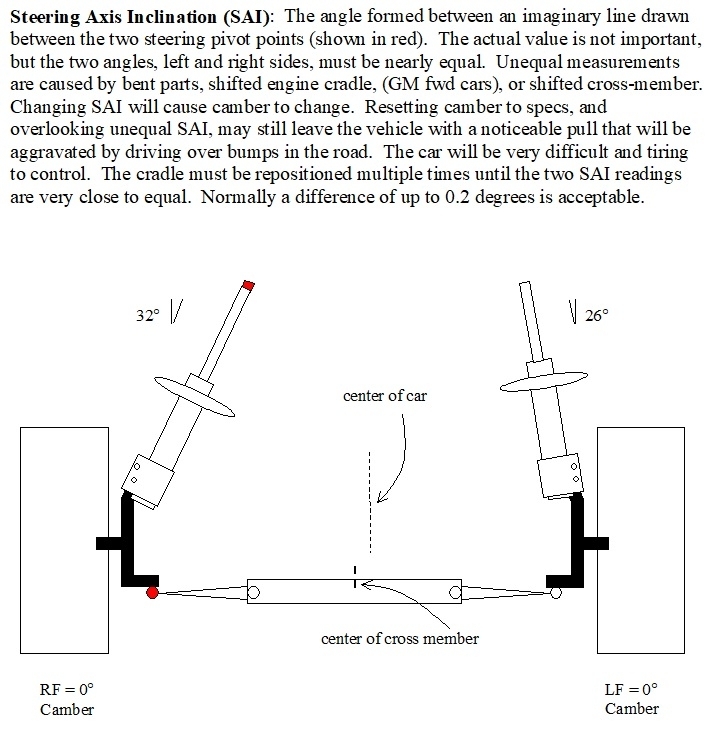
The other value I'm interested in is "steering axis inclination", (SAI). There is never a spec given for that. All we care about is it is equal on both sides. Remember where I described caster as the upper ball joint is further back than the lower one, and that angle is viewed when standing beside the vehicle and looking straight at the side of the wheel? If you draw an imaginary line between those two ball joints, that angle is caster and is identical to the rearward tilt of the front fork on a bicycle. Well, SAI is another imaginary line drawn through those two ball joints, but this time it's viewed from in front, looking back parallel to the tire's sidewall. The lower ball joint will be out further, kind of in the area of where a clutch pedal would be if you had a manual transmission. The upper ball joint would be closer to the center of the vehicle, kind of inline with the brake pedal. From true vertical, that SAI line will typically be around 28 to 32 degrees. If both sides are within 0.2 degrees of each other, we're happy. When they aren't equal, it points to possible crash damage and will make for a miserable car to drive. There will be no "predictability", meaning you have no idea which way it's going to veer each time you hit even a tiny bump in the road.

SAI is commonly messed up on GM vehicles. To service the engine or transmission usually requires everything be dropped down on the sub frame / cross member. We're supposed to mark the four or six bolts that must be removed so we can reinstall the assembly in the original position. When you don't know where you started, that assembly can be bolted in off-center up to a quarter inch to either side. Because the lower control arms are connected, along with the lower ball joints, shifting the cross member's position raises camber on one side and lowers it on the other side. Camber is all that shows up on the main adjustment screen, and that's what most people will correct. While camber can look perfect on the final printout, SAI is still unequal and handling will still be horrendous. Some specialists will switch screens and look at SAI, (those readings get measured automatically, but we have to consciously look at them), and make that correction first. Most of the time doing that correction brings camber on both sides right back into specs. The four or six bolts are just loosened a little, then the cross member can be pried to either side with a big pry bar. It's a quick, simple procedure, but you have to know it needs to be done. I always recommend people tell the alignment specialist what service work was just performed that made the alignment necessary, then it's more likely SAI will not get overlooked.

Many Chrysler models can have their drive trains serviced in a similar manner, but the bolts holding the cross member in have really wide shoulders right under their heads, before you get to the threaded sections. The holes in the cross member just fit those shoulders, so as the cross member is installed, the bolts force it to go back to its correct position.

What I had to say in the classroom was so terribly important that I didn't want my kids writing notes rather than paying attention to our story hour. I developed a pile of "Notes Pages" to hand out instead. Here's a copy of one that may explain SAI better. The upper strut mounts are the upper steering pivots instead of upper ball joints, but the rest of the story is the same.
Aug 18, 2023 at 5:49 PM
Avatar
MELISSA ACOSTA
  • MEMBER
  • 53 POSTS
I understand that the place I got my tires and free alignments for a year obviously don't know much about it because everything that you are explaining I can actually feel in my vehicle as I drive it. Is there a way for me to do it without taking it back to them with your help? Without the computers also?
Aug 18, 2023 at 8:49 PM
Avatar
MELISSA ACOSTA
  • MEMBER
  • 53 POSTS
I can feel a major improvement in the handling of my truck, but I know it can be better. I don't want to mess anything up, but I know that the shop isn't really trying to make it better either. I have a friend who is a certified mechanic right down the road from me and I think I can get his help also, but he has already admitted that he doesn't do much with alignments. I just need some guidance from someone knowledgeable and I know I can do it. I'm smart and a quick learner.
Aug 18, 2023 at 8:53 PM
Avatar
CARADIODOC
  • CERTIFIED EXPERT
  • 34,306 POSTS
The first choice is to have the original shop fix the camber on the right side. If you don't want to go there, the next suggestion is to find a community college with an Automotive program and talk with the instructor. We were always looking for live work, and we had a few dozen local people who would sit on a broken car for months until it fit what we were teaching, because they knew the value that live work offered our kids. Be aware, in our case, we taught eight areas, each once a year for eight weeks. Part of that time was spent in the classroom, so it can take days or weeks to get a job back that should take a few hours. If nothing else, they can use it for one class period to inspect it and see if and why camber can't be fixed. They won't work on it outside of Suspension and Alignment class as that would put them in competition with the local shops that hire their graduates.

We got parts at very good discounts, then marked them up ten percent to form a "breakage" fund in case we damaged something. Labor was billed at $10.00 per hour for what the job was supposed to take at a regular shop.

I'm running out of laptop battery so I might have to continue this story tomorrow. I can copy and format the instructions for adjusting camber. I see now a good reason why they may not have done it, but you can do this yourself, then take it back.

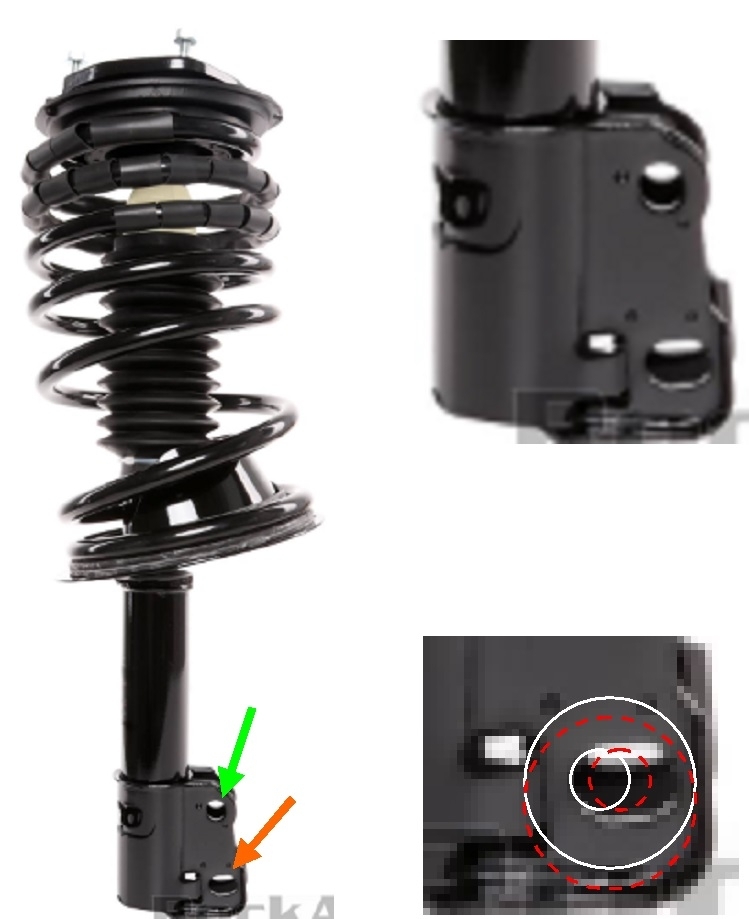
Back in the '80s and '90s, Chrysler used a "cam bolt" at the bottom of each strut. Simply loosening, then rotating that bolt pushed the spindle in or out to adjust camber. GMs worked a similar way, except you loosened the bolts, kicked the tire to move the wheel, tightened the bolts, checked what you got for camber, then do that over and over until you gave up and called it "good enough". Also, on GMs, you have to take everything apart first and grind that hole bigger to allow for the adjustment. If you remove your right front wheel, (please be sure to use jack stands), look at the bottom of the strut. You'll see two long bolts going through it that hold it to the spindle. On Chrysler struts, that lower hole was ovel-shaped. The photos below are for my old '88 Grand Caravan. Notice the oval mounting hole.

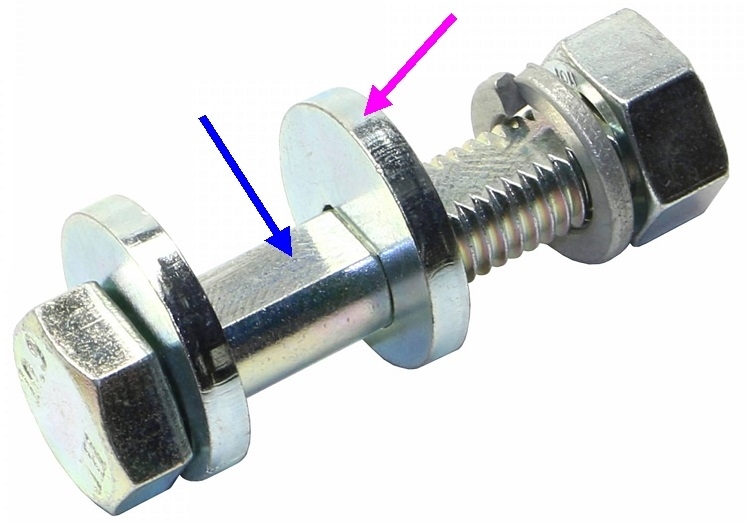
On GM struts, that hole was round and had to be ground larger with a die grinder the first time camber needed to be adjusted. Aftermarket replacement struts usually come with the elongated hole. On GMs and many newer Chryslers, you have to remove the original lower bolt and install the cam bolt. The aftermarket version is shown in the second photo. You loosen both bolts, then reach over the tire and with a ratchet and long extension, rotate the head of the bolt until you get what you want for camber, then tighten them. From what I briefly read for your model, both bolts are supposed to replaced with skinnier bolts to produce the "slop" that allows the spindle to be tipped. One new bolt might be enough, but you can do that yourself. Replace one first and snug it to hold things in place while you install the second one. Now, loosen both of them a little, then tug out on the top of the brake rotor or bottom of the strut. You'll see the movement which is the camber setting being changed. As a guess, I'd suggest the top of the brake rotor would need to be pulled out roughly a quarter to a half inch to get camber closer to specs.

Those bolts will need to be really tight before you set the vehicle down on the tires. Its weight and hitting bumps can let those bolts slip, then you're back to the alignment shop.

If the parts store offers you a cam bolt instead of the two smaller bolts, go for that. On the older struts, the offset head sat in a pocket on the strut. That held them in place and made them just about immune to slipping. GMs don't have that feature, and this newer design you have might not have that either. I'll have to look for a photo of your struts to see if a cam bolt will work.

I'll be back tomorrow night to see how far you got.
Aug 18, 2023 at 10:59 PM
Avatar
MELISSA ACOSTA
  • MEMBER
  • 53 POSTS
Thank you. Both of the bolt holes on my strut are pretty big. The bolt that goes inside them is 22mm and they are the bolts that are threaded only so far then smooth. Every time I have to undo them, I have to take a mallet to them until the thread catches. I always try to be very careful not to beat the threaded part through, so I don't mess it up. Not that I don't have hardware for 3 X's everything that even touches my front wheels because every time I have replaced anything I always get new hardware too, but if I get lazy and just beat it out and use the new, I will run out and then where would I be? Up the creek without a paddle. So, I don't want to get complacent. Besides if I stay vigilant about what I'm doing I just might learn something and actually fix this. Lol. Okay, I'll see what I can do and keep you posted. Thank you, guys, all of you, you have been a great help.
Aug 19, 2023 at 2:20 AM
Avatar
CARADIODOC
  • CERTIFIED EXPERT
  • 34,306 POSTS
In case you didn't catch it, those replacement bolts are smaller in diameter to allow the spindle to slide inside the strut bracket. You only need to install one of those smaller bolts if that gives you enough camber change. You might consider that, but take the second one along to the alignment shop in case they have to use that one too.

If I was doing this on my minivan, I would just grind the lower holes in the strut oblong and reuse the original bolts, because I'm cheap, . . . ah, . . . I mean, "frugal"!
Aug 19, 2023 at 10:27 PM