

Troubleshooting the serpentine belt path

ALL OTHER MAKES ALL OTHER MODELS
Avatar
SILVERBUFFALO8
  • MEMBER
  • 2 POSTS
This is a general question. I have not seen a good description of troubleshooting the noises, squeals, squeaks etc. along the serpentine belt path of any car.

I have heard of several tips. but not the whole story. Example tip: 1. run engine with and without alternator electrical plug connected. (removing alternator load to see if the noise is associated with it) 2. remove serpentine belt and run engine very briefly to determine if problem is in engine.
Mar 21, 2007 at 3:29 PM
Advertisement
Avatar
PEPPERMRJ
  • CERTIFIED EXPERT
  • 1,158 POSTS
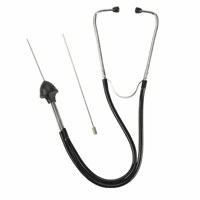
A very inexpensive mechanic's stethescope is an excellent tool if used with caution.


https://www.2carpros.com/forum/automotive_pictures/4270_mech_stethoscope_2.gif

It will pinpoint a noise in a jiffy. Outside of that I will remove the serp belt and spin pulleys by hand. Most times you can feel the roughness/resistance.
Mar 21, 2007 at 10:48 PM
Avatar
SILVERBUFFALO8
  • MEMBER
  • 2 POSTS
Ok, Dr. PepperMRJ, perhaps you could elaborate.

I've tried the mechanics stethoscope before and my novice experience is yes you can hear noises as you touch the areas around a pulley, alternator, etc, but you hear all the rotational noises as they are transmitted throughout the engine block. Even a perfectly good bearing is noisy and there is noise from other sources, ie power steering pump, alternator, etc, therefore it never seemed that useful. Obviously, I'm missing a technique. Perhaps the issue maybe that the noise you hear through the air may not be the same frequency you hear transmitted through the engine block and accessory housings. I just tried a bell shaped physicians stethoscope and that was more useful as I did not touch the engine around each accessory, but just placed the stethoscope in the vincinity of each accessory bearing.

Signed a bit deaf and dumb.
Mar 27, 2007 at 8:38 PM
Advertisement