2016 Ford Fusion 2.5L – Radiator internal cooler failure, coolant contaminated with transmission fluid – risk of engine damage?

2016 FORD FUSION
141,500 MILES • 2.5L • 4 CYL • 2WD • AUTOMATIC
Avatar
DYAMONDN
  • MEMBER
  • 19 POSTS
Hi,
I’m looking for a professional opinion before deciding whether to proceed with repairs or cut my losses.
Vehicle: 2016 Ford Fusion SE, 2.5L naturally aspirated engine (not EcoBoost).
The car was recently taken to a dealership for an overheating concern. An independent mechanic has since diagnosed the following:
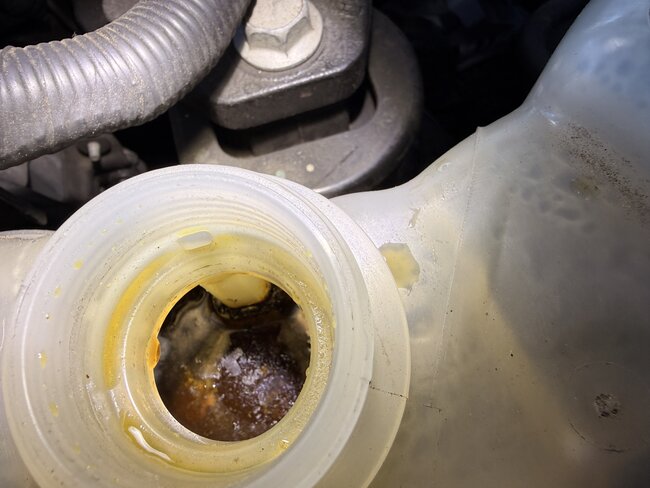
• Coolant recovery tank contaminated with transmission fluid
• Radiator has an internal transmission cooler that failed internally, allowing fluid crossover
• Transmission fluid was found to be low and dirty
• No white exhaust smoke
• No sludge found outside of the cooling system
• Vehicle drives normally at present
Recommended repairs are radiator replacement, coolant system flush, transmission service, and re-test.
The mechanic states there are currently no obvious signs of engine failure, but also cannot guarantee long-term engine health until contamination is fully resolved.
My question is:
In your experience, how often does this type of failure result in delayed engine failure after repairs are completed?
Is it reasonable to expect additional usable life from this engine if the repair is done promptly?
Are there any specific red flags I should watch for after the repair that would indicate internal engine damage?
I’m trying to make a financially responsible decision and would appreciate any professional insight.
Thank you.
Feb 20, 2026 at 11:53 AM
Advertisement
Avatar
CARADIODOC
  • CERTIFIED EXPERT
  • 34,306 POSTS
I'd be more worried about the transmission, and even that can be taken care of.

Transmission fluid is a petroleum product, and that won't hurt metal engine parts. Over a number of heat-up / cool-down cycles, that fluid will work its way into the coolant reservoir where it will float on top where it can be sucked out with a turkey baster. The bigger concern has to do with the radiator and heater hoses. Those do not like petroleum products. Transmission fluid and engine oil will rot them from the inside over time.

As for the transmission, the coolant itself won't damage parts, but it can clog the tiny passages and the valve body. This is one time where I would recommend a complete transmission flush. Normally at higher mileages like what you listed, I tend to avoid a complete flush because a failure down the road is not uncommon. Opinions vary, but my suspicion is the clutch plate material flakes off over time, and the resulting grit helps the plates remain engaged and prevents slipping. By flushing all that grit out, there's less friction to hold the clutch packs engaged.

Other people believe that grit remains lodged inside the clutch drums, and flushing breaks it free where later it grinds against the rubber lip seals causing leakage. That can also lead to slipping clutch packs.

Regardless of the cause, normally at higher mileages, I prefer to do the simpler "drain and fill" with a new filter. That only removes about half of the fluid. There's still fluid in the multiple clutch packs, passages, and the cooler. Yours is not a "normal" condition, so I would pursue the flush.

Keep the heater and radiator hoses in mind. If no more dark gunk shows up in the reservoir after a few months, the hoses likely will be fine. The rot from the inside takes some time to develop, and that's from petroleum products that have remained circulating for a long time. If your mechanic is not recommending the complete transmission flush, it could be because the new cooler in the new radiator won't have any transmission fluid in it, so there's no need to flush it. I'd defer to his recommendation for the transmission, especially if he's run into this before on this model. If shifting problems develop, that would be the time to do the complete flush. If that doesn't solve the issue, a good, used transmission from a salvage yard would be a reasonable solution for a car as new as this one, but the replacement should include flushing the transmission cooler to remove any debris that has collected in it.
Feb 20, 2026 at 5:43 PM
Avatar
DYAMONDN
  • MEMBER
  • 19 POSTS
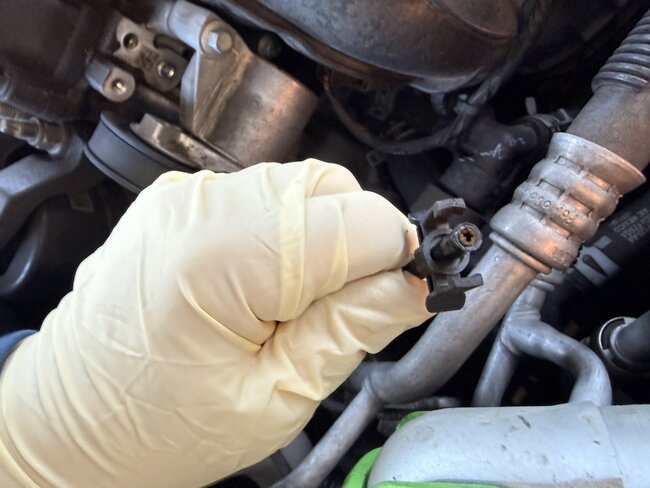
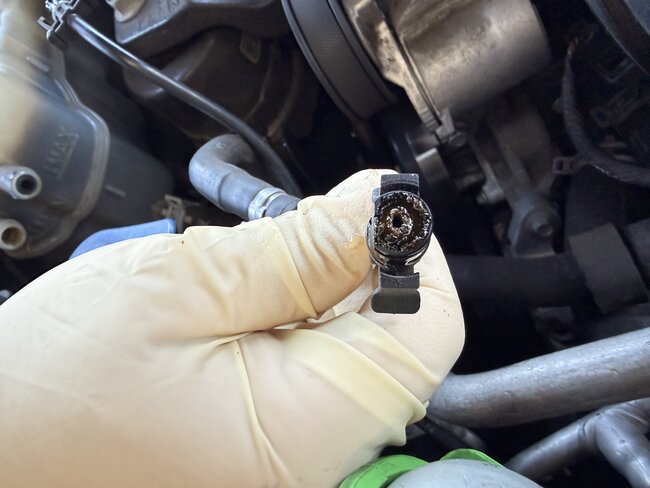
The additional photos
Feb 26, 2026 at 1:31 PM
Advertisement
Avatar
CARADIODOC
  • CERTIFIED EXPERT
  • 34,306 POSTS
What has been done to resolve this?
Feb 26, 2026 at 3:14 PM
Avatar
DYAMONDN
  • MEMBER
  • 19 POSTS
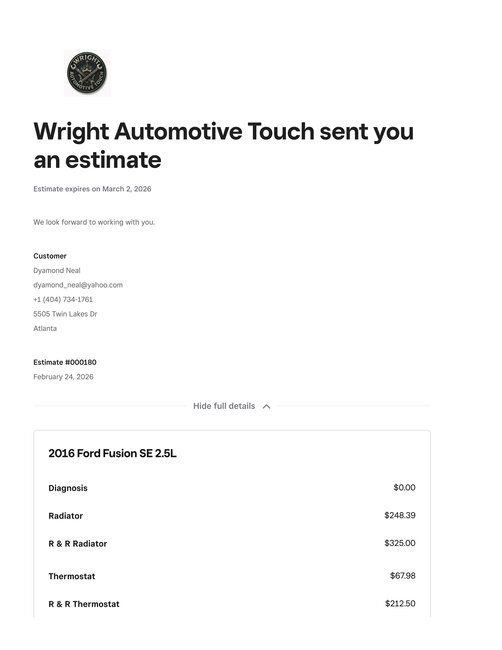
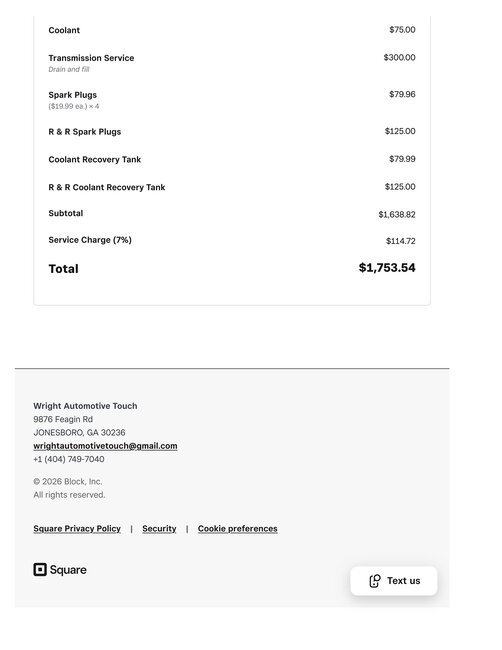
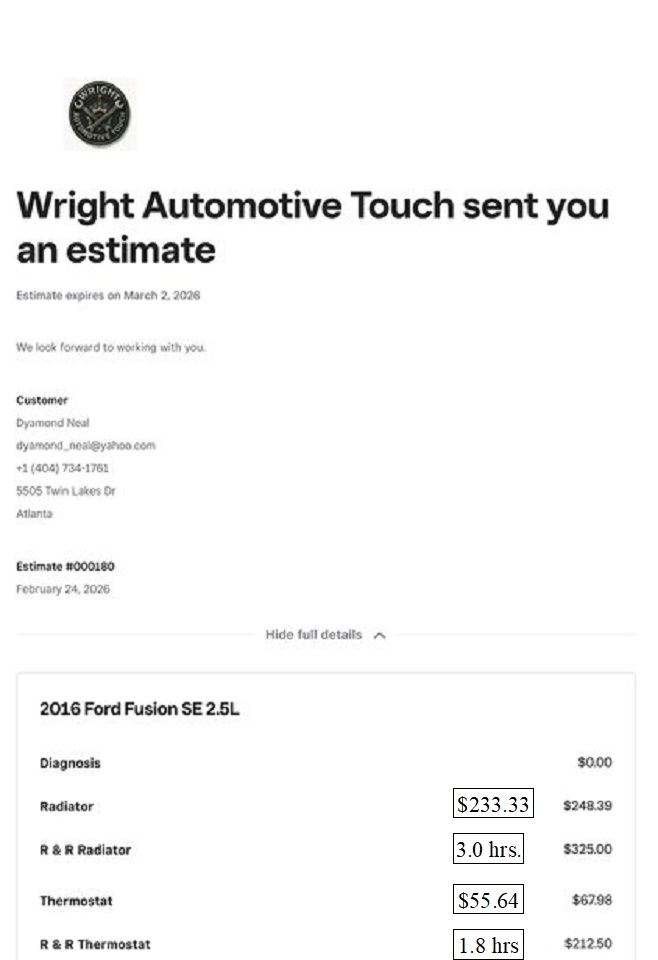
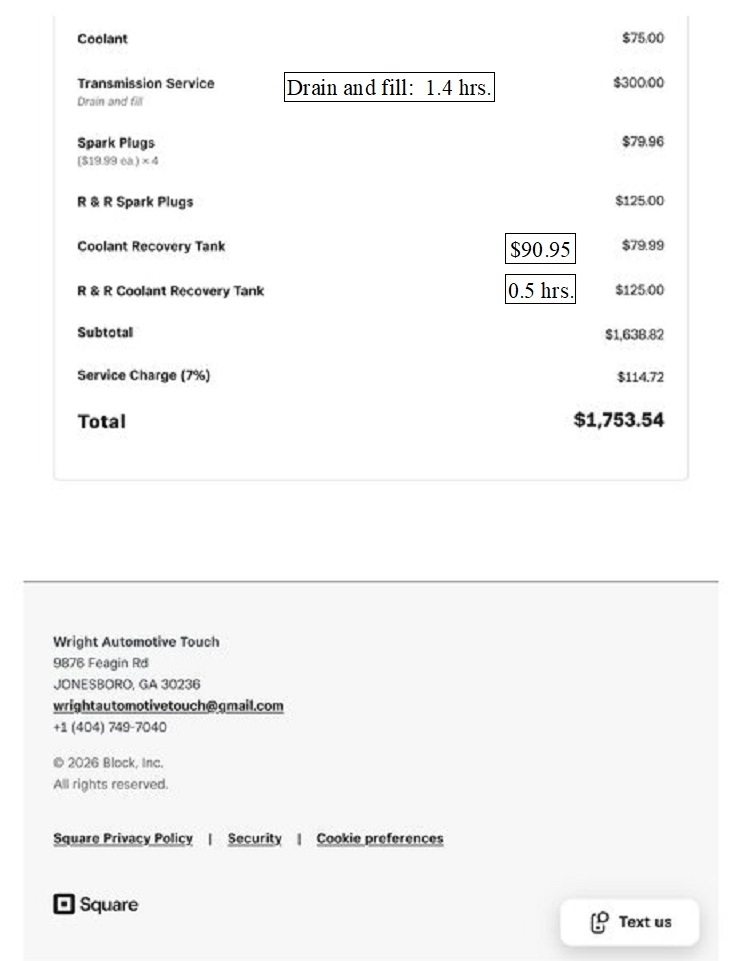
No repairs have been done yet, the car has been on ice since late November 2025 when the engine overheating light came on (It's the only time it's ever come on). This is the invoice the mechanic gave the other day.
Feb 26, 2026 at 3:54 PM
Avatar
CARADIODOC
  • CERTIFIED EXPERT
  • 34,306 POSTS
Here's what I found from our online source. It looks like your shop is in line with the flat rate guide. That guide sets normal, expected times for various services. Keep in mind the web site can be slightly outdated. Labor times won't change, but parts prices do. They use prices from the dealerships' parts departments.

Most notably, the time listed for transmission service is for the less expensive drain and fill, which is the more common service. Your job is more involved, with flushing the cooler lines and all of the transmission including areas that don't drain on their own. For flushing the cooler lines, add 0.6 hrs.

I don't see hoses mentioned here. Given the time the vehicle has had transmission fluid in the coolant, I'd be worried about them. I was surprised to see the upper and lower radiator hoses total $115.00, about double what I expected. Labor for either hose is 1.4 hrs. Labor for "all" hoses is 1.6 hrs. That suggests there's a lot of stuff that has to be disassembled just to get to them, then it's a simple matter of replacing them as it's only another 0.2 hrs. to do the second hose. Heater hoses weren't listed. Some cars use expensive molded hoses to avoid obstructions and sharp edges. When there's nothing special about a hose, most shops just use bulk hose cut off from a long roll. This is sold by the foot, and is usually pretty reasonable.
Feb 26, 2026 at 5:16 PM
Avatar
DYAMONDN
  • MEMBER
  • 19 POSTS
Thank you for explaining. I did go back and ask him about it, he agreed as well that the flush is better and agreed to that but doesn’t think that I need new hoses.
Mar 19, 2026 at 12:15 PM
Avatar
CARADIODOC
  • CERTIFIED EXPERT
  • 34,306 POSTS
Let me know when the service is completed and how it goes.
Mar 19, 2026 at 2:17 PM
Avatar
DYAMONDN
  • MEMBER
  • 19 POSTS
Hi, it took awhile to get through everything but after doing a fina test run the light came back on again and the contaminants aren’t clearing out completely even after a few flushes. I’ve been told now that it was a misdiagnosis and that the motor needs to be replaced. This job will cost $3000 ($1500 for the part and $1500 for labor). We still have the previous invoice open still right now while I make a decision on how I want to move forward and half has been paid so I’m $900 in so far. Is is worth going any further?
Apr 14, 2026 at 12:20 PM
Avatar
CARADIODOC
  • CERTIFIED EXPERT
  • 34,306 POSTS
I'm questioning the need for a new engine. The only thing that could have happened, other than the overheating, is transmission fluid got into the antifreeze. Other than the rubber hoses, transmission fluid won't hurt the engine. I'd be more worried about antifreeze in the transmission, mainly because antifreeze doesn't have the lubricating properties needed for the bushings in the transmission and the precision valves in the valve body.

Which light turned on and what are the diagnostic fault codes? If the engine is running okay and the transmission is shifting properly, I'd drive it and see what happens.
Apr 14, 2026 at 2:37 PM
Avatar
DYAMONDN
  • MEMBER
  • 19 POSTS
I wasn’t given any codes yet but I was told that the light hadn’t come since it was there throughout all of their previous testing and that the temperature keeps climbing and won’t come back down now. There was a test drive after the last flush and apparently the particles keep coming back out even after the flush and the temperature kept going up during the drive which hasn’t happened before. I was also told that the temperature part under the hood has never been changed and that it was the more than likely the cause for the problem.
Apr 14, 2026 at 3:44 PM
Avatar
CARADIODOC
  • CERTIFIED EXPERT
  • 34,306 POSTS
There's still a lot of confusion. There's multiple warning lights on the dash that mean different things. There's a lot of parts in the cooling system, so you have to be specific as to which part you're referring to.

Diagnostic fault codes are always the place to start any diagnosis. Be aware, though, they never ever say to replace a part or that one is bad. When a part is listed in a fault code, it is actually the cause of that code only about half of the time. First we have to rule out other electrical causes such as corroded or spread connector terminals, cut or bare wires, and things like that.

In the cooling system, the part you might be referring to is the thermostat. They do not wear out based on age or mileage. I would start by feeling the upper radiator hose when the engine is running too warm. If it is too hot to hold onto for very long, coolant circulation is okay and the heat is not being given up by the radiator. There's a number of things to look for. First, check for a "butterfly collection" in the air conditioning condenser's cooling fins. That will block air flow through the radiator. Dried dust or mud will do the same thing. Next, feel and look at the radiator's cooling fins, especially near the bottom. If they crumble like a rotten chocolate chip cookie, the heat will not get dispersed to the air. That happened to my '88 Grand Caravan. On any day when outside temperature was 60 degrees or higher, the engine ran warm at any speed over 60 mph. The clue was coolant temperature came down quickly to normal when the rear heater was turned on. That acted like a small radiator.

Some less common things to be aware of include the holes in the core support. That's the sheet metal plate the radiator sits in. Those holes are blocked with such things as the charcoal canister, windshield washer bottle, engine air intake tube, and things like that. If anything is removed that allows air to bypass the radiator, it can lead to overheating. You'll also find a long rubber seal, from side to side, usually under the front edge of the hood. On some models it's on the top of the core support. It seals air from flowing over the top of the radiator and bypassing the cooling tubes. Along with that is the shroud around the radiator fan blade. If that is removed, overheating is likely as the air will get pulled through the radiator, then go around and that heated air will flow through the radiator again and again.

All of these things show up at highway speed. Natural air flow is sufficient that the radiator fan is not needed. If the engine runs too hot at slower speeds and city driving, the fan becomes the better suspect. It is controlled by the Engine Computer, so it can be commanded on and off with a scanner to test its operation. Another way to test them is to unplug the coolant temperature sensor while the ignition switch is on. That removes the temperature as a variable the computer looks at, and in response, since the computer won't know actual temperature, it turns the radiator fan on as a default in case the engine is too hot. The fan will turn off a couple of seconds after the coolant temperature sensor is plug back in. The clinker here is Ford stopped using coolant temperature sensors, so this simple test may not be available on your car.

It's also smart to use the scanner to view the actual coolant temperature the Engine Computer is seeing. On your car that may be the "cylinder head temperature". If that is normal, there may be a problem with the dash gauge.

If the thermostat is not opening properly, the upper radiator hose will be cool. Besides a failed thermostat, this can be caused by a leaking cylinder head gasket. That allows combustion gas to enter the cooling system where it can pool under the closed thermostat. Heat from the engine will not make it to the thermostat and cause it to open. Thermostats have to be hit with hot liquid. Hot air won't do it. Transmission fluid in the antifreeze won't cause this. Head gaskets typically fail on their own. This can be accelerated from a failure to replace the antifreeze periodically. That used to be every two years, but today there a number of longer lasting formulations. Antifreeze is alcohol, and will always be alcohol. It's the additives in it that wear out and must be replenished. Those include anti-corrosive agents, water pump lubricant, anti-foaming agents, seal conditioners, and things like that.
Apr 15, 2026 at 11:49 AM
Avatar
DYAMONDN
  • MEMBER
  • 19 POSTS
Understood, thanks for explaining more details. I went back and asked about other testing and indicators but I’m told there weren’t any after testing and the test drives. It was only after the multiple flushes that deep internal issues were discovered so that’s why it’s needs to be replaced.
Apr 15, 2026 at 3:23 PM
Avatar
DYAMONDN
  • MEMBER
  • 19 POSTS
Sorry, forgot to mention that I am referring to the engine
Apr 15, 2026 at 3:25 PM
Avatar
CARADIODOC
  • CERTIFIED EXPERT
  • 34,306 POSTS
Rats. Since I'm not there to see and hear anything, my best suggestion, if you're "emotionally involved" with his vehicle, is to get a second opinion. There's a lot fewer incompetent shops than we're led to believe, however, we do make mistakes at times. If a second shop comes up with the same recommendations, then is the time to think about other options.

Years ago, as a tv repairman, when people needed to decide between an expensive repair or trading for a new tv, we always told people their trade-in was worth about the same regardless if they traded it while it was broken or after they paid for the repairs. They were usually better off dollar-wise putting the repair dollars toward the new tv. Same with cars. Dealers expect to find things wrong with the trade-ins. That's usually why they're being traded in. That is one of the variables when calculating what they'll give you for trade-in dollars. More expensive new cars have more profit built in, so they can offer you more for your old car.

If you don't need a replacement car, consider donating the old one to one of the charities that takes them, or to a community college with an Automotive program. At mine, we had almost-new cars donated by Chrysler after they poked and prodded them in their training classes. They didn't want those released to the public along with the defects placed in them for training. GM also donated cars, but theirs were those bought back under lemon laws. Our Fords usually came from insurance companies, commonly after receiving flood damage. Private individuals also donated a lot of cars with plenty of real-world learning experiences and problems to diagnose.
Apr 15, 2026 at 4:51 PM
Avatar
DYAMONDN
  • MEMBER
  • 19 POSTS
Thank you for the additional insight. I may get a second opinion but if not I'll just try and get a replacement car. I'm not sure what the worth is now but hopefully I'll get enough to get back what I spent on the repairs at least.
Apr 24, 2026 at 5:39 PM
Avatar
STRAILER
  • CERTIFIED EXPERT
  • 53,855 POSTS
CARADIODOC is one of our best! Use 2CarPros anytime, we are here to help. Please tell a friend.
Apr 26, 2026 at 10:21 AM