Will not start, codes p0122 and p0622

2003 DODGE INTREPID
232,977 MILES • 2.7L • 6 CYL • 2WD • AUTOMATIC
Avatar
LOREN STOVER
  • MEMBER
  • 130 POSTS
The car was running perfect a couple days ago then i got a p0122 code and installed a MAP sensor and code went away, but the car still wont start and has plenty of spark and it threw a p0622 code. I checked all ground straps and everything looked good. Don't know what to do next.
Mar 20, 2021 at 4:41 PM
Advertisement
Avatar
CARADIODOC
  • CERTIFIED EXPERT
  • 34,306 POSTS
P0122 - Throttle/Pedal Position Sensor/Switch A Circuit Low Input
P0622 - Generator Field "F" Control Circuit Malfunction

Neither code is related to the MAP sensor, and neither one will prevent the engine from running. Is it possible you disconnected the battery for the recent service? If you did, idle speed is going to be so low that you may have to hold the accelerator pedal down 1/4" for the engine to run.

First, listen for the hum of the fuel pump for one second when you turn on the ignition switch. If it isn't starting up, banging on the bottom of the gas tank often jars them enough to get them started. That failure to start may occur the next time you try to start the engine, or it may not occur again for months, but for that problem, the pump will eventually have to be replaced. When it does start up, it will rarely stop while you're driving.

What led up to these fault codes? Did the Check Engine light turn on while you were driving? What made the code erase? That doesn't happen on its own.
Mar 20, 2021 at 5:05 PM
Avatar
LOREN STOVER
  • MEMBER
  • 130 POSTS
It was a MAP sensor code and I erased it myself after I installed the MAP sensor so the throttle position sensor code was incorrect. now regarding the 622 code I'm having problems with that but I turn the key on and off three times to get that code and it did not come up on my scanner.
Mar 20, 2021 at 9:39 PM
Advertisement
Avatar
LOREN STOVER
  • MEMBER
  • 130 POSTS
Also the car shut off before the check engine light came on for the MAP sensor and because that happened I went ahead and check the on board diagnostics by turning the key on and off three times and the same code came up there plus the P0622 code.
Mar 20, 2021 at 9:44 PM
Avatar
LOREN STOVER
  • MEMBER
  • 130 POSTS
Holding the gas down just a tad bit got it started but now it's running rough at idle number 1 through number 4 cylinders are not firing 5 and 6 are. so I did the switch test between number 3 and number 5 and number 3. Still did not fire. so could number 1 through number 4 injectors be clogged or not opening?
Mar 21, 2021 at 12:34 PM
Avatar
CARADIODOC
  • CERTIFIED EXPERT
  • 34,306 POSTS
I'm going to assume the battery was recently disconnected. That results in a loss of memory in the Engine Computer. Most of the sensor and fuel trim data will be rebuilt as soon as you start driving, without you even noticing, except for "minimum throttle". Until that is relearned, the engine may not start or run unless you hold the accelerator pedal down about 1/4". You won't get the normal idle flare-up to 1500 rpm at start-up, and it will tend to stall at stop signs. Once any other problems are solved, to meet the conditions for the relearn to take place, drive at highway speed with the engine warmed up, then coast for at least seven seconds without touching the pedals.

The voltage regulator is inside the Engine Computer. That circuitry is in series with the field coil in the alternator. The regulator controls the amount of current flow through the field winding. That controls the strength of the electromagnetic field, and thereby, the amount of alternator output current and voltage. At maximum output, field current is still less than three amps, but it would take a pretty hefty switching transistor to control that. Instead, they use "pulse-width modulation" where they switch the three amps fully-on, then fully off, about 400 times per second. Both modes result in 0 watts which translates into almost no heat build-up, and the ability to use a small, inexpensive switching transistor.. Normally, when there's a defect with the voltage regulator's circuit, to include the wiring to the alternator, the typical fault code is "Field current not switching properly". Code 622 is different. As with all other codes, they never point to a part that must be replaced. This is a perfect example of where the code just tells us the circuit that needs further diagnosis.

The place to start with this problem is to measure the battery voltage, first with the engine off, then with it running. With the engine off, battery voltage must be 12.6 volts. If it's near 12.2 volts, it's okay but fully discharged. Charge it at a slow rate for a couple of hours, then check it again.

Next, measure the battery voltage with the engine running. It must be between 13.75 and 14.75 volts. If that is okay, that only means it is okay to continue with the rest of the system test, but that requires a professional load tester. The people at any battery store can run that test for you. Many do it for free because it only takes about a minute.
This article may be of more help:

https://www.2carpros.com/articles/how-to-check-a-car-alternator

also check out this video:

https://youtu.be/Z-p4dMJUpUw

I don't recall ever running into code 622, so I'm interested to know what the charging system test shows up. I have a suspicion it might find excessive "ripple voltage" which would point to one failed diode of the six in the alternator. That will also reduce the maximum current it can develop to exactly one-third of its rated output current. The voltage regulator may have a hard time adjusting system voltage when it's trying to follow the ripple voltage, and that might be the cause of code 622.

How did you determine only two cylinders are firing? Some engines use coil packs where each ignition coil fires two cylinders at the same time. A failure of one of those results in two dead cylinders. A failure of two coils is rare because the assembly gets replaced as soon as the first failure occurs. Your engine uses individual ignition coils, so any failure affects just one cylinder. To have multiple failures at the same time would suggest something else is responsible. The first thing that comes to mind is a corroded splice in the wiring harness. A common 12-volt source feeds the injectors and the ignition coils, among other things including the alternator's field coil. A corroded splice in the right spot could would affect just the items after that point. Low system voltage could also result in multiple cylinder misfires, but it's more likely the symptom would simply be a failure of the starter to crank the engine.

That common 12-volt source is switched on through the automatic shutdown, (ASD) relay. Failures of those are not at all common, but to rule out arced or pitted contacts, you might want to switch it with one of the others like it. That circuit also feeds the oxygen sensor heaters. Wiring harnesses for those have been known to fall down onto hot exhaust parts on some car models. If that heater wire melts and shorts to part of the exhaust system, a dead short will cause a fuse to blow, then you'll have a crank / no-start condition. If it isn't a solid dead short yet, it could result in lowering circuit voltage enough that some injectors and / or some ignition coils don't fire.

Check out as much of this as you can, then let me know what you find. If we have to pursue this further, do you have access to a scanner?
Mar 21, 2021 at 7:26 PM
Avatar
LOREN STOVER
  • MEMBER
  • 130 POSTS
I unplugged each coil one at a time and it only shuts off on me when I disconnect number 5 or number 6 cylinder. number one through number for has no change. I even lifted coils off each spark plug and I heard no spark whatsoever unless I'm doing something wrong. I am blown away how this six cylinder is only running on 2 cylinders and if I put it in drive or reverse it will try to shut off and has no power so I can't drive it. but as for the charging system with the car not running the battery shows 12.8 volts and with it running it shows it's charging at 13.9 volts. also the starter motor will turn over very slowly to start the car or it will click. When I started working on this car I installed the wiring harness myself so maybe the starter motor could have a bad ground or something. the car ran perfect for a couple of days then suddenly shut off on me. As for the scanner; I have an Alltel scanner Bluetooth device that shows live data, but it's not a very good or expensive one.
Mar 22, 2021 at 10:53 AM
Avatar
CARADIODOC
  • CERTIFIED EXPERT
  • 34,306 POSTS
Dandy video. It has to be running on more than two cylinders. As a point of interest, we were learning about automatic idle speed motors at a Chrysler school I attended back in the early '90s. The instructor was showing us how much control the Engine Computer had over idle speed. Part of that demonstration was performed on an 8-cylinder Jeep engine. He unplugged a fuel injector, idle speed dropped, the computer saw that, and increased idle speed back to the desired speed. Each time he unplugged another injector, the computer brought the engine back up to speed. Eventually he had seven injectors unplugged. Obviously the engine was running very poorly, but it was still at the correct idle speed, and the AIS motor was not yet at the end of its travel.

The computer is also going to detect the misfires and set diagnostic fault codes indicating which ones are not firing. You can feel the misfires because crankshaft rotational speed slows down when a misfire occurs. That is the same way the computer knows which cylinder is misfiring. It knows where the crankshaft is when it slows down momentarily.

There's two things that can block a misfire code from being set. One is when there are multiple cylinders misfiring at the same time, the computer may have trouble figuring out which ones are affected. You're more likely then to get code P0300, multiple cylinder misfire. We have to look at what all of those cylinders have in common. One thing could be low fuel pressure. Most people think of the computer first, but in fact, it has six individual ignition coil driver circuits. Computer failures are not at all common, and to have even one driver circuit fail is almost unheard of, let alone multiples at the same time.

The second thing is for any fault code to set, there is always a long list of conditions that must be met, and one of those conditions is certain other codes can't already be set. The best example of this is when the engine has been off for at least six hours, the computer knows the coolant temperature sensor and the intake air temperature sensor had better be reading the same temperature. When they are not reading the same when the engine is started, the computer has ways of figuring out which one is wrong or if it just needs to relearn or update their values. No two sensors are ever exactly alike, so to prevent needing to make all kinds of adjustments when a sensor is replaced, the computer is designed to learn the personality of a new sensor. There are other "hard" defects that will result in a code being set, but in this example, if a code is already set for the intake air temperature sensor, the computer knows it can't rely on its readings to use for comparing to the coolant temperature sensor. Other than those hard defects, like cut wires, the computer will suspend tests related to sensor calibration, meaning signal voltages it expects to see during normal operation. It still has learned data stored for the CTS, so it still knows coolant temperature, as long as you don't replace that sensor. If you do, it might see coolant temperature as being slightly higher or lower than it really is, but that won't cause a fault code to set.

A similar story can be told for code P0622. Technically 13.9 volts is in the acceptable range, but it is still on the low side. We'd like to se it closer to 14.5 volts. We still don't know the cause of code 622, but that could be on the list of codes that can't already be set when running tests for misfires. It's possible the low or unstable charging voltage could mean the ignition coils are developing weak spark, and as far as the computer is concerned, multiple cylinder misfires are to be expected, so it refuses to set misfire codes because those could be misleading or confusing and make diagnosis take longer.

The first thing I would look at is fuel pressure with the engine running. Normal is:

Fuel System Pressure .................... 400 kpa ± 34 kpa (58 psi ± 5 psi)

The next step would be to use the scanner, under the "Actuator" test menu, to fire each ignition coil one at a time. With this type of coil, you'll have to insert a screwdriver to reach the terminal, then watch if spark jumps from the screwdriver to the engine. Without that extension, spark voltage is likely to not be high enough to jump that far. This test will verify each coil is okay, along with the individual driver circuits in the computer.

Next would be to look at the signals coming from the crankshaft position sensor and the camshaft position sensor. Unlike most other sensors where the acceptable range of signal voltage is from 0.5 to 4.5 volts, these two develop signals that switch from "low" to "high", typically from close to 0 volts to close to 5 volts. The exact voltage is irrelevant. These are used for timing, so it's only the transition points that are critical. By the time the diagnosis has gotten this far, we're looking for something unusual or uncommon. Most newer scanners can graph these signals, but they occur too fast to watch. Instead, there is usually a "record" feature that lets us record a few seconds of sensor data, then we can play it back slowly later to see what happened. As an example, crankshaft position sensors on some older engines needed to have their air gaps set very precisely. That was very easy to do if procedures were followed, but I have been known to be arrogant enough to not need those procedures. If the air gap is wrong, it can result in intermittent stalling, or it could be just on the edge of reading or not reading the notches in the flex plate that the sensor uses to generate its signal pulses. That could result in the computer not seeing when to fire some injectors or ignition coils.

Your crankshaft position sensor and camshaft position sensor have mounting flanges that eliminate the need for setting the air gap manually, but who is to say someone didn't replace one in the past and left the mounting bolt loose? That would be the type of unusual thing we would be looking for.
Mar 22, 2021 at 5:46 PM

Avatar
LOREN STOVER
  • MEMBER
  • 130 POSTS
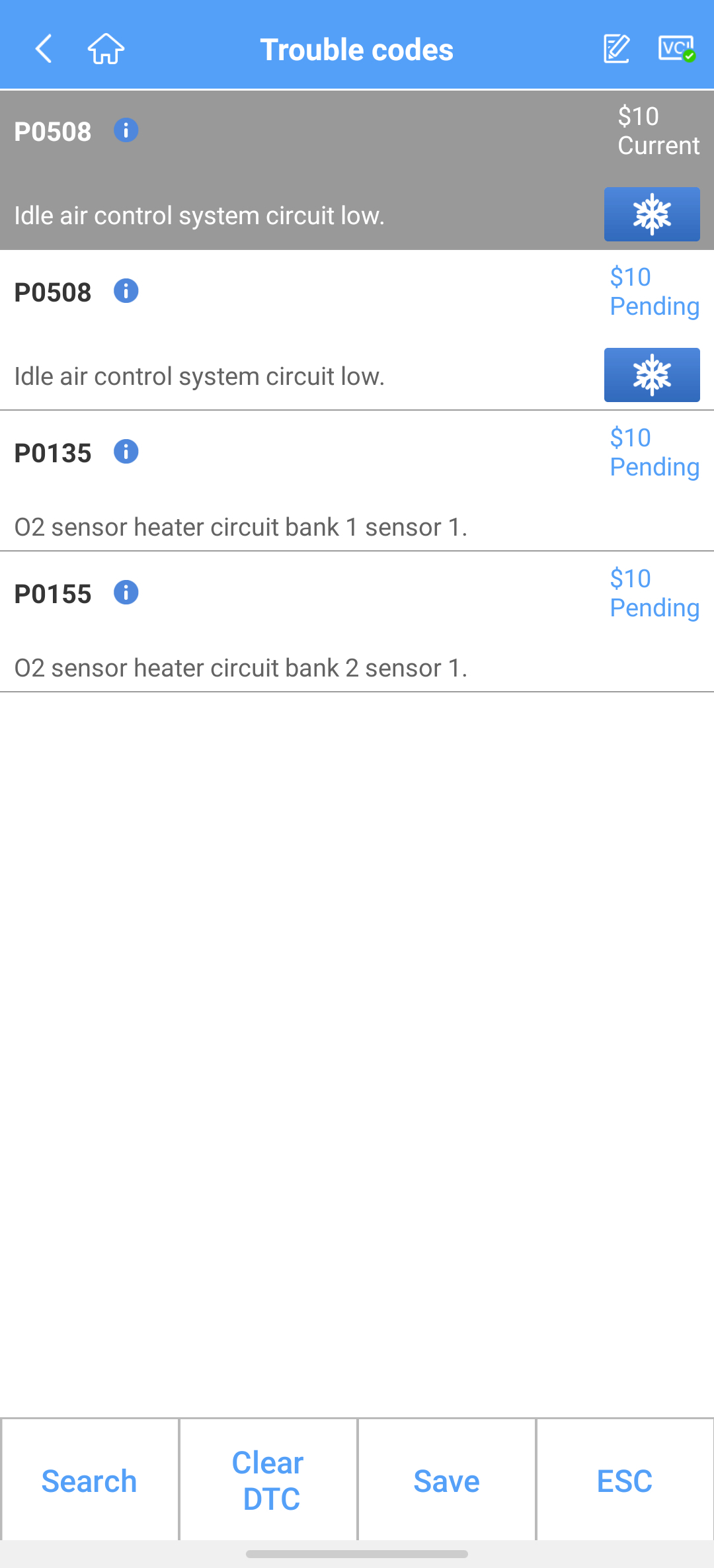
This is what I have today: I started the car and I checked for spark and it must be so weak that I can't see it, but when I shut the car off. Turned the key back on I got some trouble codes and they will be in the description I sent you. I also fix a ground wire to the starter motor and now it turns over very quickly. I'm also no longer getting the p0622 code. also after that code came up that's current I can no longer start the car. it tries to start up for a couple seconds then it will shut off.
Mar 23, 2021 at 12:25 PM
Avatar
LOREN STOVER
  • MEMBER
  • 130 POSTS
For some reason when I try to erase. P0508 code it doesn't go away it will not erase. I'm stumped about that too.
Mar 23, 2021 at 1:09 PM
Avatar
CARADIODOC
  • CERTIFIED EXPERT
  • 34,306 POSTS
I wouldn't worry about any of those codes. We'll take care of those later.

Only running for two seconds is what happens when it's in theft mode. Try locking and unlocking a front door with the key to reset the anti-theft system, then try starting the engine. Remember to hold the accelerator pedal down 1/4".
Mar 23, 2021 at 4:09 PM
Avatar
LOREN STOVER
  • MEMBER
  • 130 POSTS
I did as you said and it absolutely will not start. It fires once in a while but that's it.
Mar 28, 2021 at 4:56 PM
Avatar
CARADIODOC
  • CERTIFIED EXPERT
  • 34,306 POSTS
There's two ways to start this diagnosis. The best way is to use a scanner to view the states of the crankshaft position sensor and the camshaft position sensor. My Chrysler DRB3 shows them as "No" or "Present" during cranking. If one is listed as "No", the circuit for that sensor is what needs further diagnosis.

A less-effective method is to monitor the voltage coming from the automatic shutdown, (ASD) relay. That will be the wire that is the same color at every injector and every ignition coil. On your car that's a dark green / light green wire. Test lights are more accurate than digital voltmeters for this test because voltmeters don't react fast enough. You'll need to poke the probe through the rubber seal alongside the wire. You should see the test light turn on full brightness for one second when you turn on the ignition switch, then it will turn off. That proves the ASD relay is okay and the Engine Computer has control of it. What's important is the light should turn on again during engine rotation, (cranking or running). If it does not, the signal from one of those two sensors is not showing up at the computer.

When the ASD relay doesn't turn on during cranking, there won't be any injector pulses and the ignition coils won't fire. The fuel pump still ran for that initial one second, and since no fuel is leaving the injectors, fuel pressure will remain close to normal. Failure of the ASD relay to turn on is responsible for perhaps 95 percent of crank / no-starts. When it does turn on, those no-starts are caused by a problem in the ignition system around two percent of the time, and the fuel supply system about three percent.

Almost all fuel supply problems are caused by a fuel pump that doesn't start up when you're cranking the engine. You can verify that by not hearing it's hum for that one second when you turn on the ignition switch. Dead fuel pumps are caused by worn brushes in the motor. They can often be started by banging on the bottom of the gas tank. Once they're running, they will continue to do so until the engine is stopped. They could fail to start again the next time, or that may not occur again for months. Chrysler fuel pumps rarely stop running while you're driving.

Failure of the ignition system itself is pretty much limited to a broken wire feeding the ignition coils. All six coils and all six injectors are protected by the same fuse, so if that fuse is blown, you won't have 12 volts to any of those places when checking ASD relay operation with the test light. There's six individual driver circuits in the Engine Computer for the six ignition coils, and six individual driver circuits for the six injectors. Failure of just any one of them is not common, but that would result in a single-cylinder misfire. Failure of multiples of any of those things at the same time is even less likely. The only thing that will affect all 12 driver circuits is the loss of one of the sensor signals, and the ASD relay isn't turning on during cranking.
Mar 28, 2021 at 5:37 PM
Avatar
LOREN STOVER
  • MEMBER
  • 130 POSTS
Everything checks out and the ASD relay is working. the fuel pump is also working and it's brand new. I put it in the tank almost a year ago since the car has been broke down.
Mar 29, 2021 at 8:55 AM
Avatar
LOREN STOVER
  • MEMBER
  • 130 POSTS
I can also smell gas while cranking the engine over.
Mar 29, 2021 at 10:23 AM
Avatar
LOREN STOVER
  • MEMBER
  • 130 POSTS
My timing advance for cylinder 1 is 0 degrees also 0 degrees while i'm turning the motor over for about 5 or 10 seconds, then changes. Is that normal?
Mar 29, 2021 at 6:40 PM
Avatar
CARADIODOC
  • CERTIFIED EXPERT
  • 34,306 POSTS
I've never watched timing advance during cranking, so I don't know what normal is. Timing advance can be confusing anyway. While running, you can't get a signal pulse from the camshaft position sensor, then have the Engine Computer fire an ignition coil ten degrees before that. It's too late at that point. Instead, what they do is start out with a high amount of timing advance built in mechanically, meaning the signal pulses show up well ahead of top dead center. The computer calculates a desired amount of delay, then it fires the ignition coil. For example, a typical amount of advance to start with is 35 degrees. If the computer waits for 30 degrees, then fires the coil, you'll have five degrees of timing advance. Where the confusion comes in has to do with what the scanner is showing for timing advance. Is it showing the 30-degree delay or is it showing the five degrees actual timing advance? In fact, we don't need to know that it starts out with 35 degrees, and it's not important to know how many degrees of delay it has calculated. It's the five degrees we want to know.

I suspect you're seeing 0 degrees timing advance because less advance makes for an easier engine to crank and get started. It will jump up to around perhaps ten to 15 degrees when it's running.
Mar 29, 2021 at 7:01 PM
Avatar
LOREN STOVER
  • MEMBER
  • 130 POSTS
It usually sets around 6 degrees when i have the scanner hooked up. it never showed 0 degrees before. Should i check crank and cam sensors and if so how do i do that procedure?
Mar 29, 2021 at 11:21 PM
Avatar
CARADIODOC
  • CERTIFIED EXPERT
  • 34,306 POSTS
You need a scanner for that. It will have some provision for indicating whether or not the signals are showing up at the Engine Computer.

The earliest engines starting in the late '80s required signals from both sensors for the engine to start and run. If either signal cut out while driving, the engine would stall. Beginning somewhere around the early 2000s, both signals were still needed for the engine to start, but once it was running, if one signal was lost, it would remain running on just the one sensor. There was a back-up strategy to time the injector pulses and ignition coils on the same sensor.

Many of the more-expensive scanners also have graphing capabilities. You select the signals you're interested in, then you can see what they look like on the chart. Cam and crank sensors develop a square wave that switches from near 0.0 volts to near 5.0 volts. The actual voltage is not important, but there is a transition period that will confuse the computer if the voltage falls within that mid range. For example, does the computer interpret 4.0 volts or 1.7 volts as "high" or "low"? If the air gap is too big, or the sensor's internal magnet is weak, it may be unable to pull the signal down to 0 volts. Suppose the computer sees anything lower than 1.00 volt as "0.0" volts. That's perfectly normal, until the signal shows up as 1.01 volt. The next time it might show up as 0.99 volts. These are right on the edge of being seen as acceptable or lost.

Instead of a weak signal from the sensor, there could be corrosion between two mating terminals in a connector. That corrosion adds resistance which reduces the signal voltage seen by the computer. Moisture, vibration, and heat all affect how much that resistance affects the strength of the signal, so those are all potential factors in intermittent loss of that signal. We would see that on the graph as the signal voltage not reaching close enough to 0.0 and 5.0 volts.
Mar 30, 2021 at 4:59 PM
Avatar
LOREN STOVER
  • MEMBER
  • 130 POSTS
I changed the CPS at least and that didn't work, but i still have a strong gas smell when i crank the motor over and it fires like 1 or 2 times every 10 seconds.
Apr 2, 2021 at 4:18 PM
Avatar
CARADIODOC
  • CERTIFIED EXPERT
  • 34,306 POSTS
Can you tell if that gas smell is coming from the tail pipe, or if gas is leaking on top of the engine? There were two problems in the late '90s with gas leaks. One had to do with gluing on reinforcement strips on the sides of the fuel rails to prevent cracking, and the other had to do with injector o-rings that would shrink in cold weather and leak. The o-rings usually leaked slow enough for the gas to evaporate before you'd see wet spots, but you would still smell it. There was no 2.7L yet at that time, and I would suspect those problems were addressed in newer cars like yours. This was handled before I left the dealership, which was in late '99. If the injector o-rings are leaking, fuel pressure will bleed down when the engine is off, then you'll have an unusually-long crank time to restart the engine.
Apr 2, 2021 at 7:11 PM
Avatar
LOREN STOVER
  • MEMBER
  • 130 POSTS
I've replaced the fuel rail and the O-rings there's no more gas smell, but now none of the coils are firing and from my experience I would not think all the coils would fail at once. so it has to be something keeping it from firing. I've check the crank sensor by looking at the RPM gauge I was told you could do that and RPM gauge is moving.
Apr 3, 2021 at 4:52 PM
Avatar
LOREN STOVER
  • MEMBER
  • 130 POSTS
I checked for ignition power and signal on the ignition coils and I got no power no signal. so I checked the coil injection fuse in the power block and it has no power. I do not know what to check next.
Apr 3, 2021 at 7:38 PM
Avatar
LOREN STOVER
  • MEMBER
  • 130 POSTS
I fixed the power to the coil and injector fuse and I still have no power to the coils.
Apr 4, 2021 at 2:16 PM
Avatar
CARADIODOC
  • CERTIFIED EXPERT
  • 34,306 POSTS
Don't forget, there will only be 12 volts to the injectors and ignition coils for one second when you turn on the ignition switch. That 12 volts comes back during engine rotation, (cranking or running). That means you have to check it while cranking. That is done for safety on all fuel-injected engines. If a fuel line is ruptured in a crash, there will be no pressure. Without pressure, no fuel will spray from the injectors. The engine will stall, then there will no longer be signal pulses coming from the sensors. In response, the computer turns off the ASD relay. That removes the 12 volts to the fuel pump, so it stops dumping raw gas on the ground.
Apr 4, 2021 at 2:59 PM
Avatar
LOREN STOVER
  • MEMBER
  • 130 POSTS
I have my multimeter hooked up to the coils and while cranking the motor over it show 0.38 volts and that is on all of them not just one and I set my multimeter dial on 20 volt.
Apr 4, 2021 at 4:58 PM
Avatar
LOREN STOVER
  • MEMBER
  • 130 POSTS
Maybe i am doing the test wrong. I need to know how to test for 12 volts at the connector and how to test signal at the connector for the coils. I'm not sure how to connect the multimeter when testing.
Apr 5, 2021 at 7:50 AM
Avatar
CARADIODOC
  • CERTIFIED EXPERT
  • 34,306 POSTS
Meter's ground wire to the battery negative post or a paint-free point on the engine or body. Positive probe to the wire that is the same color at every injector or ignition coil.

Digital voltmeters usually don't respond fast enough to catch that first one-second pulse when you turn on the ignition switch. That's where test lights are better. If the 12 volts comes back during cranking, the voltmeter will see that just fine, then that one-second pulse is irrelevant. No need to use the test light at that point. It's only when you don't have 12 volts during cranking that the initial one-second pulse becomes valuable. Knowing if it is there will prove the ASD relay is switching on and the fuse feeding it is okay. Actually the ASD relay circuit is very trouble-free. If the fuse is blown, you'll have a crank / no-start condition. That is almost always caused by a wiring harness that fell down onto hot exhaust parts and a wire melted and is shorted to the exhaust pipe. The wire that feeds the oxygen sensor heaters is the same circuit that feeds the injectors and ignition coils.

When the ASD relay turns on for that initial one second but not during cranking, that is always due to the crankshaft or camshaft position sensor's signal is missing. About half of the time that's due to a failed sensor and about half of the time it's due to a cut wire or corroded connector terminal related to one of those sensors.

One problem I run into quite often is the meter's test probe doesn't make good contact with a terminal when I back-probe a connector. When you do that at an injector, for example, if you see 12 volts for that first one second, or if you see it during cranking, you obviously know the probe is touching the terminal. If I were to see 0.38 volts, that had to come from somewhere, and it wasn't through the ASD relay. I would call that "0.00 volts", and attribute the 0.38 volts to stray magnetic interference. You'll even see a very low reading like that when the meter's probes aren't even connected to anything, but are just laying near the engine. For a circuit of this type, you either have 12 volts or you don't have 12 volts. Assuming the battery is not near dead, anything less than battery voltage is not acceptable. I said it that way because the battery's voltage is going to be drawn down to less than 12 volts during cranking. If it gets pulled down to, say, . . . 10.8 volts, you can't expect to see anything higher than that at any other place in the vehicle, at that time. This is another reason I like the test light better for this type of problem. It's not the exact voltage we care about. It's do you have something or nothing?

Don't worry about testing the control side of the injectors or ignition coils. Those are pulsed on and off by the Engine Computer in time with the signal pulses from the cam and crank sensor signals. It's true those circuits won't be switching on and off if a signal is missing, but the ASD relay won't be getting turned on either. You'll see 0 volts on both sides of every injector and coil. To say that a different way, if the 12 volts is showing up at the coils and injectors during cranking, we know the sensor signals are there, then it's up to the computer to switch the coils and injectors on and off.

You can't measure the switching side with a digital voltmeter. At times you'll have 12 volts there coming through that coil or injector from the ASD relay, and at times the computer's switching circuit, (driver circuit), will pull it down to near 0 volts. Digital meters take a reading, analyze it, then display it while they take the next reading. Some times it will see 0 volts and sometimes it will see 12 volts. Old analog meters with a pointer would average that out, but digital meters show exactly what they see at each reading they take. The display will be bouncing around and you won't be able to make sense out of it.
Apr 5, 2021 at 8:10 PM
Avatar
LOREN STOVER
  • MEMBER
  • 130 POSTS
I check all the same color wires which are the green and light green wires with the test light and it still didn't light up but I still have power to the injector coil fuse in the PDC. I also bought new crank and cam sensors and I was able to test the crank sensor by turning a crank with a breaker bar with the key on and the voltage fluctuated, so I took the new crank sensor back to the parts store. Can a bad ground anywhere in the engine compartment cause the injectors or coils to not work?
Apr 6, 2021 at 4:57 AM
Avatar
LOREN STOVER
  • MEMBER
  • 130 POSTS
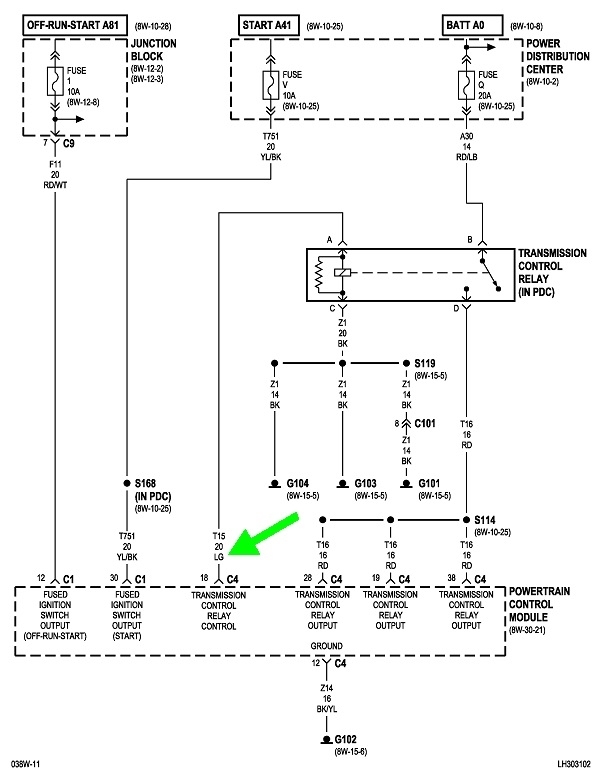
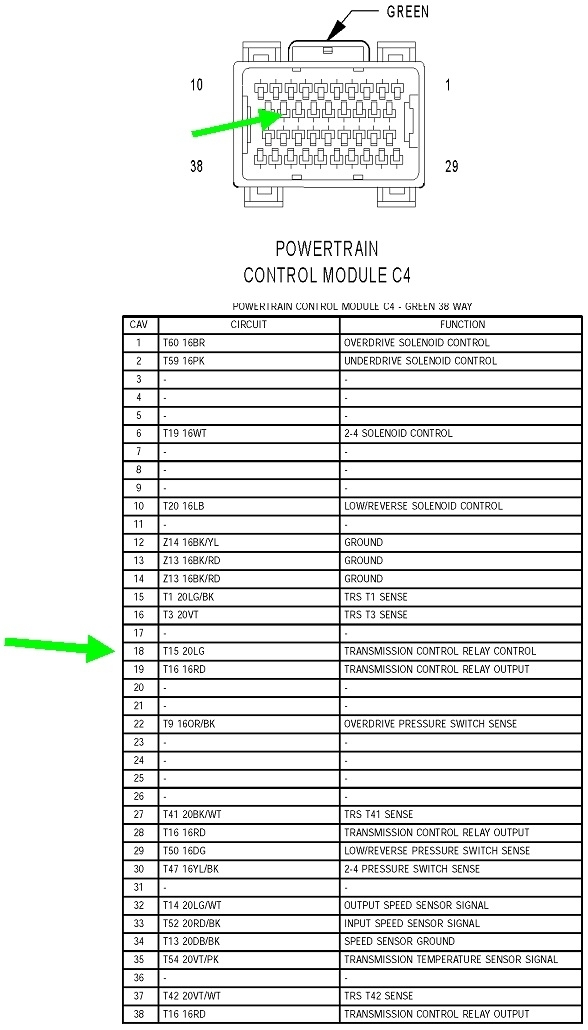
I took the power distribution center apart where all the relays and fuses are and I found a light green wire disconnected. so I hooked my light tester to it and turn the ignition on and it came on for 1 or 2 seconds then shut off. I found this wire over by the transmission shutdown relay. Could that maybe be the problem and if so where do i hook it back up at? Thank you for your help with this matter.
Apr 6, 2021 at 6:47 AM
Avatar
LOREN STOVER
  • MEMBER
  • 130 POSTS
I actually figured it out and hook the wire back where it goes, but there's still no power to the coils.
Apr 6, 2021 at 10:57 AM
Avatar
LOREN STOVER
  • MEMBER
  • 130 POSTS
I have power to the coils now there's a corroded pin inside of a connector. I also have power on the other wire that is supposed to be grounded from the computer. I just can't tell if it's pulsating or not on my test light.
Apr 6, 2021 at 4:18 PM
Avatar
CARADIODOC
  • CERTIFIED EXPERT
  • 34,306 POSTS
Ignition coils and injectors are supplied with 12 volts on one side through a common 12-volt feed from the ASD relay. Once that is there, the other side of each of them goes to ground through the driver circuits in the Engine Computer. Failure of even one of those driver circuits is extremely uncommon. Failure of two is unheard of. You have 12 of them.

So while there is no ground wire on the engine for the coils and injectors, there are four ground wires on the Engine Computer. One is called the "power" ground. It is for things that draw a lot of current, to include injectors and ignition cols, and it's for things that pulse their current on and off. Anytime you have current flow, if there is any resistance at all, you'll have a small drop in voltage across it. Those pulses or drops in voltage are completely irrelevant to those high-current circuits. They occur all over the vehicle and have been around since the first days of cars.

The second ground wire is called the "sensor" ground, or it may be called the "sensor return". It is for light-current stuff, like sensors. Some of the sensors, the MAP sensor in particular, are very sensitive, and .01 volts means a lot to the Engine Computer. Current in this circuit is very low, so small amounts of resistance don't have any real effect. Where the problem could arise is if the sensors used the same ground as the power ground. That power ground is going to see tiny pulses of increased voltage each time current flows through a coil, an injector, or a solenoid. That tiny voltage would cause corresponding pulses of increased voltage in the sensor signals. That can't be allowed to happen, That's why the sensors use their own dedicated ground circuit.

Each of these two ground wires has a duplicate, just in case one develops too much corrosion and resistance. That's why Chrysler Engine Computers have two ground wires.
Apr 6, 2021 at 6:35 PM
Avatar
LOREN STOVER
  • MEMBER
  • 130 POSTS
I tested each coil connector unplugged with a multimeter and the voltage fluctuated between 0 and 12 volts around 7.9 volts. would that be a correct reading? Next I tested or rather I tried to test the coils with an inline spark tester and got nothing and I don't understand how all the coils have no spark at the same time. is it normal for them to go out at the same time like that?
Apr 6, 2021 at 7:00 PM
Avatar
CARADIODOC
  • CERTIFIED EXPERT
  • 34,306 POSTS
I did find the light green wire for the transmission relay. That relay is most likely turned on at the same two times as the ASD relay. They often do that with a separate relay for the fuel pump too.
Apr 6, 2021 at 7:12 PM
Avatar
LOREN STOVER
  • MEMBER
  • 130 POSTS
I replaced the wire and got power but can a bad alternator cause a no spark condition? I'm not sure where to go next. I checked for spark with an inline spark tester and got nothing. I ordered new ignition coils cause it needed them anyways. Any other ideas? Thank you
Apr 8, 2021 at 9:51 AM
Avatar
LOREN STOVER
  • MEMBER
  • 130 POSTS
I asked the alternator question because of the p0622 code i got a while back when i started having problems.
Apr 8, 2021 at 9:58 AM
Avatar
CARADIODOC
  • CERTIFIED EXPERT
  • 34,306 POSTS
The alternator's field winding also gets 12 volts from the ASD relay. The only way it could cause no spark is if someone assembled it wrong and the 12-volt feed terminal is grounded. That would blow the fuse feeding the ASD relay, then you wouldn't have 12 volts at the injectors or ignition coils for the first one second when you turn on the ignition switch.

We need to know if the signals are showing up from the crankshaft position sensor and the camshaft position sensor.
Apr 8, 2021 at 3:24 PM
Avatar
LOREN STOVER
  • MEMBER
  • 130 POSTS
I unhooked the crank sensor and left it plugged in and ran bar stock ahead of it and got voltage fluctuation just testing without turning the crank and my RPM tachometer is moving when i crank the engine. The coils are getting signal from the PCM and power on all the same color wires. Oh, and i will test the cam sensor the same way if that's efficient and let you know. Anyways I will have my coils soon and I will keep in touch about those too.
Apr 8, 2021 at 5:38 PM
Avatar
LOREN STOVER
  • MEMBER
  • 130 POSTS
I'm getting signal from the computer for the cam sensor and power for the cam sensor, but what I don't know is if I'm checking for signal the wrong way on the coils. I put the new coils in today and it didn't change a thing and I don't know if the coils are firing I really need instructions on an easy way to check them for spark. I've been at this all day and feel like I haven't gotten anywhere. thank you for your help.
Apr 9, 2021 at 1:34 PM
Avatar
LOREN STOVER
  • MEMBER
  • 130 POSTS
I sprayed ether inside the intake and it didn't even try to start. signal ground and power good on the cam and crank sensors. so all I can think of is maybe the drivers inside the computer are bad that ground the coils because the timing chain on this car is brand new. it was changed before I bought it.
Apr 9, 2021 at 1:48 PM