p1155 fault code

2002 TOYOTA SIENNA
155,000 MILES • 6 CYL • FWD • AUTOMATIC
Avatar
KMF
  • MEMBER
  • 1 POST
where is af relay 02 sienna
Feb 15, 2011 at 10:30 PM
Advertisement
Avatar
TOYODAMASTERTECH
  • MEMBER
  • 25 POSTS
A p1155 (A/F Sensor Heater Circuit Malfunction
(Bank 2 Sensor 1)....generally is repaired by replacing the a/f sensor...It is the sensor that is located closest to the right head in the exhaust system (the head that is closest to the firewall..

THE A/F real is behind right side of dash, at the ECU
Feb 16, 2011 at 2:12 AM
Avatar
BILLJ7
  • MEMBER
  • 1 POST
Where is the sensor located, a picture would be appreciated
Nov 24, 2018 at 8:08 AM (Merged)
Advertisement
Avatar
MELTILLIS
  • MEMBER
  • 13 POSTS
P1135 A/F Sensor Heater Circuit Malfunction (Bank #1 Sensor #1)

P0135 O2Sensor Heater Circuit Malfunction (Bank #1 Sensor #1)

Both refer to the same part, P0135 is the manufacture code, P1135 is an after market code.

This is the heater built into the Oxygen sensor located in the exhaust line next to the cab or firewall of the vehicle. Must be worked on when engine is cold to prevent burns.
Nov 24, 2018 at 8:08 AM (Merged)
Avatar
CANDYMANMS
  • MEMBER
  • 5 POSTS
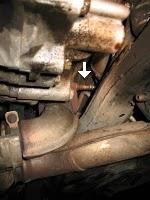
here it is
Nov 24, 2018 at 8:08 AM (Merged)
Avatar
FIXITMR
  • CERTIFIED EXPERT
  • 9,990 POSTS
did you get it changed and solve the issue?
Nov 24, 2018 at 8:08 AM (Merged)
Avatar
TAL QUINN
  • MEMBER
  • 3 POSTS
What will happen if I do not repair air/fuel heater sensor malfunction? I do not want to spend much on this old van. Would the fix be expensive?
Nov 24, 2018 at 8:09 AM (Merged)
Avatar
CARADIODOC
  • CERTIFIED EXPERT
  • 34,306 POSTS
P1135 - O2 Sensor Heater Circuit Low Voltage (Bank 1 Sensor 1)
P1155 - O2 Sensor Heater Circuit Intermittent (Bank 2 Sensor 2)

Your code description is wrong. These refer to two of the oxygen sensors, and since they are involved with emissions, they will turn on the "check engine" light. The first code means the engine computer will not be able to fine tune the fuel/air mixture on one side of the engine. The second code means that oxygen sensor will not start taking readings until the heat of the exhaust gas gets it up to 600 degrees, just like on much older cars. The heater circuit gets it up to 600 degrees faster so it can start reporting the conditions sooner.

Neither of those codes refer to something that you should notice as far as engine performance. Fuel mileage will suffer, but there is a bigger problem. Your engine computer can detect well over 2,000 defects, and set fault codes for each of them. Many of those defects are very minor with inexpensive fixes, but if ignored, could turn into expensive problems and/or miserable engine performance problems. You will never know if one of those minor problems occurs because the "check engine" light will already be on. Also, there is always a long list of conditions that must be met for a fault code to set, and one of those conditions is that certain other codes cannot already be set. Those other codes are for circuits the computer uses for reference or comparison, or when one defect can be expected to cause other defective conditions. Having these two codes set already will stop some tests from being run, so some defective conditions won't be detected, that is, until you have these current problems fixed, then the other tests will resume. That is when any new or additional problems will show up as new fault codes. The longer you wait to solve the current problems, the more time there is for additional problems to develop.
Nov 24, 2018 at 8:09 AM (Merged)

Avatar
TAL QUINN
  • MEMBER
  • 3 POSTS
Thanks. And is the fix a major repair, as in hundreds of dollars, or minor, as is around $100.00?
Nov 24, 2018 at 8:09 AM (Merged)
Avatar
STEVE W.
  • CERTIFIED EXPERT
  • 15,113 POSTS
It depends on what the issue is. Could be as simple as broken wires to the sensors or corroded connections or as bad as a failed PCM. No real way to tell without looking and testing. As for ignoring it, as Doc says, the light being on could hide something else.
Nov 24, 2018 at 8:09 AM (Merged)

Avatar
WRENCHTECH
  • CERTIFIED EXPERT
  • 20,761 POSTS
The 0/2 sensors have heaters built into them and the computer has determined they are not working in both sensors. If it was only one I would tend to blame a bad sensor but when it is both of them. I would first test all your fuses with a test light and look for a problem with any or the ground wire points.
Nov 24, 2018 at 8:09 AM (Merged)
Avatar
BAJRANGBALI1
  • MEMBER
  • 2 POSTS
Hello,
I have 2000 Toyota Sienna, LE with 3.0L 1MZ-FE engine. Lately, I get intermittent DTC P1130 & P1150. I understood these DTC are for Air Fuel Ration Bank1 Sensor1 (B1S1) and Bank2 Sensor1 (B2S1). I measured resistance on B1S1 at room temperature and it is 1.2ohm which I understand is within the rage. Since B2S1 is near firewall, I am not able to measure the resistance. These sensors are never replaced.

The van runs fine not problem. My questis are:
(1) Is it possible that the bit sensors are not completely bad but they are on their way out hence the DTCs are intermitatnt. I get MIL then it goes away. Then it comes back after few days.
(2) Is it possible for botn sensor to go bad at the same time.

Please advise.
Nov 24, 2018 at 8:09 AM (Merged)
Avatar
KHLOW2008
  • CERTIFIED EXPERT
  • 41,814 POSTS
Yes, sensors can fail simultaneously.

Diagnostic Aids

After confirming DTC P1130 and/or P1150, use scan tool to access CURRENT DATA to confirm voltage output of heated oxygen sensors (bank No. 1 and 2 sensor No. 1). ECM controls voltage of AF+ and AF- terminals at ECM to a fixed voltage (3.3 volts at AF+ terminal; 3.0 volts at AF- terminal). It is impossible to confirm A/F sensor output voltage without using a scan tool. A/F sensor output voltage on OBD II scan tools is displayed at one fifth the voltage of that displayed on Toyota hand-held tester. Using scan tool, read freeze frame data. Freeze frame records engine conditions when malfunction is detected.
During fuel enrichment, output voltage of A/F sensors may be less than 0.56 volt (2.8 volts on Toyota hand-held tester). During fuel cut, output voltage of A/F sensors may be greater than 0.76 volt (3.8 volts on Toyota hand-held tester). If output voltage of A/F sensor remains at 0.66 volt (3.3 volts on Toyota hand-held tester) during all conditions, A/F sensor circuit may be open. If output voltage of A/F sensor remains at 0.76 volt (3.8 volts on Toyota hand-held tester) or more during all conditions, A/F sensor circuit may be shorted. If output voltage of A/F sensor remains at 0.56 volt (2.8 volts on Toyota hand-held tester) or less during all conditions, A/F sensor circuit may be shorted.


Nov 24, 2018 at 8:09 AM (Merged)
Avatar
BAJRANGBALI1
  • MEMBER
  • 2 POSTS
Thank you very much KHLow2008 for your prompt answer.
Nov 24, 2018 at 8:09 AM (Merged)
Avatar
KHLOW2008
  • CERTIFIED EXPERT
  • 41,814 POSTS
You're welcome.
Nov 24, 2018 at 8:09 AM (Merged)