Truck will not start

2002 DODGE RAM
165,000 MILES • 5.9L • V8 • 4WD • AUTOMATIC
Avatar
ROBERTD123
  • MEMBER
  • 18 POSTS
My truck is the 1500. Okay, so for a little while I was driving my truck and I noticed that the oil pressure would randomly drop to zero but then would come back in less than two seconds. I planned on replacing the oil pressure sensor with the following paycheck. Before that paycheck hit, I was driving to work and my truck randomly started shaking violently. Initial symptoms were loss of steering, loss of accelerating power, and the oil pressure dropped to zero. I got the truck pulled over and turned off, started checking over the truck, checked the serpentine belt and all pulleys checked all fluids. All pulleys seemed fine and all fluids were topped off except for coolant in the reservoir but there was still coolant in the radiator(checked after engine was cooled). So I waited for a buddy to bring me some more coolant, topped off coolant with the thought of at least getting the truck back to my place and having him give me a ride to work With the coolant topped off I went to start the truck and it wouldn't start. check engine light came on and my code reader, kept in glove box, showed a misfire in both cylinder 1 and 3. truck got towed home.
Since then i have replaced all spark plugs, cables, ignition coil, distributor cap and rotor within, idle air controller, and oil pressure sensor. For the most part it still wont start. I was able to get it to kick over once but had to hit the gas pedal to get it to start and then it immediately died as soon as I took my foot of the gas. I can hear the fuel pump engage when the key is turned to on so i don't think its that. Also when I tried to kick it over after replacing the idle air controller and the oil pressure sensor. Me and my brother in law had a couple new symptoms arise. After a little bit of trying to get it to crank it would make a short pop/spark sound followed immediately by a short hiss. Once this happened i stopped trying to start the truck and we noticed that there is a small amount of thin white smoke/steam coming from the front of the engine between the water pump and the crankshaft. I plan on replacing the fuel injectors tomorrow morning when i have daylight to see. not sure what next step after that would be or what would be causing the white smoke/steam to be coming from the base of the water pump. any and all help/advice would be appreciated. thank you for your time.
Feb 16, 2019 at 3:57 PM
Advertisement
Avatar
SCGRANTURISMO
  • CERTIFIED EXPERT
  • 4,897 POSTS
Hello,

This sounds like it might be a timing issue. Just to make sure, you don't have oil sprayed all over under your truck?

Thanks,
Alex
2CarPros
Feb 16, 2019 at 5:20 PM
Avatar
ROBERTD123
  • MEMBER
  • 18 POSTS
No oil that i can see, however there is some kind of fluid around the base of the water pump and around the crank shaft. But not under the engine just around the front.
Feb 16, 2019 at 6:46 PM
Advertisement
Avatar
ROBERTD123
  • MEMBER
  • 18 POSTS
How would one fix a timing issue? The rotor in the distributor cap was only able to be attached one direction due to a kingpin built into it, and spark plugs are all in the correct firing order (triple checked those as i was installing).
Feb 16, 2019 at 6:50 PM
Avatar
CARADIODOC
  • CERTIFIED EXPERT
  • 34,306 POSTS
He's referring to a jumped timing chain.

Don't waste your time looking at the injectors. Chrysler buys them from Bosch in flow-matched sets and problems are just about unheard of. Also, you know eight injectors aren't going to fail at the same time.

Hearing the fuel pump running for one second when you turn on the ignition switch is a dandy clue that it is okay. The things you need to be looking at are whether you have spark during cranking, and if not, is the automatic shutdown, ASD) relay turning on during cranking? Also read and record the diagnostic fault codes. Do you know how to do that yourself?

If the ASD relay is not turning on during cranking, the crankshaft position sensor and the camshaft position sensor are the best suspects. SCWICKEDSTANG should be able to help with those things. I'll be back tomorrow to see how you're doing.
Feb 16, 2019 at 7:30 PM
Avatar
ROBERTD123
  • MEMBER
  • 18 POSTS
I have the code scanner that I plugged in in order to find out that cylinder 1 and cylinder 3 were misfiring. And now it's not pulling anything after replacing the spark plugs.
Feb 16, 2019 at 7:38 PM
Avatar
CARADIODOC
  • CERTIFIED EXPERT
  • 34,306 POSTS
Codes get erased if memory power is lost to the Engine Computer, either from disconnecting it or from disconnecting the battery or running it dead. Codes related to the cam and crank sensors often do not set just from cranking the engine, so don't assume they are okay just because there are no codes.

You can double-check for codes in the Engine Computer by cycling the ignition switch from "off" to "run" three times within five seconds without cranking the engine, leave it in "run", then watch the code numbers appear in the odometer display. You can go here:

https://www.2carpros.com/trouble_codes/obd2/p0400

to see the definitions, or we can interpret them for you.

To see if the ASD relay is turning on, connect a test light to the dark green / orange wire at the ignition coil or any injector. You'll see it light up for one second when you turn on the ignition switch. What's important is if it turns back on during cranking. If it does not, and there are no related fault codes, you'll need a scanner to view the signals from those two sensors to see if they're showing up at the computer.
Feb 16, 2019 at 8:08 PM
Avatar
ROBERTD123
  • MEMBER
  • 18 POSTS
Odometer reads done after doing the key thing. So no codes are being pulled. Also upon getting it to start (1/10 tries it kicks over but shuts off) there was a thick cloud of white smoke from the exhaust, took a bit to dissipate have to run to store to get new circuit tester, dog decided to rip the cables out of my other one.
Feb 17, 2019 at 7:44 AM
Avatar
SCGRANTURISMO
  • CERTIFIED EXPERT
  • 4,897 POSTS
Hello,

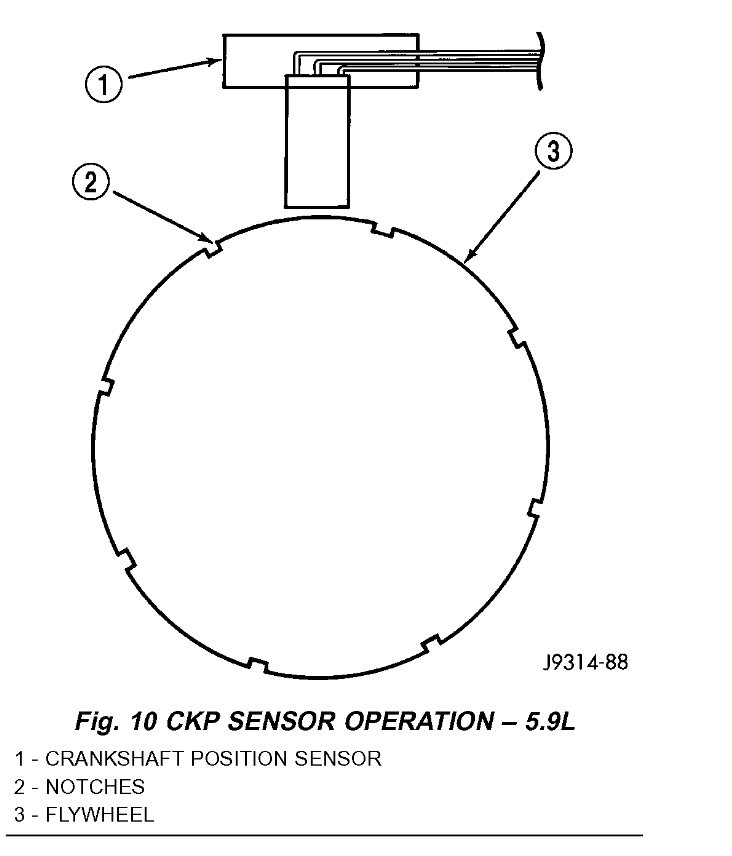
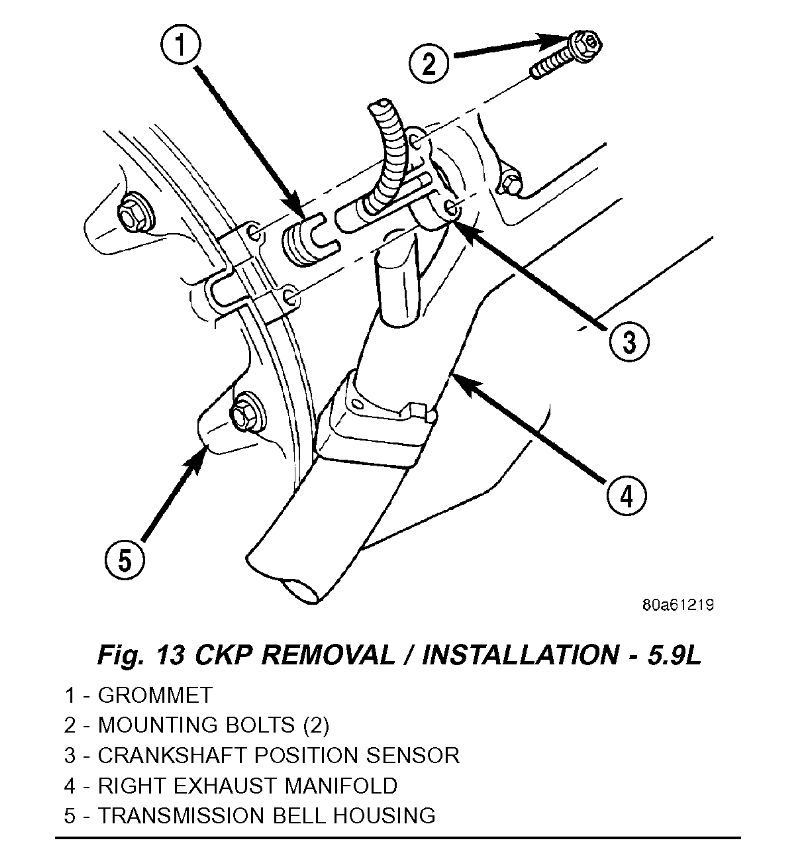
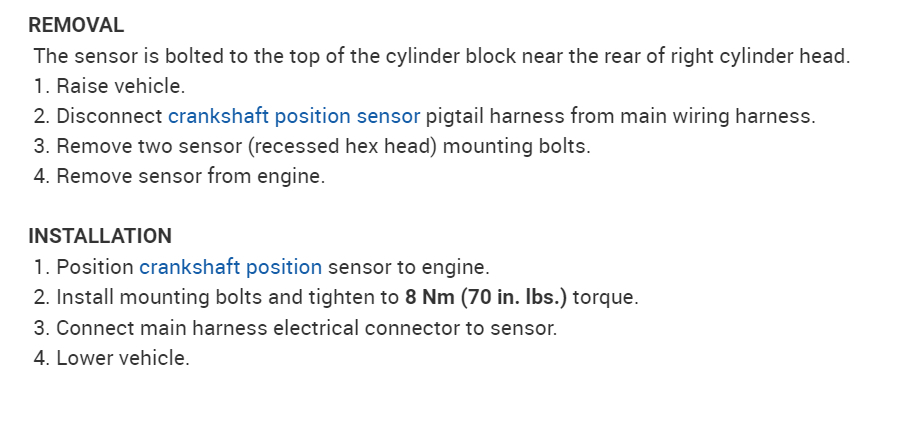
Okay, like Caradiodoc has said let's test the Ctankshaft Position Sensor. I have included a few links for you below. Please go through these guides and get back to us with what you find. I have also included vehicle specific directions for you in the diagrams below.

https://www.2carpros.com/articles/how-a-crank-shaft-angle-sensor-works
https://www.2carpros.com/articles/symptoms-of-a-bad-crankshaft-sensor
https://www.2carpros.com/articles/crankshaft-angle-sensor-replacement

Thanks,
Alex
2CarPros
Feb 17, 2019 at 8:42 PM
Avatar
CARADIODOC
  • CERTIFIED EXPERT
  • 34,306 POSTS
Allow me to add a couple of comments of great value that might save some future frustration. Some of the older crankshaft position sensors, and on some engines, the camshaft position sensors not in the distributor, have a critical air gap that must be set. That is done with a thick paper spacer stuck on the end of it. That spacer slides off the first time the engine is cranked, but its job is done by then. A lot of aftermarket replacement sensors use a thin plastic rib molded onto the end to do that job. Those ribs wear away over time, so if you remove one of those and are going to reuse it later, such as after removing the transmission, you are supposed to cut off the remaining rib, then use a paper spacer. You can get those from any Chrysler parts department. This doesn't apply to your truck specifically as its sensor uses a different style mounting bracket.

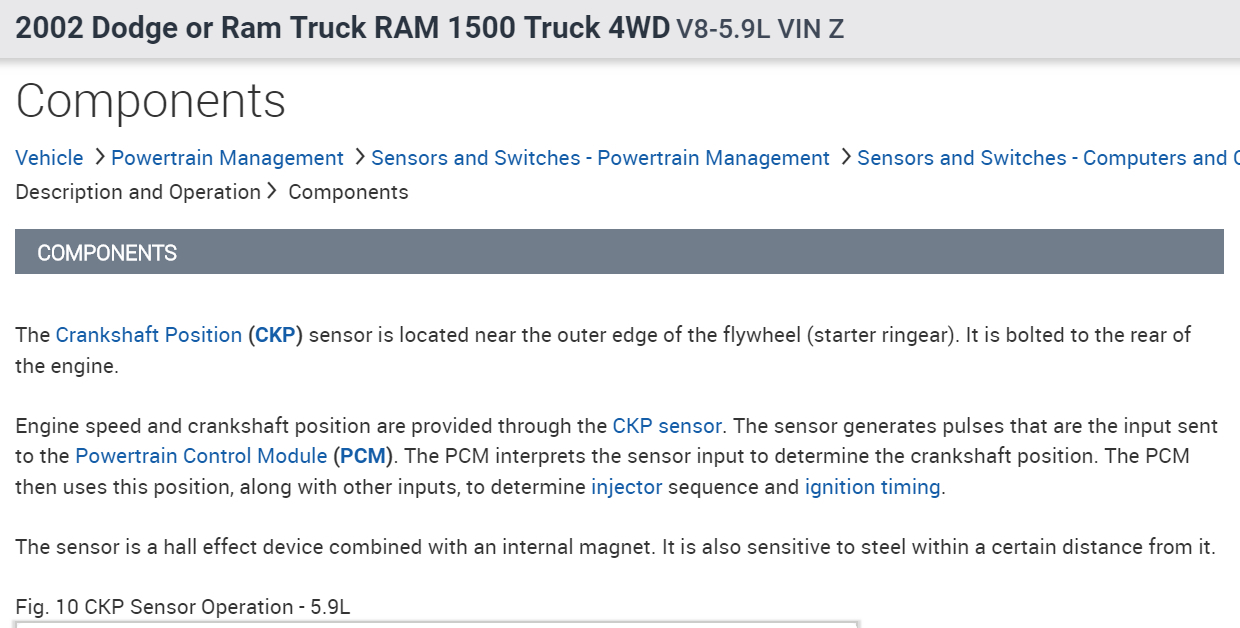
The instructions for this model year show eight notches in the ring around the flywheel that are detected by the crank sensor. Those notches can be very different one model year newer or older. Some V-6 engines use three notches, three notches, then four notches. Those engines usually have to crank a little longer for the group of four notches to be seen before the engine starts. That is how the computer knows which piston is coming to top dead center. Also, those engines will use an ignition coil pack where one coil feeds two spark plugs at the same time, one on the compression stroke, and the "waste spark" on the exhaust stroke. The point is when you replace an engine, always use the flywheel that is original to the truck. The Engine Computer won't turn the ASD relay on if it doesn't see the correct numbers of pulses coming from the crank sensor.

Testing these sensors is really difficult and imprecise unless you have an oscilloscope. If you're going to invest in test equipment, buy a nice used scanner instead. The Engine Computer will tell you, through the scanner, if it is receiving the sensors' signals, and they are correct. The best test you can do yourself is to measure that dark green / orange wire for 12 volts during cranking. If you have that, the sensors are working.
Feb 18, 2019 at 6:23 PM
Avatar
ROBERTD123
  • MEMBER
  • 18 POSTS
Okay, also when I got the current tester I tested the connections to the fuel injectors, spark plugs, and the camshaft sensor. The camshaft sensor, and the fuel injectors did what you guys said where it lights initially when turned to on then stays on during cranking. The spark plug cables on the other hand never showed the light. So I then tested the cable going into the ignition coil and had the same light up routine as the other two but when connected back into the ignition coil and attached to the top prong where the cable that goes to the distributor cap connects I got no lights what-so-ever. Led me to believe faulty ignition coil so I took it back and replaced it as it was still under warranty. Installed that and it seems to be cranking better but wasn't able to test current with the tester, before having to leave for work. Won't be able to do that till Wednesday, next day off, when I also will be replacing the camshaft sensor and fuel injectors. I know you guys said it most likely won't be that but with how much gunk I pulled from the throttle body makes me think the previous owner never did any kind of upkeep other than oil changes. That and I already have them, so I might as well throw them in just in case. They may not be faulty but could also be gummed up to where they aren't spraying fuel properly. Just a thought, fingers crossed that it fires up after Wednesday, only have until the end if the month to get truck running before I lose my ride to work as my roommate will be moving out then...
Feb 18, 2019 at 6:42 PM
Avatar
ROBERTD123
  • MEMBER
  • 18 POSTS
Will also be testing the crankshaft sensor for power if the other stuff doesn't get it to kick over, it seems like it's got more power now after the new ignition coil but it still doesn't kick over without the gas pedal and won't stay running once I remove my foot from the pedal.
Feb 18, 2019 at 6:45 PM
Avatar
SCGRANTURISMO
  • CERTIFIED EXPERT
  • 4,897 POSTS
Hello again,

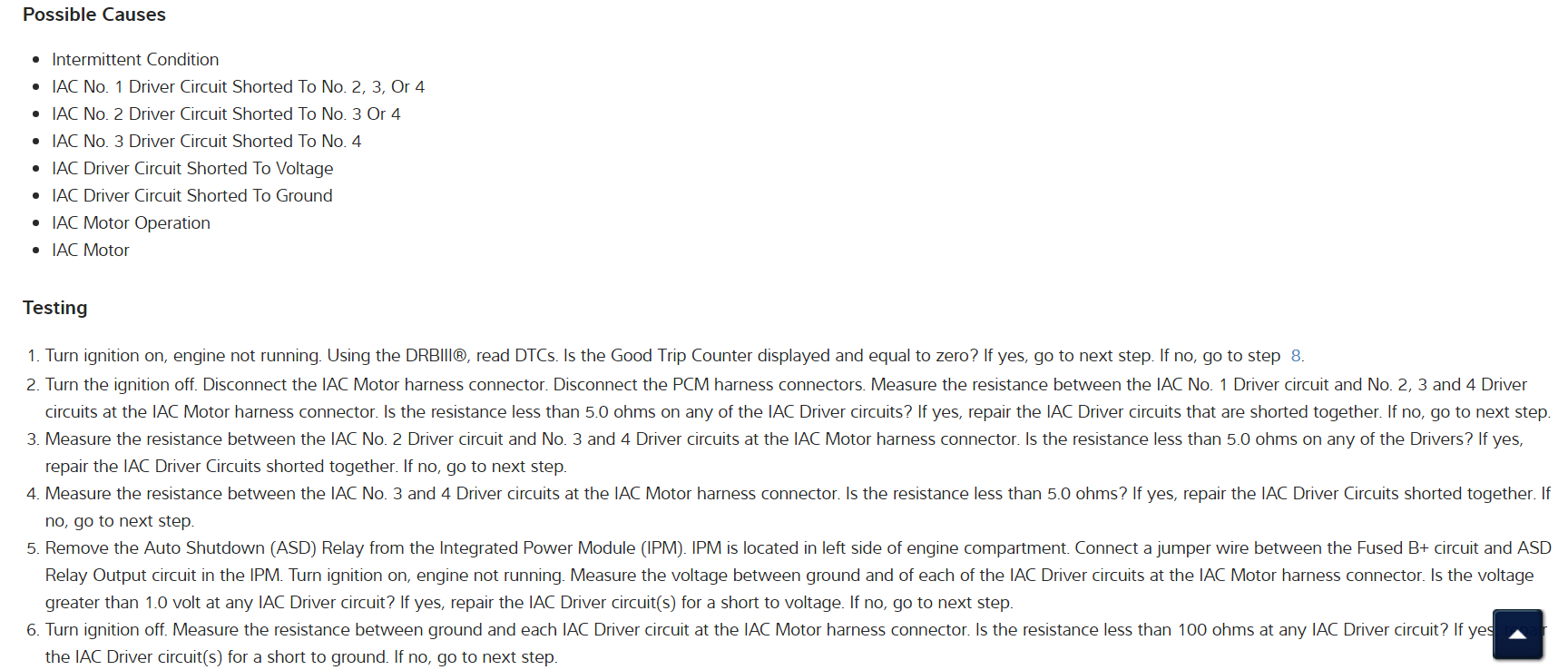
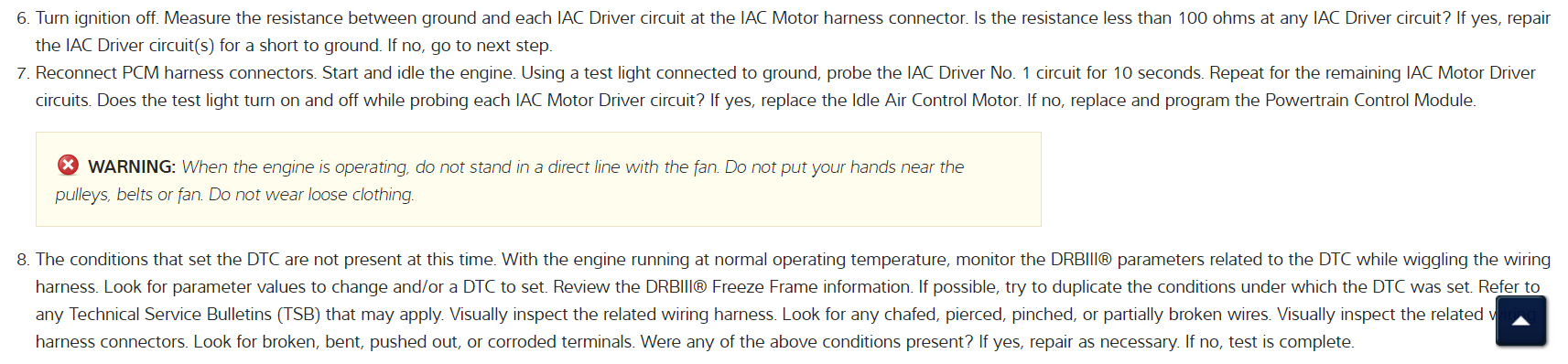
If the engine kicks over and starts, then it's probably not your crankshaft position sensor. I have included a troubleshooting guide for your idle air control in the diagrams below. Please go through it at your earliest convenience and let us know what you find out.

Thanks,
Alex
2CarPros
Feb 18, 2019 at 7:47 PM
Avatar
ROBERTD123
  • MEMBER
  • 18 POSTS
I replaced the idle air controller already.
Feb 18, 2019 at 8:02 PM
Avatar
SCGRANTURISMO
  • CERTIFIED EXPERT
  • 4,897 POSTS
Hello again,

Okay, but the truck starts when you crank it over, right?

Thanks,
Alex
2CarPros
Feb 18, 2019 at 8:08 PM
Avatar
ROBERTD123
  • MEMBER
  • 18 POSTS
So long as I hit the gas it will start after a couple tries, but if I don't hit the gas it wont.
Feb 18, 2019 at 9:29 PM
Avatar
SCGRANTURISMO
  • CERTIFIED EXPERT
  • 4,897 POSTS
Hello again,

Okay I will wait to hear from your diagnostics on Wednesday, we will get this fixed then.

Thanks,
Alex
2CarPros
Feb 19, 2019 at 9:31 AM
Avatar
CARADIODOC
  • CERTIFIED EXPERT
  • 34,306 POSTS
Hold on. You're going to add way too many variables that might also require additional troubleshooting. Take a step back for a moment. The engine is able to run, so you're done with the cam and crank sensors. They have to be working. You also verified with the test light that the ASD relay is turning on initially and during cranking. Everything is working up to that point.

Now, that doesn't mean the sensors can be overlooked completely. The crank sensor in particular is noted on all car brands for being intermittent, especially by becoming heat-sensitive. It is common for the engine to run fine until you stop for a short time, such as when stopping for gas, then the engine will not restart. During "hot soak", heat from the engine migrates up to the sensors causing them to fail, then they will work again after cooling down for about an hour. Given your initial description of the symptoms, keep this in mind if they start to occur again.

You misunderstood my procedure for using the test light in the ASD circuit. That has nothing to do with the spark plug wires. The pulse occurs much too briefly to make the test light's filament light up, and there's a good chance the bulb will burn out from being hit with 15,000 to 30,000 volts. The newer electronic test lights usually can't tolerate more than 50 - 100 volts without being destroyed.

Testing to see if the ASD relay is turning on can be done at numerous places. All of those places will have the same color wire. On most cars and light trucks that is a dark green / orange wire, but to know for sure, just look for the wire that is the same color at the ignition coil or coil pack, and any injector. Even if you try to use the wrong wire, you'll still find something close to 12 volts, but don't try that with a digital voltmeter. They respond too slowly, and they will be seriously confused by the pulsing voltages.

That same 12 volts can be measured with much more difficulty at any oxygen sensor heater wire, and on the two smaller field terminals on the back of the alternator. Only one gets 12 volts on the alternator, but until the engine is running, you can use the other terminal too. This is especially good to know because the two wires go through a black plastic block, so you can't know which wire goes to which terminal. If you use the wrong terminal, you'll still find close to 12 volts there if the ASD relay is turning on, as that voltage has to come from the other terminal, and through the field winding.

If you're going to spend lots of money on random parts to try, it would be a much better investment to buy a good used scanner so you can see what the Engine Computer is seeing in relation to those sensor signals. I have a Chrysler DRB3 for all of my vehicles. You can find these on eBay, and, with an extra plug-in card, these will do emissions-related work on all brands of cars sold in the U.S. starting with '96 models, so a lot of independent shops bought them. The first year they became obsolete was on the '04 Dakota and Durango, and the last year they worked was on some '08 Jeep models. Because of that, many of these shop owners want to sell theirs to buy something newer, so it might pay to ask around at the local shops. Ask the guys who drive the tool trucks around town too. Any mechanic at any dealership can tell you when they come to their shop, usually once a week.

The DRB3 lists the cam and crank sensors with a "No" or "Present" to indicate if their signals are showing up during cranking. For intermittent stalling or back firing problems, you can watch the state of these signals during a test-drive to see if either one drops out momentarily. This scanner also has "record" capabilities. You press the "record" button when the problem occurs. Because the data passes through the scanner's memory, the recording actually starts a couple of seconds before you pressed the button. Later, you can play that back slowly and watch for what changed or if a sensor signal dropped out.

Another good scanner for this type of problem is the Snapon Solus Edge. The problem with these is they really get you on the cost of annual updates, and you can't skip any years. If you find one on eBay that is only updated through, say 2014, that is fine for your truck, but for a shop to be able to use it on customer cars, they would have to buy the 2015 update before they could buy the 2016 update, then the 2017 update, and the 2018 update. The cost of those updates exceeds the cost of a new scanner, so those that aren't already updated lose their value very quickly and become a really good deal for you. Some of these sell for less than $800.00.

I can't stress enough that all of the injectors did not fail at the same time, and I have never come across a bad one in a Chrysler product since I started at the dealership in the early '90s. By replacing them as a test, you run the risk of cutting an o-ring, breaking the fuel rail, or not getting the o-rings seated properly. If they got plugged with gunk, you have much bigger problems as that is not all that is going to be contaminated. The biggest culprit is mold growing in the fuel tank. It feeds on the ethanol in today's gas. That mold, along with other microscopic debris, will plug the pick-up screen on the bottom of the fuel pump housing, then the symptom will be stalling when the largest volume of fuel is being pumped, which is during coasting down from highway speed. Most people attack the fuel filter for that, but other than with diesel engines, you will never solve a running problem on a Chrysler product by replacing the fuel filter. They often last the life of the vehicle unless they rust out and start to leak. That plugged sock on the fuel pump's housing, on the other hand, is not that uncommon.

The biggest thing I saw in your last reply is the engine runs if you hold the accelerator pedal down a little. That is extremely common on all Chrysler products and has such a simple fix, most people aren't even aware it is taking place. This occurs when the battery is disconnected or run dead. The Engine Computer loses its memory. As soon as you reconnect the battery and start the engine, all of the sensor data and fuel trim numbers start to be rebuilt without you even noticing, except for "minimum throttle". The computer needs to know your foot is off the accelerator pedal, then it takes a reading from the throttle position sensor and puts that in memory. From then on, anytime it sees that same voltage, it knows it must be in control of idle speed. Until that takes place, the engine may not start unless you hold the accelerator pedal down 1/4", you won't get the nice idle flare-up to 1500 rpm at start-up, and it will tend to stall at stop signs. I often kill the battery in my minivan by running a power inverter to run my laptop. I carry a jumper pack with me, and every time I use it, I have to hold the accelerator pedal down to get the engine started, and I have to initiate the relearn of minimum throttle while driving home. Here's the procedure to make that take place:

Drive at highway speed with the engine warmed up, then coast for at least seven seconds without touching the pedals.

The battery doesn't have to be totally dead for the computer to lose its memory. Trying to crank the engine with a run-down battery can draw its voltage down low enough to cause the computer's memory loss.

Related to the low idle speed and other symptoms, you mentioned the automatic idle speed motor. That motor has an uncommonly low failure rate and rarely needs to be replaced. You can test its operation with the DRB3 by commanding the Engine Computer to run idle speed up to 2000 rpm, in 200 rpm increments. Failure to respond can be caused by minimum throttle hasn't been relearned yet, a wiring problem associated with the AIS motor, or the air passage around the throttle blade it controls is plugged with carbon. Wiring problems will be detected by the computer, and you will know it by the diagnostic fault code it set. Carbon problems occurred mostly on the 3.0L engines many years ago, but we don't see that any more with the better additives today in even the cheapest gas.

The scanner will also show the "AIS steps" the computer has placed the motor at. It can pulse it to one of 256 positions. As the armature turns slowly, it rotates a threaded rod with a pintle valve on the end. As the number of steps increase, that valve opens up a little more to let more air get passed the throttle valve. At the same time it pulses the injectors on for more milliseconds to add more fuel to go with that extra air. That's how it increases idle speed. With a properly-running engine, a typical AIS value is step 32. With one misfiring cylinder on a V-6 or V-8 engine, around step 50 is typical. If you find it is at step 0, minimum throttle hasn't been relearned yet.
Feb 19, 2019 at 5:07 PM

Avatar
ROBERTD123
  • MEMBER
  • 18 POSTS
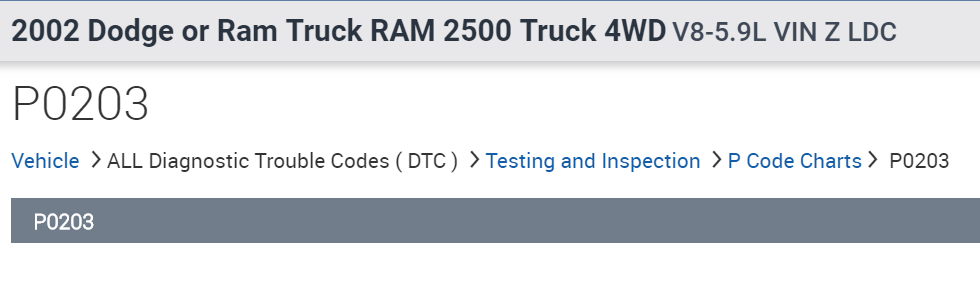
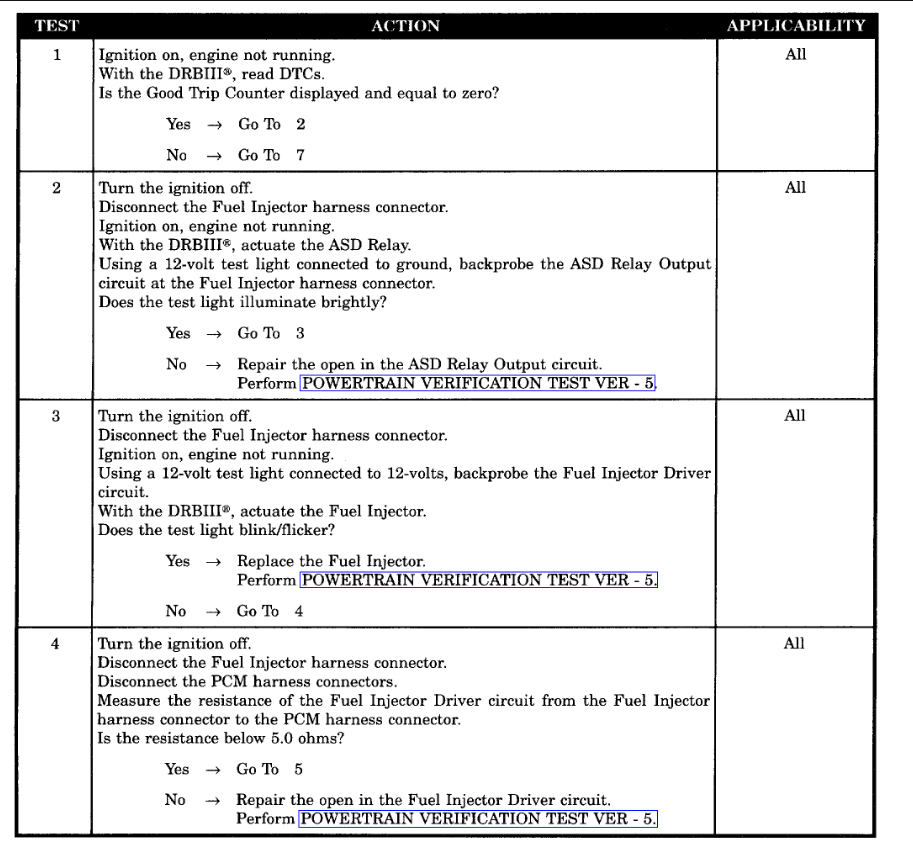
Progress made! I was able to get it to kick over again and while maintaining light pressure on the gas pedal for a little under a minute to keep the vehicle running (as stated before no pressure on gas and it shuts off) it finally popped a code P0203. if I am reading this right that means that either the PCM is faulty or there is something wrong with the cylinder three fuel injector. either the injector itself or in its wiring. Correct?
Feb 20, 2019 at 11:10 AM
Avatar
SCGRANTURISMO
  • CERTIFIED EXPERT
  • 4,897 POSTS
Hello again,

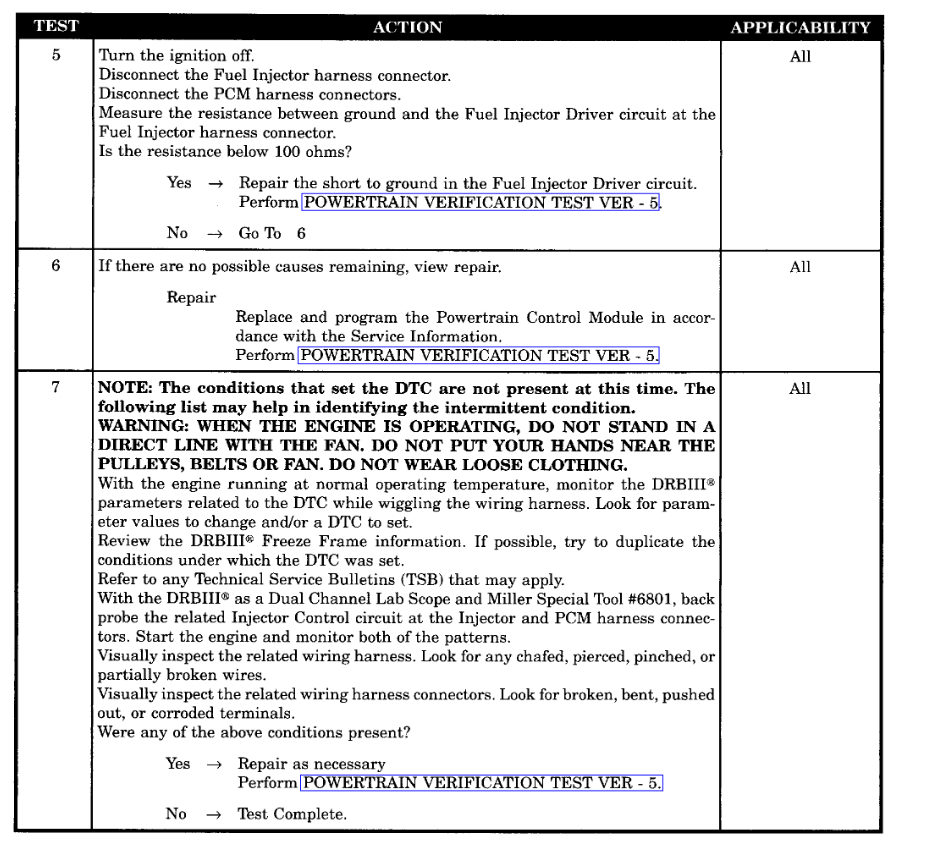
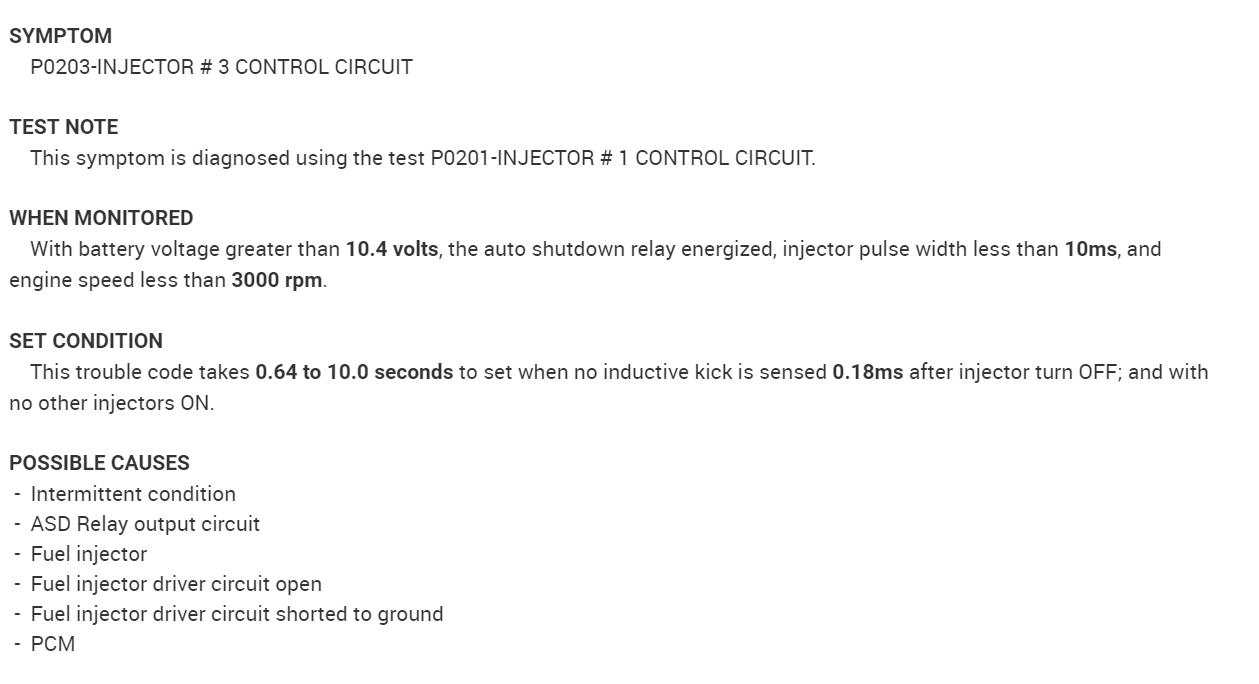
I have included the factory troubleshooting for P0203 in the diagrams down below. Go through it and let us know what you find out.

Thanks
Alex
2CarPros
Feb 20, 2019 at 11:44 AM
Avatar
ROBERTD123
  • MEMBER
  • 18 POSTS
Looking hopeful. Replaced fuel injector in cylinder three. Now when I go to start it it kicks over without needing my foot on the gas pedal. But doesn't stay running for long might be due to low battery so I'm going to charge my battery and try again fingers crossed that she stays running this time.
Feb 20, 2019 at 2:51 PM
Avatar
ROBERTD123
  • MEMBER
  • 18 POSTS
Well that didn't work. so now I'm thinking fuel filter might also be clogged up. when I pulled the fuel injector for cylinder three I noticed there was some great on both of the o-rings.
Feb 20, 2019 at 4:45 PM
Avatar
CARADIODOC
  • CERTIFIED EXPERT
  • 34,306 POSTS
Are you saying the charging system is not working? Once the engine is running, battery voltage must be between 13.75 and 14.75 volts. If it stays at 12.6 or less, we need to diagnose the charging system. Computers are very intolerant of low system voltage and will set random fault codes. Also, since low system voltage adversely affects the performance of injectors, which in turn leads to increased emissions, that will turn on the Check Engine light.

The most common cause of code 203 is a spread terminal in the connector for that injector or in the connector that sits between the engine wiring harness and the one on the body. Look for corrosion between those two mating terminals too. If you think the injector itself is at fault, switch it with that from a different cylinder. Erase the fault code, then see if the code sets again for the same cylinder or the one you moved the suspect injector to.

You should also get a code 303 for cylinder three misfire if the injector stops firing, although that might not set right away. Code 203 doesn't specify a break in the electrical circuit like code 268 does. Part of the strategy is the computer watches the current flow ramp up over time. When it reaches a strong enough magnetic field to pull the valve open, there is a noticeable drop in the rate current increase. The computer can tell by that sudden change exactly when the valve opens, then it can calculate the number of milliseconds left before it turns that current off. If it doesn't see that valve opening, it may set code 203, or any of those for the other cylinders, and that weak opening can be due to low system voltage. The injector may not open at all, but more likely it will open late, resulting in too little fuel to that one cylinder. That might result in a misfire and a code 303.

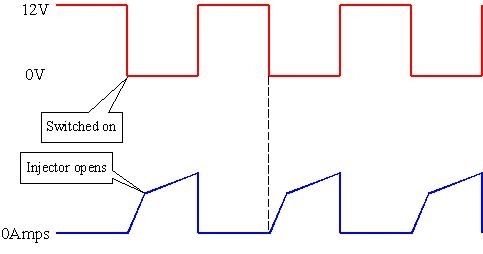
I drew you a sad graph below to show the voltage and current relationship for an injector. As of today, the computers can only modify how long the injectors are held open based on the front oxygen sensor readings for the two sides of the engine, not for an individual cylinder. If cylinder three is running lean, the unburned oxygen will be detected in the left bank, and the computer will request more fuel from all four injectors on that side. It doesn't know which cylinder is responsible, just that something needs to be tweaked on that side.

Be aware too that for any fault code to set, there is always a very long list of conditions that must be met, and one of those conditions is that certain other codes can't already be set. There's two fairly common examples of this. The first is when a defect is detected for something used for reference, anything compared to that reference won't be tested, so no fault code will be set. Consider the intake air temperature sensor and the coolant temperature sensor. The Engine Computer knows that after sitting for more than six hours, those two sensors had better be reading the same temperature. If you unplug the intake air temperature sensor, the computer will detect the open circuit and set the code for "intake air temperature sensor voltage high", meaning it's stuck at the full 5.0 volts. It knows it can't rely on that obviously-incorrect reading to compare to the reading for the coolant temperature sensor, so if that one just goes out-of-range, that won't be tested or detected. You may not get a fault code for the coolant temperature sensor until the intake air temperature sensor circuit is repaired; in this case, plugged back in. Then, the continuous self-tests will resume, and if there really is some problem with the coolant temperature sensor, that is when it will finally be detected, and a new fault code will set. This happens real often on GM anti-lock brake systems when the customer waits too long to have it repaired. That gives the vehicle time to develop multiple problems, but after the first one sets a fault code, all other related tests are halted. Finally the customer has the first one repaired, then the self-tests resume, and the next problem shows up right away. That leads to lots of frustration on the part of the mechanic, and customers incorrectly assume the problem wasn't diagnosed properly.

The second time fault codes may not set is when multiple problems are causing the same symptom. This happens most commonly with single-cylinder misfires. If the screen in an injector becomes plugged, the blocked fuel flow is not detected directly, but the computer sees the resulting slow-down of the crankshaft's rotational speed for that instant. By knowing the position of the crankshaft, and when that slow-down occurs, it can tell which cylinder is responsible. It is that same slow-down that we feel when we feel a misfire, but the computer can detect much more subtle changes than we can feel. Now if you come along and short out that spark plug wire, or the spark plug gap becomes shorted with carbon or oil, the cylinder is already misfiring due to the injector, so no additional fault code will set related to the lack of spark. You might figure out from looking at the oxygen sensor voltages that the injector is causing a problem, you replace it, and still have a misfire that requires more diagnosis. This is real common on higher-mileage GM cars. I mentioned that Chrysler buys their injectors from Bosch in flow-matched sets, and they have almost no problems. In fact, to my knowledge, no other manufacturer has common, recurring injector problems, except for GM. They just grab a handful out of a big bin and toss them into an engine as it comes down the assembly line, with no regard for matching the flow rates. That rarely causes a problem at first when the vehicle is new, but by the time it hits around 100,000 miles and it's out-of-warranty, it is real common for one or two injectors to start flowing a little less fuel than the rest. This can result in setting a "lean exhaust" fault code that is almost impossible to diagnose. As it becomes worse, you can have a single-cylinder misfire fault code, and you might not feel that misfire.

The solution to that problem is to install a set of rebuilt injectors that come in flow-matched sets. Even if you've figured out the injector is the cause of the problem, if you install one new one or one used one, you really run the risk of it not flowing the same amount of fuel as the others, and it might not solve the misfire. Jim Linder used to have an injector rebuilding shop next to the Indianapolis Speedway, and he put on real high-level training classes all over the country. On his web site they described the ten most common injector-related problems, and eight of them referred to problems on GM vehicles. My reason for describing this is if you plan on replacing just one injector, you have a very good chance of introducing this new variable and a new problem that defies diagnosis.

Here's my nifty drawing showing injector current. On almost all vehicles they are supplied with 12 volts on one terminal, and it shows up on the other "control" terminal by reading through the injector. On all Chrysler products, that 12 volts comes from the ASD relay. The red graph shows that 12 volts, then, when the computer turns that driver circuit on, which is a transistorized switch, it draws that second terminal down to close to 0 volts. That puts 12 volts across the injector's electromagnetic coil.

The resulting current flow in the blue graph causes an electromagnetic field to build up inside the injector, but since it takes energy to do that, the buildup fights, or opposes that current flow. As a result, while voltage switched instantly, current builds up relatively slowly. Some of that energy goes into making the valve move.. Once it reaches the full-open position, it can't move any further, it can't use up any more energy, so the current has to work harder to increase. That transition point is shown where the valve opens, and the computer sees that change. Failure to see that transition is what sets code 203, which is different from an electrical-related code.
Feb 20, 2019 at 5:56 PM
Avatar
ROBERTD123
  • MEMBER
  • 18 POSTS
No, there is no issue with it recharging on it's own. However, with me cranking it over and over and over with it only turning on for a couple of seconds that's not long enough to recharge the battery. Hence needing to recharge it. And for the fuel injectors as I mentioned before I already had a full set (which was bought as a matched set) and since I had already checked the wires prior to that code popping, I figured that it was the injectors. Also after pulling the injector for cylinder three I noticed that the bottom was discolored and there was grit around the o-rings on both sides of the injector. So I replaced them all so that they matched (again bought in a matched set) and now that that's been done the truck starts without having to have my foot on the gas. That being said, it only runs for about two to three seconds before turning off. That plus the grit on the injectors is causing me to believe that the fuel filter is "clogged up." So that's where I will be looking next. It will be a bit before I'm able to work on it again though due to work schedule.
Feb 20, 2019 at 6:23 PM
Avatar
ROBERTD123
  • MEMBER
  • 18 POSTS
Another reason as to why I believe the fuel filter is also clogged up is back when it was running if I had cruise control on and happened to be going up hill at anywhere from 50-60 mph it would randomly rev from 1.7k rpm up to 3k rpm in order to maintain speed. At the time I figured it was just a quirk of the vehicle given that it's over 15 years old. However now that these other things have happened it makes me believe that that was the start of the fuel filter/fuel pump starting to go as in my vehicle specifically they are the same part as the fuel filter is attached to the fuel pump.
Feb 20, 2019 at 6:58 PM
Avatar
CARADIODOC
  • CERTIFIED EXPERT
  • 34,306 POSTS
Normally I tell people why to not bother looking at certain parts because they would be wasting their money, but I forgot to add, "unless you already have them on hand". That being the case, there's little harm in trying them.

Some engines introduce fuel priming pulses when you turn the ignition switch on, and some still try to develop the "idle flare-up" even though minimum throttle hasn't been relearned yet. Either of those can cause the engine to run for a couple of seconds, then stall. The clue is if the engine will remain running when you hold the accelerator pedal down 1/4", there is no other problem other than doing the test-drive to relearn minimum throttle.

If you are filling the gas tank regularly, the additives in it will dissolve the mold and keep the injector screens clear. It's when vehicle sit for long periods of time, as many of mine do, that the mold becomes a problem.

Chrysler gas filters rarely cause a problem. The stuff you saw in the injector screens is likely mold from the ethanol in the gas. That will plug the pick-up sock in the gas tank long before it will plug the fuel filter. The clinker though is the symptom is totally different than you would expect.

When the engine is under load or heavy acceleration, that is when the lowest volume of fuel is being pumped, and it is when the engine will run the best if that sock is plugged or collapsing. You'll have stalling, if that sock is collapsing, during coasting down from highway speed. That is when the highest volume of gas is being pumped.

The fuel pump moves about a couple of gallons of gas per minute. 99 percent of that gas goes through the pressure regulator, then right back into the gas tank by way of the return hose. Only a very tiny percentage is tapped off to go through the injectors and into the engine.

If you look at a molecule of gas just waiting to jump from the tip of the injector, there's two forces acting on it. You have fuel pressure pushing on one side and intake manifold vacuum pulling on the other side. The Engine Computer knows what fuel pressure is supposed to be, (but it isn't actually monitored or measured), and it knows by the readings from the MAP sensor what intake manifold vacuum is. Based on those two values, it calculates how many milliseconds to pulse the injectors open.

During periods of coasting, manifold vacuum goes up real high. That would tug on the fuel molecules real hard, creating a very rich mixture, and excessive pollution. You'll notice the fuel pressure regulator on the engine's fuel rail has a vacuum hose connected to it. When manifold vacuum goes up, it is applied to the spring-loaded pressure relief valve in the regulator, to make that valve open easier. That drops the fuel pressure. With higher manifold vacuum and lower fuel pressure, the net difference in forces remains the same, and that prevents the rich coast-down condition.

Since the pressure regulator opens easier to send the extra fuel back to the tank, the pump doesn't have to work so hard, so the volume of fuel being pumped goes way up. For this sad story, lets say it goes up to three gallons per minute. Now maybe only one tenth of one percent of that fuel gets tapped off to keep the engine running, so gas used up goes way down during coasting, but gas being moved by the pump goes way up. It's that higher volume that will suck a weak pick-up screen closed, causing it to block fuel flow, then the engine stalls.

This was also very common on older carbureted cars in the 1970's and 1980's. Those do not use a fuel return system, so the fuel volume only goes up during acceleration or high load. The stalling occurred just opposite of how it affects fuel-injected engines.

This happened to me on a 1978 LeBaron wagon and on an 1980 Volare. With both of those, I could drive normally for around fifteen miles, then it became more and more difficult to maintain highway speed. After sitting on the side of the road for about ten minutes, the sock would stretch out, then I could drive another few miles.

When this happened the first time to my 1988 Grand Voyager with fuel injection, it took me four hours to nurse it through Minneapolis with all three interstate bypasses down to one lane for road construction. After that, once on the highway, the engine ran fine for the three-hour drive home, then it stalled again when slowing down for my exit ramp. To add to the confusion, it only acted up that day and the next day, the two hottest days of summer, then not again for another year. A new $9.00 pick-up screen solved the stalling. The same thing happened many years later on the same van, but this time I had a fuel pressure gauge tied to the radio antenna. The problem only occurred when dragging a huge tandem-axle enclosed trailer that is bigger and heavier than the van. Fuel pressure would slowly drop from 50 psi to 20 psi, with the engine still seeming to run okay. It started to sputter at 15 psi. Most other engines won't even run when it's as low as 35 psi. I found that if I lifted the accelerator pedal for just a fraction of a second, that was enough to cause fuel pressure to pop back up to 50 psi, then I could get another half mile or so. I nursed it home 55 miles that way from an old car show swap meet.

That great and wondrous story might shed some light on what is happening with your truck, or at least give you some things to consider. I agree you don't need to look at the charging system. We'll save that discussion for if and when a problem develops with that.
Feb 21, 2019 at 5:28 PM
Avatar
ROBERTD123
  • MEMBER
  • 18 POSTS
To the best of my understanding what is happening now is if I don't touch the pedal it will start up and kick over, but it shuts off almost immediately. if I touch the gas pedal at all it shuts off immediately. If it does manage to kick over even if it stalls out it will take five to ten minutes of just sitting there before it will kick over again otherwise it just cranks and cranks but won't kick over.
Feb 21, 2019 at 5:53 PM
Avatar
CARADIODOC
  • CERTIFIED EXPERT
  • 34,306 POSTS
Go back to the basics and check for spark, then fuel pressure with a pressure gauge, and verify the ASD relay is turning on. At least one of those has to be missing.

If all of those things appear to be okay, see if it will run for a few seconds when you spray in a little gas. If it does, the MAP sensor may be failing. It has the biggest say of all the sensors for fuel metering calculations.
Feb 21, 2019 at 6:23 PM
Avatar
ROBERTD123
  • MEMBER
  • 18 POSTS
Well, the ignition coil, plugs, wires and distributor are all brand new within the last month (since truck went down no real run time on any of them) and from the light testing you mentioned before the ASD was working fine before the injector swap. So I'll start with the MAP sensor and if that works then I will back track and check the others. Given that they are brand new they should be fine. Unless they were faulty when I got them. Wouldn't be the first time with my luck, lol.
Feb 21, 2019 at 6:32 PM
Avatar
STRAILER
  • CERTIFIED EXPERT
  • 53,854 POSTS
If I can jump in here. can you disconnect tall injectors to see if the engine will run on starting fluid? This guide can help as well:

https://www.2carpros.com/articles/car-cranks-but-wont-start

Please run down this guide and report back.

Feb 25, 2019 at 11:59 AM
Avatar
ROBERTD123
  • MEMBER
  • 18 POSTS
Had boss's boyfriend come out with his scanner and it didn't pull anything, then noticed that a fuel injector wasn't seated right and then he pulled the oil dip stick out and wouldn't you know? Oil is the color of clay. Either blown head gasket or cracked head.
Feb 25, 2019 at 1:31 PM
Avatar
CARADIODOC
  • CERTIFIED EXPERT
  • 34,306 POSTS
Before you get all wrapped around the axle, could you be seeing moisture from excessive short-trip driving? That will cause a white milky substance to appear under the "oil" cap, often accompanied by clear water droplets. The clue is the coolant level will still be okay.
Feb 25, 2019 at 2:00 PM
Avatar
ROBERTD123
  • MEMBER
  • 18 POSTS
We got it running and as it was running the coolant reservoir was draining.
Feb 25, 2019 at 2:01 PM
Avatar
CARADIODOC
  • CERTIFIED EXPERT
  • 34,306 POSTS
Rats.
Feb 25, 2019 at 2:30 PM