2002 Chrysler Town and Country town and country not shifting

2002 CHRYSLER TOWN AND COUNTRY
230,000 MILES • 3.3L • 6 CYL • FWD • AUTOMATIC
Avatar
TIM BAKER
  • MEMBER
  • 17 POSTS
My 2002 Town and Country will not shift out of 2nd and is stuck in limp mode. I replaced the TCM , input, output sensors but still nothing. With the neg cable off the battery I tested the relay and with my test light hooked to negative battery terminal, I get power from socket 87 Fuse B, 86 Trans. control and 85 ground. When I hook up the negative cable to the battery I get power to 87 only. I also tested it with the relay half out and get the same reading. According to the diagram 86 and 87 are the load sides and should be hot all the time.
Sep 21, 2015 at 2:23 PM
Advertisement
Avatar
CARADIODOC
  • CERTIFIED EXPERT
  • 34,306 POSTS
The first thing you need to do is have the diagnostic fault codes read and recorded to know which circuit needs further diagnosis. That information was lost when you disconnected the Transmission Computer, but since the problem is still there with the new computer, it should have set the same code(s). You may be able to read them yourself as you can with engine codes. Cycle the ignition switch from "off" to "run" three times within five seconds without cranking the engine, then watch the code numbers show up in the odometer display.
Sep 21, 2015 at 8:47 PM
Avatar
TIM BAKER
  • MEMBER
  • 17 POSTS
The trouble code is P1768 I also tested by removing the positive cable and touching the tip of my test light to the battery positive post and the clip to the battery positive cable and came up with a dim light which from what Ive read means a small short and bright light means dead short. I removed the wiring plug directly under the Auto shutdown relay on the fuse box and the light went out. As far as I can see its the harness to either the TCM or the solenoid the 2 are taped together I didn't have time Friday to check by wire colors as to where it goes.
Sep 26, 2015 at 1:17 PM
Advertisement
Avatar
CARADIODOC
  • CERTIFIED EXPERT
  • 34,306 POSTS
Your test method is valid, if the vehicle was from the 1980s or before. For a 2002 model you're going about this all wrong. There is going to be a small current drain of as much as 35 milliamps all the time to keep the many computer memory circuits alive. When you disconnected the battery, the diagnostic fault codes, fuel metering data, and transmission clutch volume data were lost. Now you're going to have engine performance and transmission shift quality problems until that data is relearned.

More importantly, some computers need up to 20 minutes to go to "sleep" mode after the ignition switch is turned off. During that time it is common to find up to three amps for current draw. You can't measure current with a test light. All you can see is if you have enough current to make the light bright enough to see. The resistance of the bulb also reduces current flow to the point where a computer may never get to sleep mode.

If you're going to pursue this line of troubleshooting, you need an amp meter, but you have to start out on a scale high enough to read at least three amps. On most digital meters, that means moving the positive lead to a special jack. Once you see current drop after 20 minutes, you need to move the lead to the standard jack and lower scale to get more accuracy. Doing that creates an open circuit while the lead is disconnected. That wakes the computers up again and the 20-minute cycle starts all over. Most digital meters have a 2-amp scale and an internal 2-amp fuse. That fuse will blow due to the three amps the computers are trying to draw.

The next problem is you'll want to switch to the 200 milliamp scale for even more accuracy. All digital meters use a "break-before-make" range switch. That means as you turn it, the switch breaks the contact to one scale, then, as you turn it further, it makes the contact to the next scale. That momentary break is enough to wake up the computers again.

You need to insure there is never a break in that circuit when you do any switching. That is easy to do by connecting a small jumper wire from the battery's post to the cable clamp when any switching is done. We always do this with the negative cable. Once you're on the scale you want, remove the jumper wire so current goes through the meter.

As for code 1768, there is no real good description for it but it is related to the transmission relay. Typically you're going to find a broken ground wire for that relay, or damaged wires near the transmission or left inner fender.
Sep 26, 2015 at 3:28 PM
Avatar
TIM BAKER
  • MEMBER
  • 17 POSTS
Thanks for the fast detailed reply, I'll have to try the amp meter. Can I rule out the solenoid pack on thebtransmission? I plan to get a closer look at the wires by the transmission.
Thanks for steeeing me in the right direction.
Sep 26, 2015 at 6:34 PM
Avatar
CARADIODOC
  • CERTIFIED EXPERT
  • 34,306 POSTS
Yup. There's three ways a solenoid pack can have a problem. The first is if the assembly is leaking, and that's usually a gasket problem. That is found strictly by observation. The second way is to have an electrical problem, which is almost always due to a break in one of the circuits. That can be a corroded terminal in a connector, a cut wire, a wire rubbed bare and touching ground, or less commonly, a break inside the solenoid's winding. The third way is to have a good circuit, but when it's energized, no fluid flows so no pressure increase is detected or the clutch pack doesn't engage. That is a mechanical problem related to operation of an electrical circuit. The last two defects will be detected by the computer which will set appropriate diagnostic fault codes.
Sep 28, 2015 at 2:40 PM
Avatar
TIM BAKER
  • MEMBER
  • 17 POSTS
With a multi tester I got the following readings in the Etax relay socket
W/o negative cable hooked up and the negative test meter lead on the neg battery terminal.
pin 86 - 11.12 volts pin 30 - 11.40 volts
pin 87 - 11.82 volts pin 85 - (ground?) 11.59


With negative battery terminal hooked up and negative test lead on negative battery post
Pin 86 - 0 volts Pin 30 - 0 volts
Pin 87 - 11.76 volts Pin 85 - 0 volts

I've heard of the power distribution centers going bad could this be it? I looked at all connections and wires and cant see anything wrong.
Sep 29, 2015 at 12:44 PM
Avatar
CARADIODOC
  • CERTIFIED EXPERT
  • 34,306 POSTS
I'm not sure what you're testing, but how do you get any voltage anywhere with the battery cable disconnected?

Wait a minute, I see the problem. Your positive probe is taking a reading related to a reference point, which commonly is ground, which is the negative battery post, but you removed that. This is like trying to measure barometric pressure with the gauge sitting in a jar pumped into a vacuum. There is some circuitry that is allowing the tiniest trickle of current through your meter, and that is what is allowing it to pick something up. You can prove this by measuring any of those voltages, then place a test light across the same two points. You'll see the test light doesn't light up and your voltmeter will go to 0.0 volts.

The only valid voltage readings are those taken with the battery connected. The battery does need to be disconnected to take some resistance readings unless the circuit can be made dead some other way, as in turning off a switch or pulling a fuse. Voltage in a circuit will cause totally incorrect resistance readings.

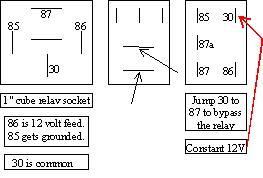
Terminals 30 and 87 are the contacts that are switched on and off. 12 volts on terminal 87 all the time is correct. That 12 volts will show up on terminal 30 when the relay is energized. Terminal 85 or 86 will have 12 volts when the ignition switch is turned on. I can never remember which one. If you have the relay plugged in and are able to reach the terminals with the meter probe, you'll find 12 volts on both 85 and 86. 12 volts is getting to the second terminal through the coil of wire in the relay. One of them gets grounded by the Engine Computer for one second after you turn on the ignition switch. It gets grounded again anytime the computer sees engine rotation, meaning cranking or running.

All of the testing you've done so far can be summed up with a single voltage reading. The relay has to be plugged in so you might have to fashion a thin piece of wire if necessary to reach the terminal. Measure the voltage on terminal 30. A test light works much better for this test for two reasons. First, most digital meters don't respond fast enough to catch quick pulses. Second, think of a compressed air line. All you need is a tiny pinhole through what is otherwise total blockage of the pipe, and you'll have full pressure on a gauge at the end of the line, but you'll never be able to get enough volume through there to run a tool. Similarly, all you need is any circuitry with really high resistance to let a teeny dribble of current through and the meter will pick that up as a voltage, but you'll never be able to get enough current through that resistance to do any useful work. A test light has very low resistance so it's going to draw relatively high current through the circuit. It can only do that and light up if the circuit is working properly. Also, we don't need to know the exact voltage at terminal 30. The test light is going to be off, (0.0 volts), dim, (insufficient voltage, but something), or bright, (enough voltage to prove the circuit is working).

There's two parts to this test. With the test light connected to terminal 30, it should be off. Now turn the ignition switch on. You should see a bright test light for one second, then it will go back off. You might hear the fuel pump's hum at the same time. That has just proven the circuit is okay and the Engine Computer has control over the relay. Next, crank the engine. The test light should turn on anytime the engine is rotating. If it does, move on to something else.

The only time a mechanic would do this test is if there was a fault code related to the "switched 12 volts is missing" and he wanted to verify that or see if the 12 volts was making it as far as the relay. That would instantly tell him if there could be a break in the circuit before terminal 87 or after terminal 30.
Sep 29, 2015 at 9:22 PM

Avatar
TIM BAKER
  • MEMBER
  • 17 POSTS
I did the test on the fuse box plug in for the Etax relay. What I dont understand is why is there power to 30 and 86 with the negative battery cable off and the multi meter black touching the negative on the battery and Red lead probing the female terminals on the fuse box, however when I do the same test with the cable hooked back up and the multi meter black to the battery negative once again I get completely different readings from 12 volts to zero. Im gonna give your test a try and see what results I get. Can I do this with the relay lifted enough to get the test lead on it? I seen a vid on youtube that showed this but just want to make sure.
Sep 29, 2015 at 10:48 PM
Avatar
CARADIODOC
  • CERTIFIED EXPERT
  • 34,306 POSTS
This is real hard for me to explain better without having a marker board to draw on. A better example might be to think about when you remove a battery cable to insert an amp meter. How can you get a reading of any current unless it is able to find a path through some circuitry on the car. Okay, now that we know there's some circuitry there, you're putting one meter probe on the battery's negative post, then the other probe on the negative cable that is attached to that circuitry and goes all the way around and back to the positive cable and battery post. In effect, you're measuring right across the battery, but with a pile of circuitry in between.

For all practical purposes, the voltmeter has extremely high resistance so it just measures electrical pressure, (voltage). No current actually flows through it. No air flows through a pressure gauge on a compressed air line. That's why it can measure full pressure when there's just that little pinhole in the blockage in the pipe.

If you tried to measure volume of air flow, you couldn't get any because of that blockage. You would not be able to run an air tool. The test light is that air tool. It needs current flow through it to make the filament light up. The circuitry in the car has way too much resistance to let enough current flow. That 's why where the voltmeter is showing 12 volts, the test light will show 0 volts. When you have the voltmeter connected and you're watching that voltage, it will drop to 0 volts when you put the test light across it.

You're right about lifting the relay out of the socket part way. All that's important is the terminals remain in contact with the terminals in the socket, otherwise it can't work. If you see the 12 volts show up on terminal 30, that can only happen if everything related to that relay is working. You can also stick a piece of wire in the terminal but you have to watch that it doesn't stretch the female terminal and cause an intermittent connection. That's a big issue with '90s GM relay sockets. Poking terminals with meter probes can cause the same problem.
Sep 29, 2015 at 11:50 PM
Avatar
TIM BAKER
  • MEMBER
  • 17 POSTS
On my fuse box there is a small hole next to the relay socket that works great for testing I can fit a test probe in it so it should fit a small piece of wire or even a piece of bent paper clip to make contact. I have to wait for it to warm up a tad before venturing out (33F here) and do your test before I get anymore confused. lol!

Sep 30, 2015 at 6:08 AM
Avatar
TIM BAKER
  • MEMBER
  • 17 POSTS
I hooked a small jumper wire into socket 30 replaced the relay turned on the key and it lit for about 3 seconds and went out however there is no light when it started. It did one time after a couple tries light for a split second and then lit when cranking and running though after that I only get the light on turning the key and nothing when running.
Sep 30, 2015 at 10:10 AM
Avatar
TIM BAKER
  • MEMBER
  • 17 POSTS
I tested socket 86 and got the same result as 30 a light for 3 sec and no light when cranking or running. Socket 87 is hot all the time and 35 I got nothing so I assume this is ground?
After re-scanning I got codes P0755 Shift solenoid A p0750 Shift solenoid B also P1768 Refer to service manual.
Sep 30, 2015 at 11:31 AM
Avatar
CARADIODOC
  • CERTIFIED EXPERT
  • 34,306 POSTS
First try swapping the relay with one of the other ones like it.

Next, what you described as intermittent operation suggests three likely possibilities. One is arced or pitted contacts in the relay. The next is intermittent loss of voltage feeding the coil of the relay. That is a Transmission Computer or wire issue. You said you replaced the computer already. The last suspect is the ground wire which seems like the best one.

Remove the relay, then use your ohm meter to measure the resistance between terminal 85 and ground. It should be real low, as in no more than a few ohms. If that appears to be okay, rig up your wire to measure the voltage on terminal 86 the way you did on terminal 30. This time it's a good idea to use the voltmeter instead of the test light. This is a very low-current circuit, and the driver transistor inside the computer may not appreciate being forced to pass enough current to run the test light.

For the moment we can assume the wire between the computer and terminal 86 is okay because you consistently saw the relay get turned on for a few seconds each time you turned on the ignition switch. What we want to see now is if that 12 volts stays there once the engine is running. Whether it stays or drops out will tell us which way to go next.
Sep 30, 2015 at 8:11 PM
Avatar
TIM BAKER
  • MEMBER
  • 17 POSTS
I did swap relays, I figured since it starts great I would use the relay for the fuel pump and got the same results and it still fired right up.I'm going to try the next test tomorrow.
Who would have thought being so confused could be so much fun! LOL!
Sep 30, 2015 at 11:04 PM
Avatar
TIM BAKER
  • MEMBER
  • 17 POSTS
I went out and tried the next test here is what I found

Socket 85 I have to insert the black probe in the socket and the red to the ground and all I get is a negative reading when it should read zero like when I tested it before hooking it up; If I hook it up the other way, I get nothing. Most likely my cheap digital tester soon to be replaced.

Socket 86 Key off 0.0 , key on 10.5 volts dropping off to 0.1 engine started around 2 volts


Oct 1, 2015 at 6:33 AM
Avatar
TIM BAKER
  • MEMBER
  • 17 POSTS
I bought another tester and here are the results
Battery voltage 11.89
RELAY IN KEY OFF
Socket 30 ---0.00
Socket 86--- 0.00
Socket 87 --- 11.8


RELAY IN KEY ON
Socket 30 ---11.8 dropping to zero and zero when running
Socket 86---- 10.5 Dropping off to 0.00 and zero when ruinning
Socket 87 --- 1.88

RELAY OUT KEY OFF
Socket 30 --- 0.00
Socket 86----0.00
Socket 87 ---11.8

RELAY OUT KEY ON

Socket 30-- 0.01
Socket 86---0.00
Socket 87 ---11.8
Oct 1, 2015 at 1:35 PM
Avatar
TIM BAKER
  • MEMBER
  • 17 POSTS
I also checked the continuity from socket 30 to the body and got 0.00 right away and the multi meter alarm went off so can I assume the ground is good?
Oct 1, 2015 at 7:05 PM
Avatar
CARADIODOC
  • CERTIFIED EXPERT
  • 34,306 POSTS
I think we're making some progress. Terminal 86 jumps to 10.5 volts, then drops to essentially 0 volts, which is correct, but it should go back up with the engine running. We have a problem there when it stays at 2 volts. It could be the computer is detecting a problem and is turning that voltage off on purpose to turn the relay off.

Terminal 87 must have 12 volts all the time. That comes right from fuse 15, a 20 amp, in the same computer module / fuse box as the transmission control relay. You posted:

RELAY IN KEY ON
Socket 30 ---11.8 dropping to zero and zero when running
Socket 86---- 10.5 Dropping off to 0.00 and zero when ruinning
Socket 87 --- 1.88

Unless you mistyped, you can't have only 1.88 volts on that terminal. The only thing that can cause that voltage when current is trying to flow is high resistance in that circuit. That would be like stepping on a garden hose a partially blocking it. As long as the nozzle is closed, you'll still have full pressure there. When you open the nozzle to turn on current (water) flow, the pressure, (voltage) will drop off. This is where a test light is more accurate. It needs current flow to operate where a voltmeter doesn't. Do this test again on terminal 87 with a test light. No matter what you do with the ignition switch, that test light should never go out. If it does, find that fuse 15 and test the voltage on it the same way. There will be two tiny holes on top for taking the readings.
Oct 1, 2015 at 7:47 PM
Avatar
TIM BAKER
  • MEMBER
  • 17 POSTS
Sorry it should have read 11.8 on socket 87 I will try the next test in the morning.
Oct 1, 2015 at 8:00 PM
Avatar
CARADIODOC
  • CERTIFIED EXPERT
  • 34,306 POSTS
Okay, terminal 87 is fine. It doesn't have a problem. The question now is why is terminal 86 dropping to 0 volts? My only guess at this time is the computer isn't happy about something so it's turning the relay off. What I would do next is remove the relay, leave the ignition switch off, then jump terminal 87 to 30. Listen for any clicking which would indicate there's nothing shorted in that circuit and things are trying to work. If you hear that, that's a good sign. If you don't hear anything, that's not a bad sign. If something is shorted, the 15 amp fuse is in there to protect the wiring.

If nothing goes up in smoke, remove the jumper, start the engine, then put the jumper back in. Along with all the other circuits that relay feeds, one line goes right back to the computer as its way of verifying the relay turned on when it expected it to, but it also wants to see it goes off when it's supposed to. If you leave the jumper in while you're cranking the engine, I suspect the computer will detect that, as far as it knows, the relay is stuck on, and therefore it has no control over it. By waiting to reinstall the jumper until after the engine is running, that will be avoided.

If everything seems to be okay, try driving the van to see if it shifts. With luck some other diagnostic fault code will pop up that may provide a clue as to where to look next.
Oct 1, 2015 at 9:17 PM
Avatar
TIM BAKER
  • MEMBER
  • 17 POSTS
jumped 87 and 30 got zero clicks
started the engine w/ relay out put jumper back in and relay back in test drove it and no shift however I did get the following codes
P0755 Shift solenoid B
P0750 Shift Solenoid A
P1767 Refer to service manual
P1768 Refer to service manual

Pin 87 i got a light that didnt change except it got brighter when the engine fired I assume this is due to battery charging?

Oct 2, 2015 at 1:38 PM
Avatar
CARADIODOC
  • CERTIFIED EXPERT
  • 34,306 POSTS
Now I'm going to have to refer you to a transmission specialty shop. I don't know if those codes set because the solenoids didn't respond due to the jumper wire wasn't in yet when the self-tests were performed, or if there is a problem with them or their wiring. You might want to measure the resistance on those wires to see if one is grounded or if there's an open circuit to one of them.
Oct 3, 2015 at 8:28 PM
Avatar
TIM BAKER
  • MEMBER
  • 17 POSTS
Thanks for all your help and input I really appreciate it. I found this link on testing the solenoid pack and from what I can find its dead. Heres the link to the test, can you tell me if its valid?
http://easyautodiagnostics.com/chrysler/3.3L-3.8L/transmission-code-p0755-tests-2
Oct 4, 2015 at 3:57 PM
Avatar
CARADIODOC
  • CERTIFIED EXPERT
  • 34,306 POSTS
That's an interesting site that I'm going to explore further later.

There's a few issues I have with the tests. That test is real basic and an open circuit is going to be one of the least likely defects to occur. First, besides testing for continuity between the two terminals, you have to consider that you're testing a big coil of wire and there's two things that can go wrong with it. They're having you measure for continuity but anywhere along that wire it can be grounded to the housing. Without researching a lot further, I don't know if that will set the same fault code, set a different code number, blow a fuse, or simply shut the computer down. So, . . . in addition to testing continuity, measure between either terminal and the housing. That should read infinite, (open circuit). If one reads open, the other terminal is going to read the same, but you can test it anyway to prove it to yourself.

The next thing to be aware of is they're saying normal resistance is between 0.5 to 9 ohms. That seems like an awfully broad range. If 9 ohms is normal, the coil could be half shorted and read 4.5 ohms, which they say is okay. A coil of half strength won't engage a valve reliably.

Next, remember that your meter leads will have perhaps as much as two to five ohms of resistance so you have to add that to your readings. A totally-shorted coil with 0.0 ohms resistance will appear to be okay if you don't factor in four ohms of resistance in the meter's leads.

I've never actually measured the resistance when diagnosing a problem like this. I have Chrysler's DRB3 scanner, and under the "Actuator Test Mode" it allows the solenoids to be activated by pressing a few switches. If you hear the solenoid click, or if you feel something happen when the engine is running, you know the 12 volt feed circuit is okay, the control circuit is okay, the solenoid is okay, and the computer's switching circuit has control over it. It isn't until there's no response with the scanner that you have to dig into the individual parts of the circuit.

The solenoids also have a mechanical side where it moves a valve. Just because the winding is okay electrically, the plunger might be sticking or the valve could be plugged and fluid can't get through. Since those are not electrical in nature, the computer won't detect an electrical problem and set an electrical-related fault code. Instead, when it activates a solenoid, it expects to see a corresponding rise in pressure from a sensor. If that doesn't occur, a different fault code related to that mechanical problem will be set, but it still requires the operation of an electrical sensor.
Oct 5, 2015 at 10:44 PM
Avatar
TIM BAKER
  • MEMBER
  • 17 POSTS
I stopped at the local transmission shop and they said the test I did should confirm the solenoid is dead. I got a new Borg Warner on ebay for 75.00 free ship so its worth a try. He did explain the transmission should be flushed first in case the fluid is contaminated and possibly plugged the screens in the old solenoid its no use ruining a new one. Its not too hard to flush it so Im gonna do this while I wait for parts to arrive.
Oct 6, 2015 at 5:00 PM
Avatar
TIM BAKER
  • MEMBER
  • 17 POSTS
Hey Doc!
I got it fixed!
A friend stopped by yesterday and we re-tested all of the recommendations that you posted, we found no continuity between the TCM and the relay which I did find before, so after unbolting the battery box and totally unplugging the wire harness and feeding it down below we traced the wire (White orange?) I found a break in the wire hanging by the coating just up from where I stopped removing the wire cover to find a break earlier. My buddy is a diesel mechanic and when he looked at the way the wire was bent he said it most likely broke due to not being wrapped first before being put into the wire loom and the wire was kinked from being stuffed in. We also figure that when I started tracing wires I may have pulled on the wires and caused the wire to make contact and give a false test when I tested the power above. I got it put back together and test drove it although it didnt seem to shift at first, it started to shift soft and then fine after a few stop and go's. I do recall the computer needs to learn the shift codes or something. I got it all taped up but didnt get the loom on yet that's tomorrow due to rain today.
Bad thing is I dumped over 200 in parts but a shop would have been over 300 so I still came out good in the end and I got some new parts that I dont have to worry about.
Thanks again for all of your help on this it was an adventure to say the least!


Oct 26, 2015 at 8:54 PM
Avatar
CARADIODOC
  • CERTIFIED EXPERT
  • 34,306 POSTS
Yippee! One in a row! Happy to hear it's solved.

You're right about the relearn procedure. If you had the Chrysler DRB3 scanner, there is a relearn sequence that can be done in the shop, but few mechanics use that because it's easy to do the normal way. After any transmission work, the vehicle gets a test-drive, and that's enough miles for the relearn to take place.

There are four clutch packs with steel and fiber plates that wear out over time just like in all transmissions. The difference is with the old ones, slipping between shifts gradually increased as those fiber plates wore out, and you'd have two or three years notice that was taking place. The shifts were just a little more mushy as the months went by. Chrysler was the first to use this design where the computer watches how many CCs of fluid it takes to apply each clutch pack. As the plates wear down and get thinner, it takes more and more fluid to fully apply the packs. It takes time to fill those assemblies with fluid, so to maintain the nice crisp shift quality, the computer learns to apply third gear, for example, just a fuzz sooner before releasing second gear. That gives third gear time to get fully locked up just as second gear is releasing.

Depending on the amount of wear in the clutch packs, before the relearn takes place, the transmission could feel like a dragster with a real hard shift quality, or it could be real soft and mushy. It takes about a dozen up-shifts over a few miles to complete the relearn process. Most people don't even know that's taking place. The Transmission Computer goes through the same relearn procedure after simply disconnecting the battery, at least that was the case in the '90s. Most newer computers retain much of their learning and programming when the battery is disconnected.

If you're interested, the DRB3 scanner will display the "clutch volume index", (CVI) to show how much life is left in the clutch packs. The updating of the shift schedules as you drive is what makes the shifts feel like when the vehicle was brand new, but since you can't go by feel anymore to get an idea of the wear, this set of four numbers shows the volume, in cubic centimeters, of fluid it takes to apply each clutch pack. An experienced transmission specialist can tell by those number how much life is left in the transmission. A lot of independent shops have the Chrysler DRB3 scanner because with an extra plug-in card, they could do emissions-related diagnostics on any brand of vehicle sold in the U.S. starting with '96 models. I suspect a lot of the better aftermarket scanners have this capability too.

The big disadvantage to this computer-controlled system is the shift feel is always nice and solid, . . . as long as the computer can keep updating when to apply and release each clutch pack. The time will come when it can't update any further because the plates are so worn, there is no amount of fluid that will make that clutch pack lock up solidly. You would never get that far with the older transmissions because the severe amount of slippage would be horrendously annoying. That slippage would cause a lot of excess heat to be generated which would damage a lot of other components. Once this computer can't update further, slippage occurs, that is detected by the computer, it sets a diagnostic fault code related to "gear ratio error", and defaults to "limp mode" which gives you second gear, neutral, reverse, and park. The problem is you go from shifting fine yesterday to limp mode today with no warning. You can get an extra couple of years out of the transmission, but try selling that as an advantage to the family in the middle of a cross-country vacation!
Oct 26, 2015 at 9:31 PM