Aftermarket radio

2001 GMC YUKON
260,000 MILES • 5.3L • V8 • 4WD • AUTOMATIC
Avatar
PACKERS27
  • MEMBER
  • 205 POSTS
This vehicle is the XL 1500 model. most diagrams show a couple of yellow wires but my harness does not have yellow wires but it has a few orange wires. I figured I would go ahead and throw that out there. Like a dummy, I cut the plug off from the harness and was going to wire a new harness on for my aftermarket double din radio. This radio comes with a rear view camera so there is a parking sensor wire. To make a long story short I am having a lot of problems. The factory harness has about thirty wires. The aftermarket radio has about twelve. Now I am going to have to try to put the harness back on the wires. I feel like if I do this and buy an adapter that goes from my original to the new then I do not think it is going to work because the original harness is not going to support the parking sensor wire. Is this correct? I do not know much about this. I figured I would go ahead and mention that this system does have a factory amp but I do not believe it is the Bose system. What my plans were was to leave the factory amp in there and let it run the original speakers but I was going to hook up my own amp and run a sub-woofer of mine in the back. Another thing is that the factory harness has a vehicle speed sensor wire so my speedometer total mileage and cruise control is not currently working. Are there certain aftermarket radios that has to support the VSS wire or will it work on any aftermarket radio? With all of this said, what is your advice?
Aug 27, 2017 at 2:51 PM
Advertisement
Avatar
STRAILER
  • CERTIFIED EXPERT
  • 53,855 POSTS
I am not sure what you are asking here what do you need help with?

Let me know

Cheers, Ken
Aug 30, 2017 at 9:05 AM
Avatar
PACKERS27
  • MEMBER
  • 205 POSTS
Will a double din aftermarket radio work in this vehicle?

What's the easiest way to wire the factory plug back on without screwing it up?

What kind of adapter do I need?

Where do I wire the parking sensor wire?

The radio is one of those cheap Chinese radios. 1078B or whatever
Aug 30, 2017 at 11:52 AM
Advertisement
Avatar
STRAILER
  • CERTIFIED EXPERT
  • 53,855 POSTS
Yes a double din radio should work. There should be a stereo wiring adapter that the company recommends like this one from Amazon for $14.00

https://www.amazon.com/gp/product/B06WGM5FXZ/ref=as_li_qf_sp_asin_il_tl?ie=UTF8&tag=2carprcom-20&camp=1789&creative=9325&linkCode=as2&creativeASIN=B06WGM5FXZ&linkId=189ecce6a461d2d72e286f5f7d0382a9

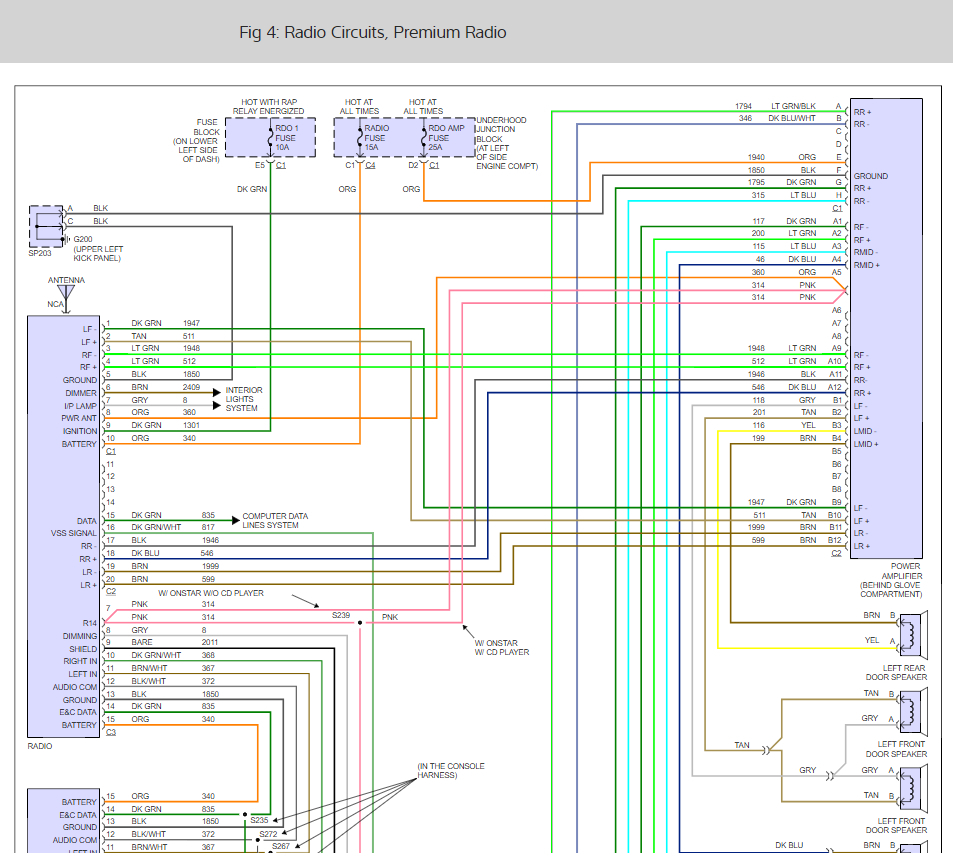
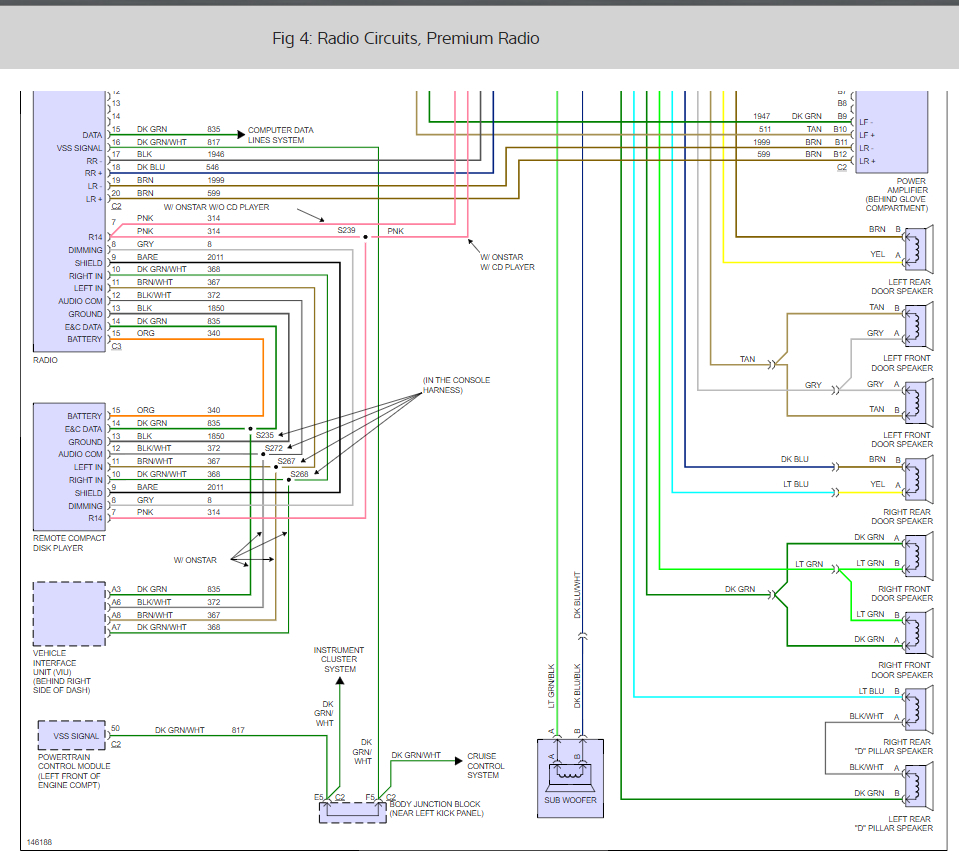
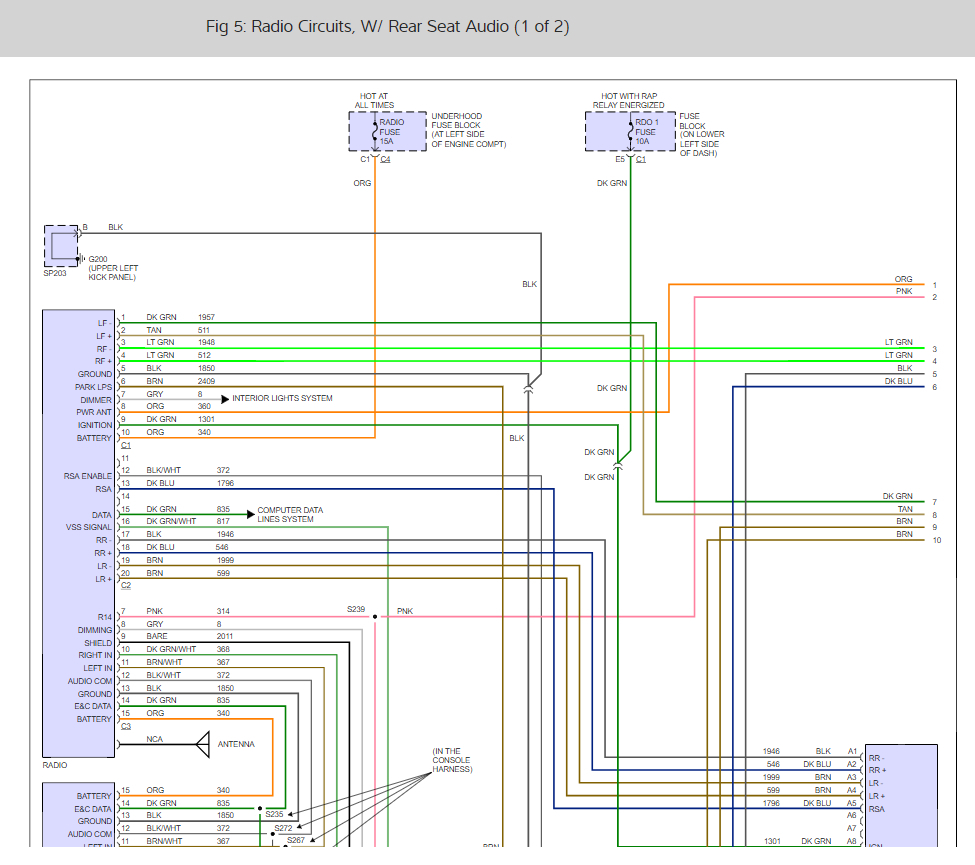
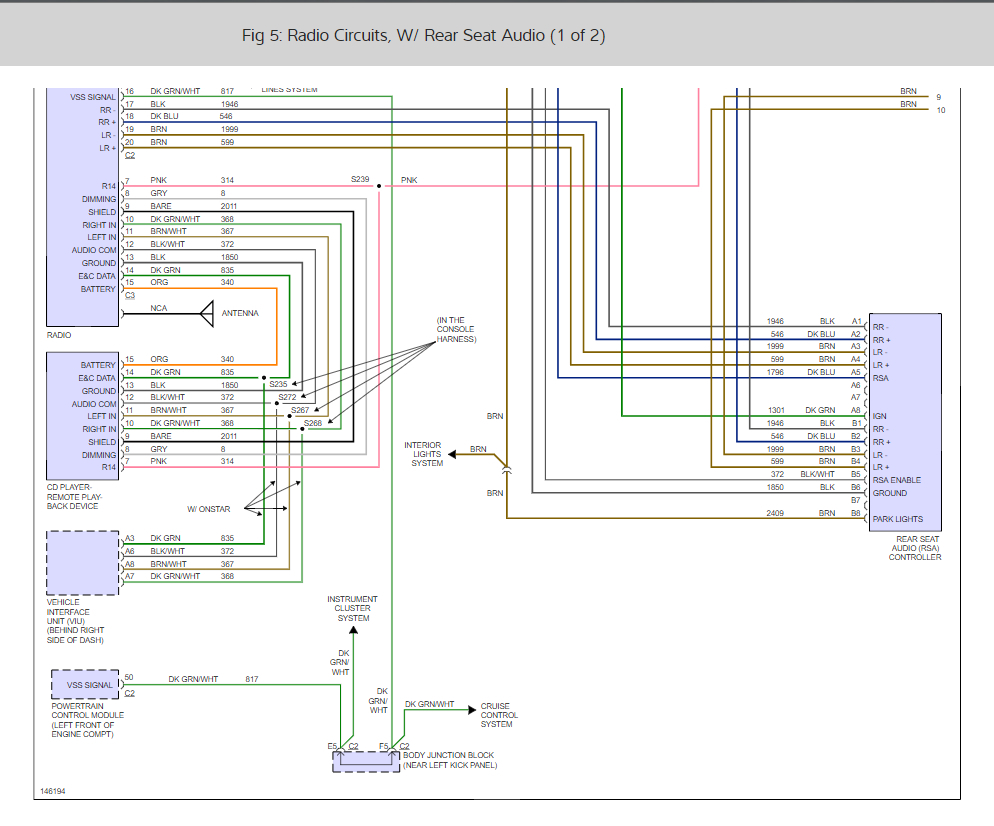
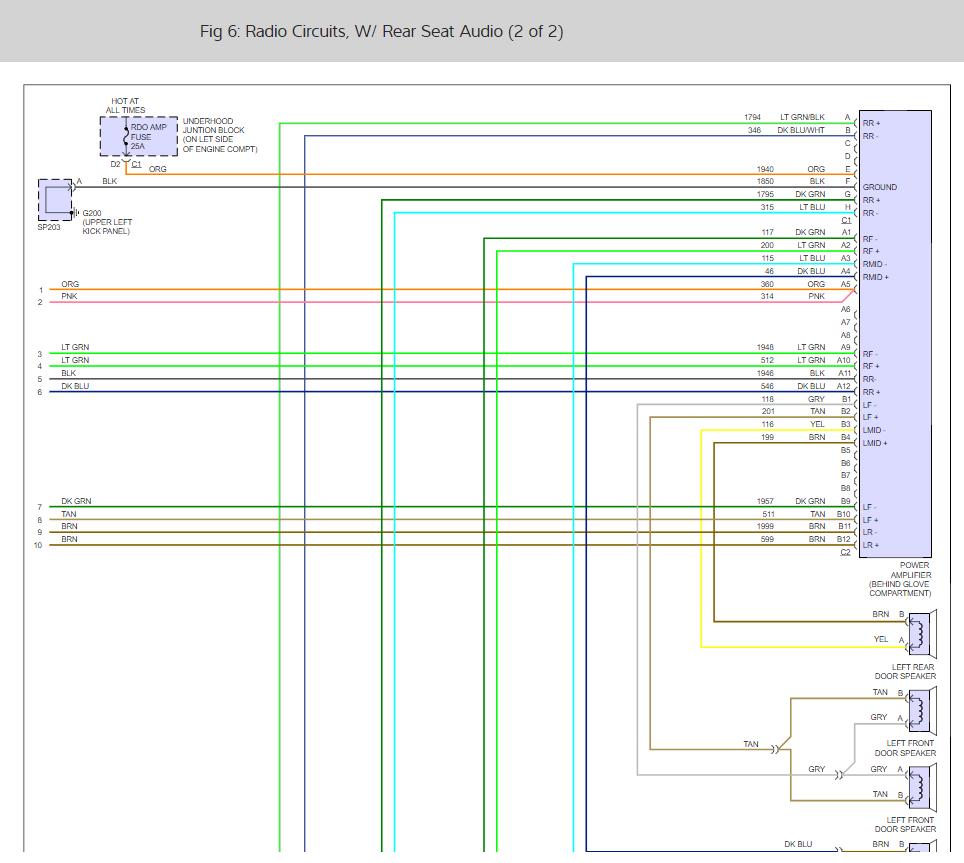
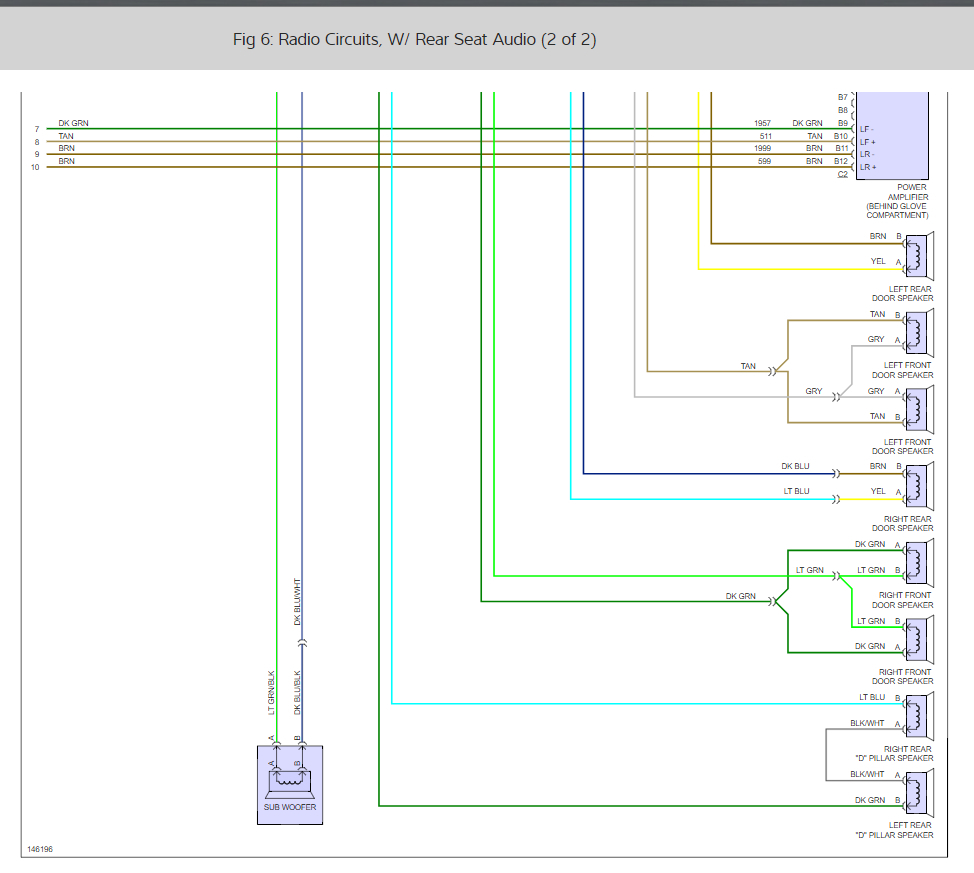
It looks like the wire to connect to the VSS is the dark green and white. Here is a wiring diagram for your car so you can do the job.

Sorry about the confusion earlier.

Please let us know if you need anything else to get the problem fixed.

Cheers, Ken
Aug 30, 2017 at 4:52 PM
Avatar
PACKERS27
  • MEMBER
  • 205 POSTS
Here's the thing. I don't have 2 color wires, besides the black with white's stripe ones. When you say dark green and white, all of my wires are solid color. Some wires are one size in diameter but there's others that are smaller. What's the difference in them?
Aug 30, 2017 at 5:16 PM
Avatar
STRAILER
  • CERTIFIED EXPERT
  • 53,855 POSTS
Can you take a picture so I can see what you are talking about?
Aug 31, 2017 at 9:26 AM
Avatar
PACKERS27
  • MEMBER
  • 205 POSTS
I don't even know what the harness is on the left. Like I said, I cut the plug when I shouldn't have
Aug 31, 2017 at 11:21 AM
Avatar
STRAILER
  • CERTIFIED EXPERT
  • 53,855 POSTS
Use the wiring diagrams to find and reconnect the wires to see what happens.
Aug 31, 2017 at 7:46 PM
Avatar
PACKERS27
  • MEMBER
  • 205 POSTS
I did that today and I'm not getting power
Aug 31, 2017 at 8:15 PM
Avatar
STRAILER
  • CERTIFIED EXPERT
  • 53,855 POSTS
Check you recheck the fuses maybe you popped one.
Sep 1, 2017 at 11:28 AM
Avatar
PACKERS27
  • MEMBER
  • 205 POSTS
Ok Will Do
Sep 1, 2017 at 12:19 PM
Avatar
PACKERS27
  • MEMBER
  • 205 POSTS
I bought a decent multimeter and quickly found the battery and accessory wire. I've got power to the HU.I should be able to scope out the negatives and positives of the speakers. Here's the big question. I want to use my factory Amp to power the existing door speakers. Will that work or will I have to bypass the Amp? Im also going to run my aftermarket amp and sub in the cargo area and may even replace the factory 8in sub and put it on the aftermarket amp. So what about the factory Amp?
Sep 5, 2017 at 6:14 AM
Avatar
STRAILER
  • CERTIFIED EXPERT
  • 53,855 POSTS
You can just remove it and run your aftermarket amp and wire it accordingly.
Sep 5, 2017 at 11:49 AM
Avatar
PACKERS27
  • MEMBER
  • 205 POSTS
You mean remove the factory amp completely and use my amp for all of the speakers? If I do that then I'll have to run speaker wires from every one, right? Doesn't it more more sense to just use the amp I already have, for that?
Sep 5, 2017 at 12:09 PM
Avatar
STRAILER
  • CERTIFIED EXPERT
  • 53,855 POSTS
Ya it would be easier to use the existing amp I thought you wanted to use the one you bought
Sep 6, 2017 at 10:49 AM
Avatar
PACKERS27
  • MEMBER
  • 205 POSTS
No. I just want to use my equipment to power a 12 inch aftermarket sub and stay in the left lane a 8-inch replacement sub that is going in the rear cargo area. some people talk about having to bypass the factory amp. I just want your confirmation that I don't have to do that to use it solely for powering the existing door speakers
Sep 6, 2017 at 12:03 PM
Avatar
PACKERS27
  • MEMBER
  • 205 POSTS
Ignore the 'stay in the left lane". My GPS picked up the sound.
Sep 6, 2017 at 12:07 PM
Avatar
STRAILER
  • CERTIFIED EXPERT
  • 53,855 POSTS
lol cool, the only thing that maybe an issue is that the aftermarket amp may pull more amperage than the stock unit so you may need to run a new larger gauge power wire to the amp from a good power source.
Sep 7, 2017 at 9:44 AM
Avatar
PACKERS27
  • MEMBER
  • 205 POSTS
Ok thank you
Sep 7, 2017 at 10:27 AM
Avatar
PACKERS27
  • MEMBER
  • 205 POSTS
Installing aftermarket HU and going to let the factory amp continue to power the door speakers. However, after powering HU and factory Amp, the only sound that comes out of the speakers is a whining noise. My understanding is that it's called an alternator whine. The sounds fluctuated with the accelerator.

My questions are, other than a bad ground, what could cause this whine. MOST IMPORTANTLY, shouldn't there still be some sort of music coming out, other than the whining? THOUGHTS?
Sep 13, 2017 at 11:50 AM (Merged)
Avatar
STEVE W.
  • CERTIFIED EXPERT
  • 15,113 POSTS
Sounds like you have a couple issues. Whine is 50% battery power issue and 50% antenna lead issue. To check where yours is coming from make sure the radio case has a good ground. Then take a wire attached to ground and just touch the center connector for the antenna. Whine goes away? = antenna cable shielding is junk.
To see if it's alternator is simple, connect a wire directly from the battery to the power feed on the unit. if the whine goes away or is greatly reduced it's from the alternator. You can get filters for the power feed at most stereo/electronics shops to eliminate it.

You might have sound unless the alternator feedback is killing the signal.
Do you hear anything if you turn the key to on but no engine running?
If not you have some mixed up wiring or the new head unit blew the inputs in the factory amp with a high signal levels.

What make/model of head unit? I'll see if I can find it's wiring diagram online and what you need to connect to the truck.
Sep 13, 2017 at 8:18 PM
Avatar
PACKERS27
  • MEMBER
  • 205 POSTS
It's 7018B. Cheap Chinese 2din. The wiring diagram is on the caseof the HU. I'm pretty sure I got some wires mixed up. Like a dummy, I cut the original harness. Also, there's no ground on the HU casing. I have it out in the open, working on it.

Also, I know I have an orange wire that's suppose to be the power antenna. What's the difference in that small wire and the black antenna cable that plugs into the back of the HU? I know it's for radio reception but what's the small power antenna wire?
Sep 13, 2017 at 8:57 PM
Avatar
CARADIODOC
  • CERTIFIED EXPERT
  • 34,306 POSTS
Allow me to add a few comments of value. The first has to do with the factory amplifier. All radios have a receiver section that picks out the station you want to listen to, and an amplifier that makes the signal loud enough so you can hear what the speakers reproduce. GM and Ford will often put that amplifier in a separate remote location. Without that amp, you'd be lucky to hear a very faint sound from the speakers when the volume was at maximum.

Some of their other models have the amplifier built into the radio. Everything works exactly the same way, but you have much less wiring to worry about. In short, when the original radio uses a remote-mounted amplifier, it MUST be used with that amplifier, and if it did not use a remote amplifier, it can not be used with one. To get technical for a moment, your speaker wires start out with 6 volts on them, then the amplifier runs them up as high as close to 12 volts, and as low as almost down to 0 volts, when at maximum volume. It can't go any further than that because the circuitry won't allow it to, and if you tried to, the signal would get cut off at 0 and 12 volts. You would hear that as extreme distortion. You wouldn't be able to stand to listen to that for more than few seconds.

Your new radio has an amplifier built into it already, AND, . . . if it has a pair of double wires with RCA plugs on the end, those come out before the amplifier. That means you can use the radio either way. What you can not do is run the new radio's speaker wires, which are already speaker-level output, through a second amplifier like you want to do, meaning the vehicle's original amp. Your radio's built-in amp is already driving the audio signal from 0 to 12 volts. The second amp would try to increase that to around more than 100 volts. Of course it can't really drive it to anything higher than the supply voltage, and that's where the really bad distortion comes in. Think of placing a step ladder on top of another step ladder. You're trying to get twice as high, but you're going to fall over before you achieve that. To feel stable, you're limited to one step ladder. To sound clear, you're limited to one amplifier, either the one built into the radio, or the remote amp, but not both.

At this point I need to add another comment for the people researching this topic. None of this wondrous information applies to Chrysler products. All Chrysler radios put out speaker-level output and will run speakers directly, AND they can be used with an additional remote amplifier or with the small amps built onto the speakers. All of those amps are only for tone conditioning for the shape of the vehicle. Chrysler amps do not increase power or volume. If you replace the factory radio with another one, at most you will need to turn the bass control way up or way down to sound right. Their higher-class Infinity radios put out less bass than normal, then it is made up in the amplifiers.

The orange wire you asked about is the "12 volt switched power" wire, but they call it something different to not confuse it with the "12-volt switched" coming from the ignition switch. It gets 12 volts switched onto it when the ignition switch is on, and the radio is turned on. That is the wire that tells the power antenna when to run up or down, AND it is the turn-on wire for a remote amplifier. This is not a power wire, as in powering your ear drum-blowing amplifier. That will have its own problems with getting enough current to function properly. That little orange wire will melt if you try to run anything on it. It is just a signal wire to tell other stuff when to turn on. Your truck's original amp has its own really fat ground wire, and a similar 12-volt feed wire that is always live. The amp turns on internally when that 12-volt signal comes in on the "turn-on" wire.

As has been mentioned already, you're better off using an adapter harness, but those are only going to take care of the two 12-volt power wires and the speaker wires. The truck's harness will have a tail light wire to tell the display to dim when you turn on the head lights, and a dash light wire to tell the display how much to dim. There will also be a pair of wires called the "data buss" for all the computers to talk back and forth to each other. The original radio used that for the speed-sensitive volume. Aftermarket radios don't use those so they won't be included in the adapter harness. Similarly, you car doesn't have a back-up camera, so there aren't going to be wires for that in the adapter harness. Those will have to have separate new wires run for those functions.

Getting back to the speakers, if your radio has those RCA cables, those are "line-level" output, which is too low to hear in a speaker. You should be able to run those to the original remote amp, but you'll have to connect the rear and front speakers together so the amp will power all of them. If your radio has four RCA cables, you should be able to use the front / rear fader function too.

For the generator whine, unplug the small plug on the rear / side of it. If the noise is gone, that is the source. If it is not gone, it's ignition system-related. As Steve W. mentioned, spark noise is being picked up by the antenna or by an antenna cable with poor shielding. That's the braided outer wire cover just under the first layer of insulation. It can also be picked up by the antenna if the base isn't making good contact with the fender sheet metal. If your antenna is a pair of fine black lines in the windshield, those often break leaving you with no antenna or a not much of one. All radios have circuitry that boosts its "gain" in an attempt to pull in a weak station. The drawback is when it has to work that hard, it also works that hard at finding sources of noise. That is a characteristic of AM radio. You won't hear most of that noise when you have a strong station tuned in.

You have one more serious issue to contend with. There is no way to sugar-coat it. GM went from having the world's second-best generator to by far the worst design ever, starting with the '87 model year. Due to their design, they develop huge voltage spikes that can destroy its internal diodes, its internal voltage regulator, interfere with computer sensor signals, AND send voltage pulses into the radio's power wires where it can show up as a loud whine. The original radios have an excessive amount of filtering to clean that up, otherwise they'd have a real lot of angry vehicle owners. The key component in damping and absorbing those harmful spikes is the battery. Do not do anything to degrade the connections between the battery's posts and the cable connected to them. A lot of people try to stuff new wires inside the cables, and clamp them in that way. We see that as starter problems when not enough current can get through, but even though the rest of the electrical system draws just a fraction as much current, the added resistance in the form of less-than-perfect connections impedes the battery's ability to dampen those spikes. I've seen people chase all kinds of elusive problems after adding their own make-shift wiring.

It is also real common for these generators to develop one failed internal diode of the six. That will reduce the generator's ability to produce its rated current to exactly one third of what it should be. 30 amps from the common 90-amp generator is not enough to run the entire electrical system under all conditions. The battery will have to make up the difference until it slowly runs down over days or weeks. These generators have a real high failure rate. It is not uncommon to go through four to six of them in the life of the vehicle. To reduce that number of repeat failures, when you need to replace the generator, always replace the battery at the same time, unless it is less than about two years old. It will work fine in an '86 or older model with the better generator. As the battery ages, the lead flakes off the plates, so there's less material to absorb those voltage spikes.

All AC generators develop three-phase output which is very efficient. There is always one phase coming up on producing its maximum output when the other two are going down. That results in a very smooth and steady voltage. Batteries like that. When one diode fails, one entire phase is lost. You'll get a pulse of voltage, (and current), a pulse of voltage, then a gap where voltage falls to perhaps as low as four to six volts. That is called "ripple" voltage, and in this sad story is extremely high. A good battery helps to smooth that out. That ripple voltage can be seen in the entire electrical system, including the two power wires for the radio. Imagine turning the radio on and off real fast, and what that would sound like. High ripple voltage is like doing that 1,000 times per second, and that is real easy to hear as a whine in the speakers. It will increase in frequency, (pitch), when you speed up the engine.

Noise radiating in from the ignition system is not affected as much by engine speed. With generators, you're getting a steady series of pulses that increase in number when the engine speed increases. More pulses per second means higher pitch. With spark noise, it's true you do get more pulses per second when you increase engine speed, but with that system, you get a pulse, then a gap, more gap, . . . wait for it, . . . still more gap, then finally another pulse. Think of this as a single pulse of real low frequency, then you just get more of those single pulses when engine speed increases. Usually you'll hear spark noise as a low-pitched growl that only gets louder when engine speed goes up, not higher in pitch.

For my final comment of value, a lot of people ask about installing a larger generator to power add-on equipment. That is possible when there were multiple optional sizes for your application, either when the truck was built, or if one became available years later, but there are some things to consider. In the past, as in the '70s and '80s, there could have been a 45-amp generator as standard equipment, a 60-amp if the vehicle had options that required it, and even an 80-amp for police vehicles. My '80 Volare has $500.00 worth of factory-added plastic trim panels, and an AM / FM radio. That warranted a bigger alternator. (Alternator and AC generator are the same thing. To use correct terminology, Chrysler copyrighted the term "alternator", but everyone will know what you mean when you use that term). The output wire going back to the battery is large enough to carry the maximum current any available generator can produce. As a related point of great interest, AC generators are physically incapable of developing more current than they are designed for. No matter which generator you upgrade to, the output wire can handle it. Where the problem comes in is there is a fuse in that wire. AC generators have two sets of three diodes, six in total, at a minimum. If one shorts in each set, you'll have a direct short from the battery's positive post to ground, and a real lot of smoke and excitement. On those older cars, the fuse was in the form of a fuse link wire spliced into the output wire, usually near the battery. While the output wire is large enough to handle any generator, the fuse link is not. Its size is selected at the factory based on the size of the generator being installed. The other point you need to understand is the generator will only develop the amount of current the electrical system needs at that instant, and no more. If you have a 90-amp generator, and the electrical system needs 37 amps, it is going to develop exactly 37 amps, regardless of engine speed. If you install a 120-amp generator, and the system still needs 37 amps, you are still only going to get 37 amps. Think of your air compressor. If your tool is drawing one cubic foot of air per minute, that's all the air that's going to flow through the hose, even though the compressor has the capability of producing more. If you switch to a larger compressor, that tool is still only going to draw one cubic foot per minute.

Where this great and exciting story becomes important is while it's true you won't get more current simply by installing a larger generator, you WILL reach its maximum current during an output current load test. Along with ripple voltage and charging system voltage, the full-load output current test shows if the generator can develop its rated maximum current, one third of that value due to a failed diode, or 0 amps due to some other defect. That test requires a professional load tester, and it only takes a few seconds; just enough time to read the display. The problem is that fuse link wire. Up to now you had the capability to produce a higher amount of current, but that never actually happened because the electrical system didn't need it. If you had installed a larger generator, NOW is when that higher current will be produced during that brief full-load test. On the older cars with fuse link wires, those take some time to burn open, just like delayed-action fuses in your house, for motors. Fuse links are simply a short section of smaller diameter wire that makes it the weak link in the chain. The secret though is their insulation is designed to not burn or melt. You buy replacement pieces by the insulation's color to denote its current rating. Due to its delayed action, they usually survive that short burst of high current during the full-load output current test, as long as it only takes a few seconds. With a truck as new as yours, you are more likely to have a regular fuse bolted into the under-hood fuse box. Those do not have the time delay characteristic. That fuse size is selected at the factory based on the size of the generator that was installed there. You won't have a problem as long as no one performs the full-load output test, . . . or you don't add something that draws a ridiculous amount of current, (amplifier loud enough to entertain the entire neighborhood).

When the generator is upgraded to one with a higher current capacity, we needed to replace the fuse link wire with one appropriate for that unit. Fortunately those were listed in the wiring diagrams, so it was easy to know which size to get. The problem now is it isn't always as simple as bolting in a larger fuse. Cost of material is such a big concern that they typically don't put in an output wire that can handle any generator. If your truck came with a 90-amp generator, the output wire is just large enough to handle around 100 amps, but not for very long. If the truck came with a 120-amp generator, it would have come with a slightly larger output wire. If that bigger wire wasn't needed, you would have gotten the smaller wire to save on cost. Now you have a problem when upgrading to a larger generator. The irritating thumps from your amplifier draw a real big pulse of current; much more than when playing the high notes at the same volume. If you don't upgrade the output wire to a larger size, the current will still get through, and since the pulses are intermittent, the wire likely won't overheat, but it's a sad fact that all wire has some resistance in it, just like every hose and water pipe has some resistance in it. If they didn't, opening a fire hydrant would cause the municipal water tower to empty instantly. In reality, the resistance in the pipes results in the water pressure in the hose being a lot lower than the pressure in the tower. Voltage is electrical pressure. When there's resistance in the output wire, it limits the free flow of current in that wire. Using a large diameter wire makes its resistance too low to be noticeable in that circuit. But when you add more loads, (amplifier), that high current causes some voltage, (pressure), to be dropped across that wire. The generator might be putting out 14.5 volts, but after going through all that wire, you might end up with 13.0 volts at the amp. The bigger problem is since the current flow is pulsing in time with the "music", the voltage at the amp is also pulsing up and down. That shows up as distortion. As the supply voltage pulses up and down, so does the volume. (Sure took a long time to get to that explanation). Some people will add large capacitors to smooth out those voltage fluctuations, but to be effective, they have to be right next to the amp, not up front by the generator. This would be similar to adding a small water storage tank to a pump in a well. That tank allows the pulses of current, (water flow), to occur while maintaining a smooth, steady pressure in the rest of the system.

Too many people think loud is the final goal, and everyone will appreciate the music, but they forget about clean, crisp, clear sound that is pleasing to listen to. Achieving that requires eliminating all those sources of distortion.
Sep 14, 2017 at 1:06 AM

Avatar
PACKERS27
  • MEMBER
  • 205 POSTS
It's sounds like no matter what I do, it's not Gonna work right, due to the alternator? So in order to get sound back in this truck, what's the easiest route? Use the amp that's behind the glove box or use my aftermarket 800 watt Amp? Either way you think, can u give me some info on how to get this done?
Sep 14, 2017 at 6:39 AM
Avatar
PACKERS27
  • MEMBER
  • 205 POSTS
From my understanding, the pink wire is the factory amp turn on wire. I wired it to the ignition turn on. That's when the whine happens. As soon as I disconnect the pink wire, it stops
Sep 14, 2017 at 7:37 AM
Avatar
STEVE W.
  • CERTIFIED EXPERT
  • 15,113 POSTS
I show an Orange as amp power for one option, Dark Green with another option and
Pink as feeding the signal to the onstar system.

If it was me I would simply remove the factory amp, Wire in the aftermarket unit and call it a day. I might use the factory speaker wires but I would plan on replacing all of the speakers as well. The OEM ones don't like power.
Sep 14, 2017 at 9:58 PM
Avatar
CARADIODOC
  • CERTIFIED EXPERT
  • 34,306 POSTS
I suspect you're turning the amp off when you disconnect the pink power wire, so no sound, including the whine, is going to get through to the speakers. The amp will work that way being hooked to the ignition switch, but it will be turned on anytime that switch is on. The reason it was hooked to the switched wire from the radio is so it would be off when the radio is off, even if the ignition switch is on. The circuitry coming from the ignition switch is not filtered to eliminate that whine. You won't know it exists by running the heater fan, wipers, or power windows. The two power wires feeding the radio DO have filtering inside, in fact, quite a lot of filtering. The switched wire coming out of the radio will also have that whine filtered out.

Keep in mind there's two things to look at for a whine. The first is to prevent it from ever occurring, and the second is to filter it out when it does occur. If your battery is three or four years old, try installing a new one. Have the charging system professionally load-tested to be sure the generator is able to develop its full rated current, and that ripple voltage is low. Whine is the result of excessive ripple voltage which is a problem with '87 and newer GM generators, and is even worse with a failed diode. Load-testing will identify if there's a failed diode.

If you identify the cause of the whine, . . . lets say it's the battery, put the old one back in so the whine returns, then work on eliminating it at the end of the line. Move the amp's turn-on wire to the radio's switched 12 volt wire instead of the ignition switch. Add a second ground wire between the radio's case and the body sheet metal. Unplug the antenna or play a CD. If the whine goes away with the antenna unplugged, it's being picked up by the antenna, not in the power wires.

Once you figure out how to filter out the whine at the radio / amp, go back and do what you did to eliminate it at the source, (replace the battery, for example). That way you will have solved it twice. The whine won't be produced, and the filtering will stop any whine from being heard.

As for how to proceed, I had a really nice-sounding home stereo system in the mid '70s that put out 10 watts per channel. With the speakers placed just right, the stereo sound sent shivers up my back. Later I bought a receiver rated at 50 watts per channel that also sounded great. I burned that one up in a house fire three years ago. I've been watching for one like it on eBay ever since. I hate all the new stuff with the ugly black faces with lettering so tiny, I need a microscope to read the functions, and I have no use for most of their "features". I couldn't stand to turn the volume up more than about half way, so what in the world would anyone need 800 watts for? The thumping bass the youngsters like sounds like a dump truck rolling down my highway. Inside, it doesn't sound natural. The worst-quality sound you can get is at a live rock concert. It's too loud to enjoy or to be pleasing, but that volume masks singing off key and other mistakes. Recorded music is much cleaner, and it should be pleasing to listen to and make you feel good. The loud, booming bass is out of proportion to the high notes and the singing. Why would anyone want to purposely distort the tone response by doing that? The most expensive and highest-quality audio equipment can advertise their tone response is perfectly flat over the entire human hearing spectrum, meaning the circuitry amplifies every frequency exactly the same amount.

To address your concern about the amp, the manufacturers put a real lot of research and development into designing their audio systems to sound good. Chrysler only has a few radio models, but a lot of different amplifiers and speakers to tailor the tone response to the vehicle. GM has a lot of different radio models that all look and work the same, but each one has different output circuitry to adjust the tone response. No generic aftermarket radio is going to improve on that except in a few applications here and there. Those radios are not designed with any one body shape in mind. GM truck radio systems are totally different from their car systems, and nothing interchanges. That means they had to design everything twice, at twice the cost, but they did that because they knew one system wouldn't sound good in the other application.

Of course that's not to say an aftermarket radio can't sound really good. The secret is there is a range of volume where we hear the clearest with the most detail. That is when the sound is loud enough that we don't have to strain to hear it, and it's not so loud that it gets mixed with delayed echoes bouncing off the windows. Radio manufacturers concentrate on building quality radios. Truck manufacturers concentrate on building trucks, and they spend less resources on keeping us entertained.

My vote is to keep all of the original system, which is a huge improvement over the single-speaker AM utility radios from the '60s. As a bonus, when you get to be my age, you'll still have great hearing. If that doesn't excite you, my next choice would be an aftermarket AM / FM / CD player with upgraded speakers. Don't try to make this as nice as a home audio system. In your house you don't have background road noise, engine noise, and wind noise. How much the original remote amplifier increases power and volume has to be matched to the original radio and the amount of power it puts out. That variable likely will be different than that of an aftermarket radio, meaning you won't want to use a GM amp with an aftermarket radio, unless that radio is specifically designed for that application. All audio signals from a radio have to go through an amplifier, and your aftermarket radio has the right one built in. It will do a dandy job of delivering clear and peasant sound, . . . as long as you listen to good music.

To pursue the aftermarket option, you can snip the speaker wires off at the original amp, then extend them to run to the new radio. I can help by finding which wire colors go to which speakers. As an alternative, you should be able to find an amplifier bypass junction connector that just plugs in at the amp's connector. That will connect the input wires to the output wires, then you connect the new radio's speaker wires right to the wires that were plugged into the original radio. This is easier to describe than to do. A cheaper but more time-consuming alternative is to snip all the wires at the amp, two at a time, to splice the left front positive input wire to the left front positive output wire. You'd have to do the same with the seven other pairs of wires too. Another potential clinker is the truck could have six speakers instead of just four. There may be one in each front door too. Typically those would be spliced in with the front dash speakers.

My least favorite choice is to install an aftermarket radio with an aftermarket amplifier. You have a radio and amplifier now. There isn't much to gain by throwing the radio and amp out, and replacing them with a radio and amp.
Sep 14, 2017 at 10:17 PM
Avatar
PACKERS27
  • MEMBER
  • 205 POSTS
Ok. I'm gonna go with Caradiodoc and just use my factory Amp. Here's the biggest thing I need to be educated on. I have a decent multimeter. How do I diagnose what wires are what by using the multimeter? Can I pin point all of them individually with a multimeter? Id like to know how to do it to the speakers without taking the door panel off and looking at the speaker. Remember, I cut the harness
Sep 15, 2017 at 1:19 PM
Avatar
PACKERS27
  • MEMBER
  • 205 POSTS
Also, by having this aftermarket radio, it won't work with the factory amp? If not, what if I bought a used oem radio for it,. Will that work?
Sep 15, 2017 at 2:26 PM
Avatar
CARADIODOC
  • CERTIFIED EXPERT
  • 34,306 POSTS
You didn't say why you're doing this conversion. If the original radio quit, there's two things to consider. First, all through the '90s, GM had a 100 percent failure rate on their CD player lasers. The fix is to send it to one of the authorized repair centers, but they don't actually repair anything. They just pop in a whole new mechanism, which insures it will work right, but you likely will have the same problem in a few years. This is why aftermarket radios were so popular. To combat that, starting with 2002 trucks, GM built the Body Computer into the radio so it had to remain in the truck. The aftermarket industry fought back with "radio relocation kits" that let you mount the original radio under the seat, then cut the speaker wires and run them to the new radio.

You should still have a three-piece radio with the control head, receiver box, and amplifier, plus a remote cassette player or CD player if you have one of those.. All the common problems, other than the CD laser problem, occur in the receiver box. Those are not expensive to have repaired or to buy used. A typical repair charge is around $40.00. You can also find plenty of used ones at salvage yards, but there are a number of versions. Some have AM stereo, some do not. I don't know what all the other variables are, but all of these boxes interchange and will work with any truck control head. The common clue to a receiver box problem is the cassette or CD player will still work.

To add to the confusion, another version of GM's three-piece system puts all of them into one assembly, but they're still separate pieces bolted together. It looks just like the older radios with the volume and tuning knobs on the left side. Those can still use a remote amp, but as I recall, I think the amp only runs some of the speakers.

If you can't see any of the old wires in the dash, you'll need to open the harness up until you find enough of the wires to splice and solder to. If it comes to that, just snip the plugs from a truck in a salvage yard, then the colors will be the same and you won't have to worry about the locations of those wires in the plugs.

To identify the wires by function, you can only do that for the power wires. The 12-volt memory wire for the station presets and clock will have 12 volts all the time. The switched 12 volts from the ignition switch will only have 12 volts when the ignition switch is in the "run" or "ACC" position. Ground wires get a little trickier. A lot of people cause problems when trying to find them with a meter, especially on Chrysler products, because there is no ground wire in their plugs, at least up through all '98 vehicles and a few models to 2003 models. You will have a wire that gets 12 volts on it when the running lights are turned on. That tells your display to dim. Another wire gets from 0 to 12 volts depending on where the dash light dimmer is set. That tells the display how much to dim. This gets even more complicated on vehicles that use "pulse-width dimming". You meter's display will go wild trying to read that. If you're using the resistance part of your meter to find the ground wire, it will read very few ohms to ground, but so will those two lighting wires. The running light wire reads real low resistance to ground through the tail light bulbs, and the dash light wire reads low resistance through the instrument cluster and heater control bulbs, then to ground. If you use either of those circuits for the radio's ground wire, that circuit will be shorted to ground through the radio's metal case, then through any metal mounting brackets that bolt to the body, or through the outer shield around the antenna cable.

If you did not have an amplifier, you could use your ohm meter to find the speaker wires. Measure between two wires, and try different combinations until you find two that give you a reading of around ten ohms or so. If your meter uses a nine-volt transistor battery or four "AA" cells, you will hear the scratching in the speaker to tell you which speaker those wires are for, Since you do have an amplifier, continuity tests don't feed through the amp, although come to think of it, I never tried that after forcing the amp to power up. I assume it would work, but it's much easier to have us here to find the wire colors and list them for you. The only thing the resistance test can't tell you is which speaker wire of the pair is the positive and which is the negative. Mixing those up will have effect, and I guarantee you will not hear the difference. All that happens when one speaker's pair of wires are mixed up is the speaker cone vibrates out while the other one vibrates in. Audiophile purists will tell you they can hear the difference, . . . in a home setting where everything is perfect. In the truck, you can't control the variable of your exact seating position for that "phasing" to be of any practical value.

I used to have these colors memorized, but brain-fade has taken hold so I deferred to one of the wiring diagrams so you don't have to do the trial and error thing.

Orange: 12-volt memory (constant)
Dark green: 12-volt switched
Black: ground
Dark green: LF-
Tan: LF+
Light green: RF-
Light green: RF+
Brown: LR-
Brown: LR+
Black: RR-
Dark blue: RR+
Orange: Power antenna or amp turn-on signal
Gray: Dash lamps
Gray: Display dimming

You can see there's a lot of duplicated wire colors. You'll need to test for 12 volts or continuity to figure some of them out. If there's a cassette player built into the radio, and a separate CD player, that CD player will be connected with its own 15" cable that doesn't go into the harness. You can leave that disconnected until you get everything else working.
Sep 15, 2017 at 6:48 PM
Avatar
PACKERS27
  • MEMBER
  • 205 POSTS
Ok. will my aftermarket radio work with the factory amp
Sep 15, 2017 at 8:31 PM
Avatar
PACKERS27
  • MEMBER
  • 205 POSTS
If I only get 1 speaker hooked up, should u hear it through the speaker or do they all need to be wired in first?
Sep 15, 2017 at 8:34 PM
Avatar
CARADIODOC
  • CERTIFIED EXPERT
  • 34,306 POSTS
I covered the likely mismatch between a generic, one-size-fits-many aftermarket radio's output level, and the manufacturer's proprietary input level required by their amplifier in a previous installment of this novel. This might work okay, but you could end up with the volume too low or it could be too high and cut off, meaning lots of irritating distortion. The line level output of the new radio, (those RCA cables), put out an industry-standard audio level, and aftermarket amps are designed to need that same standard level for their inputs. Together they produce just the right volume so there's no distortion. They're a matched set. One of the things car manufactures are famous for, especially GM, is designing their systems to work as a set, but specifically NOT to work with anything aftermarket. They don't want you replacing anything with something they didn't sell you.

Also, most aftermarket radios only have two RCA output cables, a left channel and a right channel. The left one can be connected to the amplifier's left front and left rear circuits, but you won't have a fader control to adjust that. If your radio has four RCA cables, then you can connect them to the amp's four inputs, but again, the volume might not be right if that is the original amp.

To get the project started, you only need to connect one pair of wires for one speaker, then you can listen if it sounds right. It is not uncommon to hear distortion at high volume with any system, but you should be able to adjust the volume control at least half way and it still sounds clear.

Not to confuse the issue, and you can ignore this wondrous comment, but when you're working with a radio's or an amplifier's output circuitry that goes to the speakers, a lot of those output circuits can be damaged by running them with no speaker connected. This doesn't apply to those RCA cables because those are real low power. It shouldn't apply to your new radio either because it is designed to be used with just the RCA cables. The point is it is standard practice to avoid running the volume up real high when some output circuits don't have a speaker connected.
Sep 15, 2017 at 9:41 PM
Avatar
PACKERS27
  • MEMBER
  • 205 POSTS
Why would I be using my RCA's just for door SPEAKERS?
Sep 15, 2017 at 10:47 PM
Avatar
PACKERS27
  • MEMBER
  • 205 POSTS
I have a shield wire in the 9 pin secondary harness. What do I do with that? It's bare. No coating
Sep 16, 2017 at 7:47 AM
Avatar
PACKERS27
  • MEMBER
  • 205 POSTS
Also, u said the pink was the amp turn on. Orange wire is same thing?
Sep 17, 2017 at 10:31 AM
Avatar
CARADIODOC
  • CERTIFIED EXPERT
  • 34,306 POSTS
One of the orange wires provides the turn-on signal to tell the power antenna to go up and / or the remote amp to turn on. There is no pink wire in the factory harness.

When you elect to use a remote amp, you use the radio's wires with the RCA plugs. Those send out "line-level" audio signals which are too low to run speakers. They have to go through an amplifier first, then to the speakers. When you use the radio's speaker wires, the audio has already gone though an amplifier built into the radio, so those wires run speakers directly. You can use it either way, or with a combination. The RCA cables can feed an amp that runs some of the speakers, and the radio's speaker wires can feed other speakers directly.

I don't know what the bare wire is for. If it's a braided cable around another wire, that is a shield to keep out interference. A bare braided cable can be grounded or can be allowed to touch ground, but the wire inside can not be grounded.
Sep 17, 2017 at 5:31 PM