2000 Honda Accord No power to headlights

2000 HONDA ACCORD
10,000 MILES • 3.0L • V6 • FWD • AUTOMATIC
Avatar
DEMATTA
  • MEMBER
  • 14 POSTS
I turn the headlight switch on and all the lights except the low and high beams work. I've checked the fuses and both have no power to them. The light relays have power going to them and when I put a test light on the relay pins and the switch is on the lights turn on. It seems like it's a ground but which ground is it?
May 21, 2015 at 5:58 PM
Advertisement
Avatar
CARADIODOC
  • CERTIFIED EXPERT
  • 34,306 POSTS
Boy, it's amazing how complicated the insane engineers can make such a simple circuit. There's at least two computer modules involved in turning the headlights on, but from the diagram I can't tell how they operate or when a certain point should or should not have voltage. We should be able to figure it out though if you can get to the terminals in the relay sockets and you have that test light.

There's four completely different circuits. You have to tell me if your car has daytime running lamps and whether it has "auto-off" headlamps. I guess that's for people who don't know how to turn them off or can't be bothered to do so!

I'll be here for at least another hour waiting for your reply, otherwise I'll be back tomorrow.
May 21, 2015 at 8:55 PM
Avatar
DEMATTA
  • MEMBER
  • 14 POSTS
Thanks for helping me out. And no my car doesn't have daytime running lights
May 22, 2015 at 5:51 AM
Advertisement
Avatar
CARADIODOC
  • CERTIFIED EXPERT
  • 34,306 POSTS
Do you have the "auto-off" feature?
May 22, 2015 at 3:48 PM
Avatar
DEMATTA
  • MEMBER
  • 14 POSTS
No
May 22, 2015 at 3:49 PM
Avatar
CARADIODOC
  • CERTIFIED EXPERT
  • 34,306 POSTS
Okay, . . . turn the headlight switch on, then find the two relays under the hood. Remove one and plug it back in. While doing that, feel if it clicks when you pull it out and put it back. Do the same thing with the second relay. If you feel the clicks, that will tell us that part of the switch is okay, the 12 volt feed is okay, and that circuit's ground is okay.

I'm going to keep studying the circuit while you do that.
May 22, 2015 at 4:14 PM
Avatar
CARADIODOC
  • CERTIFIED EXPERT
  • 34,306 POSTS
Next step. Try the "flash-to-pass" feature. I'll bet that works. If it does, most likely part of the headlight switch is bad.
May 22, 2015 at 4:29 PM
Avatar
DEMATTA
  • MEMBER
  • 14 POSTS
When I was testing the relays I would take the relays out while the switch was on and they never clicked. At first I thought it was the switch so I got another one and the same thing happens.
May 22, 2015 at 4:42 PM
Avatar
CARADIODOC
  • CERTIFIED EXPERT
  • 34,306 POSTS
Does the flash-to-pass feature work?
May 22, 2015 at 4:49 PM
Avatar
DEMATTA
  • MEMBER
  • 14 POSTS
IM not familiar with the flash-to-pass method
May 22, 2015 at 4:51 PM
Avatar
CARADIODOC
  • CERTIFIED EXPERT
  • 34,306 POSTS
The flash-to-pass is activated by pulling the dimmer switch to the "high" position, then releasing it. The high beams will light up as long as you hold the lever that way.
May 22, 2015 at 5:43 PM
Avatar
DEMATTA
  • MEMBER
  • 14 POSTS
No that doesn't work either. Like I said earlier both low and high beam fuses are dead. There's literally no power going to them.
May 24, 2015 at 7:55 AM
Avatar
CARADIODOC
  • CERTIFIED EXPERT
  • 34,306 POSTS
There won't be any voltage on those fuses until the relays turn on. There's two switches that will turn those relays on. One is part of the head light switch and the other one is half of the pass-to-flash switch. If the flash-to-pass doesn't work, that leaves out the head light switch as the culprit. There's either going to be a broken wire between those relays and the head light switch assembly, or there's no voltage to the relays.

I have to get to a different computer to access the wiring diagram again, but for now, remove one of the relays, then test for 12 volts in the socket. Two terminals should have 12 volts all the time.
May 24, 2015 at 9:59 AM
Avatar
DEMATTA
  • MEMBER
  • 14 POSTS
I've checked the terminals and the most voltage I got was 00.6 on both relay terminals.
May 25, 2015 at 8:42 AM
Avatar
CARADIODOC
  • CERTIFIED EXPERT
  • 34,306 POSTS
Each relay has four terminals, and two in each socket should have 12 volts all the time. If they do not, there is only a 100 amp fuse feeding them, and if that is blown, lots of other things won't work either.

Touch the test light's probe to the battery's positive terminal to be sure it's working and has a good ground. If it lights up, touch it to all eight relay socket terminals. It should light up on four of them. If it does not, look for that 100 amp fuse. Fuses that large are usually bolted in so those provide nice test points. If you have 12 volts on both sides of that fuse, there is only one other thing between there and the relays. That is something listed as "ELD". I have no idea what that is but by the way the diagram is drawn, it is not something that is simply plugged into the fuse box. It appears to be built as part of the fuse box. If it comes to that, I'll have to try to figure out what that is.
May 26, 2015 at 12:40 PM
Avatar
DEMATTA
  • MEMBER
  • 14 POSTS
So I re-tested the voltage on the relay terminals and on relay 1 I get close to nothing, on relay 2 I get all 12v. I put the test light on both relays and they both have power. If it makes any difference I tested both with the ign on switch on.
May 27, 2015 at 7:59 AM
Avatar
DEMATTA
  • MEMBER
  • 14 POSTS
Both relay terminals
May 27, 2015 at 12:03 PM
Avatar
CARADIODOC
  • CERTIFIED EXPERT
  • 34,306 POSTS
So if I understand correctly, . . . uhm, . . . I'm confused.

"on relay 1 I get close to nothing"
"I put the test light on both relays and they both have power"

Two of the four terminals in relay one's socket should have 12 volts all the time. Two of the four terminals in relay two's socket should also have 12 volts all the time. If that is what you have, . . . well, even if you have something different, I think we've established the 125 amp fuse is good. You said previously that you replaced the headlight switch assembly. That just leaves the wire between the relay box and the switch. That is a blue / red wire. There is a good suspect to look for. That is the inside fuse / relay box listed as being on the passenger side of the dash. There's no fuse in there for this circuit, but there are two connector terminals. Typically they will do that when there is some optional device that is used on some models. On yours, when that item isn't used, there's just a jumper wire in there. That would be a good place to look for corroded terminals.

If you can remove the headlight switch and get to the wires, use a paper clip and piece of wire to ground the blue / red wire. As an alternative you can test there for 12 volts. If you find 12 volts there, check again with the headlight switch turned on. If you still have 12 volts there, the new switch is defective or the wrong part for this application. At the same time, if you ground that wire, the headlights should turn on. If it's easier, you can do the grounding tests with the switch unplugged. The voltage tests have more validity with the switch plugged in. If necessary, I can explain that later.

If you do not find 12 volts there, and / or grounding that wire doesn't turn the headlights on, you'll have to work backward to that under-dash fuse box or to the relay box with those two headlamp relays. Ground the blue / red wire at the points where you find it and see where you can turn on the relays. You'll know the relays turned on by the headlights turning on.

If nothing has worked up to this point, we can approach this a different way by grounding the blue / red wire right in one of the relay sockets but I'll have to describe how to determine which terminal to ground. Lets stick with just one relay, because they're both tied together and will respond to any testing together. I'll need to know for sure that you have 12 volts on two terminals and 0 volts on the other two.
May 27, 2015 at 9:26 PM
Avatar
DEMATTA
  • MEMBER
  • 14 POSTS
You told me to check the voltage on both relays. On relay one I got 0.12v on the second relay I got 17.60 while the car and ignition were off.
May 28, 2015 at 9:37 AM
Avatar
DEMATTA
  • MEMBER
  • 14 POSTS
Ok I just grounded the blue/red wire and nothing. I checked the voltage and only got 0.02 volts. So tomorrow I will look for the wire next to the passenger side fuse box and try to ground it. I will update as soon as I can.
May 28, 2015 at 4:18 PM
Avatar
CARADIODOC
  • CERTIFIED EXPERT
  • 34,306 POSTS
Hold on. You only have a 12.6 volt battery. There's no way to find 17.60 volts anywhere. You either have the meter set on too low a scale or you have an auto-ranging meter and you didn't notice that it selected a lower scale, then you're finding 17.6 millivolts which is essentially the result of interference.

Just pick one relay and stick with it. Once we find the solution to get it working, the other one is going to work too. There's four terminals in its socket. Two of them must have 12 volts all the time. I prefer to use a test light because there's no misinterpreting the meter and you don't even have to look at it. Also, I have over a dozen digital meters for radio repair but none of them are auto-ranging. I don't like them because they trick me too often.

If you don't find 12 volts on two terminals, look for that large fuse and check on both sides of that.
May 28, 2015 at 5:23 PM
Avatar
DEMATTA
  • MEMBER
  • 14 POSTS
So I put the test light on both relays and they both have power going to them. But the fuses are still dead.
May 29, 2015 at 7:17 AM
Avatar
CARADIODOC
  • CERTIFIED EXPERT
  • 34,306 POSTS
There won't be any voltage on the fuses until we get the relays to turn on. Just stick with one relay, otherwise I'm going to get confused and tell you to do the wrong thing. There's four terminals in that socket. Do you have 12 volts on two of them?
May 29, 2015 at 10:21 PM
Avatar
DEMATTA
  • MEMBER
  • 14 POSTS
Relay 1 has no voltage, relay 2 has 12v
Jun 1, 2015 at 11:54 AM
Avatar
CARADIODOC
  • CERTIFIED EXPERT
  • 34,306 POSTS
There's four terminals in the socket. What are the four voltages on them?
Jun 2, 2015 at 7:52 PM
Avatar
DEMATTA
  • MEMBER
  • 14 POSTS
ok so i get power in both relays. relay 1 treminal 1 has 13v and with the switch on terminal 3 has 12v. relay 2 terminal 1 has 13v, switch on terminal 4 has 12v.
Jun 3, 2015 at 3:43 PM
Avatar
CARADIODOC
  • CERTIFIED EXPERT
  • 34,306 POSTS
Forget relay 2.

What switch are you referring to? No switch needs to be turned on to have 12 volts on two relay terminals. That 12 volts has to be there all the time.

Make yourself a diagram of those four terminals. Label the two with 12 volts "terminal 1" and "terminal 2". Next, use a piece of wire or a stretched-out paper clip to jump between terminal 1 to the other two, (one at a time). To be safe, the headlight switch should be turned off. When you jump to one of those other two, the right headlight low beam should light up. Don't do that too long because there will be around five amps going through that paper clip, and that will make it get hot real quickly. You just want to see which terminal it is that makes the light turn on. Label that one "terminal 3".

Next, just to double-check, jump terminals 2 and 3 together. The headlight should turn on again. If everything works up to this point, the problem is in the circuit for terminal 4, the last one we haven't used yet. What I'd like you to try to do is stick one end of the paper clip into terminal 4 in such a way that it won't stretch that terminal, then plug the relay in. The paper clip is just there to provide an easily-accessible test point. If you can accomplish the same thing by just pushing the relay partway into the socket, that's okay too. All we're after is to be able to measure on terminal 4 while the relay is plugged in.

With the relay plugged in, measure the voltage on terminal 4. You should see 12 volts there now. If you're using a test light, the relays might even click on. If you're using a voltmeter, use another piece of wire or a small jumper lead to ground terminal 4. That should make both relays click on and both low beams should light up. The high beams will work too if you switch to high beams.

Let me know if you make it this far or where one of these steps fails.
Jun 4, 2015 at 7:18 PM
Avatar
DEMATTA
  • MEMBER
  • 14 POSTS
Are you really asking me what switch? What headlight switch do think I'm talking about?!!! There's only one terminal that has 12v and that's terminal one which is the first terminal toward the front of the car.
Jun 6, 2015 at 10:06 AM
Avatar
CARADIODOC
  • CERTIFIED EXPERT
  • 34,306 POSTS
You have a head light switch, a dimmer switch, and an ignition switch, and none of them are in the picture at this point, but I'm trying to understand this:

"Ok so I get power in both relays. Relay 1 treminal 1 has 13v and with the switch on terminal 3 has 12v. Relay 2 terminal 1 has 13v, switch on terminal 4 has 12v."

There are a lot of cars on which the head lights will not turn on unless the ignition switch is on. In your last reply you made mention of a switch being on, and I don't know if you're finding a different voltage at some point based on whether that switch is on of off, or whether you just happened to have the switch on and wanted include as much detail as possible.

Regardless, as I suspected a while ago, we are not working on the same things. As a former teacher, I learned, as all others do, that if you have 18 kids in class, the best-worded test questions can still get misinterpreted 18 different ways, and that's what's happening here. You can see in most of my replies that they become cumbersome with too many words, but that is necessary to make sure you're understanding what I am typing. I just finished up with a fellow with a brake problem, and in my entire reply I never referred to "the pedal". It was always, "the brake pedal". Another one I just started tonight was about "the fuel pump". I typed that about ten times. Never "the pump".

When you don't include those details, you know exactly what you're talking about, but I don't. We should have had this problem solved a week ago. This circuit is actually very basic and straight-forward. Now, for the specifics, every relay has to have four terminals. Two are for the contacts and two are for the electromagnetic coil that operates those contacts. There is an exception where horn relays often have only three terminals because one for the coil and one for the contact both have 12 volts applied all the time, so they just tie them together to simplify the socket wiring. Yours could be the same way because yours also show two terminals tied to 12 volts all the time. I was assuming, possibly incorrectly that you have the normal four terminals because the wiring diagram shows four individual terminals.

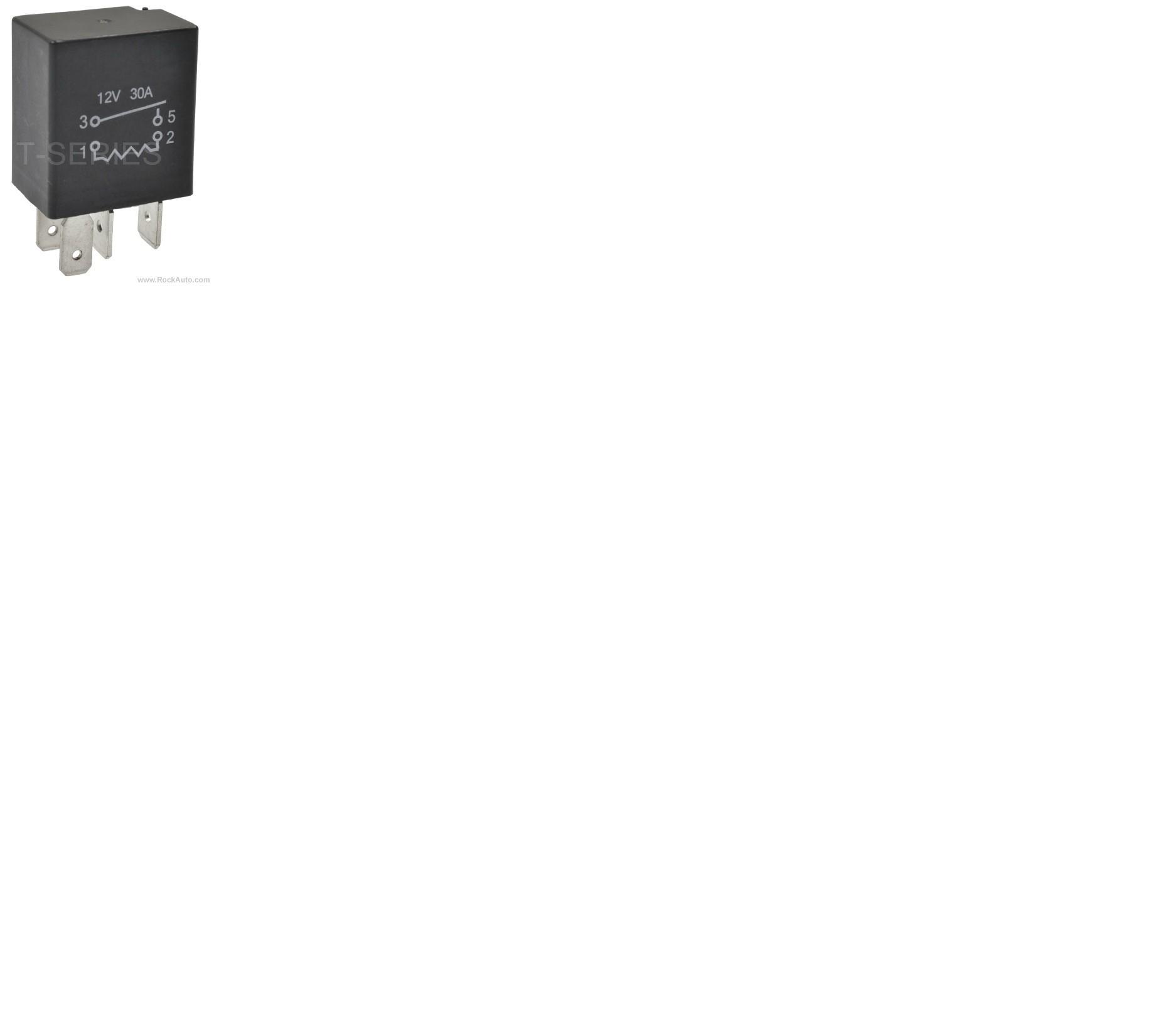
In fact, I just looked it up on the Rock Auto web site and here's a photo of what you should be seeing. Don't be confused by the "1, 2, 3, 5". Most relays of this style have five terminals with one rarely being used except for special applications.

The next problem has to do with all four of the voltage / resistance readings. There were times when my cousin and I had to work together on a tv he couldn't diagnose quickly by himself. This usually involved a 60-pin integrated circuit that we called "the bucket brigade" because it did everything. It would include a dozen different circuits that were working properly, and one that wasn't. Our procedure was for him to sit back and read the schematic diagram and tell me where to measure, then I'd tell him what I found. One of the most important details was when I found a terminal with something significantly different than what was listed, we never dropped everything else to concentrate on that one pin. We took all 60 measurements first, THEN looked at everything that was wrong. You're making that very difficult by refusing to look at all the terminals, or at least to list them. Instead, I did what I know I shouldn't do, and I gave you a bunch of tests to do with the paper clip. Doing that with just four terminals can instantly tell me if the 12 volt supplies are there, if the circuit to the dimmer switch is okay, and if, as I'm leaning toward, the wire to the head lamp switch is broken. The head lamp switch is a much better suspect but you said you replaced that already.

So now I'm left wondering how can you not have four terminals in the relay socket, and since two of them are tied together, how can you have 12 volts on only one of them. The tests I listed for you are exactly the same that my students would do on the cars I prepared for them to diagnose. As another point of interest, in an effort to ease their fears of diagnosing electrical problems, I pointed out and proved to them that by the time they got to the third charging system "bug" on the same car, or the third brake light problem, they didn't even need the service manual any more because they had the circuit memorized from the first two problems. That's what has happened to me now with your circuit. I only have to refer back to it to get the wire colors or terminal numbers. I enjoy working trough electrical problems this way, but I have a suspicion you want to drive the car and you just want to get this figured out. As I said, we should have had this done a long time ago.

My next concern is I can't see how you're getting these voltage readings. There were many times when a student got stuck, then I found he had the test light's ground clip on the battery's positive post instead of the negative one, and things like that. I had as much interest in learning what I said wrong in the classroom that allowed them to misunderstand what I wanted them to learn and do. That made me a more effective teacher every year.

To that end, I'm going to back up and unintentionally sound very sarcastic or condescending. Sorry for that. That's not my intention. I just want to know we're on the same page and that I'm using the right diagram. If you have a test light, use that rather than a voltmeter. In the case of a broken wire, a voltmeter can still pick up a tickle of voltage and give a false reading if there's a little carbon track in that break. A test light is more accurate and faster for this type of test. The test light's ground clip must be on the battery's negative post or on ay paint-free place on the body. Unpainted bolt heads are good too. I like to touch the probe to the battery's positive post or to a few fuses to be sure it's working. Once that bulb lights up, I know the ground clip is making a good contact.

I just went and looked at all the variations of this circuit, and I'm starting to think I'm using the wrong one. You said you don't have daytime running lamps and you don't have the auto-off feature. That is the only diagram that shows two relay terminals having 12 volts all the time. You're telling me only one terminal has 12 volts, and that is what could happen on the other two circuits. To add even more misery, they show differences for the daytime head lamps depending on whether the car is a "DX", an "EX", or an "LX", so you might have to tell me that too.

I see now there are only three variations, not four like I said earlier. The options are you can have only daytime running lamps, only auto-off feature, or neither of those options. You can't have both options. Both optional circuits have two different circuits feeding those two relay terminals. That would explain why you only are finding 12 volts on one terminal. If you do have one of these options, I'm going to have to visit my local Honda dealer to learn what all the abbreviations mean on the diagram, and how those computers are supposed to be diagnosed. It's 3:00 a.m. where I am right now and I've been up for over 37 hours, . . . oh, wait. It's Sunday and they're closed. I should be navigating again by Monday!

One more tidbit. The diagrams don't list terminal numbers for the relays. If the relay in this picture is the same as the most common ones, the two terminals on the right are for the contacts. That's terminals 3 and 5 shown on the side of the relay. Check if you have numbers molded in the plastic next to the terminals and if those numbers agree. If they agree, verify again which one has 12 volts with all switches turned off. If a second terminal also has 12 volts, it's going to be on terminal 1 or 2. Those are the two on the left of the picture.
Jun 7, 2015 at 1:29 AM