Why is my battery light on?

1999 PLYMOUTH VOYAGER
138,000 MILES
Avatar
GREENCHEVYMALIBU
  • MEMBER
  • 230 POSTS
I've had a lot of trouble with this can for the last few months. I had the alternator rebuild and had a new battery installed. Van would start and run fine but when you slowed down it would die. This happens every time. I had the ignition system tested and everything passed but the voltage regulator. Bought a remanufatured computer and had it flashed. Now van runs really rough and the battery light is still on. Had the system tested again and the same thing. Fail voltage regulator. What would cause the voltage regulator to keep failing? What else can I test? What would cause the van to keep firing everyone I push the brakes to slow down?
Jun 7, 2012 at 3:57 AM
Advertisement
Avatar
CARADIODOC
  • CERTIFIED EXPERT
  • 34,306 POSTS
Failing voltage regulators are extremely rare. It's much more common to have a corroded connector terminal. You would find that by measuring the two voltages on the two small wires on the back of the alternator. You must take those measurements with the engine running. One will have full battery voltage. The other one must have less than battery voltage but not 0 volts.
Jun 7, 2012 at 5:40 AM
Avatar
GREENCHEVYMALIBU
  • MEMBER
  • 230 POSTS
If the two wires have good voltage then what? And if they have bad voltage I'm assuming that the wires have a break or corrosion?
Jun 7, 2012 at 2:04 PM
Advertisement
Avatar
GREENCHEVYMALIBU
  • MEMBER
  • 230 POSTS
Would this problem cause the van to die everything I come to a stop?
Jun 7, 2012 at 2:23 PM
Avatar
CARADIODOC
  • CERTIFIED EXPERT
  • 34,306 POSTS
Those two voltages will tell us which direction to go next. Usually the 12 volt feed will be there because it is spliced in with the injectors and coil pack so if that entire circuit is dead, the engine wouldn't run.

The second wire should have roughly 4 - 11 volts. The lower the voltage, the greater the DIFFERENCE in voltage between them meaning the greater the electromagnet it's creating and the more output you'll get. The voltage regulator is incapable of drawing that voltage all the way down to 0 volts, so if that's what you find, either the brushes are open from wear and there will be no output from the alternator, or that wire is shorted to ground and you'll have way too much output. Worn brushes are real common and on many older models can be replaced without even removing the alternator from the engine.

If you find exactly the same voltage on both wires, there is an open circuit after that point. It's possible it could be an open regulator circuit but it's much more likely you'll find a break in the wire going to it. You can find that by measuring the voltage at the connector terminals on that wire, or by grounding that wire at various accessible test points. If you ground that wire at a connector terminal and the output goes way up, you know everything is good up to that point.

Sounds like the battery might have been disconnected or run dead recently. You probably did that when you replaced the alternator. If so, the Engine Computer lost its memory and has to relearn "minimum throttle" before it will know when it must be in control of idle speed. It also might not give you the normal "idle flare-up" to 1500 rpm when you start the engine. To meet the conditions for the relearn to take place, drive at highway speed with the engine warmed up, then coast for at least seven seconds without touching the brake or gas pedals.
Jun 7, 2012 at 7:22 PM

Avatar
GREENCHEVYMALIBU
  • MEMBER
  • 230 POSTS
I test the two wires but not sure if it's right. On one wire the readings where flexuating from 10.xx to 13.xx to 14.xx. The other wire I couldn't get a reading.
Jun 9, 2012 at 1:31 PM
Avatar
GREENCHEVYMALIBU
  • MEMBER
  • 230 POSTS
I'm testing the pigtail that plugs in to the alternator?
Jun 9, 2012 at 1:35 PM
Avatar
CARADIODOC
  • CERTIFIED EXPERT
  • 34,306 POSTS
This is like asking a "yes" or "no" question and getting "maybe" as an answer. That voltage you did get could be full battery voltage which would be fluctuating if the charging system was working intermittently. It also could be the control side which should be lower than full battery voltage but will rise to battery voltage if there is an open circuit after it, typically from a corroded connector terminal or possibly from an open voltage regulator in the computer.

By they way, you didn't unplug that connector to take the readings, did you? If you did, you'd still get the full battery voltage on one wire but the lower voltage on the control wire has to come through the alternator so that has to stay plugged in. You can push the meter probe through the back of the connector to get the readings.

If you find 0 volts on the second wire, there is either a bad connection in that plug or there's a worn brush inside the alternator. Worn brushes are pretty common and easy to replace but that shouldn't be a problem if your alternator was recently rebuilt.
Jun 9, 2012 at 6:41 PM
Avatar
GREENCHEVYMALIBU
  • MEMBER
  • 230 POSTS
Pigtail was plugged in. I'll test again and look for corrosion.
Jun 9, 2012 at 7:28 PM
Avatar
GREENCHEVYMALIBU
  • MEMBER
  • 230 POSTS
Ok I got the battery light off but now I have a check engine light on. P0123. It still also dies when ur slowing down/ low idle.
Jun 15, 2012 at 10:29 PM
Avatar
CARADIODOC
  • CERTIFIED EXPERT
  • 34,306 POSTS
That code is for the throttle position sensor. Any chance you unplugged it while the ignition switch was turned on? That code will also prevent the relearn of minimum throttle. You have to coast for at least seven seconds because the computer wants to see high manifold vacuum for that long. You can snap the throttle and get high vacuum for an instant, but not long enough. The only way to get it for seven seconds is to be coasting and that implies you're moving. At the same time the computer sees a low and steady voltage from the TPS. THAT'S when it takes a voltage reading and puts it in memory. If there's any fault code related to that sensor, the computer won't trust the reading and won't put it in memory. Once that voltage is memorized, anytime after that when it sees it again, it will know your foot is off the gas pedal and it has to be in control of idle speed.

If the battery light is off, measure the battery voltage with the engine running. If it's at least 13.75 volts, the system is working.
Jun 16, 2012 at 10:00 AM
Avatar
GREENCHEVYMALIBU
  • MEMBER
  • 230 POSTS
Nope didn't unplug it. Battery voltage is good.
Jun 16, 2012 at 2:14 PM
Avatar
CARADIODOC
  • CERTIFIED EXPERT
  • 34,306 POSTS
If the Check Engine light is staying on while driving, measure the three voltages on the throttle position sensor. You must do that with it plugged in. Back-probe through the rubber seals alongside the wires.

One wire must have 5.0 volts; one will have close to 0.2 volts. The third one should have near 0.5 volts at idle and up to around 4.2 or 4.5 volts at wide-open-throttle. If that one is reading correctly, the first two have to be right.

If you do get that 0.5 to 4.5 volt sweep on the signal wire, either there is a momentary glitch or "dropout" of the signal or that voltage signal is not making it back to the Engine Computer due to a break in that wire. You would figure that out by connecting a scanner that displays live data to see what signal voltage the computer is seeing.
Jun 16, 2012 at 11:15 PM
Avatar
GREENCHEVYMALIBU
  • MEMBER
  • 230 POSTS
Ok the three readings im getting are 12.45 on ground. 0.7(0.8 goes back and forth) to 3.7 on the TPS signal wire. The volts increase and decrease smoothly when i open and close throttle. And I'm getting 5 volts for the reference signal.
Jun 17, 2012 at 5:20 PM
Avatar
GREENCHEVYMALIBU
  • MEMBER
  • 230 POSTS
on the signal wire i get a steady 0.7-3.7 now. I guess the first time i didn't get a get a good contact with the probe wire.
Jun 17, 2012 at 5:27 PM
Avatar
CARADIODOC
  • CERTIFIED EXPERT
  • 34,306 POSTS
If the sensor wasn't unplugged, there must be a momentary dropout in its signal for it to set a code, or the signal wire is broken going to the computer. You would find that by measuring the signal voltage right at that wire at the computer connector or by looking at live data on a scanner.
Jun 17, 2012 at 7:17 PM
Avatar
GREENCHEVYMALIBU
  • MEMBER
  • 230 POSTS
What color is the wire going in to the computer? Which wire is it? Is there a number diagram for the wires going in to the computer? What should the voltage be? Am I measuring the dc or ohms? Does it seam like a break or faulty sensor?
Jun 17, 2012 at 8:52 PM
Avatar
CARADIODOC
  • CERTIFIED EXPERT
  • 34,306 POSTS
That's why you have to test things, to see if it's the sensor or wiring. The wire color at the computer is the same as the one at the sensor that varies in voltage as you move the throttle. I have to search for the right service manual. Will get back to you shortly.
Jun 17, 2012 at 10:26 PM
Avatar
CARADIODOC
  • CERTIFIED EXPERT
  • 34,306 POSTS
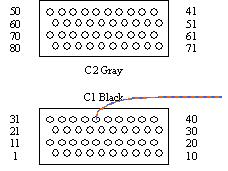
The signal wire is orange with a dark blue stripe. If you got that nice 0.7 to 3.7 volts when opening the throttle, the 5.0 volt feed (violet / white), and the ground return, (black / light blue) have to be okay.

The signal wire is pin 35 in connector C1. Even if you back-probe that wire at the computer, there is still the rare chance the terminal there is making a bad connection. That would only show up when viewing the voltage on a scanner.
Jun 18, 2012 at 12:06 AM
Avatar
GREENCHEVYMALIBU
  • MEMBER
  • 230 POSTS
With the live data what I'm I looking for?
Jun 18, 2012 at 3:57 AM
Avatar
CARADIODOC
  • CERTIFIED EXPERT
  • 34,306 POSTS
Under the "sensors" menu all of them will be listed along with their voltages. All you have to do is watch the TPS voltage as you press and release the gas pedal. The voltage should change smoothly and never pop up to 5.0 volts.
Jun 18, 2012 at 4:03 AM
Avatar
GREENCHEVYMALIBU
  • MEMBER
  • 230 POSTS
The live data on the scanner measured the TPS in %. Throttle closed was 15.68% and throttle fully opened was 75.68%.
Jun 19, 2012 at 1:16 AM
Avatar
GREENCHEVYMALIBU
  • MEMBER
  • 230 POSTS
Is there an adjustment when installing a new TPS?
Jun 19, 2012 at 5:08 PM
Avatar
CARADIODOC
  • CERTIFIED EXPERT
  • 34,306 POSTS
All the scanners I ever used showed it as a voltage, but regardless of how it's displayed you want to see it change smoothly as you slowly press and release the gas pedal. If there is any place where the wiper makes intermittent contact the reading will momentarily bounce to 100 percent or 0 percent. That is what sets the fault code.

Also, scanners and digital voltmeters have a delay between taking a reading, analyzing it, and displaying it. For that reason a glitch can occur so quickly that you don't see it but the Engine Computer will. In that case, since the readings are correct most of the time, you know the wiring is okay. Then you have to just replace the sensor.
Jun 19, 2012 at 5:12 PM
Avatar
CARADIODOC
  • CERTIFIED EXPERT
  • 34,306 POSTS
No adjustment needed or possible. The Engine Computer has to relearn "minimum throttle" after the battery was disconnected before it will know when to be in control of idle speed. Until then, the engine may not start or it may stall when approaching stop signs, unless you hold the gas pedal down 1/4". You also won't get the "idle flare-up" to 1500 rpm at engine start up. The conditions for the relearn to take place are driving at highway speed with the engine warmed up, then coasting for at least seven seconds without touching the pedals. At that point the computer takes a voltage reading from the TPS and puts it in memory. It knows by those conditions that your foot is off the gas pedal. From then on, any time it sees that same voltage, it knows it has to watch and control idle speed.

No two sensors are ever exactly alike. My understanding is that if you install a new TPS with a lower voltage at idle, the computer will see that and immediately learn that as the new minimum throttle voltage. The problem is when that new sensor's lowest voltage is higher than the old sensor's lowest voltage. As far as the computer is concerned, it thinks you haven't fully released the gas pedal so it lets you control idle speed. Mechanically, nothing has changed with the throttle blade so now the engine may idle too slowly and stall or be hard to start. If that happens you just have to do the seven second relearn again on the highway.
Jun 19, 2012 at 6:18 PM
Avatar
GREENCHEVYMALIBU
  • MEMBER
  • 230 POSTS
So the check engine light went away with out replacing it. But like u said the car dies at idle and when coming to a stop. So I'm assuming the computer has to relearn its idle. It's hard to start and when it does it seams like it wants to die. U can give it gas and it's fine but when u let off it stumbles. Also When outing it in reverse or drive it will die.
Jun 20, 2012 at 1:23 AM
Avatar
CARADIODOC
  • CERTIFIED EXPERT
  • 34,306 POSTS
Yup, do the relearn. If that doesn't help, the scanner has a test that will run the idle speed up and down in 200 rpm increments to see if it's working. If it's not, that motor could be bad but it's more likely the air passage is plugged with carbon. That's not too common anymore thanks to better fuel additives.
Jun 20, 2012 at 2:37 AM
Avatar
GREENCHEVYMALIBU
  • MEMBER
  • 230 POSTS
Drove 40 miles no luck
Jun 20, 2012 at 4:48 AM
Avatar
CARADIODOC
  • CERTIFIED EXPERT
  • 34,306 POSTS
Then you'll want to find a scanner to test the automatic idle speed motor. It's not a regular motor as you would think of with brushes but it does have an armature. Rather than spinning, it's a stepper motor that is set to various positions when the computer pulses the coils with voltage. As the armature turns, it's on a threaded shaft that retracts a pintle valve to open an air passage around the throttle blade. At the same time the computer lengthens the time it holds the injectors open. That's how it controls idle speed.

There's two things you can do with the scanner. The first is to view the number "steps" the computer has requested. There's 256 steps from 0 which is fully closed to 256 which is wide open. For a properly running engine you'll typically find it at about step 32. Step 50 is about where you'll find it with one misfiring cylinder on a V-6 engine. You can ground out one spark plug wire, then watch what happens to the steps. If it's on "0" or if it doesn't change, minimum throttle hasn't been learned. That can happen if part of the brake light switch isn't turning off, or if there is one of any of the fault codes stored that will inhibit the relearn procedure.

The second test is under the "actuator" menu. It lets you run the engine speed up to 2000 rpm in 200 rpm increments. If the steps go up but engine speed doesn't, the air passage is plugged with carbon or the motor isn't turning. Plugged passages used to be common on the 3.0L engine but it's pretty rare today.

You can also unbolt the idle speed motor and if you squeeze the valve really hard, it will retract about 1/4". If you reinstall it like that, idle speed should be too high and it will slowly come back down as the computer pulses it over as much as ten seconds. If you do remove it, be sure the torx bit driver fits snugly or the bolt heads can be rounded out. They're installed with Lock Tite and will come out hard.
Jun 20, 2012 at 5:52 AM
Avatar
GREENCHEVYMALIBU
  • MEMBER
  • 230 POSTS
I don't have a scanner that will do that. I cleaned the trottle body it was very dirty. But it didn't change. It's still hard to start. It will start then die. Have to give it some gas to stay on. Idles bad. Still dies when slowing down.
Jun 22, 2012 at 2:45 AM
Avatar
CARADIODOC
  • CERTIFIED EXPERT
  • 34,306 POSTS
What do you mean by "idles bad"? Does it have a misfire? If it's setting a related fault code, that can inhibit the relearn from taking place. Or do you mean it's just running rough because it's idling too slowly?

You can try holding the brake pedal up with your toes while you do the seven-second coast. If that works, the brake light switch is defective or out of adjustment. Next, remove the idle speed motor and retract the valve by hand. It will move hard but not so hard that you have to squeeze it in a vise.

I'm working with someone else who has the same problem on a Jeep, and he solved the problem by removing the idle speed motor and cleaning the valve and passage with carburetor cleaner and a tooth brush. I wouldn't have expected that little carbon to be a factor but there's no arguing with success.
Jun 22, 2012 at 3:29 AM
Avatar
GREENCHEVYMALIBU
  • MEMBER
  • 230 POSTS
That's actually what I just got finished doing. I took the throttle body off and cleaned it up. Yea I mean that it is idling rough. I can take the IAC out again and see if I can get it to move.
Jun 22, 2012 at 3:37 AM
Avatar
GREENCHEVYMALIBU
  • MEMBER
  • 230 POSTS
Ok I changed the Idle air control valve. When i took it out of the throttle body to set if it moves in and out. The tip of it shot off with the spring. With the new one it starts everytime and idles fine but when it warms up the idle starts to get rough and sometimes dies. Then it dies it's hard to start. It still dies when slowing down but you can feel the engine tries to stay running. Sometimes it doesn't die but you can feel that it wanted to. Any new help?
Aug 11, 2012 at 10:52 PM
Avatar
CARADIODOC
  • CERTIFIED EXPERT
  • 34,306 POSTS
You need to do the relearn procedure because either the battery was recently disconnected or the voltage at idle from the new TPS is higher than from the old sensor. No two sensors are ever exactly alike. As an example, if the lowest voltage from the old sensor was 0.72 volts, the Engine Computer will know it has to be in control of idle speed whenever it sees that voltage. If the lowest voltage from the new sensor is 0.79 volts at idle, the computer will never see the 0.72 volts it is expecting so it assumes you're holding your foot on the gas pedal and it is going to let you be in control of engine speed.

To meet the conditions for the relearn to take place, drive at highway speed with the engine warmed up, then coast for at least seven seconds without touching the brake or gas pedals.
Aug 11, 2012 at 11:12 PM
Avatar
GREENCHEVYMALIBU
  • MEMBER
  • 230 POSTS
I tried that with no luck. Still the same.
Aug 11, 2012 at 11:20 PM
Avatar
CARADIODOC
  • CERTIFIED EXPERT
  • 34,306 POSTS
Then you need to use the scanner to view the idle "steps" the computer has placed the idle speed motor to. If it is "0", the relearn hasn't taken place. Try holding the brake pedal up with your toes while doing the coasting procedure. If it is around 32 or so but the speed is too low, suspect the air passage around the throttle blade is plugged with carbon, but we don't see that too much anymore.

You can also use the scanner to run the engine speed up to 2000 rpm in 200 rpm increments. That will verify the new idle speed motor and wiring are okay.
Aug 11, 2012 at 11:35 PM