Fuse blows for IMRC, A/C, DTR, and BACKUP LIghtS

1999 LINCOLN CONTINENTAL
18,300 MILES
Avatar
CLOSENCOUNTER
  • MEMBER
  • 18 POSTS
Rough idle lean.99 continental 4.6 32 valve. Fuse blows for IMRC,A/C,DTR,BACKUP LITES all on one fuse. Looking for a plug power wire to the IMRC but can't find one.It's not even listed in the schematic book .

Fuse blows as soon as you turn the key on. Can't find a power plug to the thing that operates the valve on IMRC to test it.It doesn't even show under the fuse in the schematic book? I haven't a clue where to begin. I bought a short finder .And when I tried to use it the circuit breaker that came with it killed the battery ? I'm afraid to bring it to a garage because it is an "easy" one for them to say they spent long hours to find problem. Have been there with garages.The rough idle and the no A/C is a killer. Any help would be greatly appreciated. Since i am trying to fix this myself. Thank you for your time .

If anyone could help me I would be forever grateful.
Feb 29, 2012 at 1:52 AM
Advertisement
Avatar
CARADIODOC
  • CERTIFIED EXPERT
  • 34,306 POSTS
Well, at least you haven't chosen the expensive way to find the problem. That's by throwing random parts at it in hopes one will fix it.

Instead, plug in a pair of spade terminals in place of the fuse, then use a pair of jumper wires to connect a 12 volt light bulb. The bulb will be full brightness when the circuit is powered up and the short is present. Now, instead of trying to test everything, something mechanics never do because it wastes too much time that you're going to be charged for, you can just unplug things until the bulb gets dim or goes out.

Be aware too that mechanics at most shops have to punch a time clock every time they start and stop on a specific car. They can be fired for punching on a job they aren't working on. With all the insane, unnecessary, complicated computers on cars today, it's hard enough diagnosing those "simple" problems. The days of the 15 minute diagnosis are long gone, . . . and it's why I refuse to give up my '88 Grand Caravan in favor of another new car.

Also, as I just told my friend today, it's going to take him a lot longer to diagnose the noise on his car and fix it himself than if he took it to the shop. I couldn't do it any better, so keep in mind you'll be saving yourself a pile of money on labor, . . . as long as you don't have to pay yourself. You and I won't be saving any time.
Feb 29, 2012 at 5:17 AM
Avatar
CLOSENCOUNTER
  • MEMBER
  • 18 POSTS
Hey that's a great idea .I have been studying the schematic book and have figured there is one rd/bk wire that powers all the problem areas.And have figured out witch pin in their connectors are and where.So I will first do what you told me and also check those red and black lines ,with a little determination I just might find it.In fact I have a spare lite socket so I can run the wires of that to fuse location.Thanks so much any info is a great help.
Feb 29, 2012 at 6:49 AM
Advertisement
Avatar
RIVERMIKERAT
  • CERTIFIED EXPERT
  • 6,110 POSTS
Hey closencounter, did you figure this out? Have you plugged in a bulb in place of the fuse yet? If not, I'd recommend adding a resistor to cut down the current so as to not blow the bulb like the fuses.
Mar 12, 2012 at 12:44 AM
Avatar
CARADIODOC
  • CERTIFIED EXPERT
  • 34,306 POSTS
You can't blow the bulb. It's just going to have 12 volts across it.
Mar 12, 2012 at 12:53 AM
Avatar
CLOSENCOUNTER
  • MEMBER
  • 18 POSTS
Yes I tryed this but it killed the battery also.So what I did was take out the battery and hooked car up to a charger on trickle charge.Put a breaker in place of the fuse that kept blowing.When i did i could hear a tick or sparking when the breaker came on.It was a harness that was rubbing against a hot emissions pipe shorting out a wire.So now I have A/C.But still runs rough at idle.No back up lights or the mirror lights and compass and it is stuck in night vision.So I have solved the worst problem and am very happy about that cause I live in Florida and it's a black car ,so A/C is a must.Thanks for your help.If you have any idea what could make it rough idle .It has a new MAF sensor.New air filter and new plugs and wires.Thanks .Dana
Mar 12, 2012 at 12:55 AM
Avatar
RIVERMIKERAT
  • CERTIFIED EXPERT
  • 6,110 POSTS
If there's a dead short, cardiodoc, it doesn't matter. It isn't voltage, it's current.

Check for vacuum leaks, low fuel pressure, stuck or contaminated EGR or IAC, low compression, worn spark plugs/wires, etc.
Mar 12, 2012 at 2:57 AM
Avatar
CARADIODOC
  • CERTIFIED EXPERT
  • 34,306 POSTS
I've had students with the same misconception. You're right, it's current that burns out a bulb, but what determines how much current is going to flow through it? It's voltage, (electrical pressure), and resistance, (the resistance of the bulb AND the entire rest of the circuit. Voltage isn't going to change. It's 12 volts. Resistance for the entire circuit starts with that of the bulb, period. The amount of current through the bulb, (amps = volts / resistance), will equal 12 divided by the bulb's resistance. Anything that adds resistance to the circuit will cut the amount of current. Corrosion on a switch contact adds resistance and reduces current. Frayed strands of wire increases resistance in the circuit and reduces current.

For the sake of simplifying the explanation, lets use 12 ohms for the bulb, which is real close to the actual value for a brake light bulb. Using Ohm's Law, the first thing any electronics students learns on the first day of class, current equals 12 volts divided by 12 ohms equals one amp. The is no way possible for current through that bulb to be any higher than one amp unless you increase voltage or decrease resistance. Both of those are constants. The only thing you can possibly do to change the amount of current is to change the amount of resistance in the rest of the circuit. You can lower the negligible resistance in the wires by going to larger diameter wire, but the wires already in use are sufficient. You can add resistance by introducing a corroded splice, pitted switch contacts, longer lengths of wire, etc., but that will also just reduce current. The only real way to increase current is to increase voltage with a battery charger or shorted voltage regulator. Other than that, you'll never see a bulb burn out from too much current. It's the resistance of the bulb itself that limits current.

Your comment earlier about adding a resistor is exactly correct because it will limit current flow to a safe level, but that's exactly what a light bulb is. It's a resistor. All resistors give off heat, that's why some, such as a ballast resistor in an old ignition system have to be so big. Some resistors are smaller than the head of a finishing nail. If you raise voltage high enough, and build in low enough resistance into the resistor, it will start to glow, . . . and you have a light bulb. You can put a 12 ohm resistor in place of the blowing fuse and the most current flow you can possibly have will be one amp, but what good is that? Replace the blowing fuse with a 12 ohm light bulb and the most current flow you can have is still one amp, but now you get a visual clue as to how much current is flowing, and you can see immediately when you do something to remove the short.

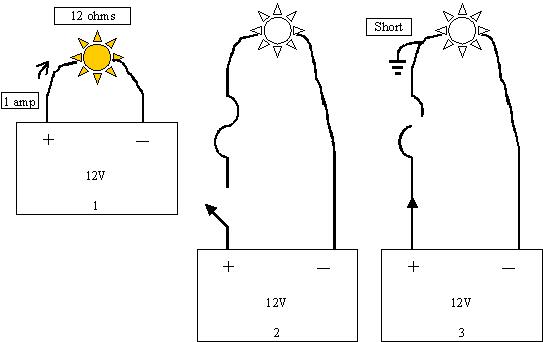
In case this explanation just made things more confusing, see if these sad drawings help:

In Figure 1, if you connect a brake light bulb right across a 12 volt battery, you get 1 amp of current flow. You can't get inside the bulb to change its resistance, and you can't change battery voltage, so that one amp is constant.

In Figure 2 we've added a switch and a fuse. Both ideally will have 0 ohms but in reality they do add a miniscule amount of resistance, but not nearly enough to talk about. Pitted switch contacts or corrosion on the fuse terminals can only add undesirable resistance which will reduce current flow.

In Figure 3, the circuit is turned on but there is a short to ground after the fuse. With 0 ohms in the entire circuit, current equals 12 volts divided by 0 ohms = infinite amps. The fuse blows.

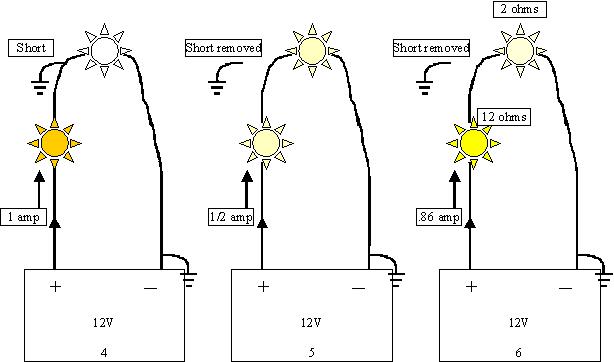
In Figure 4, I added your resistor, (my light bulb), and it's another 12 ohm bulb so again, with no other resistance in the circuit, 12 volts / 12 ohms = 1 amp. The bulb will simply be full brightness. No wasted fuses and you can see that the circuit is powered up and there is nothing else to limit current besides the resistance of the bulb.

In Figure 5 the short was located and removed. Now you have two 12 ohm bulbs in series so they total 24 ohms. 12 volts / 24 ohms = half an amp of current. At only half an amp, both bulbs will be dim. There's the convenient visual clue that you're on the right track. To find the location of the short, you can unplug harnesses, turn various switches on and off, and move wire harnesses around that could be rubbed through or laying on hot exhaust parts.

To add one more point of confusion, in this story the 12 ohm bulb in the car and the 12 ohm bulb in place of the fuse are equal in resistance so it made the math and explanation easy. In a real brake light circuit you will have two, four, or six bulbs on the car and each one will draw one amp. Again using an electronics formula, six 12 ohm bulbs in parallel equals 2 ohms. That means if you look at Figure 6, the equivalent resistance is shown. It's two ohms. You still have your test bulb in place of the fuse and it's 12 ohms. The test bulb and the rest of the circuit add up to 14 ohms. Doing the math again, current equals 12 volts / 14 ohms = .86 amps. All .86 amps flows through the test bulb and that's pretty near the normal one amp so that bulb is still going to be fairly bright. You might only see the subtle change if it occurs while you're staring at it. That .86 amps is going to be divided up equally among the six brake light bulbs. That means there will be about .14 amps flowing through each bulb, barely enough to make them glow even if you shade your eyes and look real close.

In this case when you're working in a higher-current circuit, you solve that by using a lower resistance bulb in place of the fuse. That will let more current flow so the test light will get dimmer when the short is gone and the car's bulbs will be brighter so you can see the change easier. I recommend to people to use a head light bulb in those instances. They are a little over 2 ohms so in the case of the six brake light circuit, it just happens that the head light will get half the 12 volts and be half brightness, and the brake light bulbs will also get six volts and be half brightness. That's enough voltage to see the bulbs glowing. When the brake lights glow, even real dimly, you know the short can't be present in the circuit.

Instead of a head light bulb that's rather cumbersome, a got a hold of a right rear Viper tail light harness that had five filaments in three light bulbs. I wired them all in parallel so together they draw about 4 amps. I hung that mess from the rear-view mirror so I could see it from anywhere around the car. I found a pinched trailer harness wire under the left rear tail lamp lens on a Dodge van that way. As soon as I removed a couple of screws, the tail light started to glow, then I noticed my test lights had dimmed. I also found an extra long mudflap screw run through a wiring harness by banging on the sill plate with a rubber mallet. On that car, the fuse would only blow when driving over bumpy roads. Every time I hit that sill plate, the test bulb would flash bright for an instant when the short occurred.

When you transfer all of this to a circuit that's blowing the fuse, you have to start out knowing what to expect for normal current flow. When it's a lighting circuit it's pretty easy to add up the number of bulbs in the circuit and multiply by the amount of current each one normally draws. When you get into computer circuits or motor circuits where you aren't sure of what's normal, you can use half of the fuse rating as a starting point. You have to always keep in mind that you need to tailor the test bulb to the circuit so it will be dim enough to notice when the short is gone. Take a starter solenoid circuit for example. The solenoid is so low in resistance that a single brake light test bulb will be almost full brightness when there is no defect in the circuit. That doesn't do you any good. You can go down by the starter and ground that terminal to create a short and barely see any change in your test light bulb's brightness.

If the bulb is too small, like a # 159 dash light bulb, they draw so little current that they can be almost full brightness when the rest of the circuit doesn't even have a defect. That's no help either.
Mar 12, 2012 at 1:34 PM
Avatar
RIVERMIKERAT
  • CERTIFIED EXPERT
  • 6,110 POSTS
cardiodoc, without going too deeply into it, I was an avionics technician for the Navy for 8 years and an electrician for 15.

IC's have resistors that are as small as the point of a pin.

The vacuum inside light bulbs keeps the filament from vaporizing when lit.

It sounds like you took a basic electricity and electronics course.
Mar 12, 2012 at 8:49 PM
Avatar
CLOSENCOUNTER
  • MEMBER
  • 18 POSTS
Sounds like you have a lot of experience.I on the other hand only know what I have tried on my own.I cleaned the iac valve or maybe it was the egr valve not sure ,That helped a little.I have put in new wires and plugs and that put out the check engine light.Personally I think this motor is just worn.And probably will never run correctly.I am waiting for a new short finder I bought ,it might be of some help with the back up lites.I am thinking it could be the DTR sensor because that is where the power comes from that goes to back up lights wich have no power.I can't find anything on the IMRC in the wiring diagram,Maybe they didn't have that for this year car.Cause I thought at first it was on the same bad fuse and that is why it was running like it is,It shows in the owners Manual.Doesn't make sense.It should have a plug wire that shows in diagram but not.I think the map lites and the mirror is a bad ground cause their is power getting to it.
Mar 12, 2012 at 11:51 PM
Avatar
RIVERMIKERAT
  • CERTIFIED EXPERT
  • 6,110 POSTS
Bad ground or bulb for the map lites and mirror, probably. Our reference isn't letting me look at schematics right now. Hopefully one of the other guys that have replied in here peeks in and sees this. I think having the backup light circuit diagram would be helpful in tracing this issue.
Mar 13, 2012 at 12:39 AM
Avatar
CLOSENCOUNTER
  • MEMBER
  • 18 POSTS
I have a schematic diagram book for this car.
Mar 13, 2012 at 1:10 AM
Avatar
CLOSENCOUNTER
  • MEMBER
  • 18 POSTS
The mirror is stuck in night vision it is blacked out,can't hardly see in it just a little across the top of it.
Mar 13, 2012 at 1:13 AM
Avatar
CARADIODOC
  • CERTIFIED EXPERT
  • 34,306 POSTS
Mikey, if you can diagnose and locate an electrical problem, you should not confuse yourself with my explanations and mess up what you have going for you. One of my worst students, (real nice kid, just couldn't understand electrical) sat in my classroom until 11:30 p.m. on a Friday night, and we went over everything very slowly until it clicked. Now he is the head electrical diagnostician working for a local guy who owns one of our city's top electrical shops. That guy also sounded confused, at least after listening to what my student brought back from his "on-the-job-training". After having numerous arguments or discussions, or something, one day he said his boss agreed his understanding of electrical was correct. It depends a lot too on how you originally learned it. I learned it in a two-year Electronics Technology course which was pretty much over my head as it was all design work and lots of math. I also took the last half of the one-year TV Servicing class, and that guy had a terrible time teaching, period, and he didn't have a decent troubleshooting system. I actually learned a better method later from a magazine article. I fixed tvs for over 35 years and attended a lot of manufacturer's schools, and they all approached defective circuits the same way. Why couldn't my teacher do that?

In fact, it was at a Coronado TV school that we learned the light bulb trick back in the late '70s, but in that case, it was a regular 120 volt 60 watt bulb that passed enough current to allow the circuit to be powered up, but not so much current that it exploded a switching transistor.

Getting back to how you learned electronics, if you were in the fields you listed, you learned it from an electrician's point of view, not an auto mechanic's. Automotive people learn very differently and they don't understand what they can't see, touch, and manipulate in their hands. They have a hard time with anything they have to visualize, including alignment angles. I'm an oddball in that I can visualize electrical current flow and voltage drops, and I can relate that to things automotive people ARE familiar with like water flow in a pipe.

That's another confusing concept that I spend a real lot of time on is "voltage drops" vs. voltage at a point in a circuit. Hammering on those kinds of things right away makes it a lot easier to understand how defects affect a circuit later. I've never sat in on anyone else's Electrical class that I didn't cringe and squirm, and want to add comments when I could see the students' looks of confusion, but the teachers just went right on lecturing. No wonder so many mechanics hate electronics.

I use Ohm's Law when we start the class and use basic math to describe how the circuits work. From there, building on that understanding is easy. If I was asked to teach electronics to electronics students, I would not be as comfortable because we wouldn't share the same learning styles. If your understanding works, don't mess with it.
Mar 13, 2012 at 2:12 AM
Avatar
RIVERMIKERAT
  • CERTIFIED EXPERT
  • 6,110 POSTS
closencounter: Find the schematic in your book for the backup lighting circuit. Next, make sure there is power getting to the mirror. Make sure the ground for the mirror is properly connected and clean. You might also check continuity on all of the mirror wires.


Don't cringe and squirm. Grab a 1f cap, put some voltage across it, then toss it to someone unsuspecting. Always works to get a class's attention.

BTW, I don't like Mikey. Never have.

I learned circuit analysis like an electronics technician with the Navy, but I'd already been playing with automotive electrical circuits since I was a kid working at my dad's shops. All of these were mostly DC circuitry. Obviously my sparky training was mostly AC stuff. But I mostly learned all that by talking with journeymen electricians and by doing.
Mar 13, 2012 at 4:06 AM
Avatar
CLOSENCOUNTER
  • MEMBER
  • 18 POSTS
Does anyone know if I have a IRCM in my 1999 Continental?If so where the wires that operate it and where can I find them to test them?
Apr 4, 2012 at 11:59 PM
Avatar
CLOSENCOUNTER
  • MEMBER
  • 18 POSTS
That is an intake runner control manifold.
Apr 5, 2012 at 12:01 AM
Avatar
RIVERMIKERAT
  • CERTIFIED EXPERT
  • 6,110 POSTS
According to our reference your car does, but it doesn't say anything about. It just says it's on top on the manifold.
Apr 5, 2012 at 4:02 AM
Avatar
CLOSENCOUNTER
  • MEMBER
  • 18 POSTS
And I can't find it .There is nothing on top of it .It shows up in the schematic book in the repair manual.It says it has a red and black hot run wire.But I can't find anything on the motor that looks anything like it.Weird.The car is running just awful.We put in new plugs and wires .Nothing shows up on the read out.Maybe it has a bad brain .Thanks for your response .I think they were more popular on the 98's
Apr 5, 2012 at 4:10 AM
Avatar
RIVERMIKERAT
  • CERTIFIED EXPERT
  • 6,110 POSTS
Wish I could have been better help.
Apr 5, 2012 at 5:55 AM
Avatar
CLOSENCOUNTER
  • MEMBER
  • 18 POSTS
Thanks but you have been a help.I'm thinking it is either the brain or the fuel pump .The fuel filter was real nasty pure rust came out of the inlet and it was very heavy.Dana
Apr 5, 2012 at 6:01 AM
Avatar
RIVERMIKERAT
  • CERTIFIED EXPERT
  • 6,110 POSTS
That filter should be replaced then. Buildup like that is fairly normal over the life of a vehicle. Avoiding it is a matter of being able to keep your fuel tank around half capacity.
Apr 5, 2012 at 6:08 AM
Avatar
CLOSENCOUNTER
  • MEMBER
  • 18 POSTS
It's in the trash.It looked like the original one.I was hoping it would solve the problem,but no such luck.The fuel coming out of the outlet looked clean so the filter was still working.

This explains why it is empty before it reaches the bottom empty line .It probably has 3 inches of rust in the bottom of the tank. If I ever own a new car I would never neglect it like some people do.
Apr 5, 2012 at 6:14 AM
Avatar
RIVERMIKERAT
  • CERTIFIED EXPERT
  • 6,110 POSTS
That's a great idea.
Apr 5, 2012 at 6:48 AM
Avatar
CLOSENCOUNTER
  • MEMBER
  • 18 POSTS
Really thou I think I might get a used tank from a local junk yard .It might solve all the problems.I think this tank is full of SH** And the pump is probably on it's last legs .Could explain why it is running so poorly.The pump is choking on rust.Or maybe the rust is coming from the pump.
Apr 5, 2012 at 6:53 AM
Avatar
RIVERMIKERAT
  • CERTIFIED EXPERT
  • 6,110 POSTS
Could be both. If you go the used tank route, make sure they didn't puncture it.

When you get it home, throw some small nuts and bolts in and some fuel system cleaner and about a gallon of gas. Shake well. Drain through a piece of cloth. The gas can be reused after being filtered. That'll get at least MOST of the gunk out of the tank.
Apr 5, 2012 at 7:07 AM
Avatar
CLOSENCOUNTER
  • MEMBER
  • 18 POSTS
I final found out the problem .Check engine lite came on again took it to auto zone.They tested it and it's running on 6 cylinders.He said it's the coils two of them .I pick them up tomorrow and install.No wonder the mpg is so bad. Happy now .
Apr 11, 2012 at 12:31 AM
Avatar
RIVERMIKERAT
  • CERTIFIED EXPERT
  • 6,110 POSTS
Yes. Typically a coil pack provides spark for 2 cylinders. A bad one will cause terrible gas mileage.
Apr 11, 2012 at 1:20 AM
Avatar
CLOSENCOUNTER
  • MEMBER
  • 18 POSTS
Not on this car their is one for each cylinder it comes with a plug boot and goes onto spark plug.I changed those two and it sounds like a motor again not a tractor.But it's still not to good on gas .I will change them one by one.I figure I should change the rest because they are all original ones.And it need a new dog bone motor mount .
Apr 11, 2012 at 10:23 PM
Avatar
RIVERMIKERAT
  • CERTIFIED EXPERT
  • 6,110 POSTS
The motor mount is pretty easy and straightforward to replace.

Have you tried any fuel system cleaner yet to help the mileage?
Apr 11, 2012 at 11:17 PM
Avatar
CLOSENCOUNTER
  • MEMBER
  • 18 POSTS
Yes I have .When they did the test it also said one sensor in bank one.But now the check engine light is off.And I think there is two in each two banks
Apr 11, 2012 at 11:20 PM
Avatar
CLOSENCOUNTER
  • MEMBER
  • 18 POSTS
One coil was already replaced so i will replace the other five I replaced two today.I found a set of 4 on e-bay for $66.00 .I paid 40.00 each at auto part store.
Apr 11, 2012 at 11:34 PM
Avatar
RIVERMIKERAT
  • CERTIFIED EXPERT
  • 6,110 POSTS
The coil caps for my son's VW are $20 apiece from the dealer.

There should be at least one O2(oxygen) sensor per bank. One on or near the manifold, the other after the catalytic converter.
Apr 12, 2012 at 12:21 AM
Avatar
CLOSENCOUNTER
  • MEMBER
  • 18 POSTS
I was told at the auto store there are four on my car.I know there was 4 on my cougar
Apr 12, 2012 at 12:27 AM
Avatar
RIVERMIKERAT
  • CERTIFIED EXPERT
  • 6,110 POSTS
Yes. It has 4. See image.
Apr 12, 2012 at 2:52 AM