Getting no sound out of my stereo

1995 JEEP GRAND CHEROKEE
202,000 MILES
Avatar
UDMAN2006
  • MEMBER
  • 13 POSTS
I am getting no sound out of my factory Chrysler Infinity Gold cassette stereo system. The HU illuminates and is receiving power from both the 12V constant and switched circuits. I have a remote amplifier under the driver side rear seat and it too is receiving power. I have checked continuity of the wires leading to the amp and they are intact.

The speakers appear to be capable of functioning as I have hooked a power source to them and have heard the "pop" associated with functionality. I have checked continuity of the leads of the speakers and the connections and they appear intact.

I have checked the fuse :(#10 I believe) which is specific to the radio and it was fine. I swapped out the amplifier with one from the junkyard and the problem persists.

Please note that the power antenna has been snapped off and I cannot determine if the motor is operable or not. I can tell you that no sound is audible from the motor.

I appreciate, in advance, any help you can provide. Much thanks.
Dec 10, 2012 at 2:23 PM
Advertisement
Avatar
CARADIODOC
  • CERTIFIED EXPERT
  • 34,306 POSTS
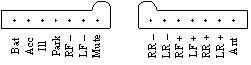
Besides the 12 volt feed and ground wires to the amp, it has to receive the turn-on signal from the radio. That's the same wire that feeds the power antenna. With the radio still plugged in, use a jumper wire to connect either power wire to the turn-on wire. If the amp turns on, there is either a relay in the radio that has bad connections or a transistor circuit that has a problem, depending on the model number. The wires to connect are the one farthest away from the key way in the end of the black plug, to one of the two farthest away from the key way in the gray plug. I prefer using the second wire from the end since that's the main power wire and is on a larger fuse. (That's "Acc" to "Ant).

If that works, it might be less expensive to find a used radio in a salvage yard, but sooner or later they all develop the same problem. Once repaired, they're fixed for life because we use beefier parts. The radios for '93 - '95 Jeeps have different mounting ears than most other Chrysler radios. Those ears were also used in the late '90s Avenger but they had orange displays. Also, look for another Infinity radio. All Chrysler radios put out speaker-level output and will run the speakers directly without an amplifier. The Infinity radios put out much less bass, then it is made up in the amplifier for the shape of the vehicle. If you use a standard radio, you'll have too much bass unless you turn it way down.
Dec 31, 2019 at 3:06 PM
Avatar
UDMAN2006
  • MEMBER
  • 13 POSTS
Hello Caradiodoc,

I have tried the same suggestions you provided. When jumping either of the two power wires with the last connection on the black connector, no change occurs.

Please note that I have changed the problem radio with another stock radio from the junk yard and the issue remains.

I am thinking that it's a ground issue and that the inoperable antenna figures into this somehow. I removed the old radio and attempted to operate it externally. I hooked up my charger to the two power pins in the back and used alligator clips to the 1st and 5th pins to hook up a speaker I had laying around to see if it would play. Although no antenna was hooked up to it, I thought I would hear some type of static at the very least. Alas, no sound was forthcoming.

Any other suggestions or directions to provide me? I'm pretty good at following instructions.
Dec 31, 2019 at 3:06 PM
Advertisement
Avatar
UDMAN2006
  • MEMBER
  • 13 POSTS
Please note that no sound emanates from the speakers no matter which band nor function I attempt to use i.e. FM/AM or tape. Either there's a ground issue or the amp is not turning on. It might be because of a broken ground since I don't have power to the rear windows nor my horn or some other fuse related matter. I have checked Fuse #s 1, 4, 8, 10 and 24 and they all appear to be intact although I have not put a continuity test to them.
Dec 31, 2019 at 3:06 PM
Avatar
CARADIODOC
  • CERTIFIED EXPERT
  • 34,306 POSTS
What happens if you try hooking the salvage yard radio ti the charger and speaker? What's the mode number on both radios?
Dec 31, 2019 at 3:06 PM
Avatar
UDMAN2006
  • MEMBER
  • 13 POSTS
I haven't done that yet, but I don't anticipate anything different. The model number of both radios is the same - 4704315. Would a broken wire in the driver side door cause any of this issue? If it were a ground wire?
Dec 31, 2019 at 3:06 PM
Avatar
CARADIODOC
  • CERTIFIED EXPERT
  • 34,306 POSTS
No to both. The only wires between the door hinges are two for each speaker. If there's separate dash speakers, the left one would still work even if there was a broken wire to the door speaker.

There's no ground wire in the two connectors. The antenna shield, (the outer braided shield in the wire), will provide a ground but it's not a good one. There will be a flat braided ground strap or a black wire bolted to the back of the radio, or a black wire clipped to a stamped terminal on the back of the housing. If the ground was missing, the radio would be dead, including the display.

Lets go back to the basics. Measure the voltage on the "Ant" wire. There should be 12 volts there when the ignition switch and radio are turned on. If there is, find that same color wire at the amp and check for the same voltage there.
Dec 31, 2019 at 3:06 PM
Avatar
UDMAN2006
  • MEMBER
  • 13 POSTS
Ok, so it appears the both of the radios are bad. I jumped the power and the remote connections and the left side speaker and the front tweeters came alive. I then tried it on the salvage radio and the same situation.

Now this solves the great mystery, but I need to know my options. What would it cost to repair the radios at your shop or is it something I can accomplish with my limited soldering skills?

Additionally, I am concerned about the poor sound quality from the other speakers. As I moved the balance control to isolate the rear speakers, no sound could be heard emanating from the rear speakers and only faintly from the passenger front speaker. The tweeters in the front dash did not appear to be fully operational either. Is this a product of the radio issue i.e. some of the channels going bad?

Appreciate all your help!

J
Dec 31, 2019 at 3:06 PM
Avatar
CARADIODOC
  • CERTIFIED EXPERT
  • 34,306 POSTS
Well, the good news is there is no relay or turn-on circuitry in your radio. The switched 12 volts at the power antenna terminal comes straight off the power switch. I've repaired hundreds of arced switches years ago, but never one on your model. I'd find it odd for two of them to be causing a problem, let alone one.

There is a fuse resistor at the end of the 12 volt line after that supply has fed the output I.C.s and the other circuitry. My suspicion is something is shorted on the turn-on circuit in or to the amp and it burned that fuse resistor open. That would do the same thing to the replacement radio, which would explain why they both have the same problem.

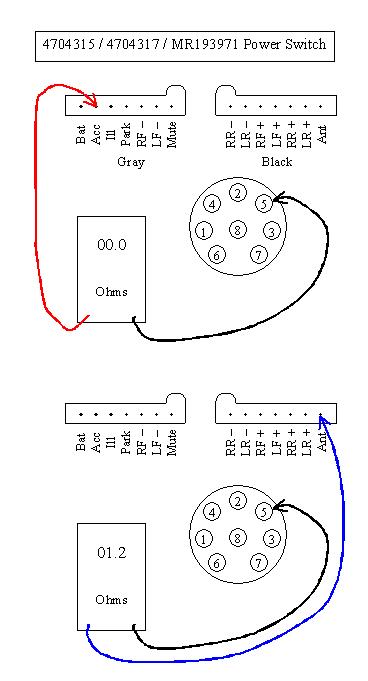
Do these tests in the diagram below. Measure the continuity between the switched ignition wire and terminal 5 in the round cd changer socket. Don't ask me how they came up with that numbering but I drew the picture with pretty red and black meter leads to avoid confusion. You should find 0 ohms with the power switch turned on, plus the small normal resistance in the meter leads. This part of the circuit should be good, otherwise the radio wouldn't play at all.

Next, measure from pin 5 to the power antenna terminal as shown with the nifty blue meter lead. You should read 1.2 ohms plus the meter lead resistance. If it reads open, that fuse resistor is burned open. If that's the case, go to the black plug in the vehicle and read the resistance between that wire and ground. It should read very high or open. If it reads a relatively low value, read it again after you unplug the connector from the amplifier. If it still reads low, that wire has rubbed through the insulation and is shorted to the body. Gotta fix that. If it reads open now, something in the amp is shorted.

I don't have service manuals for most of the amplifiers but there's a good chance I can figure out the problem and fix it. It would be easier though to try to find another one in a salvage yard. If you're anywhere between Ohio and southern Georgia, there is a real nice chain of yards called "Pull-A-Part" where you pay your buck, throw your tool box in one of their wheel barrows, and you can spend all day there. I bought a lot of Chrysler amps from them including one to replace mine in my '93 Dynasty with only 4,200 miles. The turn-on circuitry failed on it too, I suspect from constantly disconnecting and reconnecting the battery. Those amps only cost me 18 bucks each. Finding one for my Dynasty was real hard because only about one car in a hundred came with the premium sound system. The Infinity system in your Jeep was real common so amps should be easy to find.
Dec 31, 2019 at 3:06 PM
Avatar
UDMAN2006
  • MEMBER
  • 13 POSTS
Hi Caradiodoc,

First of all, thank you for all your help. I assumed we had found the problem and it was two defective radios - what's the odds of that. Now, it appears what I always suspected - a short some where.

I am clear on all your instructions except as to how you want me to check the black wire. I assume you mean to check the ground wire connected separately to the large bolt on the back of the radio. I also assume that you want me to test continuity by touching one of the multimeter leads to that wire once disconnected from the back of the radio and the other lead to some known ground point i.e. the negative battery cable or seat bolt. If this is correct, please advise and I will do so straight away.

Please note that I have installed a salvage amp in place of the original amp as I thought it might be the problem as well. As such, I would find it quite odds-defying if both of the amps were defective - the same odds-defying chance that both radios had the same defect.

If there was a short some where, wouldn't the fuse blow or some noise indicative of this be heard upon connecting the radio or amp?

I'll get the other readings while I await your reply.
Dec 31, 2019 at 3:06 PM
Avatar
CARADIODOC
  • CERTIFIED EXPERT
  • 34,306 POSTS
Don't worry about the ground wire. It has to be okay, otherwise the radio wouldn't even turn on.

If there is a short on the power antenna line, a fuse DID blow. That's the 1.2 ohm fuse resistor inside the radio. It is way at the end of the circuitry so even when it blows, the 12 volts will still get to the rest of the radio. The only place the voltage will be missing is at the power antenna terminal. That wouldn't even be noticed if the radios were used in a vehicle without a remote amp or power antenna.

If I recall correctly, you found no voltage at the power antenna terminal. I can't tell you how many times I've gone down the wrong road when troubleshooting a tv because I got an incorrect voltage or resistance reading, usually from a poor contact with the meter probe. That's why I'm having you do these resistance checks. They're just to double-check the previous findings and verify we're on the right track. We know the power switch has to be good because the radio turns on. If you don't get a near 0 ohm reading on the first test, we have to figure out what you're doing wrong before we move on to the second test.

I'm hoping you tell me you find an open circuit on the second test on both radios. If you do, the third test will determine if the wire or the amp is the problem.
Dec 31, 2019 at 3:06 PM
Avatar
UDMAN2006
  • MEMBER
  • 13 POSTS
Ok Caradiodoc,

I performed your aforementioned tests with the vehicle running and the radio connected to the wire harnesses. I inserted a wire into the pin hole number five and back probed the switched power wire with a piece of metal. I then checked continuity between those points and had none.

I then back probed the antenna wire and found complete continuity between pin connection #5 and the antenna wire. I then checked continuity between the black wire (while it was still attached to the radio) and ground and found a reading of 030. I did not test it again with the amp disconnected as of yet. I will do so tomorrow and perform any further tests as you direct.

Thanks again. I remain.

Dec 31, 2019 at 3:07 PM
Avatar
CARADIODOC
  • CERTIFIED EXPERT
  • 34,306 POSTS
Whoa. Hold on. You can't do continuity checks with power applied to the circuit. Remove the radio from the car and unplug all the connectors. Forget about that ground wire. It's fine. With the radio on the bench, just measure the resistance between pin 5 in the round jack to the other two points. To the "Ign" terminal in the gray plug should read nearly 0 ohms when you turn on the radio's power switch. To the "power antenna" terminal it should read close to 0 ohms all the time, regardless of whether the power switch is on or off. That last measurement is the most important one to tell us where to go next.
Dec 31, 2019 at 3:07 PM
Avatar
UDMAN2006
  • MEMBER
  • 13 POSTS
Hi Caradiodoc,

Continuity exists between pin 5 and the remote/antenna wire. No continuity at all between the ACC/switched circuit and pin #5; the reading is very high. The testing was consistent across both radios.

Where do we go from here?

Dec 31, 2019 at 3:07 PM
Avatar
CARADIODOC
  • CERTIFIED EXPERT
  • 34,306 POSTS
That would indicate both power switches are bad.

AGGGHHH!!! Stupid me. No wonder I can't remember working on one of these radios. What I was looking at as the power switch is not a switch. It's that relay I mentioned a while back. Those commonly develop bad solder connections. Of the over 200 radios I have here I don't have one like yours to look at so I have to do this from memory. There were three things I ran into very often. I think where I messed up is by having you jump the switched ignition wire to the power antenna wire. That would indeed bypass the relay and turn on the amp or power antenna, but there's additional circuitry that turns on electronically, not through that relay. Everything might have worked if you jumped those wires AND turned on the power switch. Can't say for sure though because the timing of those two things might be critical, and I never tried it.

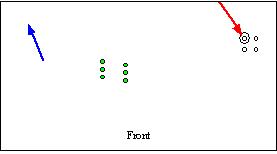
You'll need to remove both covers, then remove four screws to allow you to lift the cassette mechanism out. Two screws on each side of the radio must be removed, then you can pry out the metal plate that sits right above the cassette mechanism. Once that plate is removed, you'll see the solder side of the circuit board. My sad drawing shows approximately where the relay sits. If there's numbers on the board, it's "K701". Look at the two left terminals to see if either one has a black ring around it like I tried to show with the red arrow. If either one looks bad, resolder both of them. If the cassette player became unplugged, you can leave it out and just plug the rest of the radio into the vehicle to try it.

That problem will cause no sound, even in vehicles that don't use a remote amp, and no switched power to the antenna or amp, but the rest of the radio may still tune stations, and the display will light up and the cassette player may still run. I can't remember for sure.

Next, look in the area of the blue arrow. There are about two dozen connections that become overheated and have to be resoldered but this is easier said than done. The new solder with its flux will not flow smoothly to make a nice shiny connection. I used to use solder wick, a special braided wire with flux in it, to remove the old solder, then the new solder flowed better. You have to be careful to not overheat those connections because most of them are for transistors. Transistors hate heat. If your soldering iron is adjustable, turn the temperature up high so you can get in and get it over with quickly. People think a lower temperature is safer but in fact, you have to sit on the connections longer to get the solder to flow smoothly, and that gives the heat time to migrate into the transistor.

Those intermittent connections cause the third problem. Some of them are in the memory circuit. They turn on two transistors in the "reset" circuit. Integrated circuits and their larger microprocessors have thousands of transistors built in that start out in random, disorganized states. They must be "reset" to their starting point as soon as power is applied. That means that reset circuit only operates when the radio is plugged in or when the battery is reconnected. It will not operate again for many years when the battery is disconnected and reconnected for some other service. The two transistors involved are only capable of passing a tiny fraction of an amp or they will overheat, but in this function they have to pass about 100 times what they're capable of, but only for a fraction of a second. It's like passing your hand through a torch flame. You can do that without injury if you're fast enough.

When the bad connections develop around that blue arrow, that circuitry can turn on and off intermittently multiple times per second as you're driving on rough roads. That mimics disconnecting and reconnecting the car's battery repeatedly, and each time it's reconnected, there's that surge of current through those transistors. Each time they heat up a little more with no time to cool down, and eventually they explode. Look on the other side of the board for "Q821" and "Q822". Hope you like green. That's what I used to show their locations. Each transistor is a small black cylinder with a flat spot and three leads. If all you see are the three wires sticking up, they've exploded. Generic replacements are not expensive. If these had failed, the radio would not turn on at all. You'd have no display, but it seems to me the cassette player would still run. It's hard not to get replacement transistors that are a lot beefier and hold up to those repeated surges better, and if someone replaced them already, they could look different. There's a lot of different shapes and sizes but they'll all have three leads.

As a side note not related to your radio, there is a newer model that had a 100 percent failure rate of that reset circuit. Since it's not needed once the microprocessor is running, it can fail and no one will ever know it until the battery is disconnected for some other service or it runs dead. Mechanics often have to disconnect the battery, then they get blamed unfairly for causing the radio to be dead. The problem actually occurred months or years earlier but only shows up when the battery is reconnected. I compare that to a starter motor falling off the engine while you're driving. You'll never know it until after you stop and try to restart the engine.

Anyhow, start with those tests. The fact that you have continuity from pin 5 to the power antenna wire proves the fusible resistors are okay and nothing is shorted in the amp or the wire going to it. I was thinking about relay connections but I failed to see all of that relay on the schematic diagram. I think I'll blame that on my aging eyes.
Dec 31, 2019 at 3:07 PM
Avatar
CARADIODOC
  • CERTIFIED EXPERT
  • 34,306 POSTS
Sorry. Dandy drawing didn't get included.
Dec 31, 2019 at 3:07 PM
Avatar
UDMAN2006
  • MEMBER
  • 13 POSTS
Alright Caradiodoc, I will attempt the brain surgery you suggest. Understand, however, that I have gotten another bone yard special and will be trying that one out today. This newest addition is one of those "good" Mitsubishi radios you spoke of earlier.

I also found frayed and broken wires in the harness that runs between the doors. I took out the old harness and replaced it with one from the boneyard. The donor car was a Grand Cherokee Limited from the same year. When I installed it the tweeters came alive with more power than before and the right rear speaker works. Unfortunately, the previously operable driver side front speaker and the windows failed to work. Not sure if this is a by-product of using different wire harness for different models.

I am going to repair the old harness - two black wires in the harness were frayed and partially cut - and reinstall it. The same issue is appearing on the passenger side as well.

Even if the problem exists in the radio, wire harnesses or some combination thereof, I will be attempting the brain surgery just because....LOL.

I'll keep you posted on my progress.

John
Dec 31, 2019 at 3:07 PM
Avatar
UDMAN2006
  • MEMBER
  • 13 POSTS
Ok Caradiodoc,

I hooked up the Misubishi radio from the salvage yard and it illuminated, but did not power the speakers. Unlike the others, however, the display would change from clock to station frequency with a symbol indicating it was in tape mode. Also unlike the others, I have power at the antenna connection.

Using a jumper wire, I can get the other radios to power the tweeters, but not the speakers. I believe the speakers aren't powering because of the issue with the wires in the door.

I do believe I have the misfortune of finding two radios with internal issues. I don't believe its entirely the wiring. I am not sure if the Mitsubishi radio is also defective since it's acting differently than the others.

Any further help would be greatly appreciated.

John
Dec 31, 2019 at 3:07 PM
Avatar
CARADIODOC
  • CERTIFIED EXPERT
  • 34,306 POSTS
(I'm just leaving to help a friend out-of-town troubleshoot an intermittent electrical problem so I'll be gone for quite a while).

If you have the cd / cassette combo, the only thing that I can think of that would cause it to have no sound is intermittent FM. Once fixed, that is fixed for life, but you will still have sound on AM, tape, and cd.

Given the variety of problems, I wonder if a pair of wires shorted together between the door hinges is causing a protection circuit to kick in. Some radios have a speaker protection circuit that detects a speaker wire shorted to ground and will shut the audio output system down to protect the output ICs. One inexpensive cassette radio will display "SPKR" instead of the clock, and the shorted wire will partially bypass the protection circuit so you'll have no sound from the good channels and weak sound from the speaker with the shorted wire. Some of the higher-end radios just shut the entire audio system down, and some just turn off the affected channel.

I never really got involved with shorted wiring because other mechanics handled stuff like that. I just got handed radios to take home to fix, and there's no shorted wires on my test benches. You might try disconnecting the harnesses from the "A" pillar by the hinges, then turn the radio off and back on to see if the other speakers come back to life.
Dec 31, 2019 at 3:07 PM
Avatar
NCC74656-A
  • MEMBER
  • 6 POSTS
Sorry to resurrect an old thread, but I am having a similar issue.

Got a 1998 GC to replace my 1993, and found the radio only works on the fromt left speakers. After some "fiddling", I got the front right to work, but it will go out of I turn up the volume.

The front harness is stock and connected. The HU is stock (CD/Cass). The wires to the front right seem to be intact, but there was a Pioneer speaker there. My first test was to replace it with an infinity speaker from my 1993. Both speakers exhibit the exact same issues, so I'm ruling out a bad speaker.

When the front right goes out, it gets very distorted with increased volume, then the audio shuts down completely on that speaker only (front left stats playing).

Add to this the rear speakers which I haven't tried replacing yet, but I suspect the issue might be the amp, and failing PA transistors in it.

I would like some expert guidance. Since the front left speaker is working, I'm assuming (yes, I know) that the amp is getting power, and the head unit is keying it on. If I unplug it, I hear a power-down whine from the amp. Also, if I plug it in while the radio is powered, often the missing audio on the front right will return (hence my belief that a PA is failing). I have not had time to ring out the wires to confirm continuity, nor to check the amp voltages.
Dec 31, 2019 at 3:07 PM
Avatar
NCC74656-A
  • MEMBER
  • 6 POSTS
Sorry for the typos in the above post. Fromt=front // "of I turn up the volume" should be IF I turn it up.
Dec 31, 2019 at 3:07 PM
Avatar
NCC74656-A
  • MEMBER
  • 6 POSTS
To clarify, the rear speakers are very low in volume - almost non-existent.

I'm not sure the sub-woofer is working if there is one.

Another typo - front left STAYS playing. I guess that afternoon of diagnostics in the sun took its toll on my typing. :-)
Dec 31, 2019 at 3:07 PM
Avatar
CARADIODOC
  • CERTIFIED EXPERT
  • 34,306 POSTS
It would be best if you'd start a new post to make it easier for others who are researching for a similar vehicle, and because it's hard to go back and reread what you wrote since it sends me over three pages.

Do you have a Grand Cherokee or Grand Caravan?

One thing you can look at is to measure the DC voltages on the speaker wires right at the speakers. You should find around 6.0 volts on both. The intermittent increase in volume and distortion suggests one of the wires is grounded to the body. Some of the radios have short-circuit protection built in but those circuits only do their thing when the short is detected during the power-up sequence. That circuit will shut down all four speakers, but the clue is the affected speaker will still work with low volume and lots of distortion because the shorted wire is bypassing part of the protection circuit.

If you have a CD / cassette combo radio, that is built by Mitsubishi and is a real high-quality radio. There's no short detection though. One grounded wire will cause loss of half the signal, thus the distortion, and it will place 6.0 volts across the terminals. A speaker won't tolerate that for very long.

You made reference to an amp so I'm assuming you have only two wires going to each speaker; is that right? If so, all the speakers will have only two wires, not four. The way you described the rear speakers, it sounds like you have Infinity speakers with the amps bolted to them. Those will have four wires. If the 12 volts to run them is missing, there is still an unpowered tweeter that you'll be able to hear, but it will be very low volume.
Dec 31, 2019 at 3:07 PM
Avatar
NCC74656-A
  • MEMBER
  • 6 POSTS
First, sorry for not starting a new thread. As I said, I have nearly the same issue with the same vehicle. Yes, it is a Grand Cherokee as the subject says. Mine is a 1998 rather than 1995.

I didn't check the rear speakers yet, but I will check for speaker-mounted amps. I didn't think they would have amps since there is the amp under the rear seat that has the rear speakers pass through.

All four speakers are not shutting down. The front driver's side continues to play fine no matter what else is going on, and has no distortion. It's the front passenger side that shuts down, and it is a near complete shutdown with almost no audio after a bout of distortion. But, I agree it does sound like a protection circuit. I also thought it could be a bad (overheating?) transistor in the amp, or even a cold solder joint. If I turn the HU off, about 50% of the time the FL speaker will come back, and 50% it will not.

Yes, the fronts are definitely 2-wire speakers.

With the under-seat amp, will the rears still have only 2-wires? And if they would have the 4-wire system is the power for those separate from the amp and/or HU? Your comment on the rear tweeters sounds very plausible. I am getting a tiny bit of rear audio. I simply ran out of time to check the rears.

BTW, whether the front right has audio or not, the rears never have any audio over the faint sound.

Tomorrow I will check the speaker voltages which should be 6VAC peak, correct? Is that at full volume? Also, I will check at the amp outputs for the same. If it is an amp issue, I'm not beyond replacing transistors in the amp. I imagine they are through-hole components, and not surface mount. Even if they are surface mount, I can handle most of the older SM components fine.
Dec 31, 2019 at 3:07 PM
Avatar
CARADIODOC
  • CERTIFIED EXPERT
  • 34,306 POSTS
Nope, that's 6 volts DC. You'd hear AC as a hum.

When you have the external amp, there will not be any speakers with their own amps, and they'll all be two-wire units. A lot of them will have a little plastic box on the side with a crossover network, and while it's quite effective, it's nothing more than an electrolytic capacitor in series with the tweeter.

I doubt you have an amplifier problem, but if it comes to suspecting that, head to a pick-your-own salvage yard to find a replacement. If you're anywhere between Ohio and southern Georgia, there is a real nice chain of yards called "Pull-A-Part". I've been to 16 of them and have come home with a lot of amps that turned out to be so reliable, I've never been able to sell one. Most are out of Intrepids. There were a bunch of failures in the Cirrus and Sebrings, but not in the Jeeps. They charged me 18 bucks for each one but I think they're higher now.

I did run into one failure in a '93 Dynasty about five years ago. I blamed that on my taking the battery in and out real often because I only drive that car about once every other year. (It has 4,500 miles on it right now)! Talk about a hard one to find. In tact, that's why I had to search through so many yards. They only used that model for two years in a small percentage of Dynastys and 5th Aves. The problem with mine is the turn-on circuit is dead. It was made by Harmon and as a result, I was never allowed to buy a service manual for it, but I think I can figure it out some day when I have nothing else to work on.

As for those transistors you're expecting to find, that is pretty doubtful. All you're going to find are two rows of audio IC output modules. Instead, what I would pursue is switching the two front speakers side-to-side to verify the problem stays on the right side, then pull the two pairs of wire terminals from the amp's connector and switch them to see if the problem switches sides. You have to remember too that you could be getting a weak or distorted signal from the radio to the amp, and the amp is just passing on what it gets.

In case you aren't aware, on all Chrysler products you can add or eliminate an amp with any radio. The amps do not increase volume or power. They only modify tone for the shape of the vehicle. That means you can take the right front pair of wires from the radio and tie them right to the right front speaker wires at the amp, and run the speakers directly. You'll want to remove them all from the connector if you're just playing with one speaker. If you're going to permanently bypass the entire amp, you can be sure it will work by first just jumping the various terminals together with stretched-out paper clips or pieces of wire, when you have the plug removed from the amp.
Dec 31, 2019 at 3:07 PM
Avatar
NCC74656-A
  • MEMBER
  • 6 POSTS
OK. I thought the 6V you were talking about was the audio voltage. what would they use DC for? Or is that a bias voltage?

I doubt changing the speakers side-to-side would make a difference, as I already tried the other speaker (known good) in place of the one that is intermittent with the same results.

I will also try jumping the connectors to pass the HU audio directly to the speakers. I thought the amp actually amplified the signal.

So do you think it's more likely to have a bad HU or bad wiring? (or simply bad speakers in the case of the rear ones)

Does that 6V appear at the HU outputs as well?
Dec 31, 2019 at 3:07 PM
Avatar
CARADIODOC
  • CERTIFIED EXPERT
  • 34,306 POSTS
I am so angry right now I can't see straight to type. If I don't stop and go home, I'm going to smash this computer, and it's a borrowed pile. I just typed for over an hour, then hit some wrong key and it's all gone. Normally I save and save and save in a Word document but I got too lax tonight. There's no way to recover anything. I'll try to do it over at home, then paste it in the next night or two.
Dec 31, 2019 at 3:07 PM
Avatar
NCC74656-A
  • MEMBER
  • 6 POSTS
Update: Rear speaker issue mostly solved. Making the long story short, both speakers are bad. Only the tweeter on one was working. Replacing with speakers from the donor GC brought audio back, but the left rear speaker will distort on high volume (MIGHT be a bad speaker from the donor).

So, the only real issue left is the right front which still cuts in and out. I tried moving the cabling harness to look for shorts, but didn't see a change. Didn't have time yet to check the voltages, but I'm sure the rear speakers have the correct voltage since they now work for the most part.

I have a chance to change the Infinity speakers with Pioneer speakers. Do you think that would be a good change? I generally like to keep everything stock, but maybe good Pioneers are better than semi-good Infinity speakers?
Dec 31, 2019 at 3:07 PM
Avatar
CARADIODOC
  • CERTIFIED EXPERT
  • 34,306 POSTS
Replacement speakers might be "better", but original speakers are tailored to the specific vehicle. That's why two different models can have identical-looking and size speakers but they have different part numbers.

Here's version two of last night's reply that vaporized:

Back in the days of 8-tracks, speakers had one terminal grounded, and the audio signal showed up on the other wire. The problem with running the audio amps on 12 volts is while you can generate up to a 12 volt AC signal, the midpoint, which equates to the lowest signal level, would have to be 6 volts. No speaker would take that for very long. As the signal gets louder and the size of the sine wave gets taller, the voltage going to the speaker increases and decreases but never stays at 0 volts. Current is always going the same way, it just varies up and down. There will always be some DC voltage across the voice coil except for the very brief and rare moments when it goes to 0 volts. For those moments there will be a matching period of 12 volts. Regardless, the average is 6 volts which keeps the voice coil off-center.

That alone leads to distortion because the further the speaker cone moves, the more resistance to that movement builds, so it moves a smaller and smaller additional amount as the voltage increases linearly. The opposite is true when the voltage goes toward 0 volts. The speaker cone wants to return to its resting position anyway, and the drop in voltage allows it to do that very easily. To say this a different way, when the signal voltage rises from 6 to 9 volts, the speaker cone is going to move considerably less than when the voltage drops from 6 to 3 volts. While the sine wave might be perfectly clean with no distortion, the mechanical response of the speaker cone will not produce a matching audio waveform. It can't help but introduce distortion due to a mechanical limitation.

To address that, most manufacturers used an audio output transformer. That allowed an internal regulated voltage to be applied to the final transistor stage through the transformer's primary winding, which also presented enough resistance to limit current to safe design values, and that transistor would not introduce any distortion. You understand transistor theory, so for example, lets say the base has 3 volts at idle, (no audio signal present), and the collector has 6 volts. Now a very low audio signal shows up with a sine wave that's one tenth of a volt high. When the base voltage goes from 3.00 to 3.05 volts, the collector's voltage may drop one volt to 5.00 volts. During the other half of the signal, when the base voltage goes from 3.00 volts to 2.95 volts, the collector voltage will go to 7.00 volts. The one volt rise and one volt drop match the linear .05 volt rise and .05 volt drop at the base. That was never the issue before, but having the transformer allowed the use of a circuit that didn't introduce any distortion, while making a signal voltage available to the speaker that would allow that speaker to do its thing, also without introducing its distortion.

The secondary winding of the transformer simply puts out an AC voltage matching what went in, except now, instead of the current going to the speaker rising and falling but always going the same way, (and the speaker cone always averaging an off-center condition), this is now a clean AC signal with no DC component to it. That means that with no signal voltage, the speaker cone is centered and at rest. When a sine wave is presented, for half of the cycle, the speaker cone stretches out, and the other half cycle the cone stretches in. The forces are equal so no mechanical distortion is created.

Eventually everything started to become lighter and lighter. Even tvs lost their ten-pound power transformers. By the early to mid '80s most car radio manufacturers had gone to an integrated circuit for the final amplifier stage, but they combined the best of both worlds. There is no DC voltage holding the speaker's voice coil off-center, and there's no pair of heavy audio output transformers. They do that by placing approximately 6 volts on both speaker wires, and applying equal but opposite signals on the two wires. The most common output ICs have a pair of stages for each speaker, one stage for each wire. The DC voltage sits at 6 volts, then up to a 12 volt AC sine wave can be impressed on top of that, so the voltage can vary from 0 to 12 volts. At the same time the inverse is occurring on the other wire. That means that with two 12 volt AC signals, and one is inversed, the speaker will actually see up to a 24 volt AC voltage. You could achieve that with a transformer too, along with the weight and high manufacturing cost. At first this doesn't sound right, but if you look at both signals on a dual-trace oscilloscope with an "add" function, you'll see the one combined signal has twice the amplitude as either individual signal. (I have one more wondrous detail about this at the end of my marvelous story).

That's why you'll find 6 volts on all speaker wires in cars today. My voltages in this story are just approximate to illustrate the important points, but they're pretty close. Since nothing associated electrically with the speaker is grounded, and both terminals have exactly the same DC voltage, the voice coil sees only the 0 volt difference and not the 6 volts on each wire, so the voice coil stays centered when there's no AC signal voltage.

Most manufacturers use a pair of output ICs, and each one has four identical amplifier circuits. Two are for the pair of speaker wires for the right front speaker, and two are for the pair of wires for the right rear speaker. The second IC is used the same way for the pair of rear speakers. The radio I mentioned that had short detection was one of the rare models that used one IC for the front speakers and the other for the rear speakers. Almost all other radios split the job between left and right.

GM, true to their habit of developing customer-unfriendly business practices that put profits ahead of their customers' best interest, developed a proprietary output IC that cost well over $20.00, and they were almost impossible to harvest from a donor radio without destroying them physically or by overheating them. They stopped making those a long time ago, but they must have allowed some other manufacturer to take over production because I was able to buy them the last time I needed some. The new replacements have a higher volume, so if you only replace one, there is a minor modification that needs to be made to cut the output to match the other IC. By the way, almost all ICs in GM radios are proprietary and had to come from their parts suppliers.

Chrysler always used generic output ICs that were already developed for the home entertainment industry, so they had a known track record. Often they had in-house part numbers, but those numbers were in most cross reference guides, and the generic numbers were listed in their radio service manuals. The more expensive ones cost me $2.50 each.

In the early high-end radios of the late '80s, many of them used four output ICs but they worked the same way. Before this, front-to-rear faders were mechanical controls, usually a rheostat or wire-wound potentiometer that split the current between two speakers, a front one and a rear one. Those radios were built with two audio channels, a left and a right channel, then the fader was added to handle two more speakers.

It was easy to design in four channels right away when output ICs were used, but the balance and fader functions got rather involved because each amplifier stage needed the incoming signal to be attenuated to adjust its volume level based on the settings of the balance, fader, and volume controls. It didn't take long before they started using ICs with amplifier stages where each ones' volume was adjusted by varying a clean and steady DC voltage on a pin of that IC. That made two things possible that Chrysler exploited. One was the up and down volume pushbuttons that allowed you to change volume by just holding a switch, and the other was the balance / fader joystick.

I promised to expand on that 24 volt AC signal novel. Once you are done checking for six volts on all of your speaker wires, and if that is okay, ideally your next step is to look at the signals with an oscilloscope. This is where I got "all wrapped around the axle" about 25 years ago. The radio had one dead speaker. The other three worked fine. I had a four-trace scope so I was watching both wires going to a working speaker, and the pair going to the dead speaker. All four had close to six volts, all four had identical waveforms, and all four waveforms could be varied for volume and balance. The only possible explanation was I had a bad speaker on my test bench. I didn't notice that one waveform didn't respond to volume adjustments like the others did.

Apparently the wind through my ears blew the candle out, because it wasn't until I wasted an hour taking the bench apart and I disconnected the speaker that I noticed one of the four waveforms was missing. Closer inspection showed it had dropped to 0 volts and had no AC signal. Everything came back when I reconnected the speaker! Finally it occurred to me one of the four amplifier stages in one IC was open. The six volts and the AC signal were originating in the good stage, making it to the speaker, through it, and back to the radio where I had the second probe, but current couldn't complete the circuit through the open stage. It never dawned on me that I was seeing two identical waveforms, meaning they had the same phase, feeding the two sides of the voice coil.

To test my discovery, I jumped a fairly large electrolytic capacitor from the dead terminal to ground, and I suddenly had a working speaker, but at about half the volume of the others, then, to figure out a clue for the next time I ran into this, all it took was to use that "add" feature on the scope. There's a clinker though. With the good channel, two out-of-phase waveforms added together should have turned into a flat line, but what I found was a very tiny AC signal representing the slight changes in tone being done in one of the stages. THAT turned out to be the clue to look for. On the dead channel with the two in-phase waveforms, adding them together just produced one waveform with twice the amplitude. That alone should have told me the speaker was seeing the same thing on both terminals, which means no difference and no sound. But, when one waveform was inverted, then they were added, I got the flat line but without that microscopic AC signal. That is what represented what the speaker was seeing.

I hope all of that made sense. If you don't have a scope, and since it's faster, you might try grounding the speaker terminals, one-at-a-time, with a capacitor. That won't affect the DC voltage, but it might verify a problem in the amp that you suspect.
Dec 31, 2019 at 3:07 PM