Code 42, no start but runs on starting fluid

1991 CHRYSLER LE BARON
152,000 MILES • 3.0L • V6 • FWD • AUTOMATIC
Avatar
MARAAKATE
  • MEMBER
  • 13 POSTS
My car has been running okay for three years with a somewhat whiny fuel pump. The other week I was sitting in traffic and went to inch forward and the car would not move forward so I thought maybe the transmission was acting funny (it never has but I do know that they are known for trans issues) so I went to shift into park with the intention of shifting into drive and then the car stalled out. It would not restart so I had it towed to my work. I work in the body shop at a Ford dealership so I am able to work on this in the evenings with an experienced tech.

Anyways, I replaced the fuel pump without checking anything else first because the car fired up as soon as I got it off the tow truck and I knew it was overdue for a pump anyways. Replaced the pump and the car still would not start. Checked for power running to the pump and it does prime. Then we checked the fuel injectors and power was going to them. Checked with a noid light and no pulses are being generated for the injectors.

So we let it sit for a few days while I did some research. Checked the code and found it was giving a Code 42 about the ASD Relay. He checked the relay (now how thorough the test was I am unsure) and apparently it is okay.

We then removed the air-box checked for any potentially obvious bad wiring which the car had some previously since this car sat outside for literally fifteen years and some critters did chew on various wires at some point. This includes unwinding all the tape, removing the housing for the wires, etc. all the way from the fuse box area to the the other side by the map sensors. There was some insulation peeled back on one of the wires running to the injectors under the air box and we checked this and it was okay. He checked the wires and the positives are reading about 6.7-7.2ohms consistently.

There was also a 2-pin connector that was not plugged into anything by the fuel injector pigtail and was being melted by the exhaust. It looks like it may have went somewhere down by the transmission. Not sure if this is for some accessory wiring or what the issue is. The car has been in a collision before and there was some ground wires it appears that were redone down by the transmission. If someone needs pictures of this damage and needs to know the wiring color for that connector I can provide it.

The large positive wire coming from the battery to the fuel box was partially cut open, exposing some of the wire and a bit of corrosion and was rubbing on the master cylinder. RTV'd the exposed area, wrapped it in electrical tape and checked all the fuses and they are checking out okay.

The car will run on starting fluid so I think we can rule out the coil, distributor, and timing belt.

One of the wires running to the MAP sensor is a bit suspect, have not replaced this yet; but the tech was saying the car should at least be able to run, maybe not very well, but still run nonetheless despite the somewhat chewed wire running to the sensor.

I disconnected the fuel lines running to the fuel filter and some fuel does come out at the initial prime and I bypassed the fuel filter to be certain that it was not plugged. If I check the fuel lines by the rails nothing is coming out but I am not sure if this is because the ASD relay is preventing the pump from doing its job.

The dealership I work at has a Chrysler location on the other end of town and I am going to see on Monday if they have a DRB-II tool with the appropriate adapter that would allow me to at least run the test to energize the fuel pump; but considering the injectors are not pulsating I do not think it is a case of a plugged line.

I very likely suspect the computer at this point; but I am not sure. I do have the official dealer manuals for the car but some of the information is a bit vague on exact diagnostics to follow to fix this issue.

Starting to run out of ideas at this point, short of replacing the computer (which I do have one coming, but I do very much dislike shotgunning parts and would like to learn from this situation) and checking the appropriate wires the 60 pin connector actually cares about to trigger code 42. I am not sure which specific wires I should be caring about.

Any help/advice is appreciated.

The car is an AJ Body for anyone who is referencing the dealer manuals.
Jan 21, 2017 at 12:03 PM
Advertisement
Avatar
HMAC300
  • CERTIFIED EXPERT
  • 48,601 POSTS
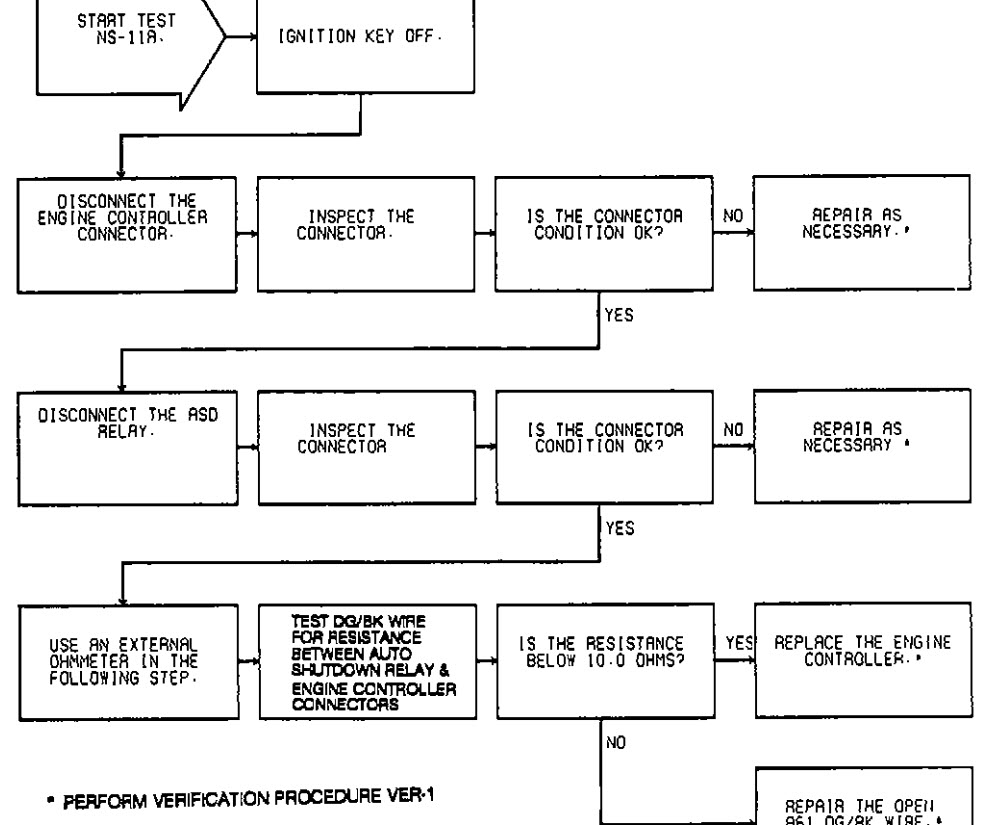
code 42 as you said is ASD relay which you say is good. however, it shuts the fuel down. See picture on how to diagnose it. It shows which wires to check for ASD relay problem.
Jan 21, 2017 at 12:39 PM
Avatar
MARAAKATE
  • MEMBER
  • 13 POSTS
So basically, I need to disconnect the 60 pin connector to the computer, then check the resistance of the dark green with black tracer wire from the fuse box where the relay is stored to the computer?

I am also a bit confused as the fuse cover says the relay is a fuel pump relay, however the dealer book and even Alldata said the relay location was in the fuse box next to the starter relay. So the ASD relay is also the fuel pump relay? I just want to be sure this is the proper relay to be looking at. The passenger-side fender also has a computer and about two or three relays there and I am not sure of their purpose and a quick gloss in the books did not clarify that.
Jan 21, 2017 at 12:45 PM
Advertisement
Avatar
CARADIODOC
  • CERTIFIED EXPERT
  • 34,306 POSTS
First let me point out some comments of value. Unlike on GM products of this era, Chrysler had extremely little trouble with their Engine Computers, so that should be the last thing on your list of suspects. Second, you will rarely solve a running problem on a Chrysler product by replacing the fuel filter. They often last the life of the vehicle, unless they rust out and leak. There are no diagnostic steps in the service manuals. Chrysler produced a lot of diagnostic manuals specific to the individual systems. There were manuals with white covers that were handed out at their training classes. Older mechanics may still have them. Starting around 1992 or '1993, the diagnostic manuals were the same colors as the service manuals for that year, and were sent to every dealership. All of the tests for diagnosing fault codes revolve around using the DRB2 scanner, but those test procedures were written for people who do not understand how the systems work. Once you do understand system operation, you will understand what each step is trying to accomplish without needing the scanner. I used the books for their connector drawings that showed which wires to take readings on.

I will describe the operation of the automatic shutdown, (ASD), relay, then you can make informed decisions as to whether it is working properly. The Engine Computer turns that relay on for one second when you turn on the ignition switch. That relay sends current to the ignition coil, injectors, alternator field, oxygen sensor heaters, and fuel pump or pump relay. You should hear the hum of the fuel pump for that one second. If you do, the ASD circuit is working, and the computer has control of it. Next, the computer turns the ASD relay on again during engine rotation, (cranking or running), and it knows that by the signal pulses it gets from the crankshaft position sensor and the camshaft position sensor. One more place that gets twelve volts from the ASD relay is a terminal on the Engine Computer. The computer turned on the relay, and the voltage on that terminal is how it verified that occurred.

In the absence of other fault codes, use the scanner on the "Sensors" or "Inputs/Outputs" screen to view the camshaft position sensor and crankshaft position sensor. They will be listed as "No" or "Present". The computer often will not set a fault code for a missing signal just from cranking the engine. They may only set while a stalled engine is coasting to a stop. If a sensor signal is missing, the ASD relay will not be turned on during cranking, so no verification voltage will be seen at that terminal on the computer. If a fault code is already set for the missing signal, the computer knows to not expect to see that verification twelve volts, so it will not set the fault code you have.

From what you described about the wiring, the first thing I would look at is the twelve volts at the injectors. Back-probe the wire at any injector that is the same color at all of them. As I recall, that will be a dark green, dark green/black, or dark green/orange wire. A test light works better for this than a digital voltmeter because meters do not respond fast enough. If the light turns on for one second when you turn on the ignition switch, and it turns on again during cranking, that circuit is okay. If the voltage is missing, I would suspect a corroded splice, as the ignition coil is working, meaning only part of the system is getting the twelve volts from the ASD relay.

Also, do not overlook the possibility of bad gas. We had two crank/no-starts come in at the same time, and everything looked good. After a day and a half, the mechanic drew a sample of gas, threw it on the floor, and threw a lit match on it. The "gas" put the flame out. Both cars were just fueled up at the same station. Draining and refilling the gas tanks solved both no-starts. Also do not overlook a jumped timing belt. The 3.0L is not an interference engine, so there will not be any bent valves.
Jan 21, 2017 at 1:26 PM
Avatar
MARAAKATE
  • MEMBER
  • 13 POSTS
Thanks for the more detailed response. I did not replace the fuel filter, only the fuel pump and only because this pump has been with a high frequency pitched whine since I have owned the vehicle and it was very cold out last week so the conclusion for me was that the pump has expired since I was riding around on borrowed time with that fuel pump.

Regarding the camshaft position sensor: If the wiring or sensor is at fault for this part of the circuit would the car still be able to run on the starting fluid?

I do not suspect the timing itself, because again, the car can run just fine on starting fluid. Unless there is something you can tell me otherwise.

I did not personally try to ignite the gas, but when I swapped out the fuel pump and bypassed the fuel filter earlier today the gas smelled healthy. It was mostly clear, the tank is a little rusty in some spots but nothing overly alarming.
Jan 21, 2017 at 4:32 PM
Avatar
CARADIODOC
  • CERTIFIED EXPERT
  • 34,306 POSTS
One thing to not overlook is switching the two hoses at the tank. I did that twice on my 1988 Grand Caravan, resulting in a crank/no-start, and I am supposed to be the expert! Remove the smaller fuel return hose by the right front strut tower. If fuel sprays out, the hoses are switched.

You are right that signals are needed from both sensors for the ASD relay to turn on. Lack of injector pulses suggests one signal is missing, provided you do have twelve volts going to them. Something does not agree here. If you have spark, the ASD relay is turning on. That means there is pulses from both sensors and the injectors should be getting pulsed on and off. Try firing the injectors with the DRB2 scanner on automatic test mode, (ATM). If you hear them click, the circuitry is okay and the Engine Computer has control of them.
Jan 21, 2017 at 6:02 PM
Avatar
MARAAKATE
  • MEMBER
  • 13 POSTS
I can check the hoses. I did actually redo the rubber hoses by removing the pressed on clamps with a cut off wheel (very slowly making sure no gas was on the floor!) and replaced them since they were dry rotted and one of them broke apart once I lowered the fuel tank. I also redid the ones on the fuel filter as well since I was down there.

Maybe it is very possible that they were swapped but like you said the hoses are two different sizes and the fits seemed tight. However, sometimes when you are tired it is easy to make such a simple mistake. I will recheck the hoses.

Earlier today, I removed the bigger line on the fuel filter and tried cycling the ignition to prime the pump and crank the engine a few times as well. I did not see anything spitting into a small bucket I provided, so I had a buddy do the same test while I watched and nothing came out. During this time I could hear the fuel pump priming during the ignition cycle. I had to work outside so I cannot re-verify if the pump was still pumping during a crank. When I removed the smaller line to the filter gas was coming out.

I did mention earlier that I am not a tech; but I work in a body shop and have basic mechanical experience on working on motorcycles and scooters so I have some decent experience with diagnostic procedures; but the little nuances (like the size of the lines, which ones are important to check, etc.) I do not know by heart.

I am also going by the techs word with the injector test with a test lamp and noid light as I have not performed these tests myself so it is quite possible he mis-diagnosed the injectors. I do remember that the dark green wire was the common on the 4 pin connector to the injectors. From what you stated earlier, I want to attach a test light to this location and verify it comes on during the ignition cycle and continues to illuminate during cranking.

The DRB2 scanner may or may not be an option for me; so let's pretend for now that I will not be getting access to it and see what I can test in the meantime.

I will check the lines tomorrow, do the relay test that was provided to me earlier, and see if I can dig up my test light to verify the 4 pin connector and let you know of the outcome. To eliminate any other possibility, I will take pictures of the questionable connector that I saw hanging around there. Maybe it was to an important sensor. But since we may be dealing with an electrical issue it is probably best to find out what is and see if it needs further attention.

Also, if the hoses were switched are car electronics sophisticated enough to know that there is no pressure in the fuel system after the initial prime and therefore disable the injectors to prevent burning them out? From what I am understand the ASD relay is supposed to start an initial one second activation during the ignition cycle for the priming of the fuel pump and then there is another wire from the computer that is supposed to check other conditions. If these fail then the pump and injectors are no longer active (I am not sure about it cutting off the coil circuit though).

Thanks for your detailed help so far. Really been learning a lot about how intertwined the electronics are shared with the fuel system and how tightly regulated it is generate the proper signals it requires to run.
Jan 21, 2017 at 8:13 PM
Avatar
RENEE L
  • CERTIFIED EXPERT
  • 1,260 POSTS
Great information CARADIODOC!
Jan 22, 2017 at 10:48 AM
Avatar
MARAAKATE
  • MEMBER
  • 13 POSTS
The problem (so far) is the replacement fuel pump.

I cleared the codes with the DRB2 tool; tried to do a few cranks, no codes except 12/battery disconnect (good).
Ran the ASD relay test on the tool; it clicks, reads ON during initial prime, switches to OFF, then switches back to ON when cranking (good).
Pulse was reading ~60 then about ~55 during a crank.
Ran injector test on all injectors all are clicking (good).
TPS voltage is below 1.00 volts at closed throttle (good).
Ran fuel system test, I can hear the pump whirring (good).
I also viewed the sensor outputs and saw stuff occurring for MAP, TPS, and Barometric. All seem to be working.

At this point I was out of ideas; tech told me to run the fuel pressure test and he assisted me. Ran the fuel system test again on the scan tool and it took a while for the gas to start coming out of the release valve on the pressure tester and it was trickling. Pressure is basically 0. There is no fuel filter since I bypassed this to be sure it was not plugged. So unfortunately it looks like a faulty pump; which is a real shame as I went out of my way to get a Bosch pump from Amazon.

In the mean time, I am going to have the parts guy at the dealership get me an aftermarket pump and filter and hook it up again and run the fuel system test make sure its good. fix up the few questionable wires before they become a bigger issue and hopefully the problem is resolved.
Jan 23, 2017 at 3:14 PM
Avatar
MARAAKATE
  • MEMBER
  • 13 POSTS
And for those curious out there, yes the ASD relay is the fuel pump relay on this car.
Jan 23, 2017 at 3:16 PM
Avatar
CARADIODOC
  • CERTIFIED EXPERT
  • 34,306 POSTS
To add to the confusion, I believe there are some car models now that monitor fuel pressure, but I cannot say which ones. Starting with all 1996 models, there is a way to monitor pressure in the fuel return system, but that is only to detect a vapor leak. For almost all cars and trucks, including yours and mine, fuel supply pressure is not monitored. That is why there are no potential diagnostic fault codes related to loss of fuel pressure. It is also why a lot of diagnostic procedures begin with measuring that pressure manually.

Burning out injectors is not a concern. Even when running out of fuel, flow stops, so no air gets pumped into the system. The fuel sitting in the injectors and lines just sits there. The bigger concern is overheating fuel pumps because the motors are cooled by the fuel. This is such a big concern with Ford products that they can have as much as seven gallons of gas still in the tank when the gauge reads "empty". This goes back as far as the mid 1980's. Their pumps were no more susceptible to damage than those of other manufacturers. They just built in the extra safety margin to avoid failures from running out of gas.

You are getting the idea of how the ignition system works. The Engine Computer gets signal pulses from the distributor pickup assembly on older 3.0 Ls and from the crankshaft position sensor by 1989 or 1990. When both signals are received, which can only occur during engine rotation, (cranking or running), the computer turns on the ASD relay. That relay sends current to the ignition coil, injectors, alternator field, oxygen sensor heaters, and fuel pump or pump relay. Some car models use a separate fuel pump relay, but the computer always turns both on at the same time and through the same terminal in its connector.

Ignition system failures only cause about two percent of crank/no-start problems. Around this time period, fuel supply failures caused perhaps ten percent of those no-starts. The biggest majority of no-starts were caused by a sensor failure that resulted in the ASD relay not turning on during cranking. That is why it is important when loss of spark or loss of fuel pressure is found, you must always check for the other one too. Too many people get stuck on the first thing they find missing and do not look further.
Jan 23, 2017 at 3:17 PM
Avatar
MARAAKATE
  • MEMBER
  • 13 POSTS
Still no good. Got another pump (this time an Airtex). The tank has about 4-5 gallons in it and I added an extra gallon to be certain. I disconnected both lines at the fuel pump and nothing comes out. I tried putting my finger one the return line and feel very little suction.

I will also check the pigtail and make sure it's actually getting 12 volts. Maybe there is a corrosion issue somewhere that is preventing it from getting the full 12 volts but the replacement pump is rather loud so I doubt that is the case.

Could the pumps be wired backwards? If they were would gas at least come out of one of those ends?
Jan 24, 2017 at 4:25 PM
Avatar
HMAC300
  • CERTIFIED EXPERT
  • 48,601 POSTS
it old be wired backwards try switch ing wire see what happens.
Jan 24, 2017 at 4:34 PM
Avatar
CARADIODOC
  • CERTIFIED EXPERT
  • 34,306 POSTS
There's no suction on the return port. Fuel leaving the regulator goes into that port under no pressure. From there it rushes past the internal bowl where it creates a venturi effect that draws fuel into that bowl to keep it full.

Replacement pumps are available as just the pump and motor or the complete housing assembly with everything in it. When replacing the motor separately in the old housing, the wires on most models are just a pair of slide-on terminals. Mine were different sizes, but I can imagine it might still be possible to mix them up. That would make the pump run backward.
Jan 24, 2017 at 4:46 PM
Avatar
MARAAKATE
  • MEMBER
  • 13 POSTS
The pigtail connector running to the pump is keyed, but I did reverse the wiring and it still isnt pumping out gas. I know there is gas in there, the tank is heavy enough I needed to use a jack to move it around when I was under the car and I also added an extra gallon of gas just to be certain.

The pump is definitely running I can hear it during prime and during cranking.

I can't check the voltage at the pump for 2 days as I have an appointment tomorrow and won't have time to fool around with it.
Jan 24, 2017 at 5:04 PM
Avatar
MARAAKATE
  • MEMBER
  • 13 POSTS
I also misunderstood part of this. I bought the complete pump assembly. But either way, I reversed the wires on the pigtail to see if the pump itself was wired backwards from the factory and it still doesn't work.
Jan 24, 2017 at 6:55 PM
Avatar
HMAC300
  • CERTIFIED EXPERT
  • 48,601 POSTS
you aren't getting power it seems trace the wire back to see what the problem is it may be corrosion or where the asd plugs in
Jan 25, 2017 at 6:45 AM
Avatar
MARAAKATE
  • MEMBER
  • 13 POSTS
I have power to the pump. It physically runs and I can hear it running. Now whether or not it's a strong 12 volts is questionable at this stage. Tomorrow I will verify that it's actually 12 volts.
Jan 25, 2017 at 7:03 AM
Avatar
HMAC300
  • CERTIFIED EXPERT
  • 48,601 POSTS
you should have done that to begin with
Jan 25, 2017 at 9:25 AM
Avatar
MARAAKATE
  • MEMBER
  • 13 POSTS
This is true. Admittedly, these are all first time mistakes and now I'm paying the price for learning from them. :)
Jan 25, 2017 at 9:26 AM
Avatar
CARADIODOC
  • CERTIFIED EXPERT
  • 34,306 POSTS
Let me share one more thing, just so we don't overlook something stupid. The tank rusted out on my '88 Grand Caravan and I had to replace it. That is when I saw the bowl in the middle that keeps the gas from running to the side when cornering. The pick-up screen sits in that bowl. The return fuel rushes out of the pipe next to that bowl, and the force creates a low-pressure area that draws additional gas into the bowl to keep it full. My question was, . . . how does the pump get gas after you run the tank empty, then put in only a gallon? Turns out the filler tube ends in such a way that the fuel you're pouring in dumps right into that bowl.

Chapter 2: Now I'm driving a '94 Grand Caravan with what I assume is the same system. I ran it empty to know how far I could stretch it once the 'Low Fuel" light came on. After that, it would not restart with just one gallon of gas. Fortunately I had five gallons with me, and it took all of that to get it started. My assumption is the gas doesn't dump into the bowl, and it takes five gallons, (almost one third of a tank), to get the level high enough to spill into the bowl where the pick-up screen is sitting.

You might just try adding a few more gallons to the tank.
Jan 25, 2017 at 12:30 PM
Avatar
MARAAKATE
  • MEMBER
  • 13 POSTS
I will check where it is resting once I verify that the voltage is where it should be.

I get a feeling if I add a few more gallons and don't see a change and drop the tank and remove the pump and take a good look I will be finding something stupidly obvious that should have been checked previously.

Also, been learning a lot from everyone here (and elsewhere) on how interrelated the system must be to function properly. Definitely a lot more complex than gravity feed carbs on 2 wheeled bikes!
Jan 25, 2017 at 12:41 PM
Avatar
MARAAKATE
  • MEMBER
  • 13 POSTS
Okay. Dropped the tank, saw nothing funny floating around in there, did a pressure test it was about 15 psi. Got one more pump (this time a Spectra Premium) and it fired right up. Drove it home and all is well. Thanks for the help from everyone.
Feb 3, 2017 at 2:54 PM
Avatar
STRAILER
  • CERTIFIED EXPERT
  • 53,854 POSTS
Glad we could help please consider buying the mechanic a cup of coffee.

Best, Ken
Feb 8, 2017 at 2:49 AM