Fuel Tank over flow tank leaking gas.

1990 PLYMOUTH VOYAGER
200,000 MILES • 6 CYL • 2WD • AUTOMATIC
Avatar
RANIERCT
  • MEMBER
  • 7 POSTS
Gentleman..I have a 1990 Plymouth Voyager LE 3.0 Fuel is leaking out of the fuel tank overflow line and its a good stream. If I loosen the gas cap, it will stop. Tried a new gas cap with negative results. This just started a couple days ago. I know besides the over flow pipe, there is also a relief valve and roll over shut of on the top of the tank. Im thinking it is the fuel pressure regulator on the engine. Any suggestions would be appreciated. My name is Mark
Aug 23, 2011 at 8:30 PM
Advertisement
Avatar
CARADIODOC
  • CERTIFIED EXPERT
  • 34,306 POSTS
There is no overflow hose. There is a vapor recovery line but that won't leak liquid fuel as there is about a five gallon air bubble on top for a crush zone. What you're more likely seeing is the return line from the pressure regulator is leaking. The clue is the engine will still run. If the supply line is leaking, the engine won't run because there won't be enough fuel pressure.

If the leakage is occurring with the engine off, it's due to expansion as the fuel warms up. That is more likely to come from the supply line. Look for rusted off hose clamps near the tank. I've had to replace mine a few times on my '88.
Aug 23, 2011 at 10:21 PM
Avatar
RANIERCT
  • MEMBER
  • 7 POSTS
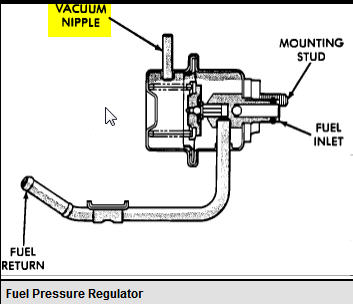
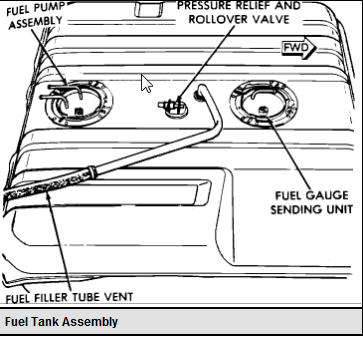
Thanks caradiodoc for your prompt reply. It does not leak when engine is off. Only when running or open the gas cap. There is a steel gas line that runs from the front top of the tank to below the bottom of the tank by the left front corner. It squirts out inline with the fill tube. See Attached photo. It is the fuel filler tube vent. Just trying to find the solution. How about the pressure regulator?

Thanks for your help. It is appreciated
Aug 24, 2011 at 2:28 AM
Advertisement
Avatar
CARADIODOC
  • CERTIFIED EXPERT
  • 34,306 POSTS
There shouldn't be any liquid in that tube. I've been searching through the service manual and I can't find a picture of the filler tube. From past experience, that filler tube extends down another few inches into the tank. Once you fill the fuel to the top of the pipe opening, fuel backs up into the tube to shut the pump off. That leaves a lot of air in the top half of the tank.

I never pulled that vent tube out so I don't know how far down it sticks into the tank. My best guess is it goes in far enough to hit liquid. Expansion would explain why liquid is in there to leak out. I think you're looking at one of three possibilities. The rubber hose is deteriorated, the metal tube has a rust hole, or the hose clamp is loose or missing. I've had to replace rusted hose clamps many times on mine.

The rollover valve is not the answer. Expanding vapor goes through it to the charcoal canister to be stored and burned in the engine later. The pressure relief function is a backup to the gas cap. The cap vents excessive pressure which isn't much. It should release over about two pounds of pressure.
Aug 24, 2011 at 7:14 AM
Avatar
RANIERCT
  • MEMBER
  • 7 POSTS
Thanks caradiodoc: The tank is less than a 1/4 full. One thing important I forgot, Is the amount of pressure in the tank. Before it started dumping fuel, I never heard pressure coming out when I took of the Gas Cap. Now there is a lot of pressure when I do. Way more than 2 psi. I already tried a new gas cap. I have a new pressure regulator. Do you think I should install it?

I have owned this van since new, off the lot. Its in near show room condition. The only major repair was the 604 tranny. Put in a Jasper. Wise move. Have over 150000 on it.

Thanks again for all your suggestions and explanations.

" An idiot with a computer is a faster, better idiot" lol

Aug 24, 2011 at 12:30 PM
Avatar
CARADIODOC
  • CERTIFIED EXPERT
  • 34,306 POSTS
By "regulator", you mean the rollover valve, right, not the pressure regulator on the engine? You can try it. First you might try removing the hoses from the charcoal canister. If vapor comes shooting out of one of them, something is plugged related to it. There's a fiber filter on the bottom, but they give such little trouble we never monkey with them.
Aug 24, 2011 at 10:04 PM
Avatar
RANIERCT
  • MEMBER
  • 7 POSTS
Yes, The pressure regulator on engine. Van is also hard to start when hot. Live in Phoenix.
Aug 24, 2011 at 10:26 PM
Avatar
CARADIODOC
  • CERTIFIED EXPERT
  • 34,306 POSTS
Never saw a defective regulator on a Chrysler product. The closest I ever saw was a cut o-ring around the nozzle on a brand new car. The symptom was about a 15 second crank time, then it ran fine.
Aug 25, 2011 at 5:13 AM
Avatar
RANIERCT
  • MEMBER
  • 7 POSTS
Dear caradiodoc: FYI. Replacing the engine fuel regulator solved the problem. I thank you for all your suggestions and the time you took to answer my questions.

Sincerely,

Mark
Aug 25, 2011 at 11:14 PM
Avatar
CARADIODOC
  • CERTIFIED EXPERT
  • 34,306 POSTS
Come on now, I just got done telling someone I've never seen a defective regulator on a Chrysler product. You're making me a liar. Just to be sure I'm clear, you replaced the pressure regulator on the fuel rail on the engine, right? Do you have any idea what's wrong with it?
Aug 26, 2011 at 12:10 AM
Avatar
RANIERCT
  • MEMBER
  • 7 POSTS
Dear caradiodoc. My Friend: No disrespect intended. You are certainly not a Liar. I thought your help was very informative. You gave me many more things to check. It was by chance the I found the problem. The part was $101.00 It sets on the left top side of the 3.0 engine. It is under the air plenum. Problem: Raw gas was coming out of the regulators "vacuum" port. See pict.
Aug 26, 2011 at 6:34 PM
Avatar
CARADIODOC
  • CERTIFIED EXPERT
  • 34,306 POSTS
That's a very common failure, . . . on GM trucks. I never heard of that happening before on a Chrysler product. So how did that cause fuel leakage back by the tank? All that regulator controls is the pressure in the fuel rail and the line from the pump to the rail. It doesn't have any affect on the pressure in the tank itself. Gonna have to add this to the memory banks.
Aug 26, 2011 at 9:15 PM
Avatar
RANIERCT
  • MEMBER
  • 7 POSTS
Actually the regulator returns fuel to the tank which if to much will cause pressure. What is odd to me is, if the pump is sending gas to the engine, you would think there would be equal pressure when you include the return line from the regulator. Live and learn.

Thanks again caradiodoc
Aug 26, 2011 at 10:23 PM
Avatar
CARADIODOC
  • CERTIFIED EXPERT
  • 34,306 POSTS
There's a clinker in yer thinker. Once the fuel leaves the regulator, it's under 0 pounds of pressure. The fuel that stays behind in the rail and supply line is what's pressurized. To look at it another way, if there was pressure in the return line, how could the regulator drop the pressure in the supply line when necessary?

The volume of fuel going through the return line is the same as the amount leaving the tank in the supply line minus the miniscule amount used by the injectors. That should create a very small amount of vacuum in the tank, but the constant stirring of the fuel causes more of it to vaporize and expand. That's why the pressure goes up in the tank.

We can't argue with success. I'm disappointed the regulator was leaking, but I'm real happy you found it. If I can't get to sleep tonight, at least I'll have something of value to think about.
Aug 26, 2011 at 10:46 PM